


Developing story update (August 01, 2026, 03:52 UTC):
Update: The vulnerability has now been narrowed to a specific device line. Based on our sources, only Coldcard Mk3 units running firmware 4.0.1 or later were exposed, while the Mk4, Q, and Mk5 models were confirmed not affected. If you hold on one of the newer models you are outside the reported attack surface, but Mk3 holders on that firmware should treat their keys as potentially compromised and move funds to a fresh device.
The drain itself was fast and contained: funds were swept in a single window between 01:10 and 01:56 UTC on July 30, in under half an hour. Despite the headline size, spot Bitcoin has stayed contained, trading near $62,940 and holding above the $62,500 invalidation level, which suggests larger players are so far treating this as an isolated device issue rather than a structural risk.
What to watch now: Whether BTC holds above the $62,500 invalidation level as any Mk3-specific fallout plays out.
Listen: the breakdown
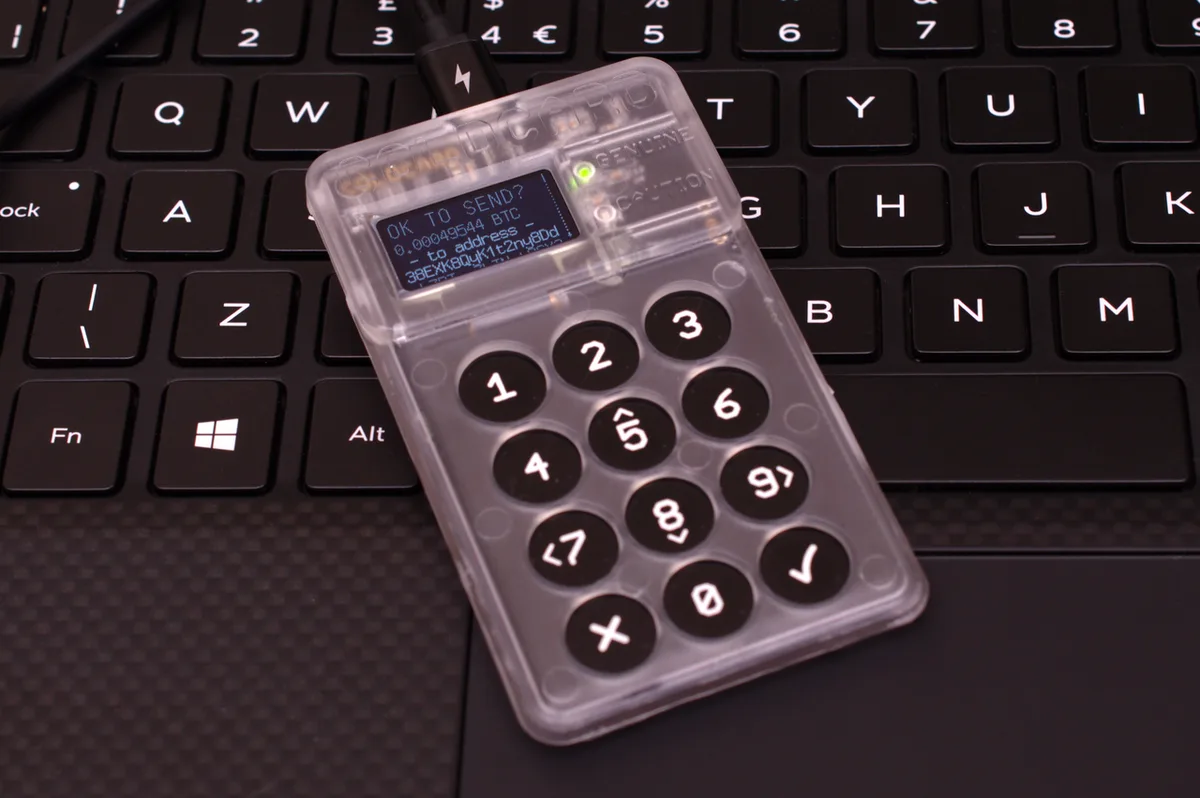
Market briefing: A firmware flaw let attackers drain roughly 594 BTC from around 500 Coldcard hardware wallets in under an hour. Bitcoin was near 62,981 dollars, down 2.3 percent, largely shrugging it off.
- Roughly 594.48 BTC, worth 38 to 40 million dollars, was drained from about 500 single signature Coldcard wallets.
- A firmware bug disabled secure random number generation, making the affected private keys predictable to attackers.
- The theft unfolded between 01:10 and 01:56 UTC on July 30, with funds gone in under half an hour.
The Coldcard hack pulled roughly 594 BTC out of cold storage in under an hour, yet Bitcoin barely moved. So is this a Bitcoin problem, or a device problem dressed up as one?
A firmware flaw inside Coldcard hardware wallets let attackers drain roughly 594.48 BTC, worth between 38 and 40 million dollars, from around 500 wallets. The theft hit single signature wallets specifically. It unfolded inside a narrow window between 01:10 and 01:56 UTC on July 30, and the funds were gone in under half an hour.
The mechanism is the part that matters. A bug in the key generation process disabled secure random number generation. When randomness dies, private keys stop being unguessable. That turns a fortress into a lock anyone with the pattern can pick.
This was not a break in Bitcoin. The protocol did exactly what it always does. A device that was supposed to protect keys failed to make them random, and everything downstream followed.
We have already tracked this thread today as the running tally climbed toward the 70 million dollar mark. So we will not rehash the count. What is new here is the how, and what it does not change about market structure.
Cold storage sells itself on the promise that your keys never touch the internet. That promise held. The keys leaked through math, not through a network. It is an uncomfortable reminder that offline does not mean flawless.
Markets treated it accordingly. Bitcoin traded near 62,981 dollars, down 2.3 percent on the day, and up a fraction over the last hour. A 40 million dollar theft is a serious loss for the victims. For a trillion dollar asset, it is a rounding error with a scary headline.
Why a wallet bug is not a Bitcoin bug
The transmission here is confidence, not supply. Nothing about this exploit touched the Bitcoin network, the issuance schedule, or the coins held by everyone else. The damage is local to a specific firmware and a specific wallet type.
That distinction drives the macro effect. When a chain gets exploited, capital flees the whole asset. When a single device model fails, the fear stays narrow, and the broader liquidity picture is untouched. This was the second case.
The stolen coins are the only real supply question. An attacker sitting on 594 BTC may eventually try to sell. Yet against Bitcoin's daily spot and derivatives turnover, that block is small. It can be absorbed without moving the tape in any lasting way.
So the honest read is that the macro structure did not change. Liquidity conditions are the same today as they were before the headline. Rate expectations, stablecoin supply, and institutional flows all sit exactly where they sat.
What did change is the FUD layer, meaning fear, uncertainty and doubt. Security scares are perfect fuel for it. They arrive with a large number attached and an easy story: your coins are not safe.
Retail reads that story literally and reaches for the sell button. Smart money reads the same story structurally and asks one question. Did the network break, or did a gadget break? The answer decides whether you panic or whether you wait for someone else to.
How the market shrugged off 594 BTC
The price reaction tells you almost everything. Bitcoin slipped 2.3 percent over 24 hours and then ticked slightly higher inside the last hour. That is not the signature of a market absorbing a genuine shock.
A real capitulation looks different. It comes with a violent wick, a spike in open interest, meaning OI, the total value of outstanding leveraged contracts, and cascading liquidations. Here there was no cascade, only a modest, orderly slide.
That orderliness is the signal. It says the selling came from headline reaction, not from structural fear. Traders who dumped were reacting to a story about wallets, not to any change in Bitcoin itself.
Down the risk curve, the pattern held. Ethereum and the larger alts drifted in sympathy but showed no independent break. Nothing about a Coldcard firmware bug touches Ethereum's security or an altcoin's fundamentals.
The smaller alts are where sympathy moves usually overshoot. Thin books amplify any fear that rolls down from Bitcoin. Yet even there, the reaction was a shrug rather than a slide, which tells you the fear never had real weight behind it. So the liquidity cascade that a scary headline promises simply did not materialize. Bitcoin held its footing, the majors followed, and the tail stayed calm.
That is the tell. When a 40 million dollar theft moves price by two percent and then stabilizes, the market is telling you it has already judged the event as isolated. The panic was priced, and it was priced cheaply.
The 62.5K line that decides direction
The whole debate now sits on one number. Bitcoin traded near 62,981 dollars, just above the 62,500 level that invalidates the current bullish structure. That gap is thin, which is exactly why the next few candles matter.
Confirmation looks like this. Bitcoin holds above 62,500, defends the 61,000 reaccumulation zone on any dip, and pushes back toward the 69,000 area where selling interest thickens. Rising spot volume on the way up would validate the move rather than fade it.
Invalidation is equally clean. A decisive close back below 62,500 breaks the structure and opens the 61,000 to 59,000 support band. That zone is not automatically bearish. It is where the next accumulation attempt would form.
Volume is the referee. Higher highs in price need higher highs in spot volume to be trusted. Without that, the bullish leg is running on hope rather than participation.
The warning signs are already on the board. A bearish divergence on the MACD histogram and a bearish cross are flashing. They are not a sell trigger on their own, but they lower the margin for error.
Watch the ascending trendline on the four hour chart. A close above it reclaims the breakout. A close below it marks the move as a fake out, and the security FUD becomes a convenient excuse for a move that was already tiring. Price, not the headline, gets the final word.
What the isolated theft means for support
The ParadiseTeam reads this hack as noise laid over an intact structure, not a reason to abandon it. Bitcoin was trading near 62,981 dollars as of the session, which sits above the 62,500 invalidation and above the 61,000 reaccumulation zone we care about.
That placement is the whole point. A security scare arriving while price hovers just over major support is the textbook setting for smart money to buy fear. The story frightens retail into selling coins that were never at risk. The steady buyer on the other side is rarely in a hurry.
We frame it through the roadmap we already hold. The plan reads reaccumulation near 61,000, a final push toward 79,000, and redistribution up there, not a panic exit over a firmware bug in one wallet brand.
So the levels do the talking. Above 62,500, the isolated theft is a headline that ages badly and the path toward 69,000 stays open. Below 62,500, we are not bearish. We are watching the 61,000 to 59,000 band for the next long structure to build.
Risk first, always. A stop loss, meaning SL, the price where a losing trade is cut, belongs below the invalidation, not at the mercy of a news cycle. Position size stays modest while that bearish divergence lingers.
The ParadiseTeam is watching who blinks. If retail keeps capitulating into a contained event, that capitulation is usually the opportunity, not the warning.
Track it live: our Crypto Fear and Greed Index and the crypto liquidation heatmap both update in real time, so you can watch this shift for yourself.
Related coverage
For exact entries, targets, and stop losses with full risk management, that is what ParadiseFamilyVIP is for. New to reading these moves? Start with our crypto trading strategies guide.
ParadiseTeam is monitoring the market situation closely, and we are taking these developments into consideration while building our trading tactics inside ParadiseFamilyVIP.
Crypto trading involves substantial risk. Prices are volatile and you can lose money. This article is educational and is not financial advice. Past performance does not guarantee future results.
Does BTC hold 62.5K after the Coldcard scare, or lose it?
This is how the Paradisers are calling it. Tap your call.
No calls on this one yet. Tap yours to be the first.
Free account, no password. Members just sign in.











Join the discussion
No comments yet. Members, share how you are reading this.