

In short
Long-term-holder SOPR, the spent output profit ratio for coins held longer than 155 days, measures the average profit those patient holders lock in when they sell. On 26 September 2026, with Bitcoin at $84,118, our MCP Insights cost-basis model estimates that cohort is realizing about 78 percent profit, against an average cost basis near $49,423. That is real profit, but it is moderate: the source feed pegs the December 2024 peak near 350 percent, so this reads as a mid-cycle phase, not euphoria. We call it constructive but unresolved, explicitly not a cycle top: patient holders sitting on gains and choosing to wait keep sell pressure contained. Short-term holders, by contrast, are barely above breakeven at a SOPR of 1.004. This piece shows you how to read long-term-holder profit-taking yourself, next to cost basis and short-term SOPR.
Key facts
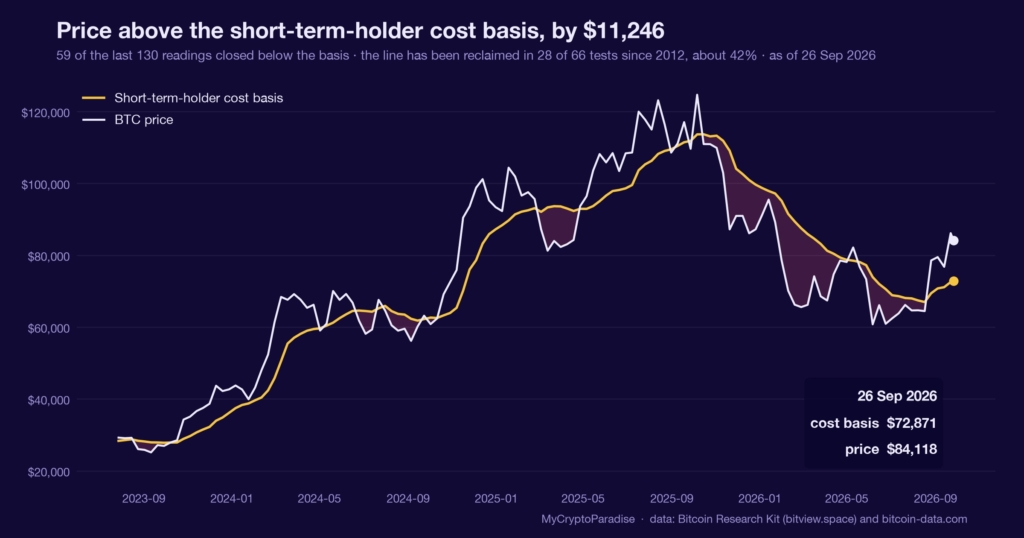
- Bitcoin price at the reading
- $84,118
- Short-term holder cost basis
- $72,871
- Price against that cost basis
- $11,246 above
- Share of short-term holder supply underwater
- 11.7%
- State
- price above the short-term-holder cost basis
- What would prove this read wrong
- A daily close below the short-term-holder cost basis near $72,871, which flips recent buyers underwater; or long-term-holder SOPR climbing toward past-peak multiples while price stalls, which would mark the patient cohort distributing into strength.
- Reading taken
- 26 September 2026
- Source
- Our MCP Insights tools, from Bitcoin Research Kit (bitview.space) and bitcoin-data.com. Upstream data published by the Bitcoin Research Kit
A patient holder sells only when it is worth it
Every coin has a cost basis, the price it last moved at. Long-term holders are wallets that have sat still for many months, through drawdowns that shook everyone else out. Short-term holders are the recent buyers, still nervous, still close to their entry.
The spent output profit ratio, or SOPR, compares the price a coin sells at to the price it was acquired at: above one means the seller booked a profit, below one means a loss. Split that ratio by cohort and it stops being a market average and becomes a behavioural read.
A long-term holder realizing a large profit is making a deliberate choice to let go of a position they defended for a long time. A short-term holder near breakeven is simply deciding whether the trade was worth the stress.
The value of the metric is that it reads intent, not price. A cohort that has waited this long does not sell for a small gain.
The two cohorts are telling opposite stories today
On 26 September 2026 Bitcoin traded at $84,118. Our MCP Insights cost-basis model estimates long-term-holder SOPR at 1.78, meaning the coins that cohort spent changed hands at about 78 percent above their acquisition price. Their average cost basis sits near $49,423.
The short-term picture could not be more different. Short-term-holder SOPR over the last seven days reads 1.004, barely above the breakeven line, and the aggregate market SOPR is 1.0046. The short-term-holder cost basis sits at $72,871, while the whole-market realized price is $53,513.
Price is comfortably clear of that short-term line: $11,246 above it, or 10.47 times the average true range (ATR), the typical daily move. Of short-term supply, 11.7 percent is underwater, and across all cohorts about 25.4 percent of supply sits below its cost.
Every figure here is our own recon reading from MCP Insights cost-basis data, flagged as a model estimate rather than a calibrated print. The story it tells is coherent: the people with the most profit are the calmest, and the people with the least are the ones price has to keep convincing.
What is different here
The ParadiseTeam does not read a profit number in isolation. We split spent-output profit by cohort, cross-check it against the short-term cost basis and the whole-market SOPR, and flag every figure as a model estimate until it clears calibration. The method is the discipline of never letting one gauge decide.
A big profit is not the same as an exit
The obvious misreading is that a cohort sitting on 78 percent gains must be heading for the door, and that the door is a cycle top. The data does not support the leap. A realized-profit reading tells you how much profit sellers took, not how many are selling.
Context matters more than the headline number. The source feed pegs long-term-holder profits near 350 percent at the December 2024 peak; our own reading today is a fraction of that. Moderate profit-taking is a different regime from the euphoric distribution that has ended past cycles.
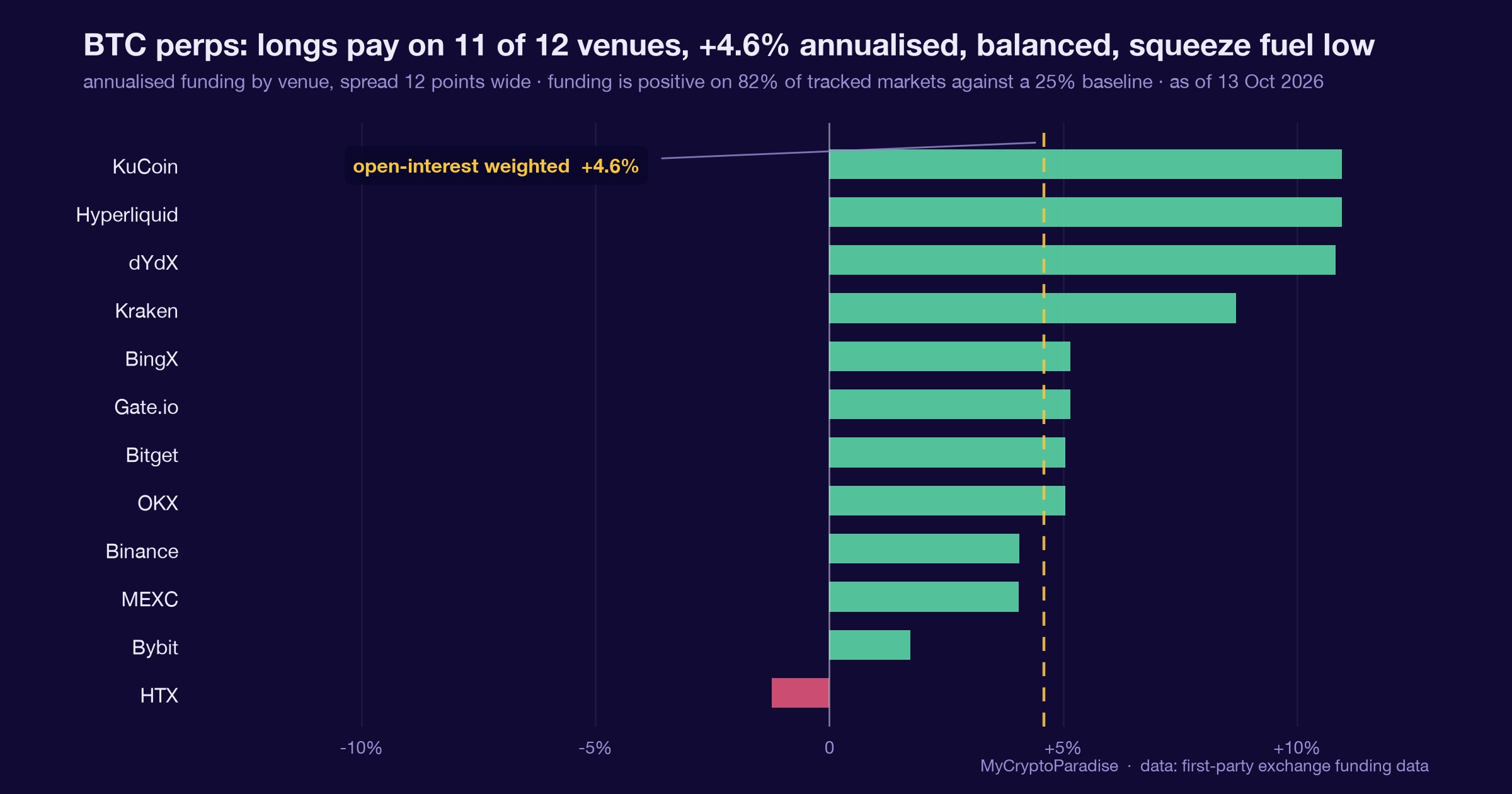
This is one input. It sits alongside funding, open interest and spot absorption, and today it is the cohort read that argues for patience while the shorter-term gauges stay neutral.
A large number is not a verdict. What matters is whether the holders of that number are acting on it, and right now they are not.
One level would change this entire read
A read this calm needs a clear off-switch. The invalidation is our long-term-holder SOPR climbing toward the euphoric multiples of past tops while price stalls: that would be the patient cohort finally distributing into strength, and the constructive case would break.
The nearer risk sits with the short-term cohort. Price is more than ten average daily ranges above the short-term-holder cost basis of $72,871; a daily close back below that line would flip recent buyers underwater and remove the cushion this read leans on.
In our recon series, 66 tests of that line since 2012 resolved higher about 42 percent of the time inside a 16-point band, which we treat as a model estimate, not a calibrated probability.
Neither trigger is close today. That is precisely why the honest posture is patience, not conviction: nothing has happened yet, and a read that waits with its holders is more useful than one that front-runs them.
Reading long-term-holder profit-taking yourself, step by step
- Open our Bitcoin SOPR tool and switch the view from the aggregate line to the long-term-holder cohort, not the market average.
- Read the cohort ratio: above one is profit-taking, and the further above one, the larger the average gain being realized.
- Compare that reading against past cycle peaks on the same chart, so you can tell moderate profit-taking from euphoric distribution.
- Cross-check the short-term-holder cost basis on our Bitcoin cost basis tool: price above it is a cushion, below it a warning.
- Set your invalidation at a daily close below that cost basis, and revisit the cohort ratio if it starts climbing fast.
The step people skip is splitting SOPR by cohort. The aggregate line blends patient holders with panicked ones and hides exactly the behavioural divergence that makes this reading worth anything.
Every number above is checkable against the live data. Start with the MCP Insights hub, then cross-read the Crypto Fear and Greed Index and the live crypto funding rates.
Act and invalidate
| Scenario | What confirms it | What kills it |
|---|---|---|
| Patient holders keep waiting | Cohort SOPR steady near current level | Ratio spikes toward past-peak multiples |
| Short-term cushion holds | Price stays above the cost basis line | Daily close below $72,871 |
| Distribution begins | Long-term SOPR climbs while price stalls | Cohort ratio falls back toward one |
Posture: Posture is patient, not aggressive: the constructive lean rests on long-term holders choosing to wait. It holds only while price stays above the short-term cost basis near $72,871. This is one probability weight among several, not an entry.
Frequently asked questions
What does long-term-holder SOPR actually measure?
It is the average profit realized on Bitcoin coins that had not moved for many months, expressed as a ratio. A reading of 1.78 means those coins sold for about 78 percent more than their owners originally paid.
Is 78 percent profit a warning sign?
Not on its own. What ends cycles is euphoric distribution, where long-term holders sell into every rally at multiples of their cost. Our reading today is a fraction of the December 2024 peak, which reads as moderate, mid-cycle behaviour rather than a rush to exit.
How do long-term and short-term holders differ now?
They are at opposite ends. Long-term holders are realizing about 78 percent profit and choosing to wait, while short-term holders sit at a SOPR near 1.004, barely above breakeven. The calmest cohort has the most profit; the nervous one has almost none.
What invalidates the constructive read?
Two things. A daily close below the short-term-holder cost basis near $72,871 would flip recent buyers underwater and remove the cushion. Or long-term-holder SOPR climbing toward past-peak multiples while price stalls, which would mark the patient cohort finally distributing into strength.
Where does this reading fit with other data?
It is one input, not a decision. On its own the cohort ratio argues for patience; stacked against funding, open interest and spot absorption, it is the layer that leans constructive today while the shorter-term gauges stay neutral. The other layers live in PRO Paradiser.
Crypto trading involves substantial risk and is not suitable for everyone. Nothing here is financial advice; it is education only. Never risk more than you can afford to lose.
The private Extras feed, where long-term-holder SOPR, the short-term cost basis and whole-market realized price update with their invalidation levels attached, is part of PRO Paradiser, the intelligence layer behind the ParadiseFamilyVIP strategies.








Join the discussion 3
ok, but how do we tell a "structural backing" from noise *before* the fact, not just after it's played out?? i always struggle with that.
Watching SOPR trends around these zones helps confirm if a reclaim has true structural backing or is just noise.
lukas thats a good point about SOPR for structural backing i also watch stablecoin exchange net flows for sustained accumulation or distribution there