


Listen: the breakdown
Developing story update (September 27, 2026, 11:48 UTC):
Update: the scale of the Bitget security incident referenced in this roundup has now been quantified at roughly $351.6 million, based on our sources. That figure reframes the exchange-risk angle in the same news cycle as South Korea’s push for KRW stablecoin liquidity safeguards, since both point at the same underlying concern about custody and settlement reliability.
For traders the read is unchanged in direction but sharper in weight: a nine-figure incident is a reminder to size exchange exposure conservatively and to watch how regulated-stablecoin and settlement rules in South Korea and Hong Kong evolve, as tighter frameworks could gradually shift flows toward venues seen as safer. BNB remains roughly flat near $779, so no immediate price reaction has followed.
What to watch now: Whether the confirmed $351.6M loss triggers any official response or accelerates South Korea's stablecoin safeguard timeline.
Developing story: This story is still unfolding. We are tracking it and will update this article as more details are confirmed.
Market briefing: South Korea is building liquidity safeguards for won stablecoins while Hana Bank issues $100M in blockchain bonds. Foundational, not a same-day catalyst. BTC traded near $84,891 as of 11:14 UTC.
- South Korea is calling for liquidity safeguards for won-denominated stablecoins after foreign stablecoins printed sharp price deviations on domestic exchanges.
- Hana Bank issued $100 million in blockchain digital bonds, a major lender putting real debt on-chain.
- The FSC has not finalised rules; the second-stage digital asset framework and stablecoin legislation remain under active discussion.
South Korea is drafting liquidity safeguards for won stablecoins as Hana Bank issues $100M of blockchain bonds. Is this the quiet groundwork for the next institutional wave?
South Korea is moving to safeguard liquidity for won-denominated stablecoins. The push follows several foreign stablecoins printing sharp price deviations on domestic exchanges. Industry participants want guardrails before a KRW stablecoin reaches scale. This is policy plumbing, not a headline trade.
On the same regulatory wave, Hana Bank issued $100 million in blockchain-based digital bonds. A major Korean lender just put real debt on a chain. That is a bank testing the rails, not a retail experiment. When the institutions start moving their own balance sheets on-chain, the story stops being about speculation.
The Financial Services Commission, the FSC, has not announced final rules yet.
The FSC has repeatedly cautioned that large parts of the second-stage digital asset framework remain under discussion. Legislation for stablecoins and other digital assets keeps grinding through negotiation between regulators and lawmakers. Nothing here fires today. Everything here shapes the next cycle.
Regulators rarely hurry, and Seoul is no exception. But the direction of travel is clear. Traditional finance in Korea is building blockchain muscle while the rulebook is still wet ink. Clarity is arriving in stages, and each stage lowers the barrier for the next allocator to step in.
A regulated won stablecoin invites institutional capital
The mechanism here is trust, not price. Institutions do not commit balance-sheet capital into legal grey zones. They commit when rules are written and liquidity is protected.
South Korea is one of Asia's most active retail crypto markets. A clear won-stablecoin framework would give banks, funds, and payment firms a compliant on-ramp. That is why Hana Bank's $100 million bond issuance matters more than its size. It signals that a regulated lender already sees the rails as usable.
Stablecoin safeguards address a real friction. Foreign stablecoins deviated sharply on domestic exchanges, which spooks anyone routing large flows. Fix that, and settlement risk drops for every serious participant.
Here is the transmission chain. Regulatory clarity de-risks the asset class. De-risking widens the pool of eligible capital. A wider pool means deeper, stickier liquidity over quarters, not hours.
None of this is a switch that flips. The FSC still has open questions, and legislation is mid-negotiation. So the near-term price effect is close to zero.
The long-term effect is the point. Asia's institutional adoption tends to lead flows, not follow them. When a regional financial hub codifies stablecoins, it lowers the cost for the next allocator to arrive. That is foundational demand being built quietly, while the headlines chase faster stories.
Slow-burn liquidity, not a same-day BTC move
Let us be honest about the tape. This story is not a same-day catalyst for BTC, ETH, or alts. There is no single confirmed event forcing price action today, and framing it as one would be dishonest.
BTC traded near $84,891, up roughly 0.9% over 24 hours, as of 11:14 UTC. That gentle move reflects the reality: regulatory groundwork rarely shifts spot prices in the hour it lands.
The liquidity effect is structural and slow. A compliant won-stablecoin corridor eventually deepens fiat-to-crypto flow in a major Asian market. Deeper stablecoin liquidity is the base layer that supports larger BTC and ETH order books.
The cascade, when it comes, runs in the usual order. New institutional capital anchors in BTC first, as the reserve asset. ETH follows as the settlement and infrastructure play. Alts move last, and only once the majors have absorbed the flow.
Hana Bank's on-chain bond hints at where this leads. Tokenised debt needs stable settlement assets, which pulls stablecoin demand higher over time.
So read this as a supply-of-trust story, not a demand shock. It widens the future funnel rather than filling it today. Traders chasing an instant reaction will find none. Allocators mapping the next 12 months should note who is quietly building the plumbing.
Signposts from Seoul's second-stage framework
The confirmation signal is concrete: watch for the FSC to publish actual liquidity-safeguard rules, not just calls for them. Draft language moving toward a vote would mark a real step from talk to framework.
A second confirmation is a formal won-stablecoin approval or pilot with named banks. If more lenders follow Hana Bank onto the chain, the institutional-adoption read strengthens materially.
The invalidation is equally clear. Repeated FSC statements that core parts of the framework remain undecided would tell you the timeline is slipping. Political friction or a stalled bill would push the payoff further out.
Watch the deviation problem too. If foreign stablecoins keep printing sharp gaps on Korean exchanges, it signals the safeguards are still theoretical. Stability in those quotes would signal the guardrails are starting to bite.
For the broader market, keep this in proportion. This is a driver for the adoption narrative, not for tomorrow's candle. Do not let a slow policy story justify a fast position.
The cleanest tell is capital behaviour. If Korean institutional flow into regulated products picks up after rules land, the thesis is working. If issuance stays a one-off and the framework drifts, treat it as intent without follow-through. Judge the story by what settles on-chain, not by what gets announced.
Groundwork meets a macro bearish tape
The ParadiseTeam separates this cleanly from near-term structure. Korea's stablecoin work is a long-horizon adoption tailwind. It does not change where BTC's stops sit this week.
BTC traded near $84,891 as of 11:14 UTC. Our standing macro lens stays cautious. We are watching the reclaim of $82,000 as support, with $88,000 to $90,000 flagged as a 60% probability rejection zone.
Apply the news to those levels. A regulatory story like this rarely fuels a breakout on its own. So strength that runs into $88,000 to $90,000 still risks meeting sellers, and we treat that band as where distribution into eager retail can happen.
Smart money is the tell here. On-chain and positioning data suggest larger players find a sustained push above $99,000 hard to justify. They are not chasing higher prices on a policy headline.
Retail behaves in reverse. Interest historically spikes on dumps, not on measured regulatory progress. So this story is unlikely to trigger a crowd stampede.
Our read: treat Korea's framework as a reason to respect the long-term bull case, not as a signal to force a long into resistance. The macro path we favour still allows a deeper flush toward the $55,000 to $44,000 zone before a durable low. Structure over headlines. Let $82,000 confirm as support before trusting any daily strength, and keep risk-to-reward, R:R, defined either way.
The read behind this: we framed this story through our own market analysis, Can Bitcoin Push to $99K?
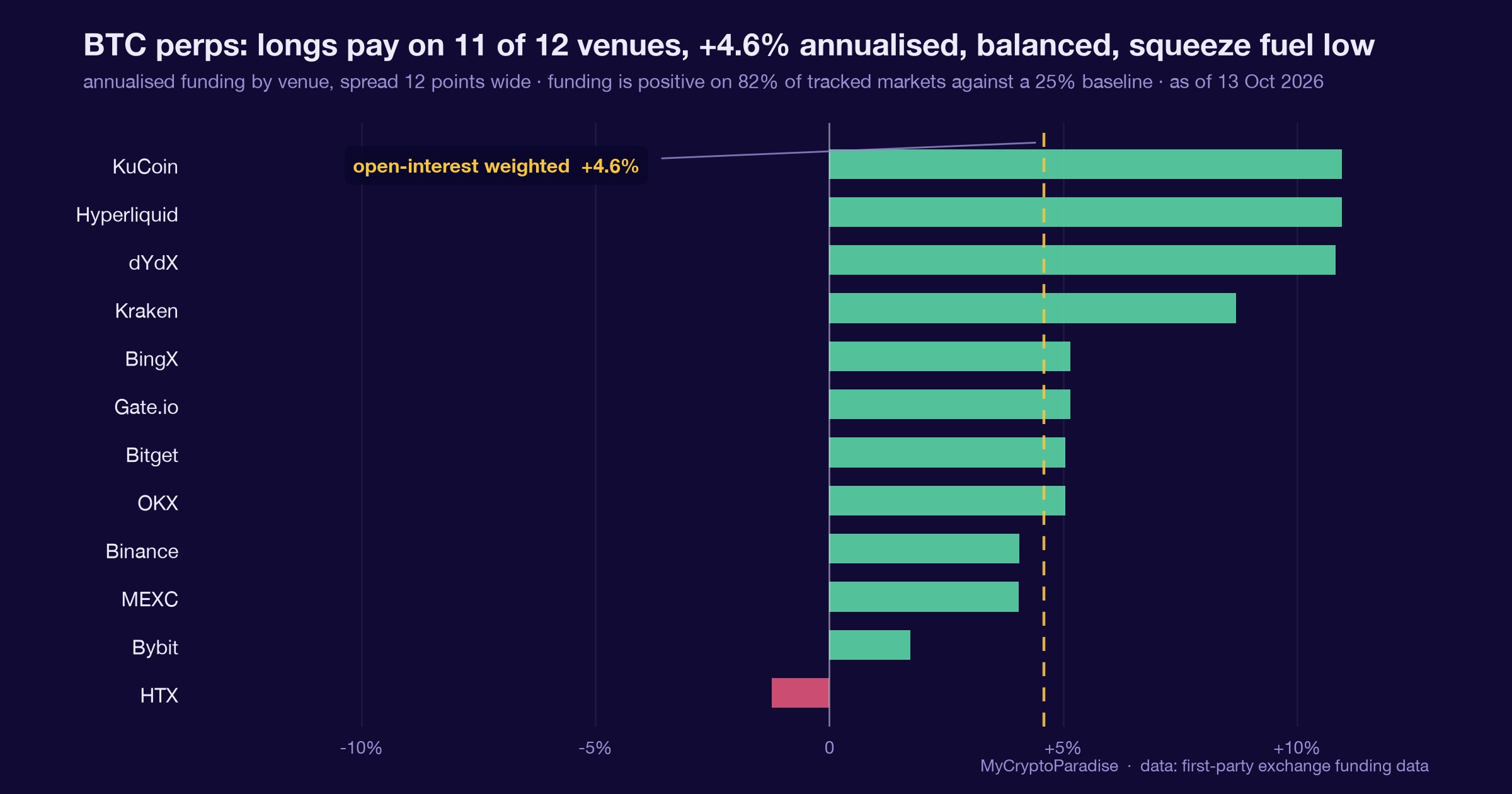
Track it live: our live crypto funding rates and the crypto liquidation heatmap both update in real time, so you can watch this shift for yourself.
Related coverage
For exact entries, targets, and stop losses with full risk management, that is what ParadiseFamilyVIP is for. New to reading these moves? Start with our crypto trading strategies guide.
ParadiseTeam is monitoring the market situation closely, and we are taking these developments into consideration while building our trading tactics inside ParadiseFamilyVIP.
Crypto trading involves substantial risk. Prices are volatile and you can lose money. This article is educational and is not financial advice. Past performance does not guarantee future results.
Does Korea's stablecoin framework move institutional money into crypto within 12 months?
This is how 19 Paradisers are calling it. Tap your call.
No calls on this one yet. Tap yours to be the first.
Free account, no password. Members just sign in.
Follow this topic: Stablecoin news







Join the discussion 5
love seeing this type of news coming outta korea 🇰🇷, means more liquidity for us all 💸. always check for their local news, they're often ahead of the curve 📈.
Good to see them thinking about the reserves... like a ship needs ballast, always better to have it there for the big waves.
I understand the push for safeguards, but isn't the point of a stablecoin to be inherently stable? Adding layers of reserves feels like they're missing the core idea of what's appealing about these. ??
i remember when banks would hold onto your cash for weeks before it cleared, this is a lot faster
Faster than weeks, sure, but "a lot faster" without specifying current settlement times for traditional rails isn't very helpful. What's the actual delta here?