

In short
A whale flow is simply a large wallet moving coins, and reading one starts with a single question: did the coins go to an exchange, or to another private wallet? On 25 September 2026, per the MCP on-chain Insider feed, a wallet dormant for four years moved its full 4,500 BTC, worth about $381.38M today against roughly $187.38M when received, to a brand-new address rather than to any exchange. We called this neutral, and we explicitly refused to call it distribution: a coin-to-coin move deposits nothing that can be sold. We do not know yet whether the new wallet is custody, a split, or a prelude to a sale, and saying otherwise would be a guess. Base rates for dormant-whale awakenings are not wired into our data, so we claim no frequency. This piece shows you how to read a whale move yourself, before the headline reads it for you.
Key facts
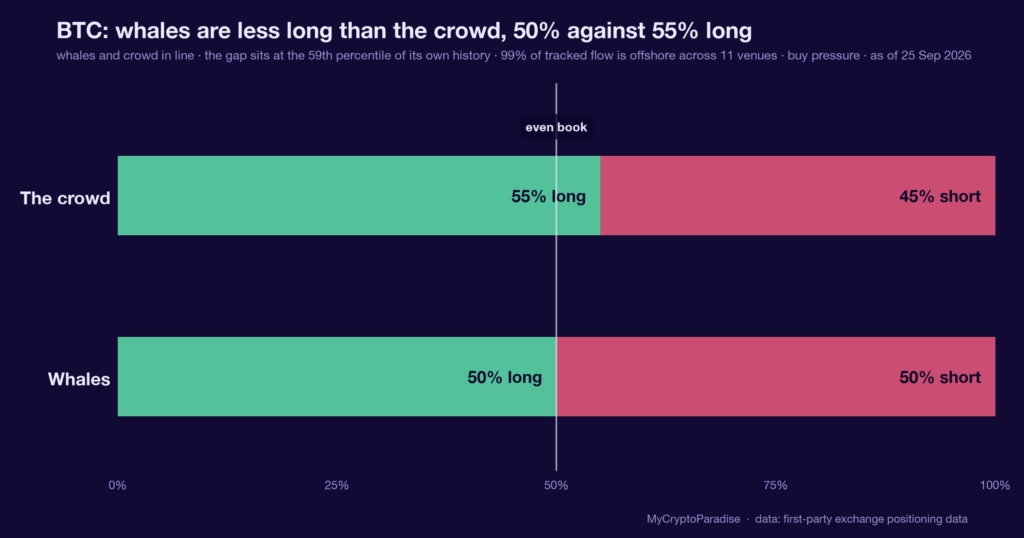
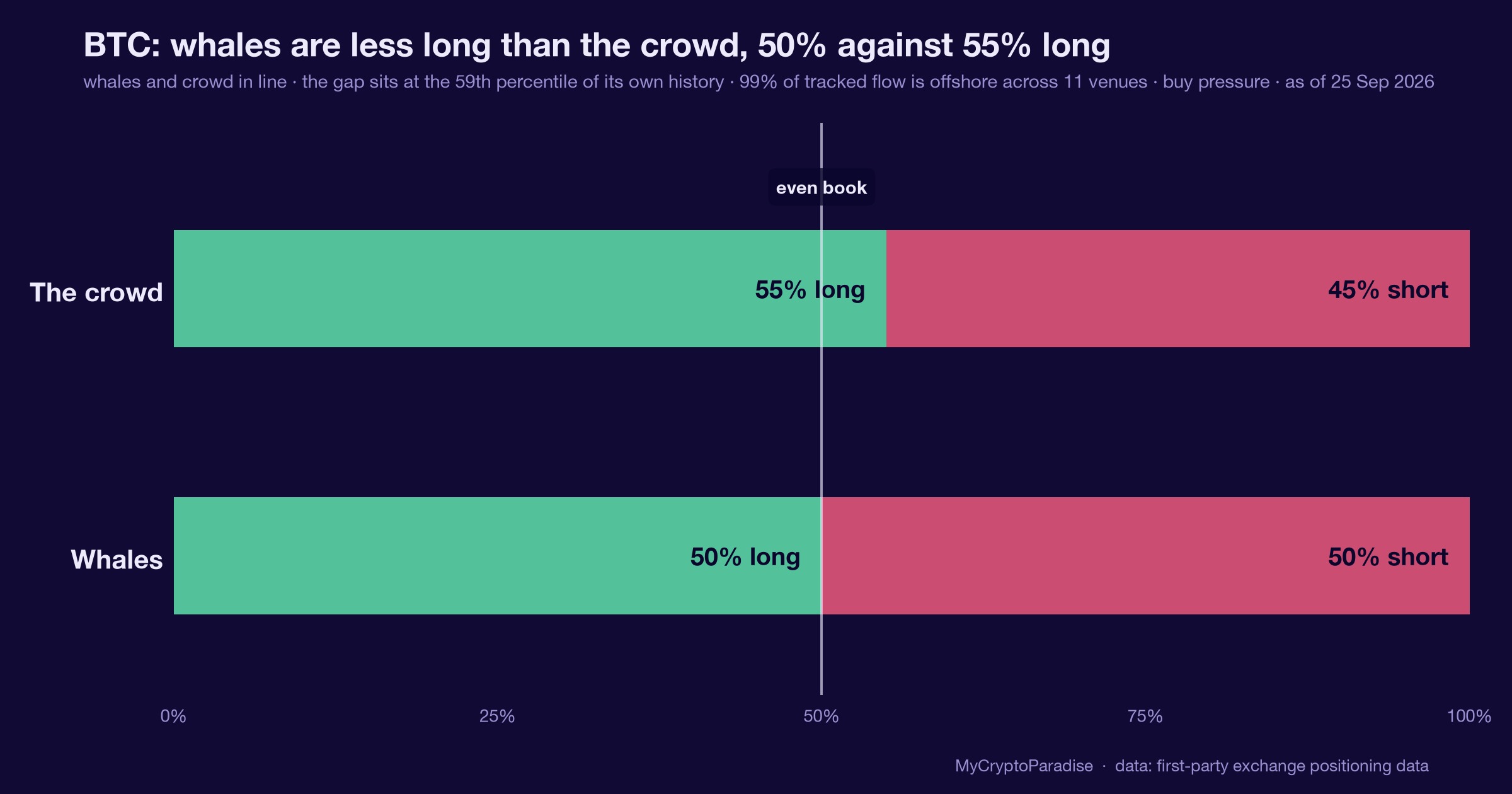
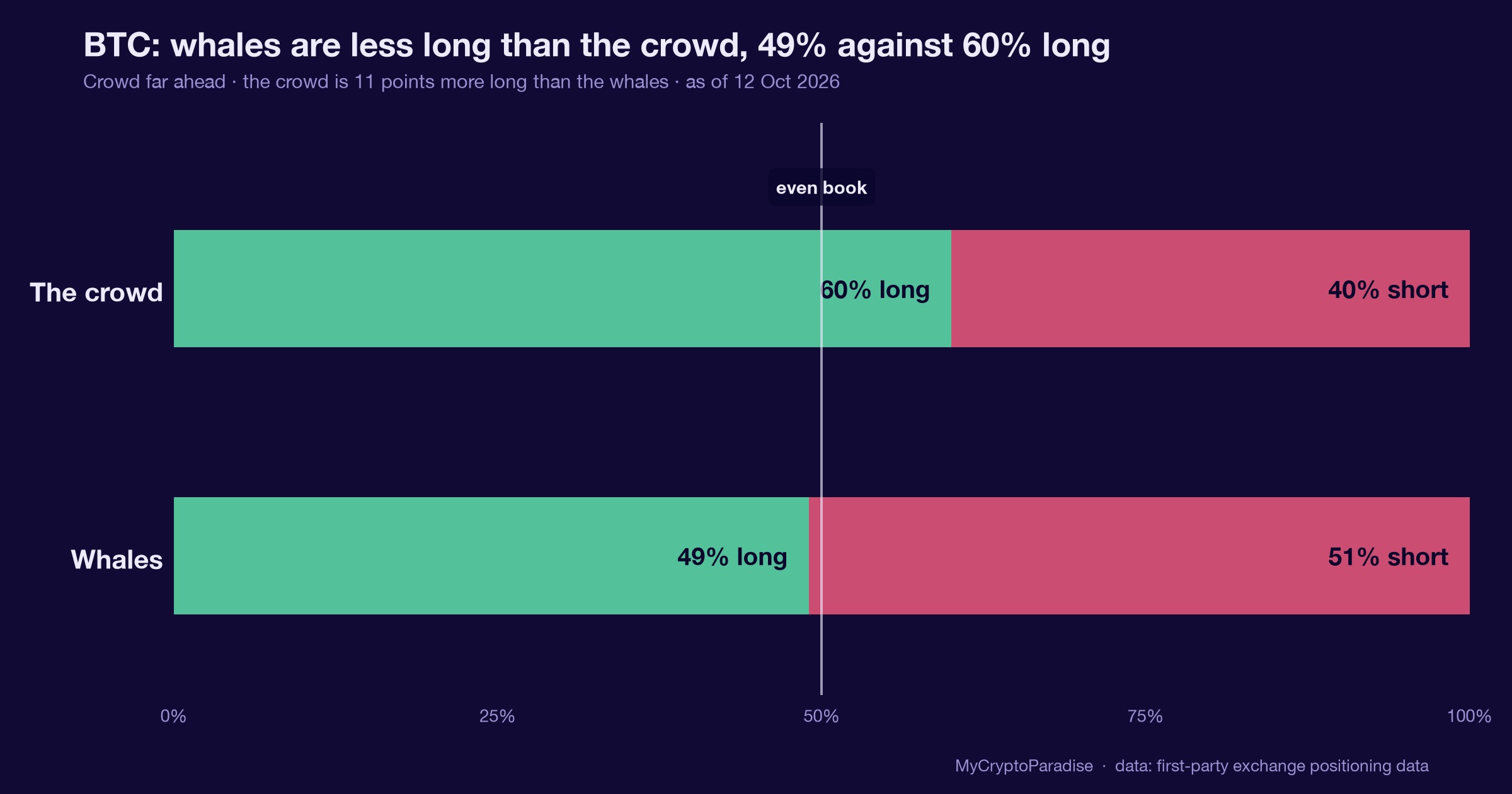
- Whale long share on BTC
- 50%
- Crowd long share on BTC
- 55%
- Where that gap sits in its own history
- the 59th percentile
- Positioning read
- whales and crowd in line
- Order flow right now
- buy pressure
- What would prove this read wrong
- An onward hop from the new wallet into a known exchange deposit address, sized near the full 4,500 BTC, which would put real, sellable supply on a venue.
- Reading taken
- 25 September 2026
- Source
- Our MCP Insights tools, from first-party exchange positioning data (OKX). Upstream data published by the OKX public API
A wallet move is not a sale
On-chain, a large transfer is just coins changing addresses. It carries no direction on its own. The only thing that turns a move into selling pressure is arrival at an exchange deposit address, where coins can meet a bid.
A wallet-to-wallet transfer does the opposite of that. Nothing lands on an order book, so nothing can be sold from it yet. Custody rotations, wallet upgrades, estate splits and internal book-keeping all look identical to a sale in a screenshot.
A transfer that never touches an exchange is a change of address, not a change of supply. Read the destination before you read the intent.
The dormant wallet woke after four years
On 25 September 2026, per the MCP on-chain Insider feed, a wallet that had sat untouched for four years moved its entire balance of 4,500 BTC in a single transaction about one hour before the alert.
That balance is worth roughly $381.38M today, against about $187.38M when the coins arrived four years ago: an implied cost near $41,640 per coin versus roughly $84,750 now, a little over a 2x gain held through the whole stretch.
The destination was a brand-new address, not an exchange. We re-verified against our own feeds: nothing in this move deposited to a venue, so none of it is sitting on an order book.
A 2x gain held for four years is patience, not urgency. The move tells you the coins are liquid again; it does not tell you they are for sale.
What is different here
The ParadiseTeam does not read a dormant-wallet alert by its size. We read it by its destination first, then check our own feeds to confirm whether any coin actually reached a venue. Size makes the headline; destination decides whether there is anything to trade around at all.
The distribution headline is the easy misread
The reflex read is simple: old whale wakes up, therefore old whale sells the top. It is a clean story and it fits a screenshot, which is exactly why it travels faster than the facts under it.
But the facts under it do not support a sale. The coins went to a fresh private address, and a private address cannot match a bid. Until these coins appear at an exchange, the distribution story is describing something that has not happened.
A headline that infers selling from a transfer is reading the intent it wants, not the ledger it has. The ledger only shows a change of custody.
What our own tools can and cannot see here
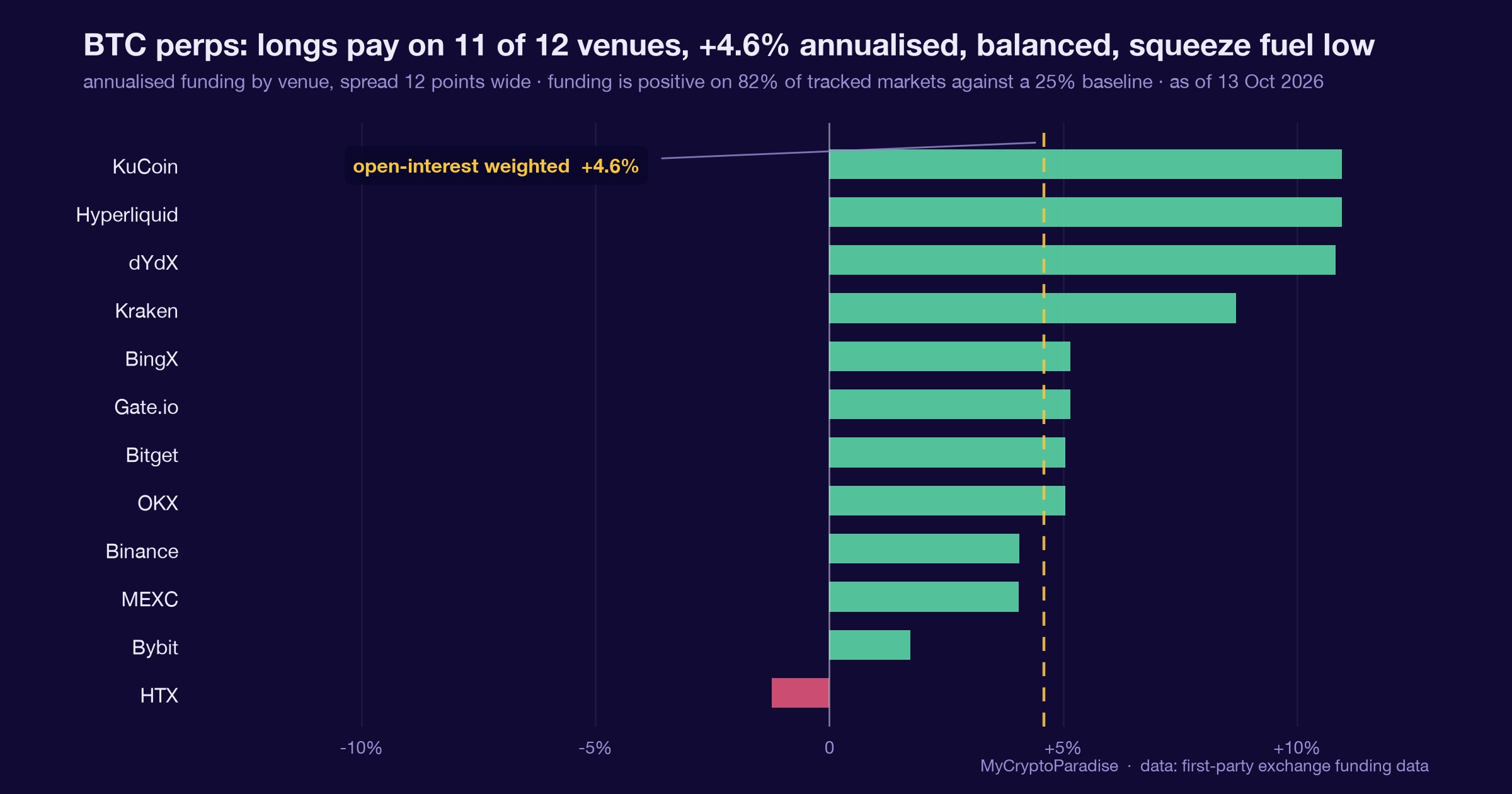
This flow is one input, and a narrow one. It sits alongside funding, open interest and exchange positioning, and on its own it settles nothing about direction; it only rules out the sale the headline assumed.
Our MCP Insights positioning data reads the broader exchange picture as a model estimate right now, not a calibrated frequency, so we lean on it lightly and quote it as an estimate rather than a rate.
One on-chain move is a single layer. It weights a bias you already hold from the rest of your reads; it is not a bias by itself.
Reading a whale move yourself, step by step
- Start with the destination address: check whether the coins landed on an exchange deposit wallet or on a fresh private one.
- Confirm the amount and the age of the source wallet, so you know whether this is a whale or a rounding error.
- Compare the value at receipt with the value today to see how long the holder waited and what they are sitting on.
- Watch the destination over the next days for any onward hop into a known exchange address, which is the real sell tell.
- Cross-check funding and exchange positioning before you weight the move, so one transfer never carries a directional read alone.
The step people skip is the fourth: most react to the first hop and never watch the second. The sale, if it comes, shows on the next move, not this one.
Every number above is checkable against the live data. Start with the MCP Insights hub, then cross-read the Crypto Fear and Greed Index and the live crypto funding rates.
Act and invalidate
| Scenario | What confirms it | What kills it |
|---|---|---|
| Quiet custody rotation | Coins stay in private wallets | Any hop to an exchange deposit |
| Prep for a staged sale | Onward hops to venue addresses | Coins idle for weeks again |
| Split or estate handling | Balance fans into several wallets | Full amount moves as one block |
Posture: No-trade on this alone: the move rules out an immediate sale but confirms no direction. Size risk from your other reads, not from a single wallet transfer.
Frequently asked questions
Does a dormant whale moving coins mean a sell?
Not by itself. Moving coins between private wallets deposits nothing that can be sold. A move only becomes selling pressure when the coins reach an exchange deposit address, where they can meet a bid. This transfer went to a fresh private wallet instead.
How much did this whale actually move?
The wallet moved its full balance of 4,500 BTC in one transaction, worth about $381.38M on 25 September 2026. The same coins were worth roughly $187.38M when they arrived four years earlier, an implied entry near $41,640 against about $84,750 today.
Why does the destination address matter so much?
Because an exchange deposit address is the only place coins can be sold. A private address cannot match an order. Reading the destination tells you whether a large transfer is a change of ownership venue or a genuine change in tradable supply.
What would turn this move into a real sell tell?
An onward hop from the new wallet into a known exchange deposit address, ideally sized close to the full balance. Until that second move appears on-chain, the coins remain in custody and there is nothing resting on an order book to sell.
Can base rates say how these awakenings resolve?
Not from our data today. Base rates for dormant-whale awakenings are not wired into our lake yet, so we claim no historical frequency. We read this one on its mechanics: destination first, onward hops next, and our own positioning as a model estimate.
Crypto trading involves substantial risk and is not suitable for everyone. Nothing here is financial advice; it is education only. Never risk more than you can afford to lose.
The private Extras feed, where the whale-flow destination read, onward-hop tracking and exchange positioning estimate update as the coins move, is part of PRO Paradiser, the intelligence layer behind the ParadiseFamilyVIP strategies.


Join the discussion 16
yeah this is a good sign. less supply pressure is never a bad thing, but I always check the next few blocks just in case.
It's not clear to me that moving to a new address definitely means they won't sell... They could still move it to an exchange later, no?
True Samuel! 🎯 And they could even spread it across multiple exchanges after that, so it's harder to track too. 🧐 More like a distribution. 📉
yeah samuel, i see what you're saying but moving to a fresh address like that instead of an exchange usually means a long-term hodl, not an immediate sell. they're not trying to hide it, just secure it. 🤷♂️
But the **absence** of an exchange transfer is exactly the point, Samuel! That's what signals holding for me. 🤷♀️
I understand it's not on an exchange *now*. But it could be sent to an exchange in the future, yes? Simply moving it to a new wallet address doesn't prevent a later sale...
it's a classic - when everyone sees "hodl" I still wonder about the new address's liquidity profile. a simple transfer doesnt tell us the full story of intent.
I take the point about immediate selling pressure, but I remain unconvinced that an address change alone dictates a long-term conviction from a whale. Time and the next move will tell.
yeah Marco I hear that. shifting to a new address definitely doesnt mean theyre holding long-term, could just be a re-org... gotta watch the next few moves for sure 🤔
Mano, these whale moves always get my hopes up for some big volatility 📈 but then it's just a new wallet. 🫠 The patience of some people, not selling for *four years*... 🤯 I could never! 😂
man, i just wish *my* "dormant" wallets were that big! 😅 mine are usually just forgotten dust from some test transaction or a tiny tip. maybe I should try forgetting about 4,500 BTC...🤔😂
yeah I keep an eye out for these dormant wallet moves too, it's like a good stress test for my "hodl at all costs" mindset. 😅 I mean, what if they were moving it to an exchange... scary stuff. 😨
why dont they split it up into many smaller wallets for privacy if its not going to an exchange
seeing a transfer *not* hit an exchange is always a credit entry in my "less immediate selling pressure" ledger. just another line to balance the books! 📊
For me, a transfer to a *new* wallet is more like a null entry for selling pressure until we see what happens next. It's just moving the data to a new server, not necessarily off the market 🤷♀️.
That's how I think about it too, Chinedu! It's such a good sign when they don't hit the exchange. 🙏