

Listen: the breakdown
Developing story: This story is still unfolding. We are tracking it and will update this article as more details are confirmed.
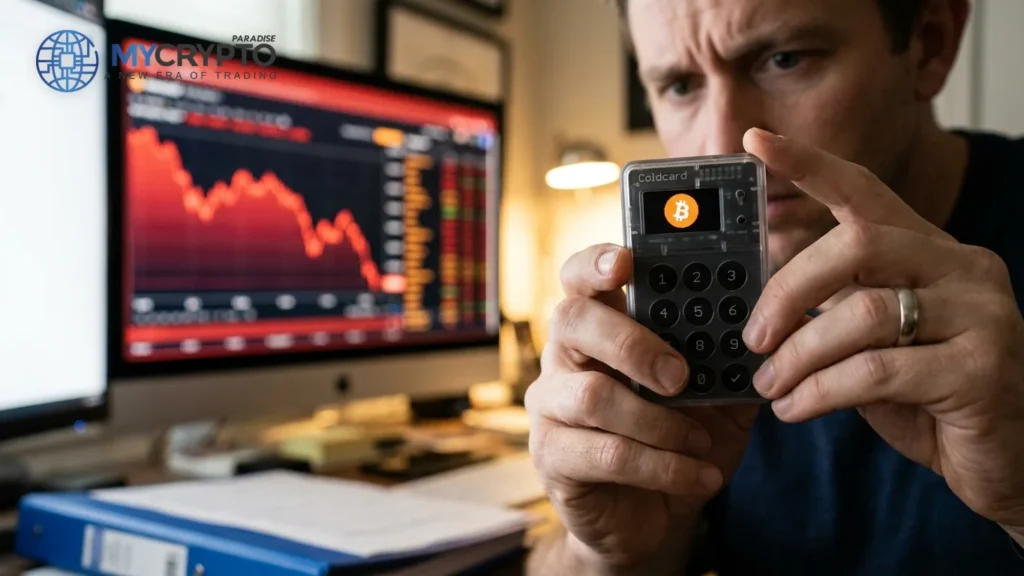
Market briefing: A reported Coldcard exploit is feeding self-custody fear, and some analysts spin it as a win for regulated Bitcoin exposure. BTC traded near $64,629 as of 00:42 UTC, up 1 percent, but crowded longs sit under resistance.
- A Coldcard exploit is circulating, feeding fresh self-custody fear across the market.
- Some analysts frame it as bullish for regulated Bitcoin exposure like ETFs.
- Our read: the FUD hits crowded longs first, raising long squeeze risk near resistance.
A Coldcard exploit is spreading fear about self-custody, and some analysts already call it bullish for regulated Bitcoin exposure. But who really pays the bill first?
News of a Coldcard exploit is moving through the market, and the story is arriving before the fine print does. Reports point to a vulnerability in a widely used hardware wallet, the kind of device holders trust precisely because it keeps keys offline and away from exchanges.
The facts are still settling. We know the exploit is being discussed, we know some analysts are already framing it as a reason to prefer regulated Bitcoin exposure, and we know the fear landed harder in trader chatter than the details themselves.
That framing deserves a second look. The argument runs that if self-custody feels risky, nervous holders will rotate toward regulated products where a licensed institution carries the custody burden. It is a clean narrative, and clean narratives tend to arrive fastest when the balance sheet behind them is still blank.
Structurally, this matters because it touches the one belief that underpins Bitcoin ownership: you can hold your own keys safely. Shake that belief, even briefly, and you change behaviour at the margin. But the immediate market does not trade long-term custody philosophy. It trades positioning. And right now positioning is crowded, greedy, and leaning the same way, which is exactly the condition where a fear headline does the most short-term damage before any regulated-exposure rotation ever begins.
Why self-custody fear moves the market
The transmission mechanism here is confidence, not code. A hardware wallet exploit attacks the psychological floor beneath Bitcoin ownership, and psychology is what sets short-term price.
When holders question self-custody, two things can happen. Long-term capital may drift toward regulated products, slowly, over months. Short-term capital reacts in minutes, and that is the flow that hits the tape today.
The long-term bullish case for regulated exposure is real but slow. Institutions do not rotate on a single headline. They move on filings, mandates, and quarters, so any custody-driven inflow into regulated Bitcoin exposure would show up well after this week.
The short-term effect is faster and less flattering. Fear tightens risk appetite exactly when funding rates are positive and longs are crowded. That combination means leveraged buyers are already stretched, so a fresh reason to doubt can trigger the exits before it triggers the rotation.
This is the gap the market keeps ignoring. The headline sells a bullish structural story, while the order book prices an immediate liquidity risk. Both can be true, but they resolve on very different clocks. So the Coldcard exploit matters less for what it says about custody and more for when it arrives. It lands into a market primed for a shakeout, and timing, not the thesis, is what decides the next move.
How the exploit pressures crowded positioning
Start with BTC, because everything else follows it. Bitcoin traded near $64,629 as of 00:42 UTC, up about 1 percent, sitting just under the resistance band our lens flags at $64,300 to $64,800. That is a fragile place to receive fear.
Crowded longs are the fuel. Positive funding means traders pay to stay long, and a wall of stops sits below the current price. Fear headlines are the match, and a Coldcard exploit is a convenient one.
If BTC gets flushed, the cascade is predictable. A sharp move down hunts long liquidations, which forces more selling, which deepens the move without any change in fundamentals. That is a long squeeze, not a trend change.
ETH rarely escapes this. When BTC leverage unwinds, Ethereum longs get caught in the same wave, usually with a slightly larger percentage move because the crowd chases it harder.
Alts feel it worst. Thinner liquidity means the same selling pressure moves price further, so the newest, most leveraged retail positions take the deepest hit while the flush runs.
The irony is quiet but real. A story sold as a reason to buy regulated Bitcoin exposure could, in the near term, do the opposite to price by clearing out the very longs that pushed BTC toward resistance in the first place.
Signals that confirm or defuse the squeeze
The cleanest tell is how BTC behaves at the $64,300 to $64,800 resistance our lens marks. Rejection here, on rising fear and positive funding, would confirm distribution into crowded longs rather than a breakout.
Watch the reaction, not the headline. If price absorbs the exploit news and holds above $62,500, the bullish daily structure stays intact and the $79,000 target our lens tracks remains the higher-probability path.
A break below $62,500 is the line that changes the story. That level marks bullish structure invalidation in our read, and losing it opens the door toward the $61,000 to $59,000 zone where patient buyers wait.
Funding and momentum are the supporting evidence. Positive funding that keeps climbing while price stalls is a warning, and the early bearish momentum divergence our lens noted suggests buying pressure is being absorbed near resistance.
There is also the slower signal to respect. If regulated Bitcoin exposure genuinely draws custody-worried capital, it will surface in steady inflows over weeks, not in a single candle. Treat any same-day claim of that rotation with patience.
So the plan is to watch two clocks at once. Short-term, the squeeze risk sits right here at resistance. Longer-term, the regulated-exposure thesis only earns belief once the flows, not the forecasts, actually show up.
What the exploit means for crowded longs
The ParadiseTeam reads this Coldcard exploit through positioning, not custody theory. With BTC near $64,629 as of 00:42 UTC, price is pressing the $64,300 to $64,800 resistance while funding stays positive and longs stay crowded. That is the setup a fear headline is built to break.
Our near-term lean is cautious. The daily path can still reach for $79,000, but the ParadiseTeam sees an imminent long squeeze risk before that, and this exploit is a plausible trigger for it.
Here is the smart-money logic. Retail is leaning greedy and long into resistance, exactly when momentum shows early bearish divergence. That is where professionals expect absorption and a flush, not a clean breakout.
The ParadiseTeam has already shown its hand on where value sits. VIP members reaccumulated Bitcoin at $61,000, in the $61,000 to $59,000 zone, on high-probability, good risk-to-reward, R:R (risk-to-reward) setups. That is the area we respect if fear pushes price down.
Confirmation and invalidation are simple. Holding above $62,500 keeps the bullish structure alive; losing it flips the near-term read and points toward that support zone.
The long-term regulated exposure story may prove right eventually. But the ParadiseTeam prioritises surviving the squeeze first, because the traders who manage risk into this fear are the ones still standing to buy the zone.
Track it live: our live crypto funding rates and the Crypto Fear and Greed Index both update in real time, so you can watch this shift for yourself.
Related coverage
For exact entries, targets, and stop losses with full risk management, that is what ParadiseFamilyVIP is for. New to reading these moves? Start with our crypto trading strategies guide.
ParadiseTeam is monitoring the market situation closely, and we are taking these developments into consideration while building our trading tactics inside ParadiseFamilyVIP.
Crypto trading involves substantial risk. Prices are volatile and you can lose money. This article is educational and is not financial advice. Past performance does not guarantee future results.
Does the Coldcard exploit trigger a long squeeze before BTC reaches 79K?
Follow this topic: Crypto regulation news







Join the discussion
No comments yet. Members, share how you are reading this.