


Listen: the breakdown
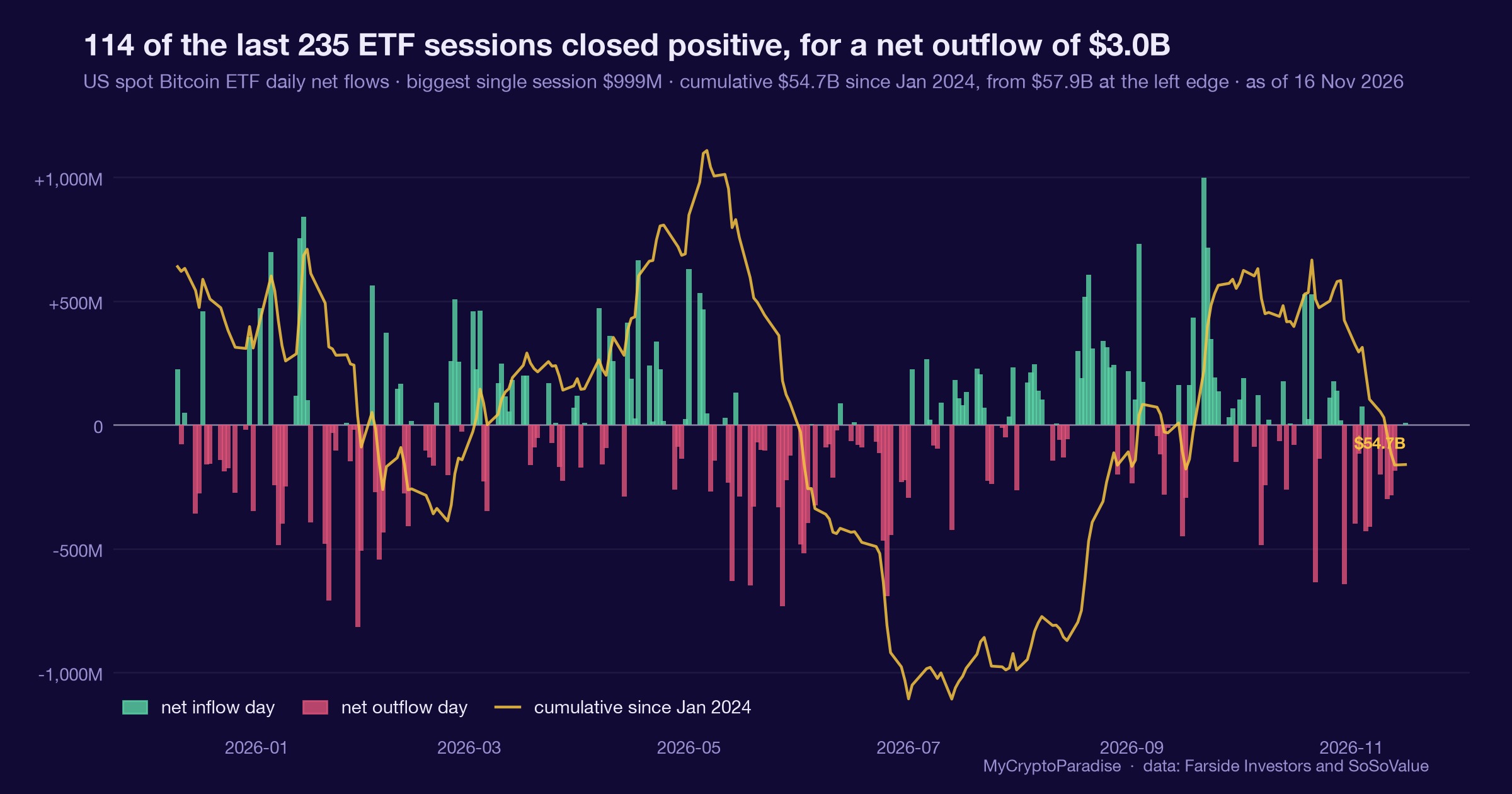
Market briefing: US spot Bitcoin ETFs took in $137 million on October 28 while Ether funds shed another $21 million. BTC was near $80,048 at the time, down about 1% on the day.
- US spot Bitcoin ETFs drew $137 million in net inflows on October 28, with BlackRock's IBIT alone adding $136 million.
- US spot Ether ETFs lost $21.41 million the same day, a fourth straight week of net outflows.
- BlackRock sits on both sides: IBIT leads Bitcoin buying while its own ETHA fund led Ether redemptions this week.
Bitcoin ETF inflows kept coming on October 28 while Ether funds bled again. Same issuer, opposite flows. Are institutions quietly picking a lane, and is it Bitcoin?
US spot Bitcoin ETFs recorded $137 million in net inflows on October 28. BlackRock's IBIT carried almost all of it, adding $136 million on its own. The rest of the field barely moved the needle.
US spot Ether ETFs went the other way. They shed $21.41 million the same day. That extends a run of net withdrawals now stretching into a fourth consecutive week.
This is not a one-day wobble. Bitcoin funds took in $176 million on October 27, led again by IBIT with $151 million and Fidelity's FBTC second at $24.5 million. Ether funds bled $60.22 million that day, and BlackRock's own ETHA was the single largest redeemer at $93.28 million.
Sit with that for a moment. The largest issuer on the planet is pulling fresh cash into Bitcoin with one hand and letting the biggest Ether redemptions run through the other. Institutions are not treating crypto as one trade.
The Bitcoin side is also a recovery story. Two days of inflows clawed back part of the prior week's damage, after $635.6 million left on October 22 and another $137.9 million on October 23. Demand is stabilising, not stampeding.
Prices, meanwhile, drifted lower across the board. BTC traded near $80,048, down about 1% on the day, with ETH near $2,315. So the flow split is a real structural signal, but it is not, by itself, the reason both coins were red.
BlackRock funds pulling in two directions
The transmission here runs through the regulated fund channel, not the open market. ETF-wrapped allocators move net new capital in creation and redemption baskets. On October 28 that machine pushed money into Bitcoin and drained it from Ether. The regulated wrapper is where institutional conviction shows up cleanly.
That split matters because it tightens one float and loosens another. Every dollar of IBIT creation pulls spot Bitcoin off the market and into custody. Every ETHA redemption does the reverse for Ether. Over weeks, those flows bend the supply picture.
Four straight weeks of Ether outflows is the part that should hold attention. One bad day is noise. A month of persistent withdrawals, with the biggest issuer leading the exit, looks like a decision rather than a reaction.
Bitcoin's side reads as repair. Two sessions of inflows after a brutal week signal that allocators came back to add, not to capitulate. The appetite survived the drawdown.
None of this is a blanket verdict on crypto. It is institutional capital differentiating between the two largest assets. The money is not leaving the asset class. It is choosing within it, and for now the choice tilts toward Bitcoin's harder supply story over Ether's.
The float squeeze building under Bitcoin
Start with Bitcoin, because the flow is additive there. Steady IBIT creations quietly remove coins from circulating supply. That is a structural bid working underneath price, even on a red day. It does not force a rally, but it thins the seller pool.
Ether faces the opposite pressure. Persistent ETHA redemptions feed spot Ether back into the market. That extra supply is a headwind ETH did not have during its own ETF honeymoon. The wrapper that once absorbed coins now releases them.
For the BTC/ETH pair, the message is simple. Institutional flow is leaning toward Bitcoin dominance, not an alt rotation. When the largest regulated buyer prefers one asset, the ratio tends to follow.
Alts inherit the Ether read, only amplified. If the biggest, most liquid altcoin cannot hold regulated demand, thinner tokens have an even weaker bid. Capital concentrating at the top usually starves the long tail.
But keep the honesty intact. Both coins fell on October 28, so flows alone did not drive the tape. The divergence is a slow structural current, not the day's catalyst. Treat it as a tide shaping the next few weeks, not the wave that moved price today.
Signals that confirm the rotation holds
The first thing to track is whether Bitcoin inflows stay a trend or fade to a blip. Two days up after a heavy week is encouraging, not conclusive. A third and fourth session of IBIT creations would turn stabilisation into genuine demand.
For Ether, watch for any single clean day of net inflows. Four weeks of outflows means the burden of proof sits with the bulls. One green day breaks the streak. A full week green would say the distribution has paused.
Keep an eye on whether the buying stays concentrated in IBIT or broadens. If Fidelity, Ark and the rest start adding alongside BlackRock, the bid is wider and more durable. A one-issuer show is more fragile than it looks.
The invalidation is straightforward. If Bitcoin ETFs flip back to outflows and join Ether on the sell side, the differentiation story dies and this becomes a risk-off move for all of crypto. That would confirm the flows were a pause, not a turn.
Finally, separate flow from price. The two can diverge for weeks. Rising inflows into a falling price is accumulation; falling inflows into a rising price is distribution. Right now we have mild inflows into a soft tape, which fits quiet accumulation more than panic.
Reading the BTC and ETH gap through smart money
The ParadiseTeam reads this flow split as confirmation of what spot behaviour already hints at. BTC was near $80,048 at the time of writing, sitting right at the $80,100 shelf where a known whale is long. Steady Bitcoin ETF creations are regulated money doing the same thing smart money is doing in spot: absorbing supply while retail sells into fear.
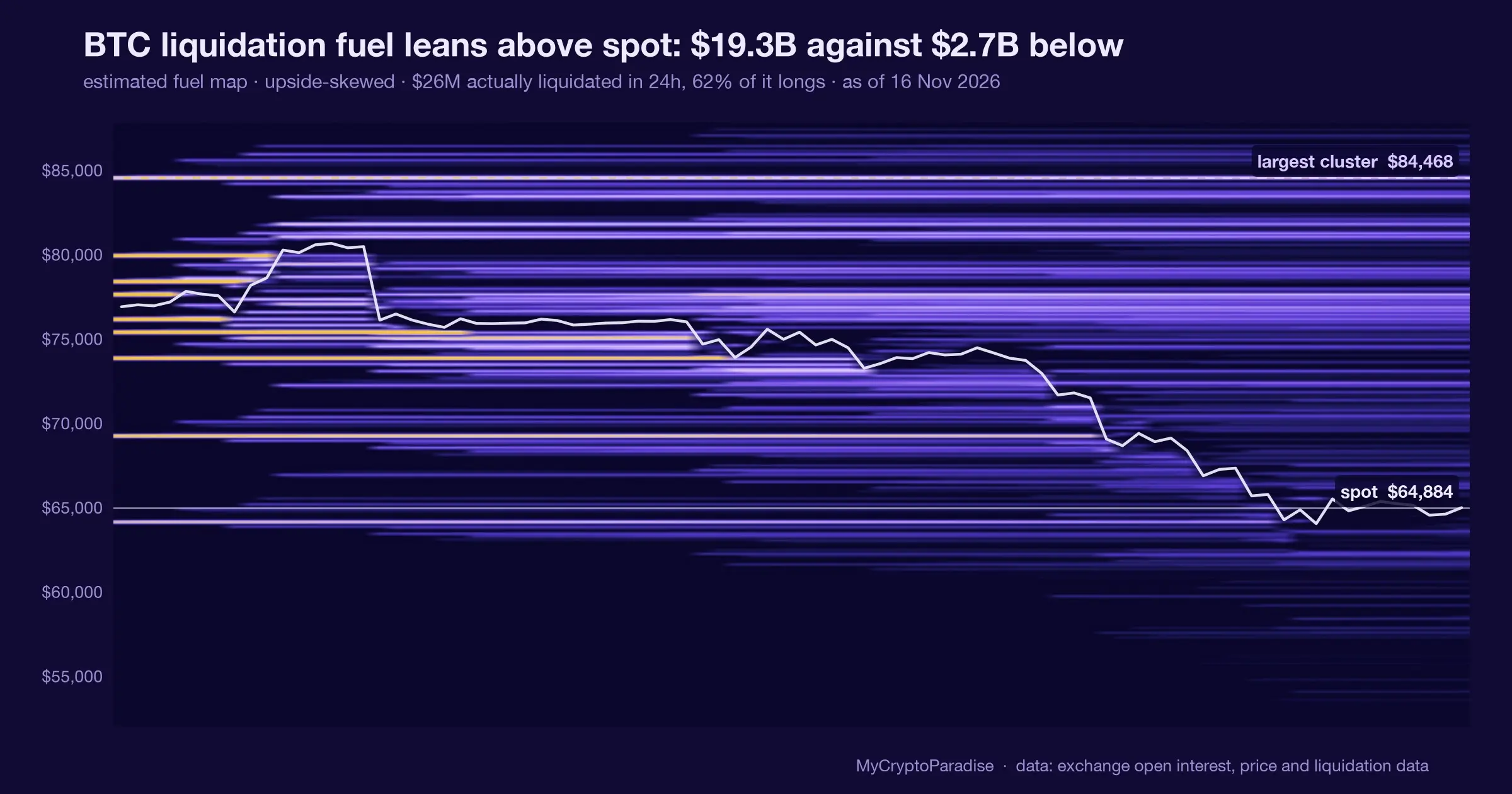
That matters for where stops sit. The crowd is heavy with longs, so a flush toward $78,000 could trigger close to $3 billion in long liquidations. ETF inflows do not stop that air pocket, but they do give the $78,000 structural support a deeper buyer behind it if price gets there.
To the upside, nearly $11 billion in short liquidations sit around $89,000, with $82,500 the first intermediate cluster. A durable Bitcoin bid is exactly the kind of fuel that squeezes crowded shorts toward the $90,000 zone.
Ether is the other side of the ParadiseTeam read. Persistent ETHA redemptions look like genuine distribution of ETH exposure by the same cohort still adding Bitcoin. That is a reason to treat ETH strength with more suspicion than BTC strength here.
Stay risk first. Higher timeframes remain bearish, so we view any push to $90,000 as a move within a larger downtrend, not a trend change.
The read behind this: we framed this story through our own market analysis, Can Bitcoin Recover to $90K From Here?
Track it live: our live crypto funding rates and the Crypto Fear and Greed Index both update in real time, so you can watch this shift for yourself.
Related coverage
For exact entries, targets, and stop losses with full risk management, that is what ParadiseFamilyVIP is for. New to reading these moves? Start with our crypto trading strategies guide.
ParadiseTeam is monitoring the market situation closely, and we are taking these developments into consideration while building our trading tactics inside ParadiseFamilyVIP.
Crypto trading involves substantial risk. Prices are volatile and you can lose money. This article is educational and is not financial advice. Past performance does not guarantee future results.
Does the Bitcoin vs Ether ETF flow gap widen into next week?
How 12 Paradisers are calling it
The first call is still open
Free account, no password. Members just sign in.
Follow this topic: Bitcoin ETF news












Join the discussion 16
Sorry if this is obvious, but isn't $137M on one day kind of small next to everything BlackRock holds?? I'd read it as the same money moving around more than new money coming in!!
I keep telling myself the ETF flows are just rebalancing.... but every time BlackRock shows up on both sides of the trade, I go back to my journal and count how many weeks Ether has been bleeding before I believe it.
Derek, I'd read the $137M differently.... BTC ETFs taking in money doesn't tell us much on its own. Ether funds bleeding while BlackRock is on both sides could just be where the dollars are parked this week, not a verdict on ETH.
Nadia, the journal says otherwise…. In my entries, when BlackRock was on both sides, ETH stayed under its 20-day line for six straight weeks, and I logged each one before the price moved. Parked dollars do not explain a six-week slide in the same tape.... Show me one week where ETH bled while the flows were truly neutral, and I will reread my own rule.
Derek, you're asking me for one neutral week, so here's one. Look at the weeks ETH sat under its 20-day line while BTC ETF inflows stayed positive and ETH fund outflows were small... the slide still held.... That tells me your six weeks may be tracking something other than BlackRock's two-sided trades.
Nadia, your neutral week is the one I would check first.... In my journal, the weeks ETH sat under its 20-day line with BTC inflows positive were the weeks I logged the same rule, so that is the test.... Send me the dates and I will pull the entries.
lol the BlackRock part is what gets me, every time i see their name on a fund i think about how my first stablecoin payment was just a tiny transfer that landed in minutes 🐱 wondering if the big money piling into BTC is quieter than the ether bleeding?
Ah the BlackRock on both sides thing gets me too 😅 but I'm not buying "institutions concentrate in BTC" as the whole story, sure a $137M day is nothing next to what's sitting in ether funds bleeding out 📉
every time i see blackrock on a fund my first thought is where did the retail money go, and tbh i still dont have a written answer for that one
Hmm, I get the BlackRock thing, but I'd flip it a bit: the retail money probably didn't vanish, it just came in later through the ETF wrapper 🤔 like the 137M on the 28th looks small next to what institutions already parked, so maybe the story is who got in first, not where it went 📉
okay but one busy day of inflows tells me nothing about what happens when the flow reverses?! where's the downside case in this piece? I'd want that before I believed any of it 🤔
so wait, does blackrock being on both sides mean anything for the 137m or is that just the big wallet shuffling its own chairs?? 🤔
Inflows into BTC funds while ether bleeds is exactly what I watched in Istanbul... liquidity goes where it's deepest, opinions just follow later. BlackRock's name on both sides still makes me check the fund's custody setup first.
every time blackrock shows up on both sides i just wonder who on the other end is the one who needs to be right. in my shift we called that the guy holding the clipboard, not the guy on the forklift
the 137M on a single day is less than i'd expect when ether is bleeding this hard, so where are the eth outflows actually landing, anyone tracked the stablecoin side of that
Ether funds bleeding while BTC pulls in money, same story I watched on the 15m all last week 📉 the dollars always go where they feel safe first, and that tells you more than any headline does 👀