

Listen: the breakdown
Market briefing: Binance says RedotPay diverted users in a 605 million dollar lawsuit. BNB slipped 1.8 percent to 593 dollars while BTC held near 64,469 dollars, right under resistance, as of 03:36 UTC.
- Binance alleges RedotPay diverted users in a $605 million lawsuit
- BNB reaction stayed muted at $593.29, down 1.8% on the day
- Crowded longs near resistance leave BTC exposed to a squeeze
Binance says RedotPay diverted users in a $605 million lawsuit, and the market barely blinked. So why are professionals watching this quiet headline so closely?
Binance has moved against RedotPay, alleging in a $605 million lawsuit that the payments firm diverted its users. The claim puts a large number and a serious accusation on the table at once.
The striking part is the market's shrug. BNB traded at $593.29, down 1.8% over 24 hours and just 0.1% over the last hour. For a headline this size, that is a remarkably calm tape.
Binance frames the case as user diversion, the commercial equivalent of someone quietly redirecting your foot traffic. A $605 million figure signals the company sees real value at stake, not a rounding error.
We report the filing itself as fact. What the lawsuit means for confidence in large exchanges is our read, and that is where this story gets interesting.
Counterparty questions rarely move price on the day they land. They move it later, when leverage is already stretched and traders are looking for a reason. That is the backdrop here.
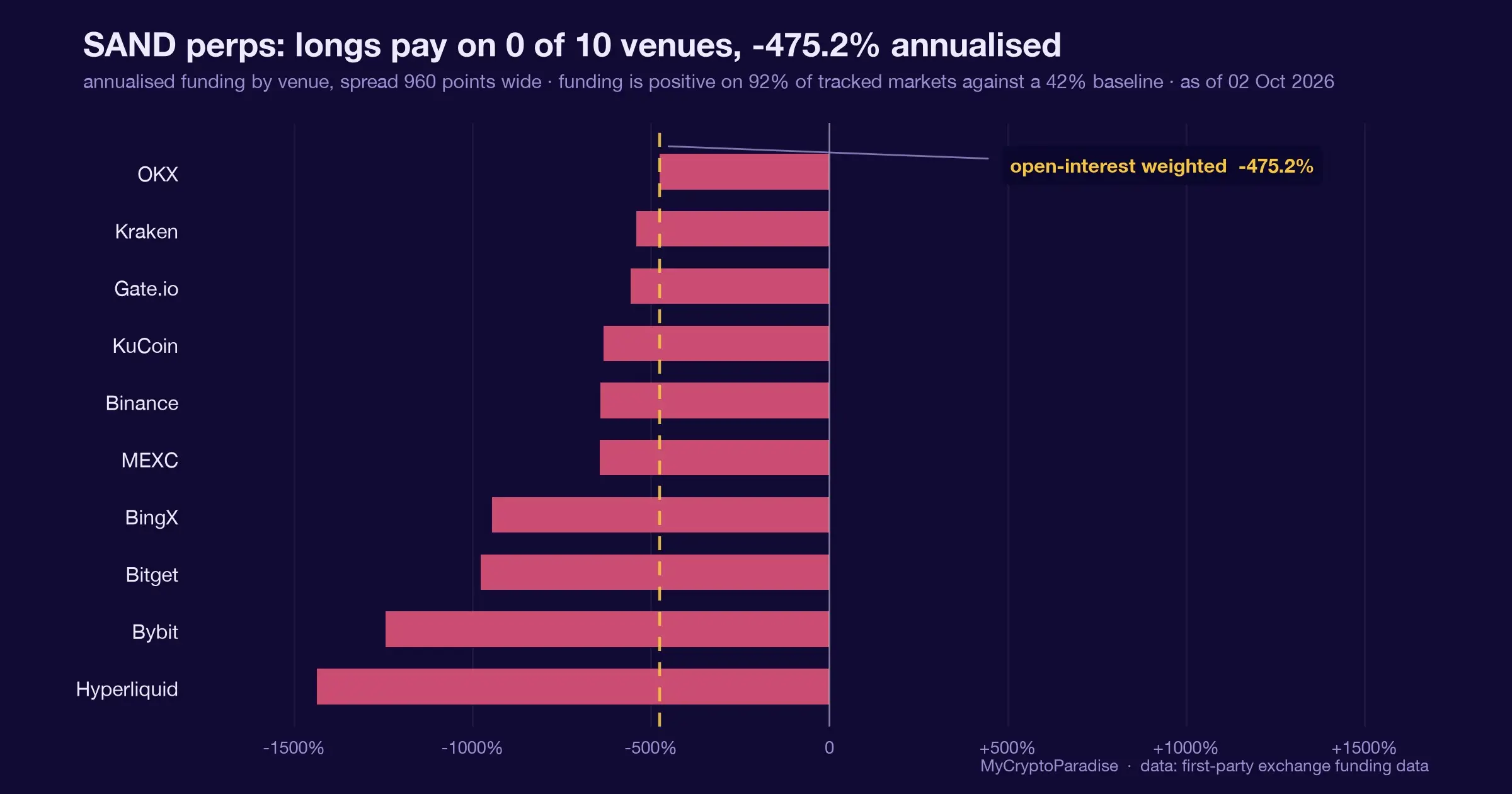
Broad crypto sentiment has been tilting toward greed, with longs crowding in and funding rates positive. Into that setup, a fresh reminder that exchanges carry legal and counterparty risk is not nothing. It is a small crack in a room full of confident buyers, and those cracks tend to matter most precisely when nobody is worried about them.
Why an exchange lawsuit tests confidence
This $605 million lawsuit matters because it reopens a question the market prefers to ignore: how much do we trust the venues holding the money? Binance sits at the center of crypto liquidity, so any dispute involving it carries weight beyond its own token.
Counterparty risk is the transmission mechanism here. When confidence in large exchanges wobbles, even slightly, traders quietly reassess where their funds sit and how fast they could exit. That reassessment is invisible until it isn't.
Right now the effect is muted. BNB down 1.8% is orderly, not panicked. That tells us the market is treating the Binance lawsuit as background noise rather than a threat.
But background noise changes character in a leveraged market. Positive funding rates mean longs are paying to stay long. Crowded positioning means many traders share the same exit.
Add a credible reason for caution, and you have the ingredients for a liquidity squeeze. The lawsuit does not need to be catastrophic to matter. It only needs to nudge sentiment at the wrong moment.
We are honest that no single confirmed catalyst is driving today's tape. This is our interpretation of how a legal headline could interact with fragile structure, not a proven cause. The distinction matters, because forecasts in this market are always confident and rarely precise.
How the tremor could reach BTC and alts
The direct hit lands on BNB, and even there it is soft. A 1.8% daily slip near $593 is the market pricing uncertainty, not fear. That restraint is the first clue to how any wider move would travel.
BTC is the real fulcrum. As of 03:36 UTC it traded near $64,469, sitting just under the resistance band our lens flags at $64,300 to $64,800. A confidence wobble here does not push BTC up. It gives crowded longs a reason to unwind.
If BTC rejects that resistance, the liquidity effect flows outward. Leveraged longs get flushed first, and the cascade of stop-losses can drag price faster than any headline justifies.
ETH tends to follow BTC's lead in these moments, amplified by its own leverage. When BTC sneezes at resistance, ETH usually catches the cold with interest.
Alts sit at the end of the chain and feel it hardest. Thin books and crowded speculative longs mean smaller coins overshoot both ways.
The RedotPay lawsuit itself may prove commercially contained. But in an over-leveraged tape, the trigger rarely matters as much as the fuel. The fuel is already stacked: positive funding, crowded longs, and momentum quietly fading at resistance.
What confirms a squeeze versus a shrug
The first thing to watch is whether the Binance lawsuit stays a one-day story. If BNB stabilizes and no fresh detail emerges, the market likely files it away and moves on. Silence would be bullish by default.
The second is BTC's behavior at resistance. Our lens marks $64,300 to $64,800 as the zone to respect. A clean, sustained break above it, with rising volume, would invalidate the squeeze thesis and point toward the higher daily target.
A rejection here tells the opposite story. If BTC stalls and slips, watch the $62,500 level closely. That is where the near-term bullish structure lives.
A break below $62,500 would confirm that sellers have taken control. It would open the door toward the $61,000 to $59,000 region, which we treat as a demand zone rather than a disaster.
Funding rates are the quiet tell throughout. If they stay hot while price stalls, longs are trapped, and the squeeze risk grows by the hour.
We would treat capitulation into support very differently from a break under euphoria. Panic selling into $61,000 to $59,000 often marks where professionals step back in. A calm drift lower on fading longs is a warning, not an opportunity. The difference is who is selling, and how scared they are.
What this lawsuit means for crowded positioning
The ParadiseTeam reads this $605 million lawsuit as a risk multiplier, not a standalone driver. The headline itself is bearish for confidence, but its real danger is timing, landing while longs are crowded and BTC sits right under resistance.
With BTC near $64,469 as of 03:36 UTC, price is pressing the $64,300 to $64,800 band our lens flags. That is exactly where crowded, confident longs meet early bearish divergence on momentum. It is a classic distribution setup, where good news struggles and any bad news finds willing sellers.
We see this as a spot where smart money can let retail hold the bag. Positive funding means longs are paying up, and a counterparty scare gives professionals cover to trim into strength.
Stops now sit clustered just below the recent range, which is precisely what a squeeze hunts for. That clustering is the liquidity a downside flush would target.
The reframe cuts both ways, honestly. If price instead flushes toward the $61,000 to $59,000 zone on fear, that is where our members reaccumulated before, and where panic tends to hand assets from retail to professionals. So the ParadiseTeam stays patient and risk-first. Below resistance with divergence building, the odds favor caution. We would rather respect the squeeze risk near $62,500 than chase confidence that momentum is quietly withdrawing.
Track it live: our live crypto funding rates and the Crypto Fear and Greed Index both update in real time, so you can watch this shift for yourself.
Related coverage
For exact entries, targets, and stop losses with full risk management, that is what ParadiseFamilyVIP is for. New to reading these moves? Start with our crypto trading strategies guide.
ParadiseTeam is monitoring the market situation closely, and we are taking these developments into consideration while building our trading tactics inside ParadiseFamilyVIP.
Crypto trading involves substantial risk. Prices are volatile and you can lose money. This article is educational and is not financial advice. Past performance does not guarantee future results.






Join the discussion
No comments yet. Members, share how you are reading this.