

In short
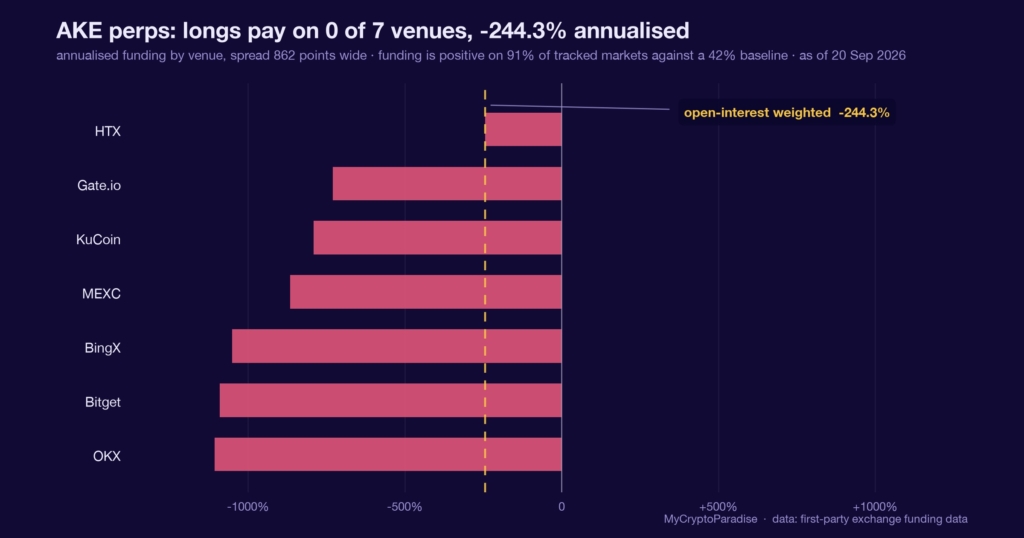
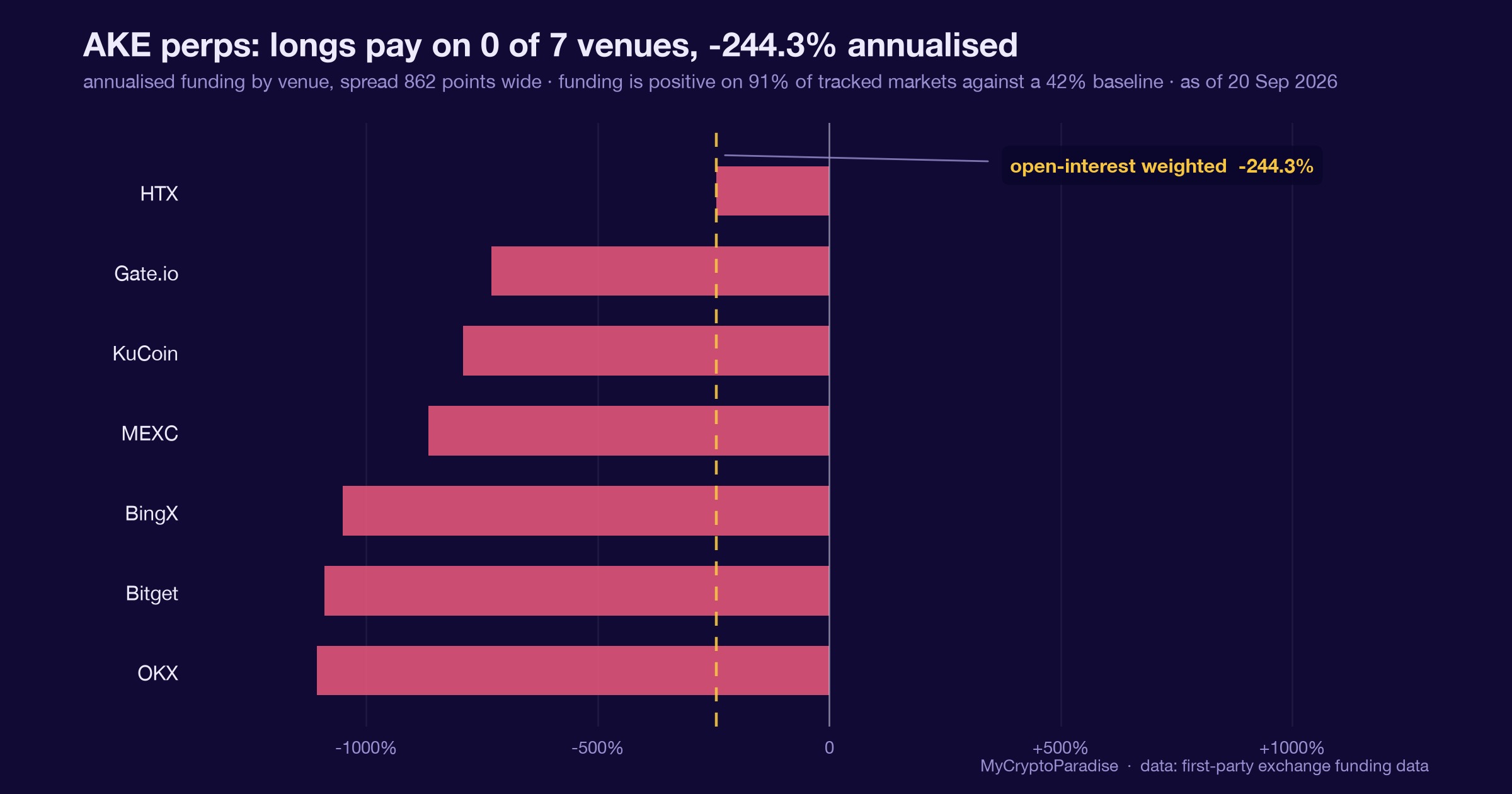
Funding is the recurring fee that perpetual-futures traders pay each other to keep the contract tethered to spot: when it is negative, shorts pay longs. Our MCP Insights funding-extremes data read AKE at minus 244 percent on an annualised basis on 20 September 2026, the most negative funding anywhere on our grid that day. That is a crowd leaning heavily short and paying dearly to stay there. We read it as constructive fuel, and we explicitly did not call it a squeeze: fuel is a location, not a trigger. Negative funding this deep can persist for days while price grinds sideways and the shorts simply bleed the fee. Base rates for funding extremes are not wired into our data yet, so we claim no historical frequency here. This piece shows you how to read a funding extreme yourself, and where the level sits that would prove the shorts right.
Negative funding is the fee a crowded short pays
A perpetual future has no expiry date, so the exchange uses a small recurring funding payment to keep the contract price glued to spot. When more capital is positioned short than long, funding turns negative, and shorts pay longs every few hours.
That fee is the market renting out conviction. A deeply negative rate means the short side wants its position badly enough to pay for it, hour after hour, rather than close it. It is information about crowding, not about direction.
The mechanism cuts both ways. A crowd that pays to stay short is a crowd that can be forced to buy back in a hurry if price turns against it, and the heavier the fee, the more expensive that patience becomes. Expensive patience is the raw material a squeeze is built from.
AKE carried the market’s deepest short-paid funding
Our MCP Insights funding-extremes data read AKE at minus 244 percent on an annualised basis, its annual percentage rate (APR), on 20 September 2026. On our grid that was the single most negative funding in the market, meaning AKE shorts were paying more, in relative terms, than shorts on any other tracked perpetual.
A minus 244 percent annual rate is not a gentle tilt. It is the kind of reading that appears only when a position has hardened into consensus, and the crowd is willing to pay a punishing carry to keep holding it.
One caveat, stated plainly: this is a single live reading. Base rates for funding extremes are not wired into our data yet, so we claim no historical frequency, and one number without an error bar is a data point, not a distribution.
What is different here
The ParadiseTeam does not treat a funding extreme as a trade by itself. We locate the crowded side, name the exact level that would prove it right, and hold the read as one probability weight among several rather than a call. The fee tells us where, never when.
A funding extreme marks a location, not a moment
The tempting misread is to treat minus 244 percent as a countdown to a squeeze. It is not. Deep negative funding tells you where the crowded position sits; it says nothing about when, or whether, that position gets unwound.
Funding this stretched can persist for days. Shorts can be right and early at the same time, grinding the fee while price drifts lower, so the carry becomes the cost of a working trade rather than the fuse on a losing one.
So the reading is fuel, and fuel needs ignition. Ignition here is price: a sustained move higher that turns the shorts’ patience into forced buying. Without that move, the fee is just weather.
How lopsided the fee is matters more than the number
How lopsided the fee is matters more than the raw number. A punishing rate on a position everyone already holds behaves differently from the same rate on a smaller, lightly held one, because the second squeezes far more violently when it turns.
We cannot see the full depth behind this single reading, so we hold it as what it is: evidence that one side has crowded, priced by how much that side is paying to stay.
That is why an extreme is read, not obeyed. A gauge that tells you where the crowd is standing is useful precisely because it refuses to tell you when the floor gives way.
Who is paying to be wrong, and what would flip it
This is one input, and on its own it is a lean, not a conclusion. It sits alongside open interest (OI), spot absorption and the broader funding regime, and today it is the reading that flags where positioning has become the most lopsided.
The honest grade is that this has not resolved. We called a comparable funding extreme on another name constructive five days ago, and that read is still open, because funding can stay stretched long after a thesis is placed.
The invalidation is specific. If AKE makes fresh lower lows while this funding normalises back toward zero, the crowded shorts were simply correct, and the fuel thesis is spent, not merely delayed.
Reading a funding extreme yourself, step by step
- Open our live funding rates view and sort every perpetual by rate, so the most negative names surface at the very top.
- Confirm the sign: a negative rate means shorts are paying longs, which marks the short side as the crowded one.
- Read the magnitude as carry, not as a timer, because a deeply negative rate can persist for many days.
- Cross-check open interest (OI) on the same name, since a large fee on a thin position squeezes differently than on a heavy one.
- Write down the price level that would prove the crowd right, and treat that level as your invalidation.
Most readers stop at the headline rate and never write the invalidation level. Without it, an extreme is just a number to admire, not a read you can be wrong about.
Every number above is checkable against the live data. Start with the live crypto funding rates, then cross-read the MCP Insights hub and the Crypto Fear and Greed Index.
Act and invalidate
| Scenario | What confirms it | What kills it |
|---|---|---|
| Shorts squeezed | Sharp move up on rising OI | Rate stays deeply negative |
| Shorts correct | Fresh lower lows as price drifts | Funding flips positive |
| Fee just bleeds | Price grinds sideways for days | OI collapses as shorts cover |
Posture: Patient and constructive, not aggressive: the crowded short is fuel and we wait for price to supply the ignition. No position is required to respect the reading.
Frequently asked questions
What does negative funding actually mean?
Negative funding means shorts are paying longs to hold a perpetual futures position. It appears when more capital is positioned short than long, so the exchange charges the crowded side a recurring fee that pulls the contract price back toward spot.
Does minus 244 percent funding mean a squeeze is coming?
No. A deep negative rate tells you where the crowded short sits, not when it unwinds. Funding this stretched can persist for days while price drifts, so the reading is fuel that still needs a rising price to ignite it.
Why is AKE funding so much more negative than Bitcoin’s?
The most stretched funding usually appears in names where one side has become a strong consensus. A minus 244 percent annual rate reflects how badly the short side wants that position, paying a punishing carry to keep it rather than a broad market view.
How do I know if the read is wrong?
Watch the invalidation. If AKE prints fresh lower lows while funding normalises back toward zero, the crowded shorts were simply right and the fuel thesis is spent. A rate that flips positive on falling price says the same thing.
Should I trade on funding alone?
No single metric decides a position. Funding is one input that flags where positioning is lopsided; it sits alongside open interest, spot absorption and the wider regime. Treat it as a probability weight on a bias, never as the bias itself.
Crypto trading involves substantial risk and is not suitable for everyone. Nothing here is financial advice; it is education only. Never risk more than you can afford to lose.
The private Extras feed, where the funding-extremes read, the crowded-short fuel map and its invalidation level update intraday, is part of PRO Paradiser, the intelligence layer behind the ParadiseFamilyVIP strategies.



Join the discussion 13
The funding extreme is certainly noteworthy, but I'm not entirely convinced it's the "fuel" here. My experience suggests that shorts capitulating at such levels are often the *result* of a move, not its initiation.
That funding extreme is more about liquidity drying up on the short side for me, Marco. Especially when you see perp open interest dropping too...
Ugh, I remember when funding rates were like a secret language to me 😵💫. Just kept rotating altcoins and praying for green candles 🙏😅, never even looked at this. My stack suffered 📉!!
that "fuel" framing seems a bit strong; typically, negative basis extremes often precede further downside, or at least a volatile chop, before any significant reversal. I'd lean more toward an exhaustion signal.
Minus 244% is a lot, but what's the actual leverage distribution across those shorts?! Seems like a setup for a clean sweep if the order books are thin.
It’s always about the liquidity, not these narratives people build around funding rates. What invalidates it for you after that kind of extreme..??
For me, it is a data point to observe, not a primary trigger. The price structure and zone reclaims dictate where I focus.
for me lukas funding like that its more than a data point when short squeezes happen they dont care about price structure
Exactly. If the structure is there, a funding extreme is just more confidence to protect your purchasing power with conviction.
Minus 244% funding... Wow, that's wild to see 🤯. Makes me think of a friend who got burned real bad chasing those extremes on a different coin, didn't end well for him at all... 😟
wow, -244% is wild 🤯 for real! it makes me think of the real-world cost for those shorting, like interest on a loan, but way worse 😬. that's painful! 🔥📉
i remember when the funding rates used to throw me for a loop 😵💫, now its more of a confirmation signal for me, especially with divergence 📈. good reminder here.
If we consider the -244% extreme, does the article show a historical correlation between funding and subsequent price movement or just that it can indicate a significant imbalance?