


Listen: the breakdown
Developing story: This story is still unfolding. We are tracking it and will update this article as more details are confirmed.
Market briefing: Iran says the Strait of Hormuz stays shut until its conditions are met, and that waterway moves a fifth of global oil. Bitcoin was trading near $80,382, down about one percent on the day, as the risk-off tone built.
- Iran conditions any Strait of Hormuz reopening on an end to war, sanctions relief, and a naval withdrawal.
- The strait carries roughly a fifth of the world's oil, so the threat feeds straight into inflation fear.
- BTC held near $80,382 and ETH near $2,575, both softer on the day as risk appetite thinned.
Iran now says the Strait of Hormuz will not reopen until every demand is met. When a fifth of global oil sits behind one waterway, does crypto get to stay calm?
Iran's parliament speaker has hardened the country's position on the Strait of Hormuz. The message is blunt: the strait stays closed until Iran's conditions are met and outside commitments are honoured. He called the stance clear, rational, and non-negotiable.
The demands are large. An end to the war. A full lifting of sanctions. A withdrawal of the naval blockade. None of those resolve in a single news cycle, which is exactly why markets should treat this as a slow pressure story, not a one-day headline.
The number that matters is the strait itself. Roughly a fifth of the world's oil passes through it. Close that tap, or even credibly threaten to, and the price of energy stops being a regional issue and becomes a global inflation problem.
We have covered the broader Gulf escalation already this week, from security alerts to forces on high alert. What is new here is the shift from tension to terms. Iran is no longer reacting; it is setting conditions, and it is willing to keep a chokepoint shut to hold them.
Crypto's reaction was measured rather than dramatic. Bitcoin traded near $80,382, down about one percent over the day, with a faint one-hour bounce. Ether sat near $2,575, softer still. That muted tape is the interesting part, because a market this greedy usually shrugs off geopolitics until it suddenly cannot.
One waterway, a fifth of global oil
The transmission runs through oil, not through crypto directly. A credible threat to Hormuz lifts the risk premium on energy, and higher oil feeds higher headline inflation across most of the world.
Higher inflation is the enemy of cheap money. It pushes central banks to stay tighter for longer, which lifts the appeal of holding dollars and dulls the appetite for anything speculative. Crypto sits at the far, thin end of that risk curve.
So the chain is simple. Geopolitical shock raises oil, oil raises inflation fear, inflation fear strengthens the dollar and drains liquidity from risk assets. Bitcoin and Ether are downstream of all of it.
There is a second, quieter effect. Uncertainty this open-ended encourages capital to wait rather than commit. Money moves to the sidelines, and in crypto that often means parking in stablecoins until the picture clears. That matters because our read of this cycle already shows large capital sitting in cash, unconvinced by the current bounce. A macro headwind like this gives that patient money a reason to keep waiting, not to rush back in.
The honest caveat: the strait has been reopened before under a brief ceasefire, then closed again. This is a stance, not yet a fresh physical closure, so the risk premium is about what could happen, not what already has.
Risk-off pressure runs from oil to alts
Bitcoin absorbs this kind of shock first, because it is the deepest and most liquid crypto market. Near $80,382 it barely flinched, which tells us the fear is a background hum, not yet a stampede.
Ether is the honest tell. Down about 2.4 percent on the day against Bitcoin's one percent, it is behaving like the higher-beta asset it is. When risk appetite thins, capital leaves ETH faster than it leaves BTC.
Alts sit at the end of the line. If a genuine oil-driven risk-off wave arrives, the smaller tokens tend to fall hardest and bounce last, because their liquidity is thin and their holders are overwhelmingly retail.
Here is the structural tension worth naming. The Fear and Greed Index is pinned at extreme greed while a serious macro threat builds. That gap between mood and risk is where painful moves are born.
Open interest (OI), the total value of live derivatives positions, matters now because leverage stacked on greed is fragile. A sharp oil headline can trigger forced selling, and cascading liquidations move price far faster than any spot seller ever could. So the setup is a calm surface over a nervous structure. Retail is buying the dip and calling the strength conviction. We would rather ask who is selling into that strength, and why they are content to let cheerful buyers absorb their supply.
Signs of a genuine capitulation flush
The confirmation we care about is not another scary headline; it is a change in how oil and the dollar behave. A sustained jump in energy prices alongside a stronger dollar would tell us the risk-off channel is really open.
On the crypto side, watch whether Bitcoin can hold its footing above the low $80,000s or slips toward the more important support that has been defended before. A slow grind down on rising OI is very different from a single flush that clears leverage.
We are also watching cumulative volume delta (CVD), which tracks net buying versus selling pressure. If price holds while CVD leaks lower, that is distribution hiding inside apparent strength.
Invalidation would be equally clear. If the Hormuz stance softens, or a ceiling on oil holds, the macro headwind fades and this becomes a headline that aged in a day.
A second invalidation for the bears: Bitcoin reclaiming and holding the daily resistance band overhead with real follow-through, not a single hopeful candle. That would suggest buyers can absorb geopolitical fear rather than merely ignore it.
The trap to respect is the false calm. Markets can price a slow-burn geopolitical risk as nothing for days, then reprice it violently in an hour. The muted tape today is information, but it is not safety.
Extreme greed meets a macro headwind
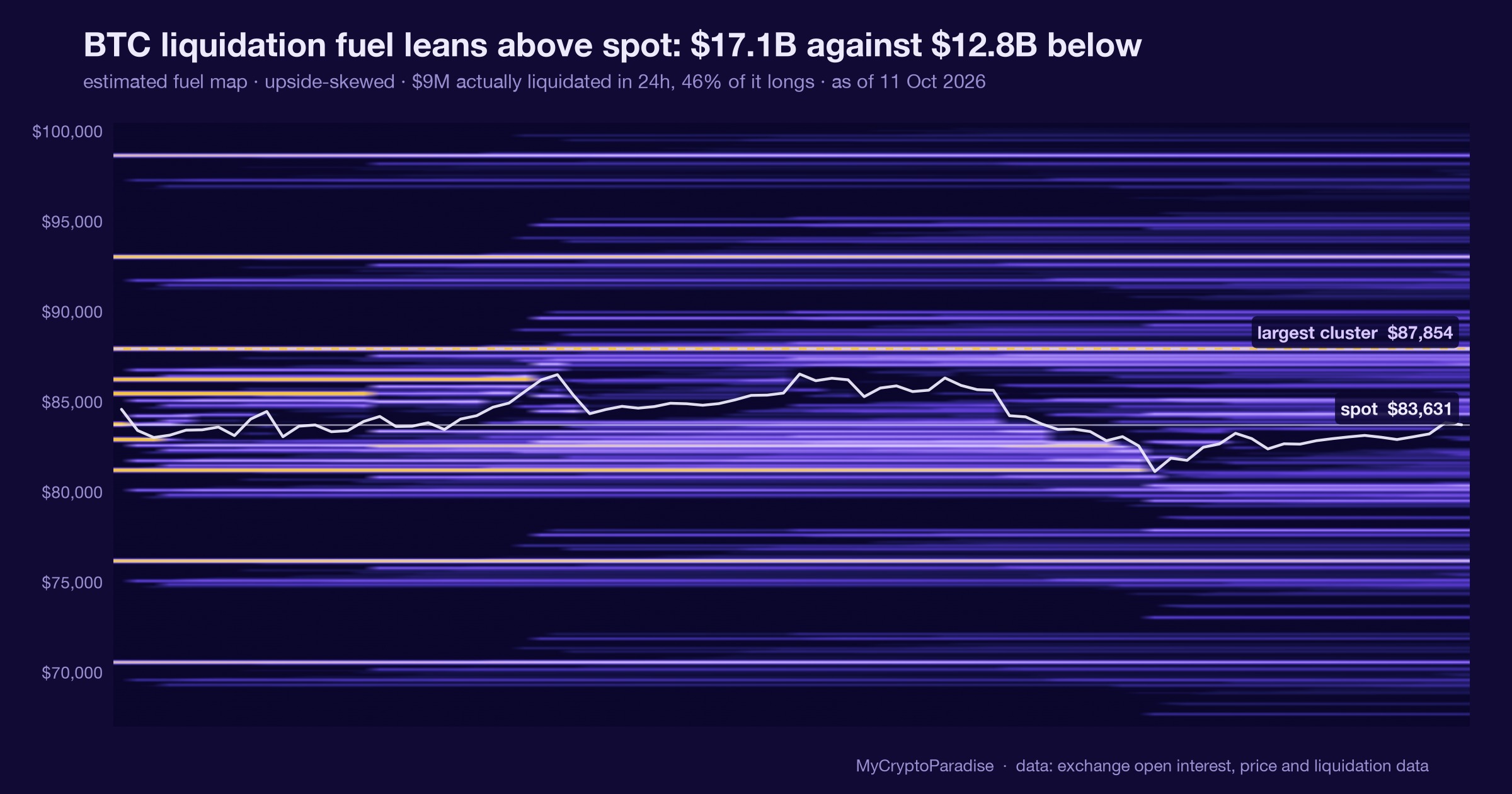
The ParadiseTeam maps this event onto a market lens that was already leaning bearish on the macro timeframe. Bitcoin traded near $80,382 as of this reading, sitting under the daily resistance band at $82,000 to $84,000, with a known liquidation cluster around $83,400 just overhead.
That overhead cluster is the magnet and the trap. In a greed-driven tape, retail buys toward it expecting a breakout. A geopolitical scare gives larger holders cover to distribute into that demand instead, which is the classic bullish-news-into-resistance pattern, only here the news is macro fear meeting misplaced optimism.
Support tells the other half of the story. The $75,000 zone has been defended before, so it is where the market's real conviction gets tested. Losing it on volume, not reclaiming resistance, is what would matter.
Our cycle read still points to a deeper macro bottom nearer $44,000, and to smart money parked in stablecoins waiting for a proper capitulation. Net Unrealized Profit and Loss (NUPL), a gauge of aggregate paper gains, has not yet flushed below zero, which is the signal that patient capital wants before it commits.
So this stance does not change the levels; it strengthens the reason to respect them. Probabilities favour caution, not conviction. A disciplined view weighs risk-to-reward (R:R) against clearly defined invalidation, and treats extreme greed under a live oil threat as a warning light rather than a green one.
The read behind this: we framed this story through our own market analysis, Can Bitcoin Break Resistance This Time?
Track it live: our Crypto Fear and Greed Index and the crypto liquidation heatmap both update in real time, so you can watch this shift for yourself.
Related coverage
For exact entries, targets, and stop losses with full risk management, that is what ParadiseFamilyVIP is for. New to reading these moves? Start with our crypto trading strategies guide.
ParadiseTeam is monitoring the market situation closely, and we are taking these developments into consideration while building our trading tactics inside ParadiseFamilyVIP.
Crypto trading involves substantial risk. Prices are volatile and you can lose money. This article is educational and is not financial advice. Past performance does not guarantee future results.
Where does BTC head next as the Hormuz standoff drags on?
This is how 14 Paradisers are calling it. Tap your call.
No calls on this one yet. Tap yours to be the first.
Free account, no password. Members just sign in.


Join the discussion 5
if this drags on, it makes saving for next semester harder... I just need my usdt to hold its value.
samuel what's your level for that usdt if things go sideways
This is such a big deal for shipping globally 🚢. I'm watching oil futures for a signal here, especially the daily close 🤔, because that's what moved the price of importing Czech washing machines for me last year 🔥.
how will we know the real price if this thing drags on, what's the one level that matters
I mean, I'm watching this like I watch all macro - on the weekly close. 🙄 Four-hour noise isn't a signal, guys.