

Listen: the breakdown
Developing story update (September 20, 2026, 18:35 UTC):
The second project caught in the same September 19 attack has been identified as NuNet, whose NTX token was hit by the 408.5 million unauthorized mint noted earlier. Fetch.ai’s own token converter loss of about 8.7 million FET remains unchanged, and FET continues to trade normally.
Following the unauthorized supply, NTX has fallen roughly 95% based on our sources. This is the sharp, isolated repricing you would expect when a token’s float is diluted by an attacker rather than a sign of contagion into FET or the wider AI basket.
What to watch now: Whether NuNet outlines a burn or remediation plan for the 408.5 million minted NTX, and if AGIX to FET conversions reopen.
Developing story update (September 20, 2026, 18:14 UTC):
Two new details have emerged since we first covered this. Based on our sources, the breach was facilitated by a leaked private key that authorized the unauthorized transaction, rather than a general contract flaw. This points to a key-management failure at the converter level, not a weakness in the core token itself.
The same attacker also minted roughly 408.5 million unauthorized NTX tokens through the affected route. Traders holding NTX or related assets should treat quoted supply and pricing with caution until the affected contracts are restored and the minted tokens are accounted for.
What to watch now: Watch for confirmation that the unauthorized NTX mint is contained and whether restored bridge contracts reprice affected tokens.
Developing story update (September 20, 2026, 17:12 UTC):
The fallout from the 19 September exploit has now hit NuNet’s NTX token directly. Based on our sources, NTX has fallen roughly 95 percent and printed an all-time low after the attacker minted 408.5 million unauthorized tokens, effectively diluting holders. This is the clearest market consequence to emerge since our first report.
The Fetch.ai side of the picture is unchanged: core contracts remain unaffected and FET continues to operate normally, with AGIX to FET conversions still paused as a precaution. The measurable damage so far is concentrated in NTX, not FET. Traders holding either token should treat the converter and bridge routes as the primary risk surface until conversions are formally restored.
What to watch now: Whether NTX stabilizes or keeps bleeding, and any official timeline to restore the paused AGIX to FET conversions.
Developing story update (September 20, 2026, 16:10 UTC):
Update: based on our sources, the root cause of the FET converter breach now points to a leaked private key rather than a purely contract-level flaw. A leaked key would have let the attacker produce a valid conversion authorization, which lines up with the earlier account of a legitimate-looking signature calling the conversion function.
For traders this narrows the story from a broad smart contract vulnerability to a likely key or operational security failure. The headline figures are unchanged: roughly 8.7 million FET drained, worth about 1.53 to 1.56 million dollars, plus 408.5 million unauthorized NTX minted, with NTX now at an all-time low. Fetch.ai contracts remain unaffected and FET continues to trade normally while the investigation continues.
What to watch now: Official confirmation of how the key was exposed and whether AGIX to FET conversions resume.
Developing story: This story is still unfolding. We are tracking it and will update this article as more details are confirmed.
Market briefing: A single valid signature drained a Fetch.ai converter of roughly 1.56 million dollars, while sister token NTX crashed 95 percent. Bitcoin barely moved, trading near 80,815 dollars, because this is an altcoin security scare, not a macro shift.
- An attacker used one valid conversion-authorizer signature to drain about 8.7 million FET, near 1.56 million dollars, from a Fetch.ai token converter on Ethereum.
- Fetch.ai says its contracts are safe and FET operates normally, but the same attacker minted 408.5 million NTX and that token crashed 95 percent.
- Combined losses sit near 2 million dollars; the ParadiseTeam reads this as altcoin fragility, not a Bitcoin event.
The Fetch.ai exploit split into two stories on one day: a contract drained, a team insisting everything is fine, and a sister token down 95 percent. So which signal do you trust?
One valid signature did the damage. On September 19, an attacker used a legitimate conversion-authorizer signature to call a conversion function inside a Fetch.ai token converter on Ethereum. About 8.7 million FET left the contract, worth roughly 1.53 to 1.56 million dollars. The weak link was a security check inside the Artificial Superintelligence Alliance token converter.
Fetch.ai has now drawn a line. It says its own contracts are not affected, no contract is under threat, and FET continues to operate normally. The team acknowledged the reports and confirmed an investigation is underway. That containment claim matters, because the same attacker did not stop at one project.
The blast radius widened into NuNet. The attacker minted 408.5 million unauthorized NTX tokens, and NTX crashed 95 percent almost immediately. Combined losses across the two projects sit near 2 million dollars.
So we have two stories running at once. One is a clean, contained message from Fetch.ai. The other is a near-total collapse in a sister token. Both are true, and the market has to price both.
For the wider AI narrative, that split is the real event. These projects share branding, share a converter design, and now share an attacker. A press release saying everything is fine reads a little differently when the token next door has lost almost all its value in a day.
A single signature widens the Alliance risk
This is a security failure, not a price failure, and that distinction drives everything downstream. When an exploit rests on a valid signature and a weak check, the problem is trust in the code, not sentiment. Traders cannot chart their way around a contract that mints tokens from nothing.
The transmission runs through confidence. AI tokens have been one of the loudest narratives of this cycle. A converter drained by one signature reminds everyone that emerging narratives often ship faster than they harden their security.
That reminder tightens risk appetite unevenly. Capital does not flee the whole market at once. It rotates, quietly, from the assets that feel most fragile toward the ones that feel most liquid.
Right now that means altcoins with thin security stories take the first cut. FET held up, but the NTX collapse does the psychological work. Retail sees a 95 percent candle and files every AI token under suspicion, fairly or not.
Smart money reads it differently. It treats the event as one more data point confirming caution, not a reason to panic-sell BTC. The macro backdrop already leans defensive, so a fresh altcoin scare simply reinforces a stance that was already in place.
The through-line is simple. A single flawed check in one converter feeds a broader question about how much of the AI trade is built on code nobody stress-tested.
Where the fear rotates from here
BTC barely moved on this. It was trading near 80,815 dollars as of 15:47 UTC, down about 1.2 percent on the day. A two million dollar exploit in an altcoin converter is not a Bitcoin event, and price is telling you so.
ETH sits closer to the action. It was near 2,602 dollars, down about 1.6 percent on the day, because the drained converter lives on Ethereum. Yet ETH is not bleeding either, which says the market reads this as isolated, not systemic.
The pain concentrates where you would expect. NTX lost 95 percent while FET kept operating. That gap is the whole liquidity story: money did not leave crypto, it left one fragile token and its neighbors.
For AI tokens specifically, the risk premium just went up. Buyers now demand a discount for converter risk, migration risk, and signature risk they ignored a week ago. Thin books make that repricing violent.
BTC and ETH may even see a small relative bid. When altcoin security scares hit, some capital rotates toward the assets that feel like the exits, and the two majors are the widest doors in the room.
None of this changes the macro picture. It sharpens it. The flush is happening at the edges first, in the smallest and least defended corners, while the majors hold and wait.
Signals that separate contained from contagious
The first thing to watch is whether Fetch.ai's containment holds. If the investigation closes with no further FET contract exposure, the clean message survives and FET can decouple from the NTX wreckage.
Invalidation looks like scope creep. Any sign that other Alliance contracts share the same weak check would turn a contained incident into an ecosystem problem, and the whole AI basket would reprice lower together.
Watch the 408.5 million NTX mint next. Where those unauthorized tokens go, whether they are burned, frozen, or dumped, decides how much more downside NTX carries. A frozen supply calms it; an open dump extends the bleed.
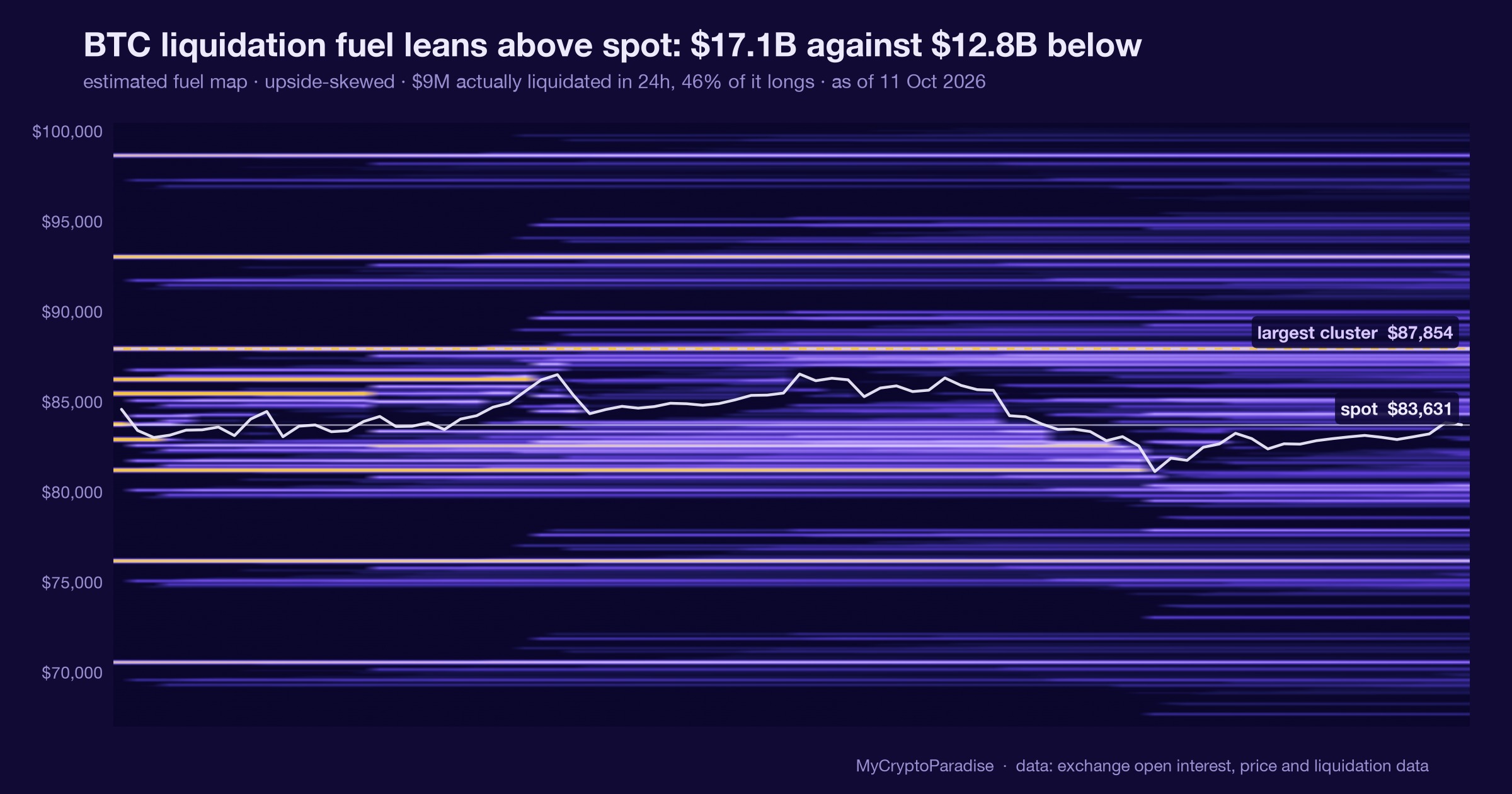
On BTC, the levels have not changed because of this exploit. Price is pressing the 82,000 to 84,000 daily resistance, with a liquidation cluster near 83,400 sitting just above. That cluster is the magnet, exploit or not.
Confirmation of strength is a clean reclaim of that 82,000 to 84,000 zone with follow-through. Without it, the more likely path is a rejection back toward defended support at 75,000.
For the AI narrative itself, watch whether volume returns to that sector or stays absent. Absent volume after a scare is how a narrative quietly cools. Returning volume would suggest buyers see the exploit as a one-off, not a pattern.
What the exploit means for altcoin liquidity
The ParadiseTeam reads this as an altcoin-specific scare landing inside a macro that was already defensive. It does not move our BTC map, and that is the point.
BTC was near 80,815 dollars as of 15:47 UTC, still trading beneath the 82,000 to 84,000 daily resistance. The liquidation cluster at 83,400 sits just above, which is exactly the kind of magnet that draws price up before smart money uses the fuel.
Here is the tension we keep flagging. The Fear and Greed reading sits at 80, extreme greed, while smart money holds mostly USDT and waits. Retail is buying strength; the professionals are not.
An exploit like this does not trigger their re-entry. It confirms their patience. We still expect a genuine capitulation, Net Unrealized Profit and Loss below zero, before a durable macro bottom, and that has not happened.
So the read for AI tokens is caution, not bargain-hunting. A 95 percent NTX candle into a greedy tape is not the fearful support test that flips a bearish story bullish. It is fragility meeting complacency.
For BTC, the invalidation of our cautious stance is a clean reclaim of 82,000 to 84,000 with follow-through and an RSI (relative strength index) uptick off its trend line. Until then, we treat rallies as retail-fueled and rejection risk toward 75,000 as live. Probabilities, not promises.
The read behind this: we framed this story through our own market analysis, Can Bitcoin Break Resistance This Time?
Track it live: our Crypto Fear and Greed Index and the crypto liquidation heatmap both update in real time, so you can watch this shift for yourself.
Related coverage
For exact entries, targets, and stop losses with full risk management, that is what ParadiseFamilyVIP is for. New to reading these moves? Start with our crypto trading strategies guide.
ParadiseTeam is monitoring the market situation closely, and we are taking these developments into consideration while building our trading tactics inside ParadiseFamilyVIP.
Crypto trading involves substantial risk. Prices are volatile and you can lose money. This article is educational and is not financial advice. Past performance does not guarantee future results.
Where does FET go from here after the converter exploit?
This is how 11 Paradisers are calling it. Tap your call.
No calls on this one yet. Tap yours to be the first.
Free account, no password. Members just sign in.











Join the discussion 10
aye and then when it all goes pear-shaped 🍐 who picks up the tab for these 'exploits' eh 🤔 not the people who caused teh mess usually 😡. reminds me of '08 🙄.
The point on BTC risk-first makes sense, but this exploit does not feel like the primary driver. Often these events have broader implications.
That NTX crash is so scary... 😱 It makes me wonder about project stability overall, not just smart contracts. It's a lot to learn and keep track of!
smart contracts are always a tightrope walk; I usually keep a mental check on protocol TVL when looking at new altcoin options. that 95% NTX drop stings though! 📉
The Fetch.ai exploit certainly highlights the ongoing smart contract risks. What would such a vulnerability look like in a mature Bitcoin ecosystem, were it to scale in the ways some anticipate?
Wow 🤯 1.56M is a huge amount for one exploit! 📉 Do you think most projects really check for these things before launch? 🤔 Or just when something bad happens? 😠
ja, this is why I like starting with small positions, just to get a feel for things... it helps keep the fear in check when you see these stories 😬.
The exploit detail is concerning, but the article's linking it directly to why ParadiseTeam "still reads BTC risk-first" feels like a stretched connection. Those are separate risks.
Eu entendo seu ponto, Sandra! 🤔 Mas a mentalidade "risk-first" da ParadiseTeam também pode vir de ver altcoins terem esses problemas de liquidez súbita, né? 📉 Tipo, não só exploits.
Sandra, I agree that the exploit is a distinct event, but the question for me is whether it impacts the fundamental decentralization thesis of the broader ecosystem.