

In short
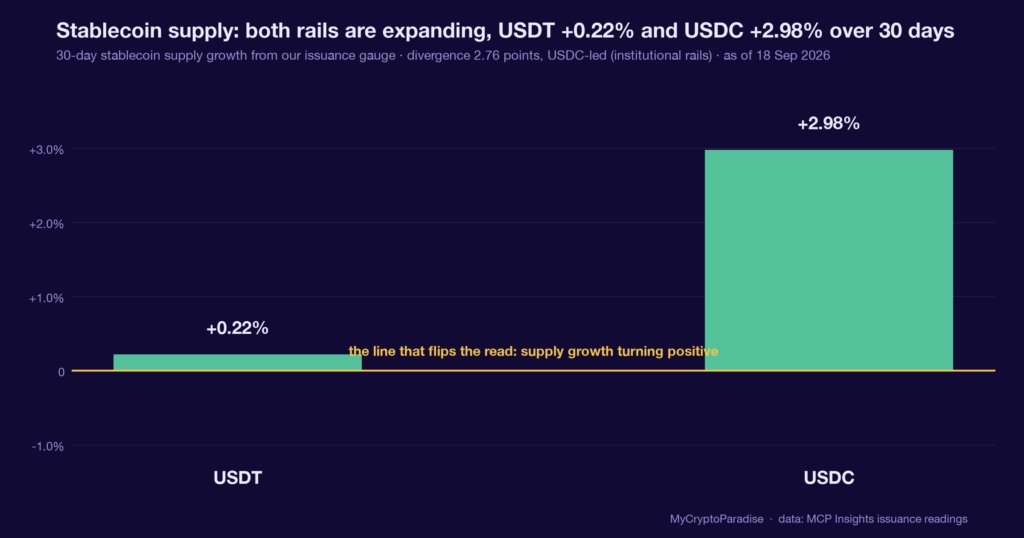
Stablecoin turnover measures how many dollars of stablecoins actually change hands on-chain, a rough proxy for how much fresh liquidity is circulating into crypto. The source feed puts adjusted turnover near $138 billion, well below the trillion-dollar days of late 2021, and reads that as cooling demand. Our own MCP Insights issuance data on 18 September 2026 complicates the picture: USDC supply grew 2.98 percent over 30 days against just 0.22 percent for USDT, a 2.76 point gap that leans institutional. So we called it neutral, explicitly not a liquidity all-clear and not a top call. The two series disagree, and a disagreement is not a verdict. This piece shows you how to read stablecoin turnover against issuance yourself, so a cooling headline number does not become a forecast you never checked.
Stablecoin turnover is a liquidity proxy, not a verdict
Stablecoins are dollars that live on a blockchain. When their on-chain turnover rises, it usually means more dollars are moving toward exchanges and into positions. When it falls, that flow of fresh buying power is thinning out.
Turnover is a proxy for demand, not a direct measurement of it. A single cooling reading tells you the tide may be going out; it cannot tell you what price does next, and treating it that way is where readers get hurt.
A metric that measures flow is a weather report on liquidity, not a map of where price is going. The distinction is the whole discipline.
Our issuance data disagrees with the cooling headline
Start with the number that is not ours. The source feed puts adjusted stablecoin turnover near $138 billion, against a peak above $1 trillion a day in late 2021. We cannot verify that series, so we treat it as context, not proof.
Our own MCP Insights issuance data, read on 18 September 2026, points the other way. USDC supply grew 2.98 percent over the past 30 days; USDT grew 0.22 percent. That is a 2.76 point gap, and it is USDC-led, the institutional rail.
The Coinbase premium, our first-party spot gauge, reads plus 0.0131 percent on Bitcoin, a $10.57 gap at roughly $80,900 spot, sitting in the 89th percentile of the last 150 days with a z-score of minus 0.43. On Ether it is 0.0151 percent, in the 79th percentile.
A percentile in the high 80s says the premium has been firmer than most of the last five months, even as its short-term z-score sits below zero. Two-thirds of a story is not the story. The disagreement is the reading.
The cooling headline is not the whole liquidity picture
The obvious misreading is to see a falling turnover figure and conclude that demand has collapsed and price must follow. That skips a step. Turnover measures velocity of existing dollars; issuance measures whether new dollars are being created at all.
Right now those two point in opposite directions. Velocity is cooling, but USDC issuance keeps minting new institutional dollars at 2.98 percent over 30 days. Fresh supply that is not yet circulating is dry powder, not absence of demand.
This is one input. It sits alongside funding, open interest (OI) and spot absorption, and today it is the reading that quietly disagrees with the cooling narrative everyone can see.
A gauge that flashes one alarming number while a second gauge calmly contradicts it is doing its job. The contradiction is information, not noise.
What is different here
The ParadiseTeam does not read a single cooling number and call it demand destruction. We line the fast gauge, on-chain turnover, against the slow one, stablecoin issuance, and weight the series that is expensive to reverse. A method that cross-checks its own alarms beats one that trusts the loudest reading.
Which side is paying to be wrong
In a divergence, the useful question is who carries the cost if their read fails. Issuers minting USDC are committing balance-sheet dollars; that is a slow, deliberate signal that does not reverse in a day.
Cooling on-chain turnover, by contrast, can rebound the moment volatility returns and traders move stablecoins back onto exchanges. One series is sticky; the other is reflexive. Weighting them equally is the mistake.
So the lean is defensive but not bearish. We are not calling a top and not calling a bottom; we are saying the liquidity backdrop is mixed, with the slower, stickier series still expanding.
When a fast gauge and a slow gauge disagree, trust the one that is expensive to be wrong about. Conviction is cheap; committed capital is not.
The premium quadrant sits in a low-conviction zone
Our two-premium model places the current setup in what we label a capitulation quadrant, with the Coinbase premium z-score at minus 0.43 and the Korean spot premium running about 1.5 percent below global pricing.
That combination usually means local buyers are absent while the longer-run premium stays firm. It is not a floor and not a launchpad; it is a market with no urgent bid and no urgent seller.
A quiet tape is the easiest one to project a story onto. The discipline is to let it stay quiet until one of the gauges commits.
Reading stablecoin turnover yourself, step by step
- Pull the adjusted stablecoin turnover figure and compare it to its own 30 and 90 day range, not to an all-time peak.
- Separately check stablecoin issuance: is USDC or USDT supply growing, and by how much over the trailing 30 days.
- When turnover falls but issuance rises, mark it a divergence and refuse to treat either half as the full read.
- Cross-check the Coinbase premium and its percentile to see whether spot buyers are actually paying up right now.
- Write down the level or condition that would resolve the split before you act, so the divergence cannot become a forecast.
The step people skip is the second one: they see turnover fall and never check whether new dollars are still being minted underneath the cooling activity.
Every number above is checkable against the live data. Start with the MCP Insights hub, then cross-read the Crypto Fear and Greed Index and the live crypto funding rates.
Act and invalidate
| Scenario | What confirms it | What kills it |
|---|---|---|
| Divergence resolves up | Turnover rebounds as USDC keeps growing | USDC 30-day growth rolls negative |
| Divergence resolves down | USDC issuance stalls under 1 percent | Turnover reclaims its 90-day average |
| Split persists, no trade | Both gauges drift sideways | Coinbase premium breaks its recent range |
Posture: Defensive and patient while the fast and slow liquidity gauges disagree. The stickier series, issuance, still expands, so the bias is mixed rather than bearish, and no urgent action is warranted.
Frequently asked questions
What does falling stablecoin turnover actually mean?
It means the dollars already sitting in stablecoins are changing hands less often, a proxy for thinner circulating demand. It is a velocity reading, not a supply reading, and on its own it cannot tell you where Bitcoin goes next.
Is cooling stablecoin volume bearish for Bitcoin?
Not automatically. On 18 September 2026 turnover was cooling while USDC supply still grew 2.98 percent over 30 days. When a fast liquidity gauge and a slow one disagree, the honest posture is defensive and mixed, not bearish.
Why compare USDC and USDT growth separately?
Because they represent different money. USDC growth of 2.98 percent against USDT at 0.22 percent shows the expansion is institutional rather than retail-driven. Watching only total supply hides which kind of dollar is entering, which changes how you read the flow.
What is the Coinbase premium telling us here?
It reads plus 0.0131 percent on Bitcoin, firm enough to sit in the 89th percentile of the last 150 days, yet with a short-term z-score below zero. In plain terms, spot buyers are present but not aggressive right now.
What would change this neutral read?
A daily rebound in turnover back above its 90-day average with USDC issuance still expanding would tilt it constructive. The other way, USDC 30-day growth rolling negative alongside a slipping Coinbase premium would tilt it defensive. Either resolves the split.
Crypto trading involves substantial risk and is not suitable for everyone. Nothing here is financial advice; it is education only. Never risk more than you can afford to lose.
The private Extras feed, where the stablecoin issuance split, on-chain turnover and Coinbase premium update intraday with their invalidation levels attached, is part of PRO Paradiser, the intelligence layer behind the ParadiseFamilyVIP strategies.











Join the discussion 4
yeah it's a tricky one - i remember seeing similar divergences in OI vs turnover early in 2021 and thinking a major correction was due and it just kept grinding higher for months.
It's true, Tobias. Those divergences can be deceptive, especially with so much capital looking for a home in the stablecoin ecosystem.
makes sense... always wondered if the turnover rate would keep up with the supply expansion, especially with liquidity tightening globally... digital dollars literally saved my family.
I see it quite differently. Global liquidity is still historically elevated, even if contracting, suggesting that the supply expansion might actually be understating the true available float.