

Listen: the breakdown
Developing story update (August 14, 2026, 16:53 UTC):
The self-custody exploit at the center of this story now carries a confirmed figure of $116 million, yet the immediate BTC price reaction stays muted near $63,000, down about 1.4% on the day. That gap between a large headline loss and a contained price suggests the move is being driven more by liquidity and positioning than by the exploit itself.
On the flow side, Bitcoin ETF inflows are rebounding and Strategy is signaling intent to acquire more Bitcoin, based on our sources. Separately, miners are reported to be pursuing billions in AI-related deals, a structural demand thread worth tracking alongside spot flows.
For traders the setup is unchanged in shape: extreme retail fear against crowded long funding rates leaves room for a long squeeze before any push higher, with a bullish MACD divergence and oversold Stochastic RSI pointing to fading downside momentum. Treat these as probabilities, not guarantees, and size for the squeeze risk.
What to watch now: Whether ETF inflows and Strategy accumulation absorb the exploit shock or a long squeeze hits first.
Market briefing: A $116 million Bitcoin wallet exploit has put self-custody back under the microscope. BTC trades near $62,864, down 1.7 percent on the day, yet the theft is not what is moving price. We read the fear as accumulation fuel.
- A $116 million Bitcoin wallet exploit has reopened the self-custody debate.
- The theft is isolated and is not the reason BTC slipped 1.7 percent to $62,864.
- Extreme fear near support looks like smart money accumulation, not a top.
A $116M Bitcoin self-custody exploit is spreading fear while price barely reacts. So who really loses when panic peaks near support, and who quietly buys?
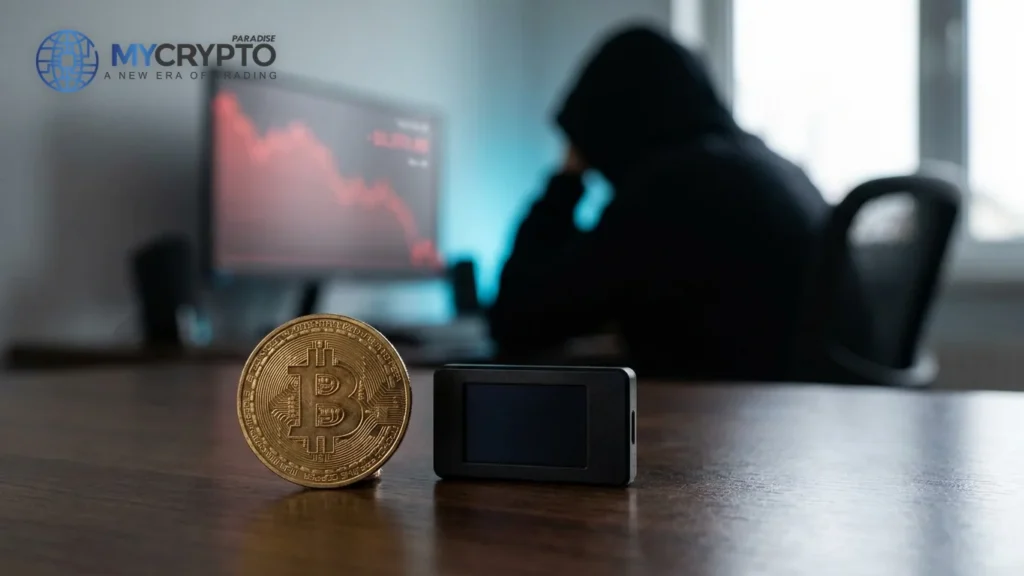
A single Bitcoin wallet just lost $116 million. That number alone is enough to reopen the oldest argument in this market: is self-custody freedom, or is it a liability most holders are not ready to carry.
The facts are narrow. One wallet was drained. This was not an exchange collapse, not a protocol failure, not a chain halt. It was a targeted exploit against a specific holder, and the wider network kept running exactly as before.
Still, the timing lands into a jittery tape. Bitcoin trades near $62,864, down 1.7 percent over the last 24 hours and flat on the hour. The headline feels heavy, yet the price is not behaving like a market in shock.
That gap between story and screen is the real signal here. Around this exploit sits a busier backdrop: exchange-traded fund inflows have been rebounding, one large corporate buyer is eyeing more BTC, and miners keep chasing billions in artificial-intelligence deals. None of that changed on the theft. So self-custody becomes the emotional anchor of the day, not the structural one. Fear headlines write themselves after a nine-figure loss, and retail reads them at the worst possible moment.
Our reporting keeps the two things separate. The exploit is real and confirmed. The idea that it is steering price is not, and we will not pretend otherwise. What matters is who gets scared, and who is waiting with capital while they panic.
Why a single theft rattles confidence
The macro chain here runs through confidence, not through supply. A $116 million self-custody exploit does not remove Bitcoin from circulation, and it does not touch monetary policy or liquidity. What it touches is trust, and trust is the softest input in any market.
When a large wallet is drained, the story travels faster than the facts. Holders who barely understand the attack still absorb the headline. That is how a narrow, isolated event becomes a broad emotional tax on the entire asset.
The transmission is simple. Fear raises perceived risk, perceived risk shortens time horizons, and short horizons turn long-term holders into nervous sellers. Weak hands start eyeing the exit over a threat that never actually reached their coins.
There is a quieter irony in the self-custody debate. The same people who celebrate being their own bank often skip the boring parts of running one, and exploits like this are the invoice for that gap.
Macro context matters too. ETF inflows rebounding and corporate buyers adding BTC point to steady institutional demand underneath the noise. That demand does not vanish because one wallet was compromised.
So the mechanism to watch is sentiment, not solvency. The theft is confirmed, but its power over price is psychological. It manufactures fear at a moment when fear was already elevated, and fear near support is exactly where markets hand assets from impatient owners to patient ones.
How the fear filters into BTC and alts
Start with Bitcoin, because everything downstream keys off it. BTC sits near $62,864 after a modest 1.7 percent slide, and it did not crack on the exploit headline. A market that shrugs off a $116 million theft is telling you where the real pressure is not.
The liquidity picture explains the calm. Selling driven by a security scare tends to be thin and emotional, and it gets absorbed quickly when larger buyers are waiting. That is the opposite of a forced, cascading liquidation.
Underneath, positioning is doing the real work. Open interest, meaning the total value of live derivatives contracts, shows crowded longs building on the four-hour timeframe even as daily sentiment prints extreme fear. That combination raises the odds of sharp two-sided squeezes.
Ethereum inherits this indirectly. When BTC holds firm through a fear headline, ETH usually stabilizes with it rather than leading a breakdown. A self-custody scare is a Bitcoin-branded story, so it rarely triggers independent ETH selling.
Alts sit at the far end of the whip. They amplify whatever Bitcoin does, so a BTC bounce off support can snap oversold alts higher fast, while a genuine BTC break would hit them hardest.
The honest read is that this exploit is a sentiment event, not a liquidity event. It adds fear to the tape without adding real selling pressure to the market structure, which is why price and headline have quietly parted ways.
What confirms strength versus real weakness
The first thing to watch is whether fear converts into actual selling. So far it has not. If BTC keeps holding immediate support near $62,800 while the exploit headlines circulate, that non-reaction is itself bullish confirmation.
Invalidation is just as clear. A clean break and hold below $62,500 would flip the four-hour structure and suggest the fear is finally biting. That is the level that separates a healthy shakeout from a real change of character.
Above price, the ceiling tells the next chapter. Immediate resistance sits near $63,200, then a heavier band at $64,000, with the $64,500 to $64,800 zone stacked above it. Reclaiming that upper zone would confirm buyers have taken control back from the fear crowd.
Watch funding and open interest closely here. Crowded four-hour longs mean an over-eager rally can get squeezed before it runs, so a flush lower first would not surprise us. It would clear the leverage before the real move.
Keep the exploit story in its lane while you watch. Any further self-custody headlines are sentiment noise unless they touch an exchange or a protocol, which this one does not.
The cleanest tell is behavioral. If retail keeps selling extreme fear into support while price refuses to break, someone larger is absorbing those coins. That is the footprint we track, and it usually shows up before the chart makes it obvious.
What the fear near support signals for positioning
The ParadiseTeam reads this exploit as an emotional trigger arriving at a technically interesting spot, not as a directional cause. Price near $62,864 sits right between immediate support at $62,800 and resistance at $63,200, and a self-custody scare tends to shake out exactly these coiled ranges.
Our bias stays constructive short term. Bullish divergence on momentum and an oversold reading suggest bearish pressure is fading, and a fear headline into that setup is the kind of thing that flushes weak longs before an upward push.
The roadmap we are watching runs higher first. A move toward $69,000 would likely liquidate over-leveraged shorts placed into this fear, and that squeeze is where the exploit narrative gets proven irrelevant to price.
After that, discipline matters more than direction. A push into $69,000 is where we would expect distribution, not chase, with attention then shifting to a firmer long zone between $61,000 and $59,000 if price rotates back down.
Key guardrails stay simple. The $62,500 break invalidates the near-term bullish structure, and the $61,000 area is where deeper re-accumulation interest lives. Those levels, not the theft, define the plan.
Risk-to-reward, meaning potential reward against risk, and a stop-loss below invalidation still govern everything. The self-custody story sells fear to retail near support. The ParadiseTeam treats that fear as information about who is capitulating, not as a reason to join them.
Track it live: our Crypto Fear and Greed Index and the live crypto funding rates both update in real time, so you can watch this shift for yourself.
Related coverage
For exact entries, targets, and stop losses with full risk management, that is what ParadiseFamilyVIP is for. New to reading these moves? Start with our crypto trading strategies guide.
ParadiseTeam is monitoring the market situation closely, and we are taking these developments into consideration while building our trading tactics inside ParadiseFamilyVIP.
Crypto trading involves substantial risk. Prices are volatile and you can lose money. This article is educational and is not financial advice. Past performance does not guarantee future results.
After this self-custody scare, where does BTC go from $62,864 first?
How the Paradisers are calling it
The first call is still open
Free account, no password. Members just sign in.










Join the discussion
No comments yet. Members, share how you are reading this.