

In short
Whale flow is the net of large on-chain and exchange orders: it measures whether the biggest wallets are adding or shedding, not what price does next. The on-chain Insider feed called it on 30 October 2026: whales bought 2,573 BTC, about $202 million, buying the dip. Our own whale radar read the opposite. Over the 24 hours into 31 October our tape logged a net minus $24.46 million, $59.29 million bought against $83.76 million sold across 30 orders, the single biggest a $26.2 million sell. We called the tape distribution, cautious, and explicitly not a reversal. Base rates are not wired for this event, so we quote no historical frequency and lean only on the live reading. This piece shows you how to read the whale tape yourself, before a headline reads it for you.
Key facts
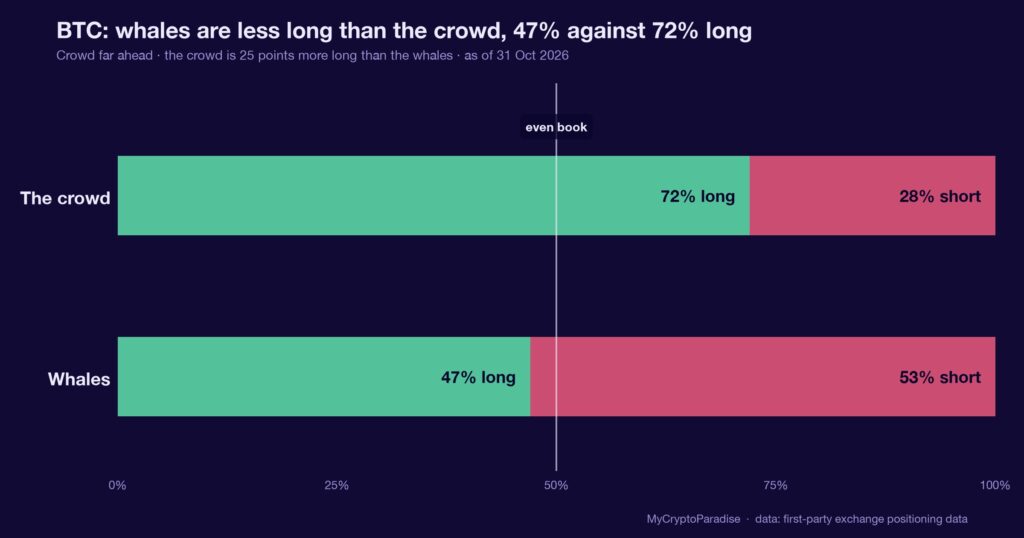
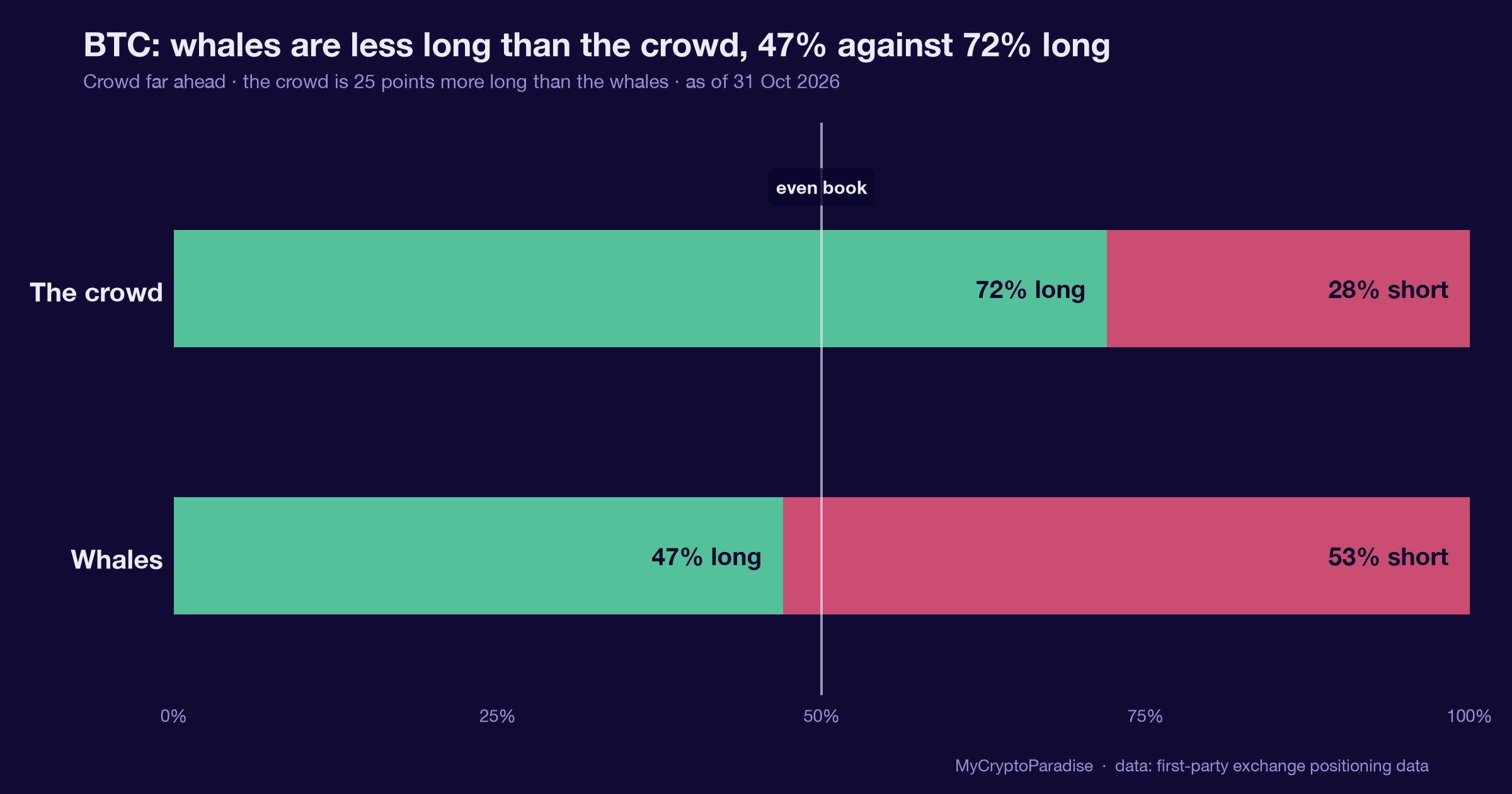
- Whale long share on BTC
- 47%
- Crowd long share on BTC
- 72%
- Crowd minus whales, long share
- +25 points
- Positioning read
- Crowd far ahead
- What would prove this read wrong
- A 24-hour whale net flow flipping clearly positive, or a US-led spot-premium session ending the seven-session offshore streak.
- Reading taken
- 31 October 2026
- Source
- Our MCP Insights tools, from our own MCP Insights first-party data
A claimed buy is not a measured flow
A whale-flow reading is a tally, not a story. It sums the large orders crossing the spot and perpetual futures markets over a set window and nets the buying against the selling, so the output is a direction and a size, never a motive.
A headline that says whales are buying the dip is a claim about intent. Our radar cannot see intent, and neither can the feed that posted it. Both of them see orders, and orders either net to buying or they net to selling.
So the test is simple, and it is the same one every time. When a feed asserts a direction, we hold that assertion against the measured net over the same hours. Either the claim and the tape agree, or one of the two is decoration.
A number bolted onto a narrative is still only a narrative until the order book agrees with it.
Our tape read net selling into the claim
Per our MCP Insights whale radar, the 24 hours into 31 October 2026 netted minus $24.46 million: $59.29 million bought against $83.76 million sold across 30 tracked orders. Our grid marks that lean balanced, not one-sided.
The largest single order was a $26.2 million sell on a perpetual futures market, timestamped 21:06 UTC on 30 October. That is not the dip-buy the feed described.
Our whale index sits at 48 on the sell side, the 29th percentile of its 30-day range. The four-hour read is weaker at 22 and the one-week read at 39, all three leaning the same way.
Positioning reinforces it. Our whale-versus-crowd gauge has the crowd 72 percent long against whales at 47, a 25-point gap it calls crowd far ahead, now a 10-day run with funding at 9.76 percent annualized and longs paying to hold.
Our Coinbase premium gauge adds the venue split: US spot has led the BTC price in just 3 of 17 sessions since 8 October, 0 of 5 this week, a minus 0.09 percent discount.
Four of our own gauges pointed one way while the headline pointed the other.
What is different here
The ParadiseTeam does not repeat a feed before measuring it. Where the Insider post read intent from a single large number, we netted every tracked order over the same window, checked positioning, funding and the venue split, and let the four gauges agree or disagree before we wrote a word.
Net selling is not a crash call
The easy misread simply runs the other way now: our tape shows net selling, so price must fall. It does not follow. A balanced-to-distribution net over a single day is a statement about who transacted, not a forecast of the next candle.
The honest reading is narrower than either extreme. The dip-buying story is not visible in our orders, and the crowd is already heavily long into it, which is precisely where crowded positioning carries its risk. That is a lean, and it is worth one line of risk, not a position.
This is one input. It sits alongside funding, the premium split and the positioning gap, and today all four lean the same cautious way: the dip-buy claim is the outlier, not our tape.
A read that only quotes the half that confirms the headline is marketing. The half that disagrees is what sizes your risk.
Where the resting size actually sits
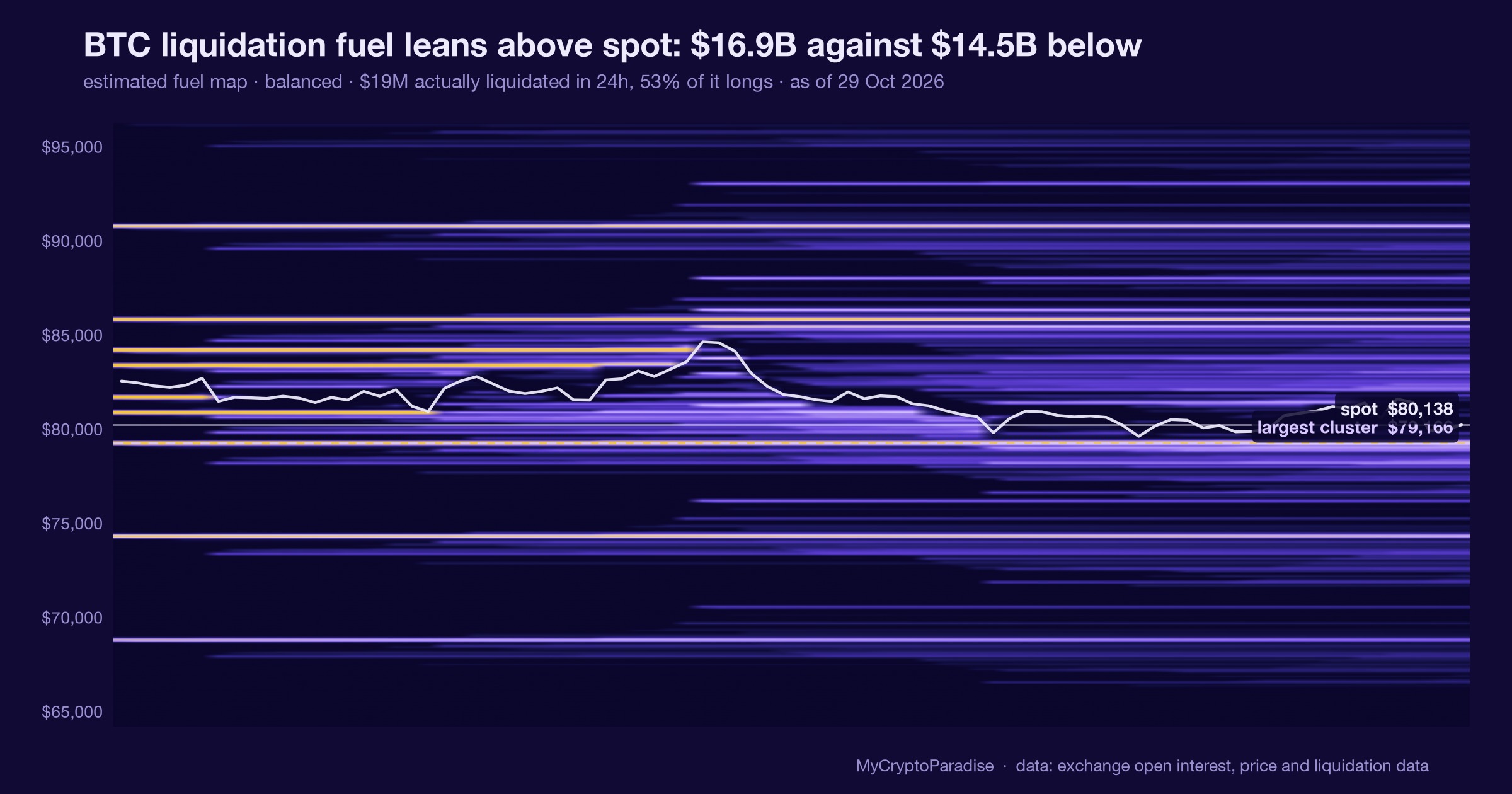
Grade it against the map, not the mood. Our liquidation and pain map puts the heaviest resting cluster overhead, roughly $145 million stacked at $87,100 to $87,700, well above a spot near $77,400.
The nearest downside pockets are lighter and lower: about $45 million at $66,200 to $66,800, and $22 million nearer $72,000. The fuel is not symmetric, and more of it sits above than just below.
The premium streak is the tell that has held. Seven straight sessions of offshore leadership, with US spot leading only 3 of 17, says the marginal bid this month has not been the US dip-buyer the feed invoked.
An imbalance is an observation about where the orders rest today, not a schedule for when they get tested.
Reading the whale tape yourself, step by step
- Start with the net, not the biggest order: sum buys against sells over a fixed 24-hour window and read the sign.
- Check the lean label: a balanced net and a one-sided net carry very different weight even at the same dollar figure.
- Pull positioning next: compare crowd long share to whale long share, and note how many days the gap has run.
- Add funding and the venue split: who is paying to hold, and is US spot leading or trailing the price.
- Only then weigh the headline: a claimed direction that no gauge confirms is a narrative, so size it as one.
The skipped step is the lean label. A minus $24 million net reads as heavy selling until you notice the grid calls it balanced, which halves what it should move.
Every number above is checkable against the live data. Start with the MCP Insights hub, then cross-read the Crypto Fear and Greed Index and the live crypto funding rates.
Act and invalidate
| Scenario | What confirms it | What kills it |
|---|---|---|
| Distribution holds | Whale index stays sell, net stays red | A green 24h net above balanced |
| Crowd long unwinds | Gap narrows from 25, funding cools | Crowd run extends past 10 days bid |
| Feed claim validated | US spot leads price, net flips buy | Offshore streak extends past seven |
Posture: Defensive while our tape nets red and the crowd sits 72 percent long into it. This is not a short invitation: it is a reason to carry less risk until a positive net or a US-led premium session says the dip-buyers actually showed up.
Frequently asked questions
Did whales really buy $202 million of BTC?
The on-chain feed said so, but our own whale radar did not corroborate it. Over the 24 hours into 31 October our tracked orders netted minus $24.46 million, with selling outweighing buying and the single largest order a $26.2 million sell.
What does a balanced lean mean here?
It means neither side dominated the flow. A minus $24.46 million net looks heavy, but our grid weighs the order mix and calls it balanced, so the distribution is real yet mild rather than a wholesale exit by the largest wallets.
Why does the crowd being long matter?
Our positioning gauge shows the crowd 72 percent long against whales at 47, a gap it has held for ten days while longs pay 9.76 percent annualized funding. Crowded one-sided positioning is where forced unwinds tend to start.
What would change this cautious read?
A 24-hour whale net that flips clearly positive, or a US spot session that leads the BTC price after seven straight offshore ones. Either would mean the dip-buying bid the feed described had finally reached our own tape.
Is this whale reading enough to trade on?
No single gauge is. This one sits beside funding, the premium split and positioning as one probability weight on a bias, not the bias itself. The deeper layered reads live in PRO Paradiser.
Crypto trading involves substantial risk and is not suitable for everyone. Nothing here is financial advice; it is education only. Never risk more than you can afford to lose.
The private Extras feed, where the whale net-flow tape, the positioning gap and the premium split update intraday with their invalidation levels, is part of PRO Paradiser, the intelligence layer behind the ParadiseFamilyVIP strategies.











Join the discussion
No comments yet. Members, share how you are reading this.