

Listen: the breakdown
Developing story: This story is still unfolding. We are tracking it and will update this article as more details are confirmed.
Market briefing: A frontend attack campaign using the StepDrainer toolkit just jumped from two confirmed sites to twelve-plus smaller DeFi front-ends overnight. BTC was trading near $77,206, down 1.3% on the day, with no move attributable to this story.
- A StepDrainer-linked frontend attack now touches 12-plus DeFi sites, up from two confirmed overnight
- Kintsu and Flap confirmed DNS hijacks; malicious scripts redirect wallet-connect flows toward theft pages
- Risk is isolated to those protocols' users; BTC and ETH show no attributable move
A wallet drainer campaign widened from two DeFi sites to more than twelve in a single night. The real question is simple: did you connect a wallet to any of them?
The frontend attack started small. A security firm flagged malicious scripts on two DeFi front-ends, Kintsu and Flap, where wallet-connect actions were being quietly redirected toward asset-transfer pages built to drain funds.
Both confirmed DNS hijacks. That detail matters, because a DNS hijack means the attacker controlled what visitors actually loaded, not just a stray injected line of code.
Then the list grew. A later alert named StonkBrokers alongside the first two, then ten more projects hit by the same StepDrainer-linked toolkit: StonkFun, Pickle Finance, Echelon, Origami, Fluxbeam, Stakepoint, SupSwap, Longbow, SHPRD and ApeX DeFi.
Twelve-plus sites, effectively overnight. The toolkit is the thread tying them together. StepDrainer is a packaged drainer kit, and a packaged kit is exactly how a two-site incident becomes a twelve-site campaign so fast.
The mechanism is mundane and effective. You visit a site you trust, your wallet prompts you to connect or approve, and the compromised front-end swaps the legitimate transaction for one that signs away your assets. The chain is still live and still growing, so treat the list as a floor, not a ceiling.
We have covered a loud week of security news, from the Binance hot-wallet breach to federal probes and proposed exchange rules. This one is quieter and more personal. It does not threaten an exchange's balance sheet. It threatens the approvals sitting in your own wallet right now, which is arguably worse if yours is on the list.
Trust, not liquidity, is the casualty here
This is a security-incident story, not a macro liquidity event. No funding shift, no ETF flow, no rate decision sits behind it. So the transmission path to prices is narrow by design.
The damage is reputational and custodial, concentrated on the affected protocols and their users. When a front-end can be hijacked at the DNS level, the attacker does not need to break the smart contract. They just hijack the door you walk through to reach it.
That distinction is the whole point. DeFi users have been trained to trust the contract and check the URL. A DNS hijack quietly defeats the second habit, because the URL looks right while the page underneath does not.
The broader backdrop is a 2026 pattern of phishing and front-end campaigns aimed at smaller-cap protocol websites rather than core infrastructure. Attackers go where defenses are thinnest, and a small DeFi project's hosting and DNS rarely carry an exchange's security budget.
There is a grim efficiency to it. One toolkit, a dozen weakly defended front-ends, and a steady supply of users who approve transactions without reading them.
For the wider market, the mechanism simply does not reach BTC or ETH liquidity. The dollar value at risk is spread across minor-cap user bases, not pooled where it could force selling. That is why trust, and not price, is what this story actually moves.
Isolated damage with no BTC spillover yet
Start with what did not happen. BTC was trading near $77,206, down 1.3% on the day, and ETH sat near $2,238, essentially flat. Neither move is attributable to this campaign.
That is the honest read. There is no evidence of coordinated selling, no exchange-flow spike, and no panic signature tied to these twelve sites. The liquidity cascade this story would need to touch BTC simply is not forming.
Walk the usual chain and it stalls at step one. A frontend attack drains individual wallets on small protocols. It does not pull liquidity from the deep BTC or ETH books, so the move never propagates up to majors, let alone down into alts.
The affected tokens themselves are the real exposure. Protocols on the named list carry direct reputational risk, and their users carry direct custodial risk. That is where any price reaction belongs, not on the majors.
Sentiment confirms the containment. Chatter on this specific event is thin to mixed, with no direct crowd reaction worth trading. A genuinely systemic exploit does not stay this quiet.
So the market impact is best measured in revoked approvals, not in red candles on BTC. The verdict leans mildly bearish on sentiment grounds, because a spreading drainer toolkit chips at the trust layer of DeFi. But the effect is narrow, slow, and confined to the trust each affected project has left to lose.
Revoke approvals before the list grows again
The single most useful action sits with you, not the charts. If you connected a wallet to Kintsu, Flap, StonkBrokers or any of the ten newly named protocols, assume compromise and revoke your token approvals now. That is the confirmation that matters at the personal level. Check approval histories, move funds from any wallet that touched these sites, and treat a clean revocation as the only real all-clear for your own exposure.
For the campaign itself, watch the count. The list jumped from two to twelve-plus overnight, so the active signal is whether more front-ends get named in the coming days. A growing list means the toolkit is still finding weak DNS and hosting setups.
Invalidation of the containment read would look specific. It would take a named exchange or a top-tier protocol front-end confirmed hijacked, with real volume at risk, before this becomes anything the majors need to price. Nothing in the current facts points there.
Confirmation of containment is the quieter outcome. The list stabilizes, affected projects restore clean DNS and front-ends, and BTC/ETH keep trading on their own macro drivers with this story absent from the tape.
For the broader market, keep your eyes where the liquidity actually is. This week's exchange-level security news carries the systemic weight. A drainer kit hitting small DeFi sites is a personal-security alert, not a market signal, and the two deserve very different responses.
Reading quiet BTC against a loud exploit
The ParadiseTeam separates this cleanly: a security alert for affected users, not a catalyst for BTC positioning. With price near $77,206, nothing in this campaign changes the structure we are already watching. That structure still rules the tape. BTC is being held at support by smart money absorbing supply, while the danger liquidation cluster sits just overhead at $79,000. A frontend attack on minor DeFi sites does not add a single coin of pressure to that fight.
So the levels stand on their own logic. Our standing bias is structurally bearish on the higher timeframes, with a 60% lean toward a rejection near $90,000 and a flush back into the $44,000 to $55,000 reaccumulation zone over time. Prior absorption at $71,000 and $61,000 frames where real bids have lived.
Smart money already sold the $79,000 bounce in profit and now waits lower. This story gives it no new reason to act, which is precisely the point.
Where it does sharpen our thinking is trust. A spreading drainer kit is a slow tax on DeFi confidence, and thinner confidence tends to keep speculative alt money cautious. That fits a market where retail stays on the sidelines and smart money sets the pace. So we read BTC's quiet through the same lens as before: propped at support, capped by resistance, and entirely indifferent to a drainer campaign happening twelve URLs away. Watch your approvals, not your BTC chart, for this one.
The read behind this: we framed this story through our own market analysis, Is Bitcoin Ready for a Bigger Rally?
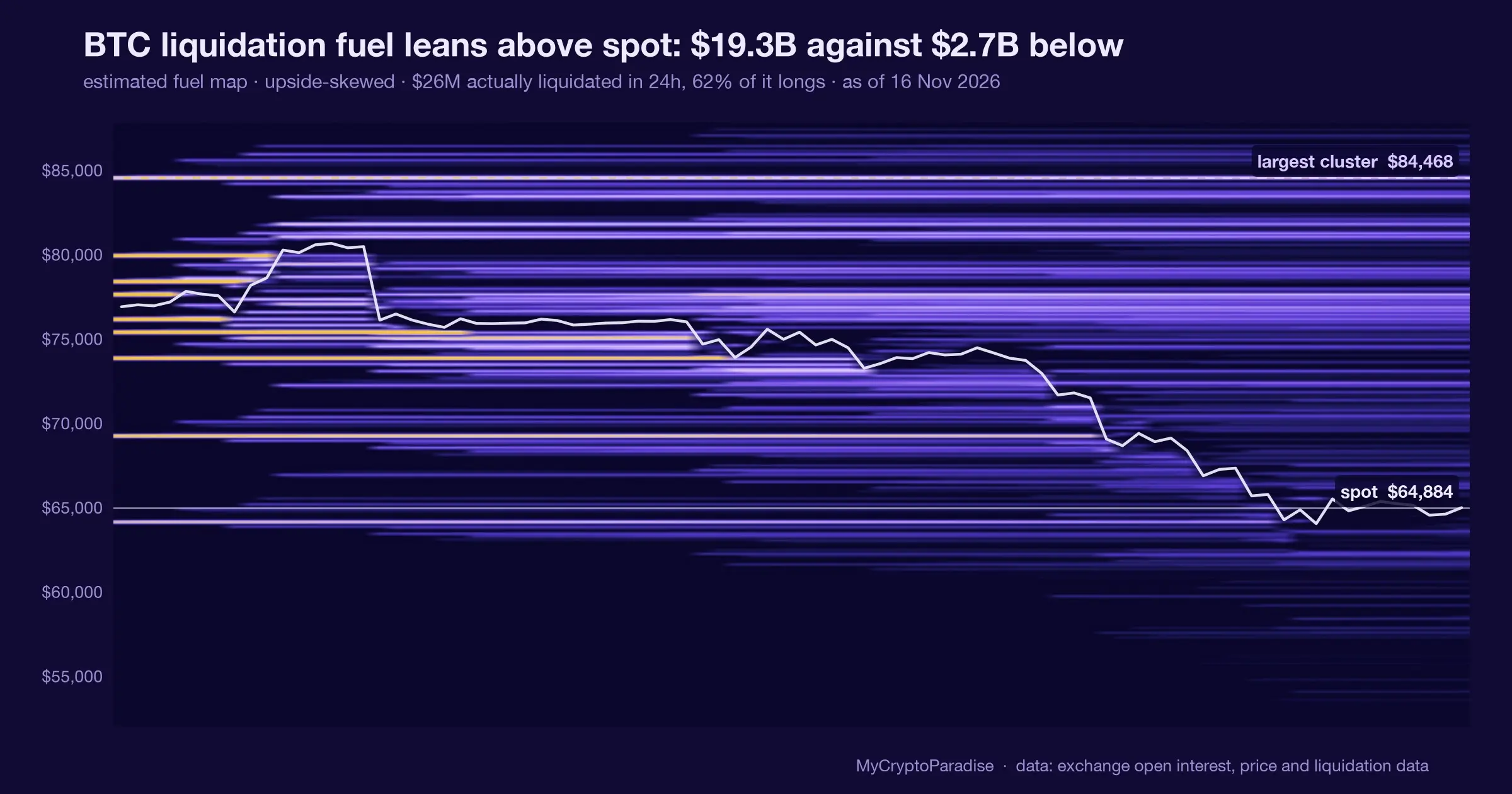
Track it live: our Crypto Fear and Greed Index and the crypto liquidation heatmap both update in real time, so you can watch this shift for yourself.
Related coverage
For exact entries, targets, and stop losses with full risk management, that is what ParadiseFamilyVIP is for. New to reading these moves? Start with our crypto trading strategies guide.
ParadiseTeam is monitoring the market situation closely, and we are taking these developments into consideration while building our trading tactics inside ParadiseFamilyVIP.
Crypto trading involves substantial risk. Prices are volatile and you can lose money. This article is educational and is not financial advice. Past performance does not guarantee future results.
Does this StepDrainer campaign keep spreading to more DeFi front-ends this week?
How 16 Paradisers are calling it
The first call is still open
Free account, no password. Members just sign in.









Join the discussion 27
Ok but the wallets are the whole story for me, I pulled the two original sites' approval history last night and the pattern looks like a template... did anyone else check which contracts got approved before the drain?
Honestly the frontend part is what gets me, a site that looks identical to the one you trust is basically a fake storefront!! I always check the URL bar twice before I sign anything 😅
twelve-plus is doing a lot of work here. Nobody lists the sites or says how they counted them. Two becoming twelve overnight with no domains published?! Show me the list first.
nah i disagree, 12 sites isnt the scary number for me, the farm i lost my stack in looked totally normal till it didnt !! the approve prompt is what i'd look at first 😅 🔥
honestly the part i dont buy is btc and eth not moving, if twelve sites got drained overnight the big coins should at least twitch. maybe thats just how the drainer keeps it quiet, who knows
Honestly the part that gets me is which wallets are actually getting hit, because a drainer spreading to twelve sites tells me nothing about who's on the other end 🤔 I'd start by checking how many of those frontends were ever on my corridor maps 😅
Yeah this is what i keep coming back to too... if the drainer is hitting the wallets people actually use, then maybe the first thing to check is which of those 12 frontends were ever on my corridor maps.... 🤔
Honestly this is why I stopped checking charts between tasks. Back when I was 19 I'd have sworn a site was legit just because it looked nice 🙃 Hope everyone is checking approval permissions this week.
ya the 19 year old version of you would've trusted a pretty site lol, ive been burned by a nice looking pub menu before 😅 the bit that gets me is how fast the copies spread tho, twelve sites in a night is wild to think about
lol the bit about btc and eth sitting still is what gets me too, i'd want to know what size the people who got hit were running..? a drainer doesnt care about your stop but the position you had open when it hit sure does
Counting sites feels like the wrong test to me. What would change my view is whether the wallet showed exactly what was being signed. If it did, this is a frontend problem and the chain itself is fine, and that is the part I'd want to pin down first.
Not convinced by the BTC and ETH part. A drainer hitting twelve frontends overnight should still push some flow through the majors, even just from liquidations on the affected users. Flat across both on a Sunday session is what I'd want to see timestamped before I accept it.
ok but what happens to the wallets that already signed something last night?? because that's the part nobody's saying, the site being fixed doesn't un-sign anything !! i keep my btc on a hardware wallet and even i'd be checking approvals first
Ah the StepDrainer thing again, the 12 sites overnight is what gets me, that's a lot of people who clicked the wrong link 😅 Still ran in my head like a quiet bar where nobody checks the tap, not the price. Keep an eye on the approvals side yeah 👀
I lost a wallet to a fake swap page in Cairo back in 2019, when my nephew sent me the link, and I still check the domain three times before I sign anything. Twelve sites in one night is the same trick repeated at scale, so the checking habit matters more than any chart.
ahmed fair on the domain habit 😅 but i think the approval step is what gets people. a clone can look perfect and still ask you to sign unlimited token access, so checking the url alone doesnt cover it!! 🙃
fair point on the approval step carlos, but thats exactly why i keep it to two checks. 1) the url, 2) the allowance amount. a clone can copy the page, not the spending limit i read before i sign. if an unlimited approval is asked for, i reject it, every time. the risk sits in the approval, and the checks catch it there.
so when two sites turn into twelve overnight i stop caring about the price, i want to know which wallets actually got signed. nobody in the article says how many people clicked approve on something they didnt read, and thats the number i'd want before anything else
yeah that's the bit that gets me too anna 😅 the approve button is basically a sign on the dotted line for most people, and nobody reads the contract at 2am lol. my money's on the signed approvals being the real story 👀
dont think the drain is the scary part to me, its that btc and eth didnt move at all. so the perp premiums stayed flat while twelve sites got hit, which makes me wonder if someone with size knew before it went public
hmm that size angle is interesting jonas but i wonder if its less about someone knowing early and more that the frontend people all just trust the same little script tag. the dull stuff is what gets you
What I watch here is how many new frontends get added per day rather than the headline total, since a jump from two to twelve usually means the list is still moving while the first two are being sorted out.
lukas the per day count is smart but i'd also want to know how many of the twelve had old token approvals still open on thier wallets?! those leftovers seem to matter more than the headline 🤔
Okay the screenshot of those twelve sites is what got me 😅 I checked my own bookmarks last night and two of them I don't even remember saving, so now I'm clearing the list one by one 🔍
Oh no, clearing bookmarks is a good shout!! I'd also check which of those sites ask you to connect a wallet at all, since I'm not sure a plain page view can do much harm 😅 sorry, probably obvious to you lot
ok but why would a drainer that hits twelve sites overnight leave btc and eth flat, thats the part that doesnt add up for me. if its just stolen approvals dumping, you'd expect some sell pressure somewhere, not nothing at all
so wait, if the drainer is coming in through the frontend and not the chain, why would btc and eth even be the thing to watch.... like which wallets are actually at risk here, the ones that signed something on those 12 sites?