


Listen: the breakdown
Market briefing: Visa told investors its stablecoin settlement run rate crossed $25 billion a year, up tenfold. BTC sat near $80,973, barely moving, as the infrastructure story kept building quietly.
- Visa stablecoin settlement run rate now exceeds $25 billion annualized, roughly 10x higher year-over-year
- CEO Ryan McInerney disclosed the figures on Visa's fiscal Q4 2026 earnings call, with no separate revenue breakout given
- Visa says it settles across 10 blockchains and multiple stablecoins in all five global regions
Visa stablecoin settlement just crossed $25 billion a year, up 10x. A payments giant is quietly building crypto rails while traders stare at candles. So what does it really change?
Visa just put a number on something the crypto market has argued about for years. On its fiscal Q4 2026 earnings call, CEO Ryan McInerney told investors that Visa's stablecoin settlement volume has passed $25 billion on an annualized run-rate basis. That figure is up roughly tenfold from a year ago.
The mechanics matter more than the headline. Visa says it can now settle stablecoin payments across 10 different blockchains and multiple stablecoins, operating in all five of its global regions. In plain terms, a legacy payments network has turned stablecoins into working plumbing, not a pilot project.
One detail keeps the excitement honest. Visa did not break out any specific revenue tied to this business. So we know the volume is growing fast, but the company is not yet telling Wall Street what it earns from it. That gap between a glossy growth number and a disclosed profit line is worth remembering.
Still, the direction is unmistakable. A $25 billion annualized run rate climbing 10x year-over-year is the kind of curve that compounds quietly in the background while the price screens flash red and green over nothing.
This is not a crypto-native catalyst. It is a corporate disclosure from a traditional finance incumbent, and that is precisely why it carries weight. The adoption thesis for stablecoins is no longer a forecast. It is now a line item inside one of the largest payment networks on earth, and it is scaling.
Why a payments giant settling in crypto counts
The transmission here is slow and structural, not fast and speculative. Visa is not buying crypto. It is quantifying stablecoins as a settlement layer inside the existing payments system, which is a very different kind of signal. When an incumbent of this size reports 10x growth, it tells the market that demand for on-chain dollar rails is real and compounding.
Stablecoins sit at the base of crypto liquidity. They are the dollars that fund spot bids, settle cross-exchange flow, and move value between chains without touching a bank wire. More stablecoin usage through trusted rails tends to deepen that base over time. It widens the on-ramp between traditional money and crypto markets.
That matters most for the issuers and the chains Visa settles through. Every extra billion in settlement volume strengthens the case that regulated institutions want this infrastructure, which pulls more capital toward the networks that host it.
Here is the honest limit. This is a quarterly earnings disclosure, not a surge in on-chain liquidity you can trade today. It reinforces a multi-quarter adoption narrative rather than injecting fresh buying into BTC or ETH this week.
So the macro read is a thickening pipe, not a flood. The more real-world value flows through stablecoin rails, the harder it becomes for policymakers to treat crypto settlement as a fringe experiment. That slow legitimisation is the real prize, and it accrues to patient capital long before it ever shows up on a candle.
How this reaches BTC, ETH and the alts
The immediate price impact is almost nothing, and that is the point. BTC was trading near $80,973 as of the latest read, up about 0.5% on the day, while Ethereum sat near $2,349. On the hour, BTC slipped 0.28% and ETH 0.20%. Neither move can be pinned to this headline.
That flat reaction is exactly what a structural adoption data point produces. There is no liquidation cascade and no sudden flow, because nobody is forced to act on a quarterly disclosure. The story works on cap tables, not candles, at least for now.
Follow the chain anyway. Deeper stablecoin rails feed the dollar liquidity that ultimately bids BTC first, because Bitcoin remains the reserve asset of the crypto system. When that base thickens, it typically supports BTC before it supports anything else.
Ethereum carries a cleaner link. A large share of stablecoin settlement runs through chains and smart contracts where ETH is the gas and the collateral. Sustained growth in settled volume strengthens the demand case under the networks that actually host these payments.
Alts come last and most selectively. The tokens tied directly to stablecoin issuance, payments and settlement infrastructure stand to benefit more than the broad speculative tail. This is not a rising tide for every coin. It is a targeted tailwind for the plumbing.
So treat the signal as a slow current beneath the market. It raises the floor of the adoption story without moving today's price, which is usually how the durable shifts begin.
What confirms this adoption curve, what breaks it
Watch the next disclosure, not the next candle. The cleanest confirmation would be Visa, or its peers, reporting the settlement run rate still climbing in coming quarters. A second 10x is unlikely, but continued double-digit growth would turn a single print into a trend.
The real tell will be revenue. Right now Visa shows volume without a disclosed profit line, so the number proves demand, not economics. If a future call finally attaches earnings to this business, the market gets to price it properly instead of guessing.
Invalidation looks different for a structural story. It would not be a price drop. It would be stagnation: a run rate that plateaus, or regulation that boxes in how regulated institutions can settle stablecoins. Either would stall the compounding that makes this interesting.
Keep one eye on policy. Stablecoin settlement at this scale sits squarely inside the regulatory conversation, and the rules around reserves and issuance will shape how far networks like this can push. Friendly clarity accelerates it. A crackdown freezes it.
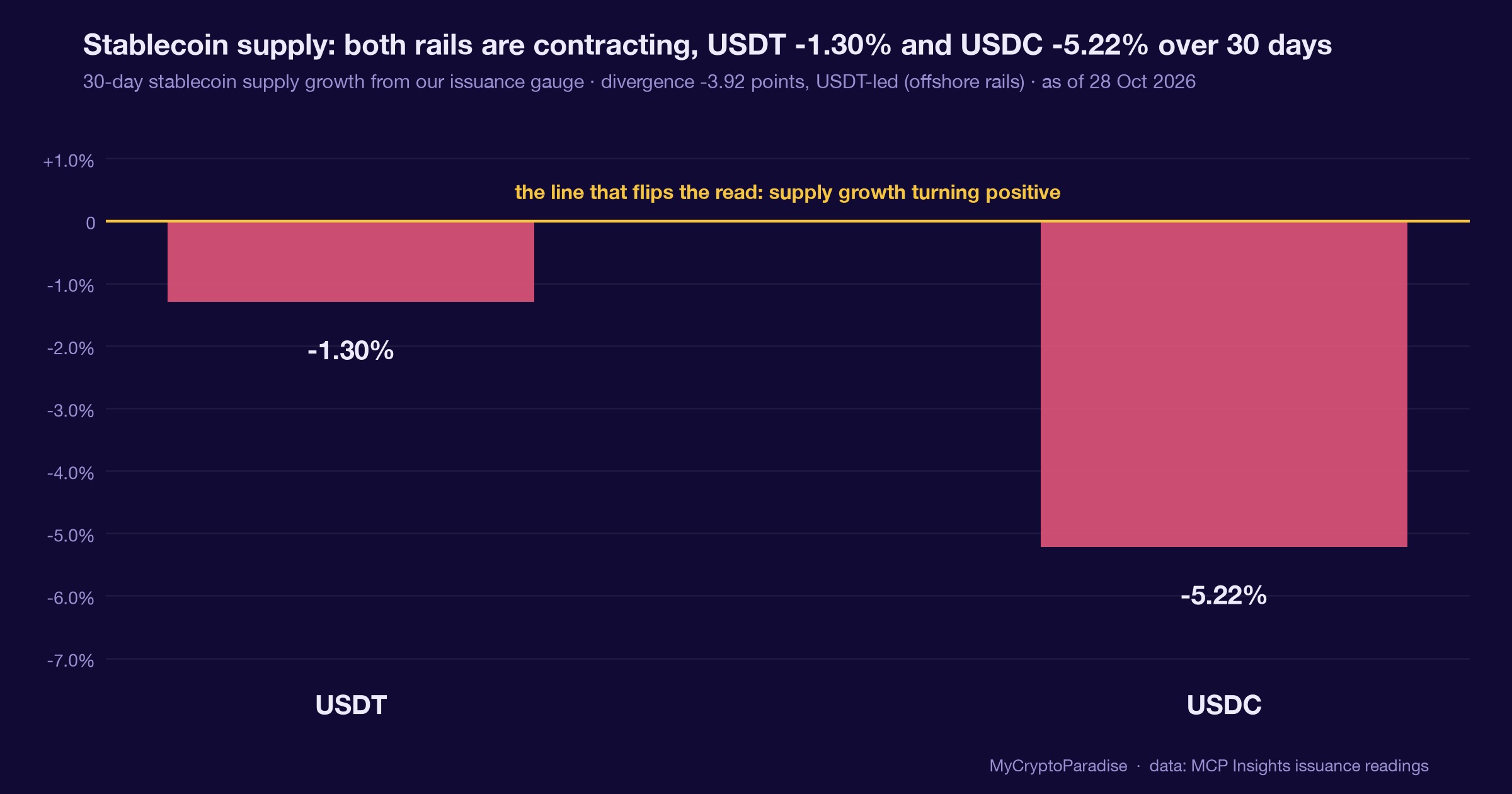
For the crypto tape itself, the thing to watch is whether on-chain stablecoin supply and exchange balances keep expanding alongside these corporate numbers. That is where the adoption story would show up in liquidity you can actually trade.
Until then, this stays a slow-burn data point. It tells you the direction of travel for crypto infrastructure. It does not tell you what BTC does by Friday, and pretending otherwise would be dishonest.
What settling dollars on-chain means for positioning
The ParadiseTeam reads this as a structural positive that changes the long-term map, not today's levels. A payments giant scaling stablecoin settlement 10x is exactly the kind of adoption that patient capital accumulates around, quietly, while retail waits for a candle to tell it what to think.
Apply that to where BTC sits now, near $80,973. This news does not move our key levels, but it sits comfortably inside the picture of smart money absorbing fear-driven selling at support. Structural flows like stablecoin rails are what deep-pocketed buyers lean on when they add into weakness, not what they chase at the top.
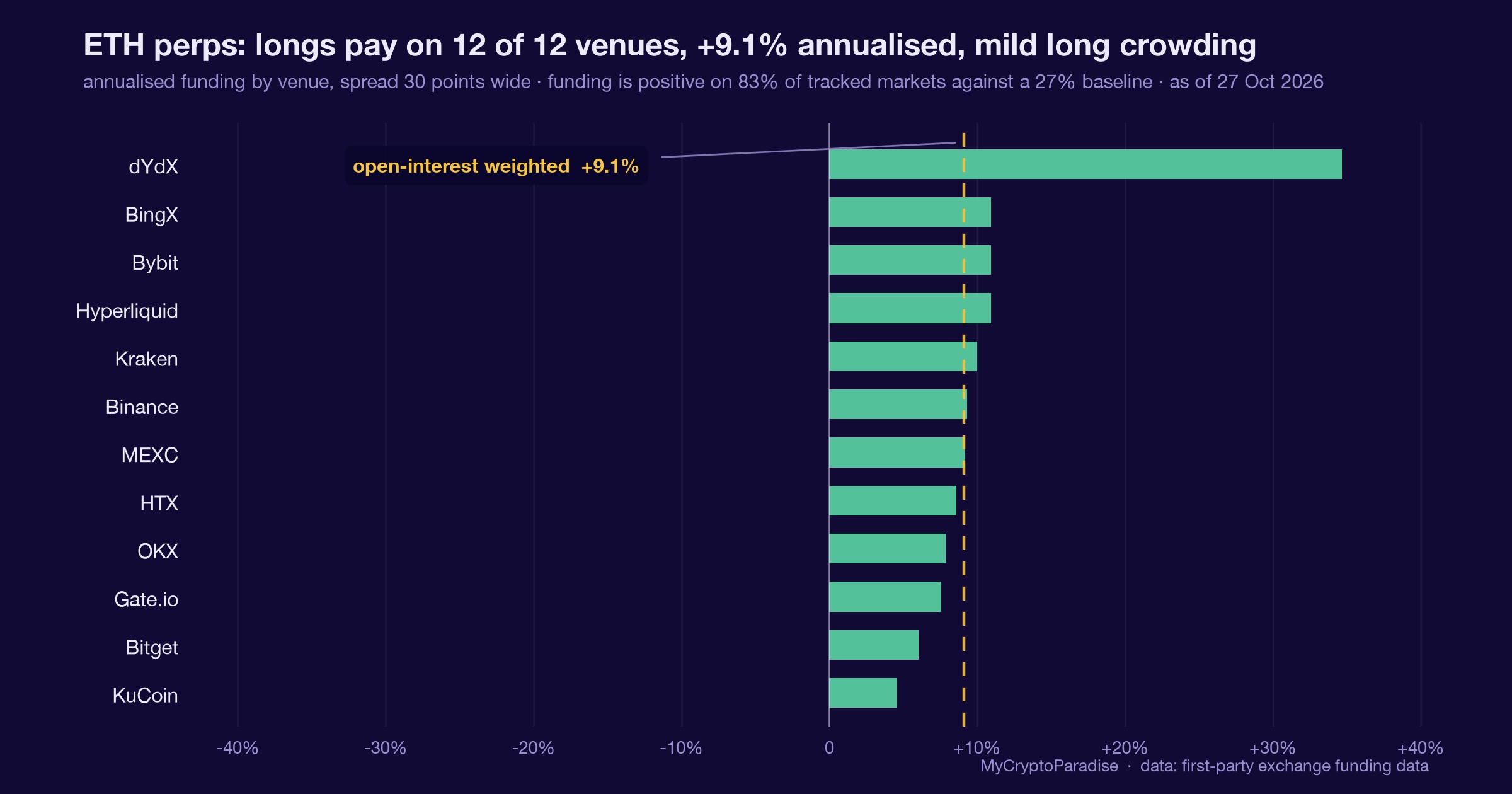
Our standing map still runs through $78,000 support and $82,500 resistance overhead. A clean hold of $78,000 keeps the door open toward a short-term push at $90,000, where almost $11 billion in short liquidations sits waiting to be run. But caution is the honest frame. The higher timeframes stay bearish, and strength into resistance can still meet sellers. An adoption disclosure does not rescue a bad structure, and longs look crowded, which leaves room for a squeeze if $78,000 cracks first.
So the ParadiseTeam treats Visa's number as a reason to respect the long-term crypto rails thesis, not as a trigger to force a trade here. It thickens the foundation under the market. It does not change where today's stops sit, and that distinction is what keeps you solvent through a bearish higher-timeframe trend.
The read behind this: we framed this story through our own market analysis, Can Bitcoin Recover to $90K From Here?
Track it live: our live crypto funding rates and the crypto liquidation heatmap both update in real time, so you can watch this shift for yourself.
Related coverage
For exact entries, targets, and stop losses with full risk management, that is what ParadiseFamilyVIP is for. New to reading these moves? Start with our crypto trading strategies guide.
ParadiseTeam is monitoring the market situation closely, and we are taking these developments into consideration while building our trading tactics inside ParadiseFamilyVIP.
Crypto trading involves substantial risk. Prices are volatile and you can lose money. This article is educational and is not financial advice. Past performance does not guarantee future results.
Does Visa's 10x stablecoin growth matter for crypto prices this quarter?
How 1 Paradiser is calling it
The first call is still open
Free account, no password. Members just sign in.
Follow this topic: Crypto regulation news · Stablecoin news











Join the discussion
No comments yet. Members, share how you are reading this.