


Listen: the breakdown
Update on this developing report (September 09, 2026, 10:23 UTC):
An update on the settlement story: based on our sources, the Open USD stablecoin effort is not a single-network play. It is now confirmed as a joint project fronted by Stripe, Visa, and Mastercard, which puts the two largest card networks and the largest private payments processor on the same token rail rather than competing tokens.
For traders this narrows the earlier read that Mastercard was taking a purely separate, vertical path. A shared token standard backed by all three names raises the odds that stablecoin settlement volume consolidates around one dominant rail, which matters for how payments equities are priced against onchain competition. It does not change the near-term tape: the muted crypto reaction suggests the market is still treating this as long-term structural validation, not an immediate catalyst.
What to watch now: Whether Open USD launches under all three names on a single standard and which chains and licenses it targets first.
Update on this developing report (September 09, 2026, 08:57 UTC):
A newer detail sharpens the story: based on our sources, Visa’s product solicitation now describes handling settlement for a shared stablecoin project, referred to as Open USD, that Stripe, Visa and Mastercard are fronting together. That is notable because it puts Mastercard alongside Visa on a common token rather than only competing on separate rails, and it brings a major payments processor into the same settlement layer.
Visa is also framing the broader push as a move from a payments network toward a credit network, roughly a year after its onchain lending research. For traders the read is unchanged in the near term: this is infrastructure positioning, not a fresh capital catalyst, and price action in BTC and ETH remains flat drift rather than accumulation.
What to watch now: Whether the Open USD settlement project moves from RFP language to a named launch and which chains it settles on.
Market briefing: Visa is pushing further into stablecoins and onchain credit, yet the crypto reaction stays muted. BTC traded near $79,211, up about 1% on the day, which reads as noise inside a broader distribution phase.
- Visa is expanding from a payments network toward an onchain credit network, with stablecoin card volume up 200%.
- Visa now runs more than 160 stablecoin-linked programs and is bringing a stablecoin built as open infrastructure to market.
- The Visa stablecoin push lands into a thin, distributing tape, so we read the small BTC and ETH bounce as noise, not a bullish turn.
Visa is wiring stablecoins and onchain credit into its core rails, and crypto barely moved. So is this Visa stablecoin news a bullish catalyst, or cover for distribution?
Visa is pushing deeper into the plumbing of digital money. The company plans to share more data with blockchain lenders, pairing its VisaNet settlement records with onchain credit infrastructure. In plain terms, the world's largest card network wants to sit inside crypto rails, not beside them.
The numbers behind the shift are real. Visa's stablecoin card payment volume has jumped 200% versus a year ago. It now runs more than 160 programs linked to stablecoins. Management describes a move from a payments network to a credit network, with onchain credit helping to back settlements.
There is more. Visa says it is bringing to market the first stablecoin designed as open infrastructure, part of an Open Standard effort. Its request for product discusses supporting a range of stablecoins and handling settlement for the Open USD project, fronted alongside Stripe and Mastercard. Leadership framed a payments world stretching into AI commerce, cloud banking, and agentic payments.
So the direction of travel is clear, and it is genuinely large. This is the kind of adoption story crypto spent years asking for.
Here is the honest part. Structurally, this changes the future of settlement more than it changes today's price. There is no single confirmed same-day catalyst tying this to a move. That framing is our interpretation, not a proven cause, and it matters for how you weigh the modest green candles on the screen.
Payments giant rewires where money settles
This matters because Visa is not chasing a trend. It is standardising it. When a network that touches most global card spending starts settling on stablecoins and lending onchain, the rails of money movement begin to shift under everyone's feet.
The transmission runs through credibility and infrastructure, not through a sudden demand shock. Stablecoins gain a settlement backbone. Onchain credit gains a data partner with decades of payment history. Over years, that lowers friction and pulls more real economic activity toward blockchains.
But the macro backdrop refuses to cooperate with the optimism. Our read is a bearish bias on higher timeframes, with new capital inflow minimal and retail participation near record lows. Adoption headlines land in a market that is tired, not hungry.
That gap between narrative and flow is the whole story. A glossy strategic announcement can be completely true and still move no price, because the marginal buyer is missing. Infrastructure gets built in bear phases; prices tend to reward it much later.
So we separate the fact from the effect. Fact: Visa is expanding into stablecoins and onchain credit, confirmed and sizeable. Effect: in the near term, this is unlikely to be the fuel that reverses a distribution phase. Treating a multi-year infrastructure play as an immediate bullish trigger is how traders talk themselves into the wrong side of a tired tape.
Stablecoin plumbing meets a thinning market
Price action tells the quieter truth. BTC was trading near $79,211, up about 1% on the day, with ETH near $2,511, up roughly 1.4%. Those are not the candles of a market discovering a new bullish catalyst.
The liquidity picture explains the muted reaction. New money is barely flowing in, and most retail participants who wanted exposure already have it. Without fresh demand, even a serious adoption headline struggles to lift the whole book.
BTC sets the tone first. A market with fading participation lets larger players offload into strength rather than chase it. That is why a genuine positive story can coincide with sellers, not buyers, doing the heavy lifting.
ETH follows the same logic and usually with more slack. Stablecoin and onchain credit narratives touch Ethereum's settlement layer directly, so any excitement should show up here. Instead it looks contained, which signals the bid is thin.
Alts sit at the far end of the chain and feel it hardest. In a low-liquidity, distributing environment, weaker tokens tend to bleed while attention concentrates on majors. A Visa headline does little for a small-cap when the crowd has stopped rotating.
The cleaner interpretation is unglamorous. A 1% bounce during a distribution phase is noise, not confirmation. Adoption is compounding in the background, but the tape is still doing the boring work of transferring coins from patient hands to nobody in particular.
Confirmation sits at the 77,700 retest
The levels decide whether this bounce means anything. The zone around $77,700 is the line we care about first, because losing it and failing to reclaim it keeps sellers in control.
Invalidation of the bearish read would look specific. BTC would need to reclaim the $77,700 support from below, then push back through and hold above the $79,000 area that was recently broken. A clean reclaim on rising volume, not a thin wick, would force us to respect a stronger bounce.
Confirmation of continuation looks different. A weak retest into resistance on fading volume, followed by five clear moves lower, would tell us the sellers never left. In that path, the $82,000 prior high stands as heavy resistance that a tired market is unlikely to break.
Downside targets stay on the table if support gives way. Below current levels, the $58,000 prior low is the reference we expect to be tested and potentially broken over the higher timeframe. That is structure, not a prediction of timing.
Watch participation as closely as price. If volume keeps making lower highs while price grinds up, that divergence favours distribution and warns the bounce is hollow. If volume genuinely expands on a reclaim, the odds shift.
The Visa story itself needs no daily babysitting. It is a multi-year build, so treat it as background context, not a level-moving trigger. Let the chart, not the press release, tell you who is winning.
Institutional headlines against a distribution tape
The ParadiseTeam reads this Visa news as structurally important and tactically minor. It fits our higher-timeframe bearish stance, where smart money has already distributed most of what it accumulated near $61,000 without needing much price to do it.
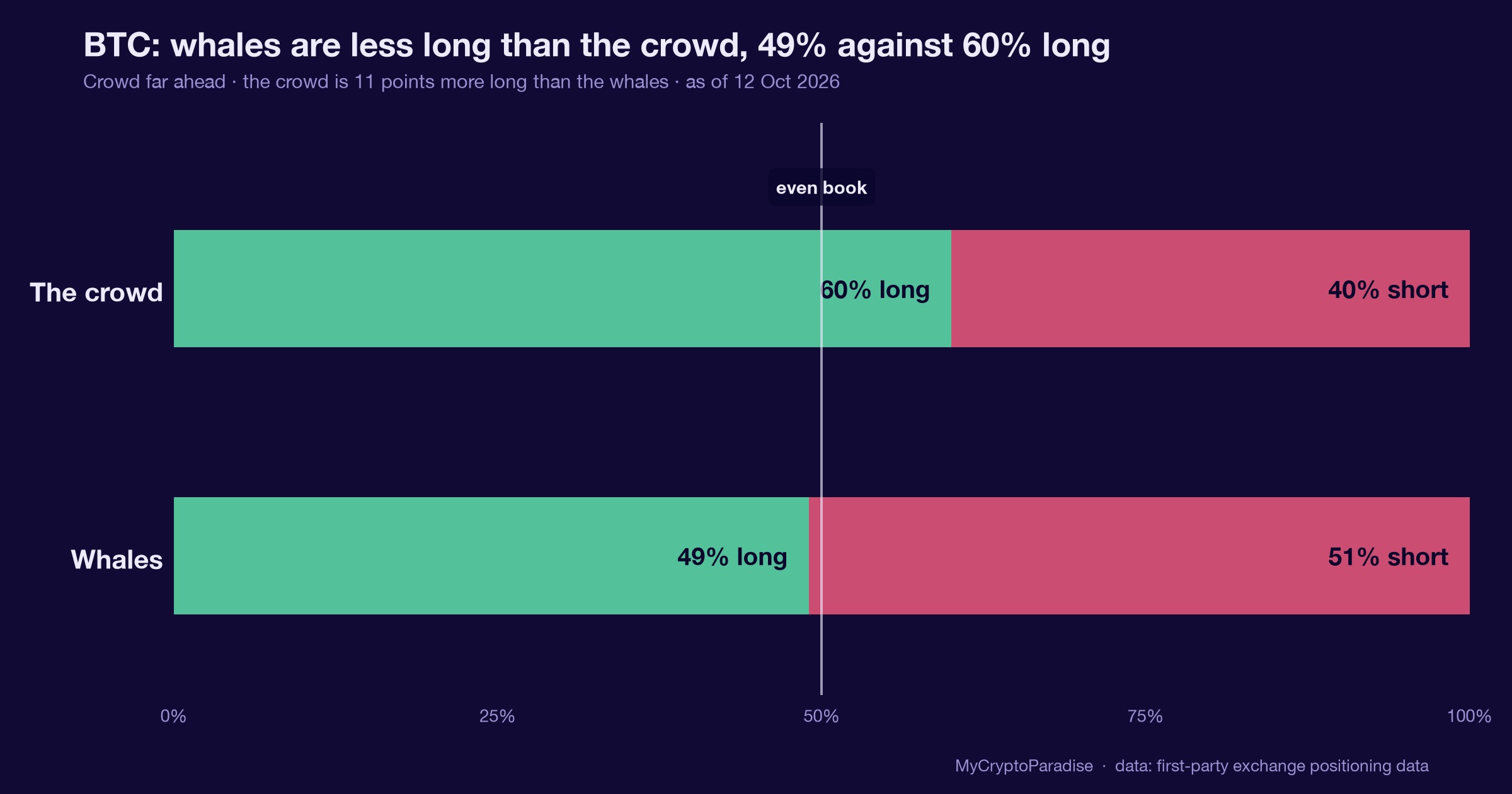
Here is the mechanism. Whales and spot CVD (cumulative volume delta) show quiet offloading, while retail interest sits near record lows. A positive institutional headline into that setup is exactly the kind of cover professionals like when handing coins to a thin crowd.
So we frame the current bounce with discipline. Near $79,211, the $77,700 and $77,000 supports are the pivot; the $82,000 high above is the wall. Our bias favours continuation lower toward the $58,000 region on the higher timeframe, with a possible final flush before any durable turn.
For those hunting the short side, we watch a specific pattern: a low-volume retest into resistance, then the first five-wave move down. That is where R:R (risk-to-reward) improves and where a tight SL (stop-loss) above the reclaim level keeps risk defined. Resting stops above $79,000 and $82,000 are the liquidity a bounce may reach for before rolling over.
On the bull side, respect invalidation. A firm reclaim of $77,700 with expanding volume changes the near-term picture and is not something to fade blindly.
Probabilities, not certainty. Size small, protect capital first, and do not let a Visa headline talk you into buying a market that is quietly being sold.
The read behind this: we framed this story through our own market analysis, Bitcoin Breaks $79K: Where Is Next Support?
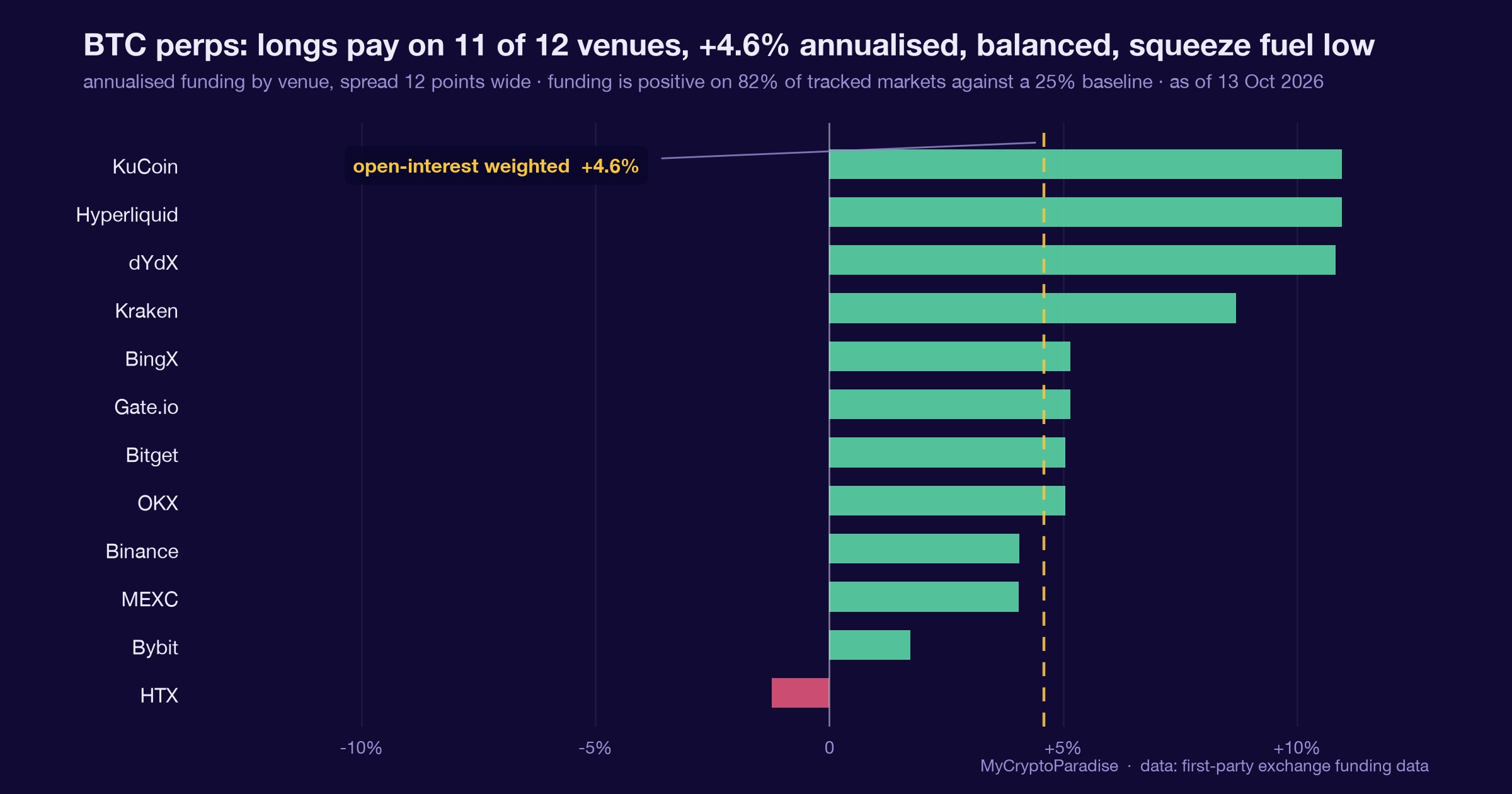
Track it live: our crypto liquidation heatmap and the live crypto funding rates both update in real time, so you can watch this shift for yourself.
Related coverage
For exact entries, targets, and stop losses with full risk management, that is what ParadiseFamilyVIP is for. New to reading these moves? Start with our crypto trading strategies guide.
ParadiseTeam is monitoring the market situation closely, and we are taking these developments into consideration while building our trading tactics inside ParadiseFamilyVIP.
Crypto trading involves substantial risk. Prices are volatile and you can lose money. This article is educational and is not financial advice. Past performance does not guarantee future results.
Does Visa's stablecoin push change BTC's near-term path from here?
This is how 16 Paradisers are calling it. Tap your call.
No calls on this one yet. Tap yours to be the first.
Free account, no password. Members just sign in.
Follow this topic: Stablecoin news










Join the discussion 1
Hmm, "muted move as distribution" feels like a stretch here, especially with the prices we've seen. Visa getting involved usually means increased utility, not necessarily selling pressure based on past patterns.