

Listen: the breakdown
Market briefing: The US is moving a third aircraft carrier toward the Middle East as strike threats against Iran grow. Bitcoin held near $84,806, up about 1.1% on the day, with crypto so far unmoved by the escalation.
- The USS Theodore Roosevelt strike group heads to CENTCOM as a third carrier, with arrival expected by late November.
- The deployment adds roughly 9,000 to 10,000 troops on top of more than 50,000 already in the region.
- BTC traded near $84,806 and ETH near $2,698 as crypto showed almost no immediate reaction.
A third US aircraft carrier is steaming toward the Middle East as strike threats on Iran build, yet crypto has barely twitched. Is this the calm before a risk-off storm?
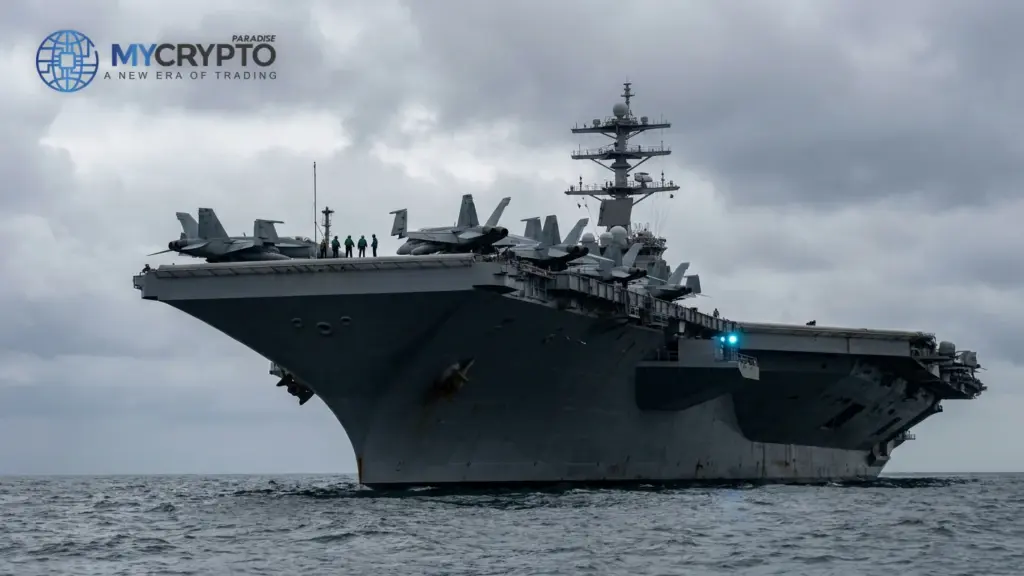
The United States is sending a third aircraft carrier toward the Middle East. The Theodore Roosevelt Carrier Strike Group is moving into Central Command's area of responsibility, with arrival expected by late November.
The deployment adds roughly 9,000 to 10,000 troops to a region that already hosts more than 50,000. It lands as the President has openly threatened to bomb Iran if no agreement is reached. That is a serious escalation, not a routine rotation.
This carrier does not arrive to an empty theater. The Abraham Lincoln has operated there since at least late summer, and its Marine F-35Cs recently struck Houthi positions in Yemen. Earlier in the year the George H. W. Bush was also sent in, with a British carrier placed on advanced readiness. Three carriers is a message, and markets usually read messages like this as rising conflict risk.
Here is the odd part. Crypto has barely moved. Bitcoin held near $84,806, up about 1.1% on the day, while Ethereum sat near $2,698. The one-hour changes were effectively flat.
So a clear geopolitical escalation met an almost silent response in digital assets. That silence is itself the story. Either the market does not yet see this as a direct catalyst, or it is waiting for oil, equities and gold to speak first. Big fleets move slowly, and so, it seems, does this particular risk premium. For now, crypto is watching the convoy from a distance.
How conflict risk tightens global liquidity
Military escalation changes the price of risk before it changes the price of anything else. When a third carrier moves toward a possible strike on Iran, investors start pricing a wider range of outcomes, and a wider range of outcomes means more caution.
That caution flows through a familiar chain. Geopolitical tension pushes capital toward perceived safety, often the dollar, short-dated government debt and gold. As money crowds into those, liquidity for riskier assets thins. Crypto sits firmly in the risk-asset bucket, whatever the long-term store-of-value argument says.
Energy is the direct link. The Middle East still anchors global oil supply, and a strike scenario raises the tail risk of a supply shock. Higher oil can feed back into inflation expectations, which complicates the easier-liquidity path that risk assets have been leaning on.
There is also the simple matter of attention and leverage. In a risk-off week, funds trim their most volatile positions first to protect the book. Crypto, traded around the clock and heavily leveraged, is an easy early lever to pull.
None of this guarantees a selloff. Markets price conflict premiums unevenly, and many escalations fade without a shot fired. But the structural bias from this specific event points one way: more uncertainty, tighter risk budgets, and a higher bar for new money to chase crypto higher while the fleet is still at sea.
Why BTC leads if risk-off finally bites
If this escalation does start to bite, the sequence usually runs through Bitcoin first. BTC is the deepest, most liquid crypto market, so global de-risking tends to hit it before anything else. A move lower there sets the tone for the rest.
For now, the tape is quiet. Bitcoin near $84,806 with a flat hourly change tells us no forced selling has arrived from this headline. That can change quickly if oil gaps up or equities roll over, because crypto often imports risk-off from traditional markets rather than generating it alone.
Ethereum is the second domino. Near $2,698, ETH has lagged on the day, and it typically amplifies BTC's direction in a stress move. When liquidity thins, the ETH to BTC ratio often weakens, so a risk-off leg would likely pressure ETH harder.
Alts are the third and most exposed layer. They trade on borrowed liquidity and sentiment, both of which evaporate first in a scare. A geopolitical shock rarely spares the long tail; it usually hits it twice.
The honest caveat is that no single same-day catalyst has forced crypto to react yet. This is our read of how the cascade would travel, not a confirmed move on the chart. The escalation is real and bearish in bias, but the market has not voted. Until it does, treat the current calm as unpriced risk, not proof of resilience.
The signals that turn silence into selling
The first thing to watch is not a crypto chart at all. It is oil, equity index futures and gold, because crypto will likely follow their lead on this story. A sharp oil spike paired with falling stocks would be the clearest sign the risk premium is finally repricing.
Headlines matter on timing. The carrier is expected on station by late November, and any concrete move toward a strike, or toward a deal, could flip sentiment fast in either direction. A genuine de-escalation would remove the overhang and invalidate the bearish case outright.
On Bitcoin itself, the confirmation of weakness is a clean break and hold below the levels traders are defending, on rising volume and with derivatives flushing out. Watch open interest, OI, the total value of outstanding futures contracts. A drop in price with falling OI points to deleveraging, which is the risk-off footprint.
The invalidation is just as important. If Bitcoin keeps absorbing this news and holds its recent range while oil stays calm, the market is telling you it does not see a direct crypto catalyst here. Flat is a verdict too.
Finally, watch correlation. If crypto suddenly starts tracking equities tick for tick, this has become a macro event. If it keeps trading on its own internal flows, the carrier story stays background noise for digital assets, however loud it is elsewhere.
Reading the escalation against BTC support
The ParadiseTeam sees this as a risk overlay on a market that is already stretched near resistance, not a fresh signal of its own. Bitcoin near $84,806 is still working to turn $82,000, the prior daily high, into firm support. Geopolitical stress raises the cost of failing that test.
Above, the $88,000 to $90,000 band remains the heavy weekly ceiling, where we carry a roughly 60% rejection probability. A conflict premium gives any push into that zone a second reason to stall. Strength into resistance during a risk-off week is exactly where distribution tends to hide.
The counterweight is real. Aggressive whale accumulation, roughly $380M in a day, shows large hands still buying this range, and bulls hold the medium-timeframe structure. That is why we are not flipping to outright bearish on price; we are flagging asymmetry.
The caution sign is momentum. A bearish divergence is forming on the daily MACD and RSI, and volume faded on the recent breakout. Add an external risk shock and the odds of a rejection near $90,000 before a deeper move rise, which fits our standing weekly lens.
So the ParadiseTeam watches whether $82,000 holds as support if headlines sour. Lose it with conviction, and smart money may let retail chase the knife lower before stepping back in. Hold it while oil stays calm, and the carrier simply remains someone else's problem.
The read behind this: we framed this story through our own market analysis, Can Bitcoin Reach $90K After Whale Buying?
Track it live: our Crypto Fear and Greed Index and the live crypto funding rates both update in real time, so you can watch this shift for yourself.
Related coverage
For exact entries, targets, and stop losses with full risk management, that is what ParadiseFamilyVIP is for. New to reading these moves? Start with our crypto trading strategies guide.
ParadiseTeam is monitoring the market situation closely, and we are taking these developments into consideration while building our trading tactics inside ParadiseFamilyVIP.
Crypto trading involves substantial risk. Prices are volatile and you can lose money. This article is educational and is not financial advice. Past performance does not guarantee future results.
Does this Middle East escalation finally move crypto in the next two weeks?
This is how 11 Paradisers are calling it. Tap your call.
No calls on this one yet. Tap yours to be the first.
Free account, no password. Members just sign in.





Join the discussion 23
My 15m chart barely flickered with this news 🤷♀️. So when these big geopolitic things drop, what exactly are we looking for to see real impact on us? 🤔📉
Aisha, that's what's interesting, isn't it? The spot price might not jump instantly, but the *implied* volatility in the options market often picks up the scent of fear first. That's usually where I look. 🧐
Implied vol 🤔 for options traders, sure. But for me on the 15m spot, the real impact is a proper setup or a clean break of structure. Not options. 🤷🏾♀️ What moves the market for us? 👇🏽📈
even with the news, my debits and credits for this week were already locked in. no need to reconcile new entries when the risk-reward is off. 🤷🏾♂️
i wonder if the big moves are already priced in before the news even hits the wire, maybe thats why no flickers aisha.
It's funny, these big global news drops sometimes make my heart rate go up 📈 but the charts just yawn 😴. Still, I always check the gas prices here in SP right after! ⛽️
Honestly, I don't get the fuss about geopolitical "risk" either if the weekly candle barely moves. Four-hour noise is not a signal, people! 🤦♀️
Watching the DXY and sovereign debt spreads more than anything here. Liquidity seems to be the bigger driver... not the headlines.
Nadia, I track these events differently. My journal shows the biggest moves often come from the liquidity shifts, not the initial headlines themselves... That’s what I've seen play out.
Often" implies a lag. I'm looking at the immediate, systemic impact of dollar liquidity tightening globally, not just headline reactions. You see shifts, I see foundational pressure... what kind of journal is this anyway?
It's confusing to see how global events like this... don't always reflect in crypto... I thought it would have more of an impact.
samuel, it is a bit confusing… but it's like a ship engine, you know? you expect a big swell to rock everything, but sometimes the stabilizers just keep you steady.
Samuel, I understand your expectation that global events would have a clearer impact. However, I tend to view crypto more like a technology-driven index, less directly tied to daily geopolitical shifts.
always a factor i check, particularly the delta on crude futures versus permian basin spreads. seems perp premiums are not reacting to traditional risk-off, which is curious.
yeah its weird how that plays out jonas. i see gold not moving either its like a whole different market at times
Curious indeed. My main thought is always how quickly these "non-reactions" can turn around and bite you. Always gotta wonder about the downside risk building up under the surface, right? 🤔
i remember a time when stablecoin on-ramps to exchanges always saw a lift on geopolitical news. now its the opposite.
it feels like global events used to be simpler filters for usdc or tether moves, now its just noise for a lot of it
I still remember loading up on puts after that Suez canal thing 🚢 thinking it was a sure bet, then nothing 🤷. Hard to unlearn that gut reaction 🤔.
One wonders if the market has already priced in regional instability, given how long these tensions have simmered. How much further downside could this meaningfully introduce for BTC?
the geopolitical risk factor for bitcoin often seems discounted, even with significant force projection. its a difficult load to calculate.
It’s really interesting to see the markets absorb these big headlines without much... *ping*... on the charts. I usually check the news first thing to understand the mood for the day. 😅
The market's job is to price the future.. so if the news is out, it's often already absorbed. Liquidity just finds the new equilibrium.