

Listen: the breakdown
Developing story: This story is still unfolding. We are tracking it and will update this article as more details are confirmed.
Market briefing: US and Iranian forces are trading fire in the Strait of Hormuz, with strikes on Qeshm Island and tanker fires reported. Yet BTC sat near $75,587, down a fraction, as crypto so far shrugs off the war headline.
- US forces struck an Iranian air-defense system on Qeshm Island in the Strait of Hormuz, confirmed by the US President
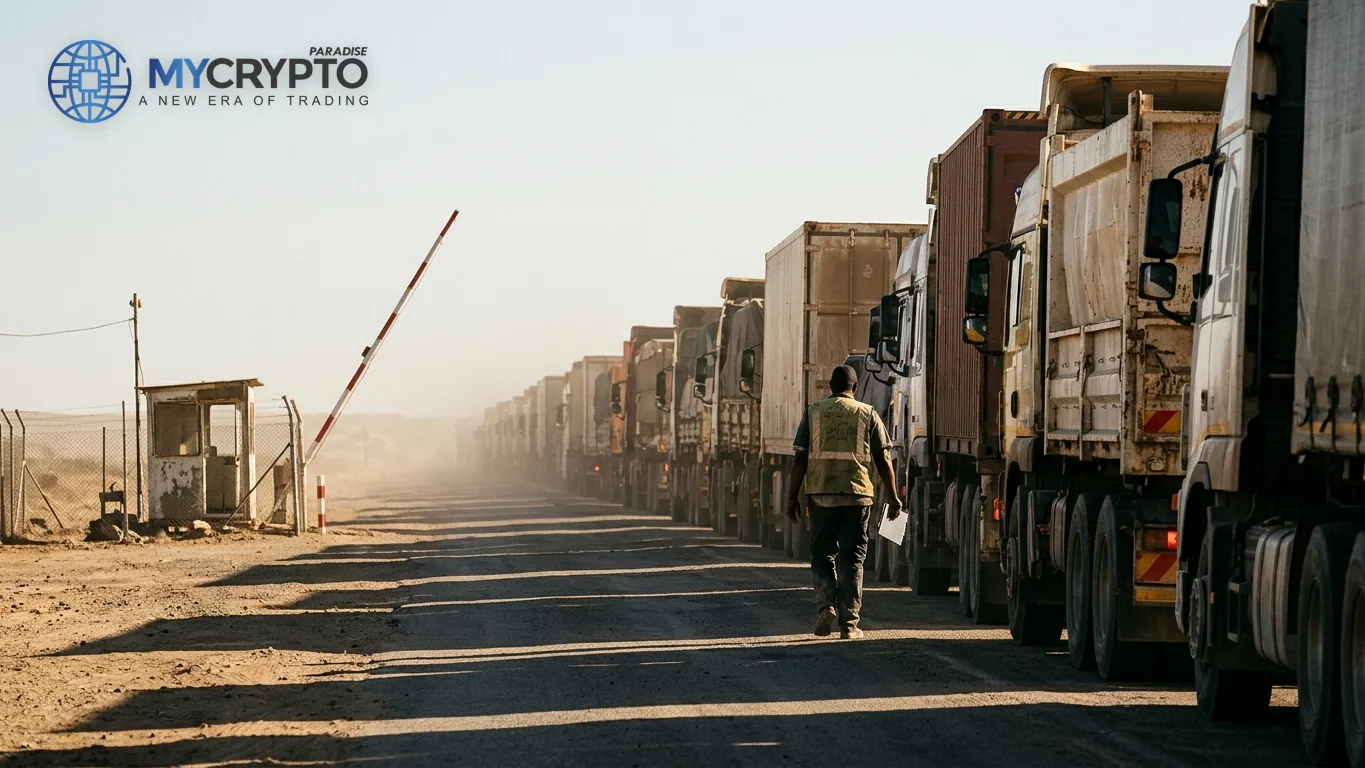
- A new US unit, Task Force Iron Gate, extends the blockade from the sea onto overland trade routes
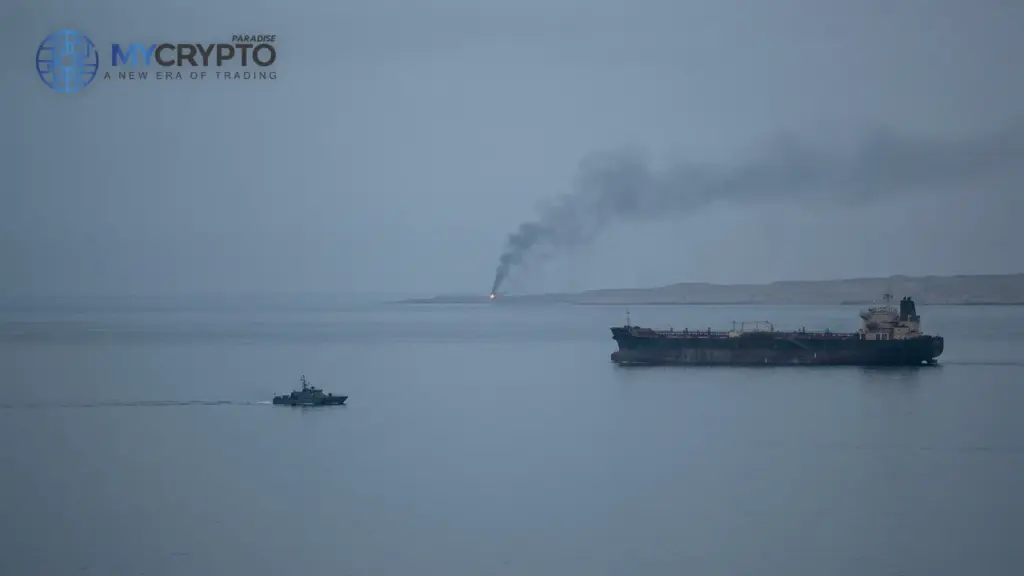
- Five oil tankers and a tugboat reportedly caught fire in the strait, yet BTC and ETH barely moved
Missiles are flying around the Strait of Hormuz, the planet's busiest oil artery, and crypto barely twitched. So what would it actually take to make Bitcoin care about this war?
The confrontation between the United States and Iran crossed a new line this week. US forces struck an Iranian air-defense system on Qeshm Island, inside the Strait of Hormuz. The US President confirmed the strike directly.
We covered the blockade moving onto land and the Caspian earlier. This round is different. Both sides are now trading fire, and the shooting sits directly on top of the world's single most important oil chokepoint.
US Central Command stood up a new unit, Task Force Iron Gate, to push the blockade's disruption from the sea onto overland trade routes. Iranian state media reported explosions on Qeshm and Hengam islands, and in the mainland city of Bandar Abbas. Tehran also claims its forces captured a US drone near Qeshm and downed a US A-10 with a surface-to-air missile. The US side has not verified either claim, and we are careful to flag them as claims, not facts.
Then came the part markets usually panic about. Iranian media reported five oil tankers and a tugboat on fire in the strait. Oil, which had slumped after the midterms, ticked back up.
And crypto? Bitcoin traded near $75,587 as of the latest read, down a rounding error on the day. ETH sat near $2,224, also barely changed. For a shooting war this close to global energy supply, the tape is almost suspiciously quiet.
Oil's most important chokepoint under fire
The Strait of Hormuz matters because a huge share of the world's seaborne oil passes through it. Choke that corridor and the price of energy moves, fast. That is the transmission line running from this driver into every risk market, crypto included.
The mechanism is simple. Tanker fires and a widening blockade raise the risk of supply disruption. Supply fear lifts oil. Higher oil feeds inflation expectations, and that complicates any path toward easier policy.
Tighter financial conditions are the real enemy of risk assets. When liquidity gets scarce and safe yields look attractive, capital rotates out of the far end of the risk curve. Crypto sits at that far end, so it usually feels these shocks late but hard.
Here is the honest part. Right now the chain is intact in theory but invisible in the data. Oil rebounded only slightly. BTC and ETH are both under a third of a percent on the day. That is not distinguishable from normal background drift.
So the macro case is a conditional, not a confirmed cause. If the escalation widens, the pass-through to liquidity becomes real. If it stalls, this becomes one more headline the market files away. We are naming the risk pathway, not pretending it has already fired.
Crypto barely flinched at war headlines
The most telling fact in this story is the one that did not happen. Bombs fell near the busiest oil lane on earth, and crypto did not break stride. BTC held near $75,587, ETH near $2,224.
In a genuine risk-off cascade, the order is predictable. BTC leads lower as the largest, most liquid book. ETH follows with a slightly heavier beta. Then alts, thin and fragile, take the worst of the drawdown as liquidity drains from the edges inward.
None of that is visible yet. The near-flat tape tells us the market has either priced this ongoing conflict already or is treating today's strikes as noise rather than a fresh catalyst.
That calm is not comfort. It is coiled risk. A market that ignores an oil-supply shock is a market with no cushion priced in if the shock turns real. The repricing, when it comes, tends to arrive all at once rather than politely.
Our directional read on the facts is bearish. The first-order effect of military escalation at a critical chokepoint is higher supply risk and tighter appetite, and that leans against risk assets over the coming days to weeks. But we hold that read lightly. The evidence of actual selling is simply not in the tape today. The bearish case is a risk to respect, not a move to chase.
The spark that turns risk-off real
One variable decides whether this becomes a crypto story at all: oil that keeps rising. A slight rebound is a shrug. A sustained, accelerating spike is a repricing.
Watch the strait itself. Any sign that traffic is actually halting, that insurers are pulling cover, or that the chokepoint is closing in practice rather than in headlines, would turn a geopolitical risk into a liquidity event. That is the confirmation path for the bearish case.
Watch the dollar and short-dated yields too. If capital runs to safety, crypto usually feels the undertow within a day or two, not instantly. A firmer dollar alongside climbing oil is the combination that drags risk assets down together.
The invalidation is just as clear. If oil fades back toward where it started and BTC stays pinned near $75,587, the market has voted. It judged this round of the conflict as contained, and the war premium never arrives.
Be honest about the unverified pieces. The captured-drone and downed-A-10 claims come from one side and remain unconfirmed. Treat a confirmed widening of direct US-Iran engagement very differently from state-media claims that cannot yet be checked.
For now, the signal lives in oil and in liquidity, not in the crypto chart. The chart is still waiting to be told whether this matters.
Flat price, accumulating whales at support
The ParadiseTeam reads this as a risk overhang sitting on an already delicate structure. BTC near $75,587 hovers right at the $76,000 level that defines so much of the current map. That is the line we care about before any war premium even enters the picture.
A reclaim of $76,000 that holds keeps the door open to a short-covering squeeze toward the $81,700 to $82,500 cluster, where roughly 2.2B in short liquidations sit waiting. The path of least resistance still leans that way in the near term. A clean loss of $76,000 instead exposes the $70,000 to $71,000 liquidation pocket below.
Whales have been net buyers into this dip, absorbing sell pressure while the Fear and Greed gauge sits near 20. That is retail fear being quietly used as accumulation fuel, not a trend change. So here is how a bearish oil shock would interact with that backdrop. If energy prices spike and liquidity tightens, over-leveraged shorts could still get hunted first on a squeeze, before any sustained downside toward the dominant $44,000 thesis reasserts.
Our standing medium-term bias remains cautious and lower. A geopolitical scare does not flip that. But it does not override the short-term tug-of-war either. Treat any war-driven dip into $70K to $71K as a zone whales may defend, and treat any relief bounce into $82K as potential exit liquidity, not a breakout.
The read behind this: we framed this story through our own market analysis, Bitcoin Squeeze to $82K or Crash to $44K?
Track it live: our Crypto Fear and Greed Index and the live crypto funding rates both update in real time, so you can watch this shift for yourself.
Related coverage
For exact entries, targets, and stop losses with full risk management, that is what ParadiseFamilyVIP is for. New to reading these moves? Start with our crypto trading strategies guide.
ParadiseTeam is monitoring the market situation closely, and we are taking these developments into consideration while building our trading tactics inside ParadiseFamilyVIP.
Crypto trading involves substantial risk. Prices are volatile and you can lose money. This article is educational and is not financial advice. Past performance does not guarantee future results.
Does this Hormuz escalation finally move crypto, or stay a headline?
How 1 Paradiser is calling it
The first call is still open
Free account, no password. Members just sign in.





Join the discussion
No comments yet. Members, share how you are reading this.