

In short
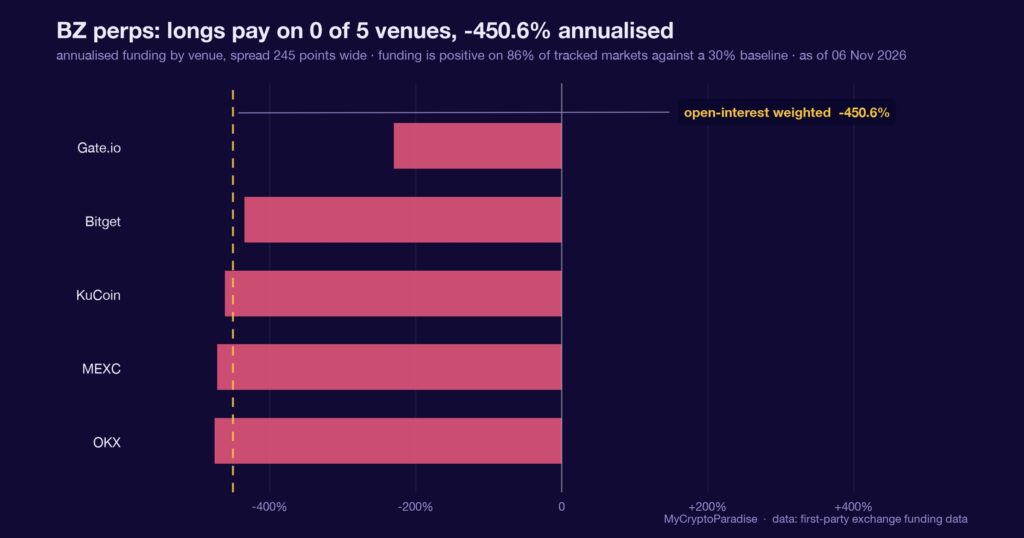
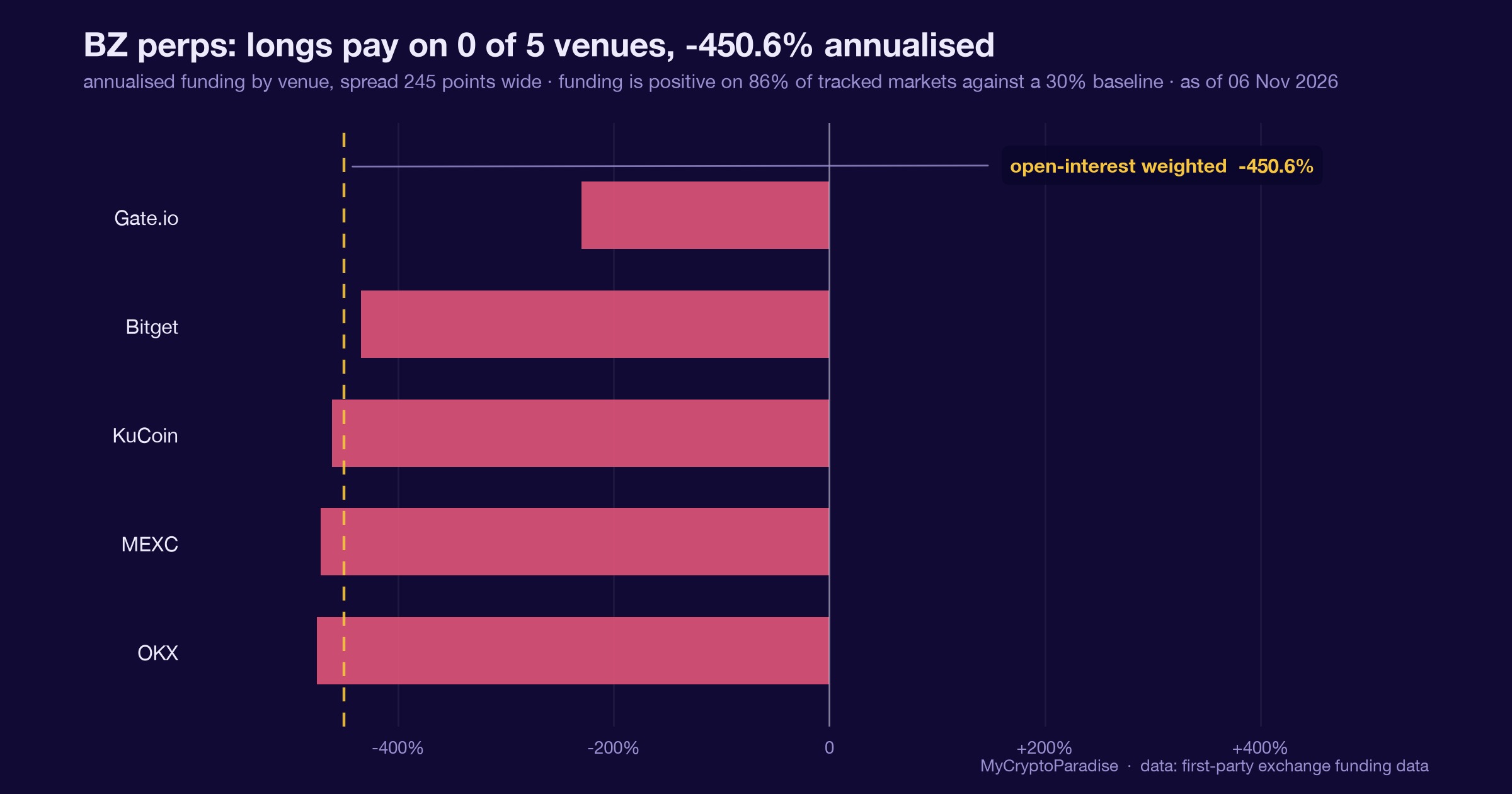
Funding is the fee traders pay to hold a leveraged position, and when it runs deeply negative it is the shorts who pay, hour after hour, to stay short. On 6 November 2026 our MCP Insights funding-extremes reading put BZ at minus 450.6 percent annualized (APR), the single most short-paid rate across 2,266 tracked markets; the raw feed logged minus 438 percent, and where the two differ our recon series wins. We called it squeeze fuel, not a squeeze: a short side paying that much is a loaded setup, explicitly not a forecast that it fires. We have watched a comparable extreme before, and it drained rather than detonated, which is the honest base case here. Base rates are not wired for this event, so we quote no historical frequency. This piece shows you how to read funding extremes yourself, and where the fuel actually sits.
A short side that pays is loaded fuel
Perpetual funding is the periodic fee that keeps a futures price tethered to spot. When more leverage leans one way, that side pays the other to hold its position. Positive funding means longs pay; deeply negative funding means shorts are paying, and paying heavily, simply to stay short.
A short that pays a large fee every few hours is renting conviction at a steep price. If spot ticks up, those shorts face the fee and the loss at once, and the cheapest exit is to buy back, which lifts price into the next short.
None of this requires knowing the fundamentals of the coin. Funding is pure positioning: it measures the price of conviction, not its merit. A market can be wrong and still make the other side pay to disagree with it.
That feedback loop is why a crowded, well-paid short side is described as fuel rather than a verdict. Fuel is potential energy. It tells you what could move, not that it will.
The tape leans long, but BZ pays shorts
On 6 November 2026 our MCP Insights funding-extremes series put BZ at minus 450.6 percent annualized (APR), the single most short-paid rate on a tape of 2,266 markets. The source feed logged minus 438 percent; where the two differ, our recon reading wins.
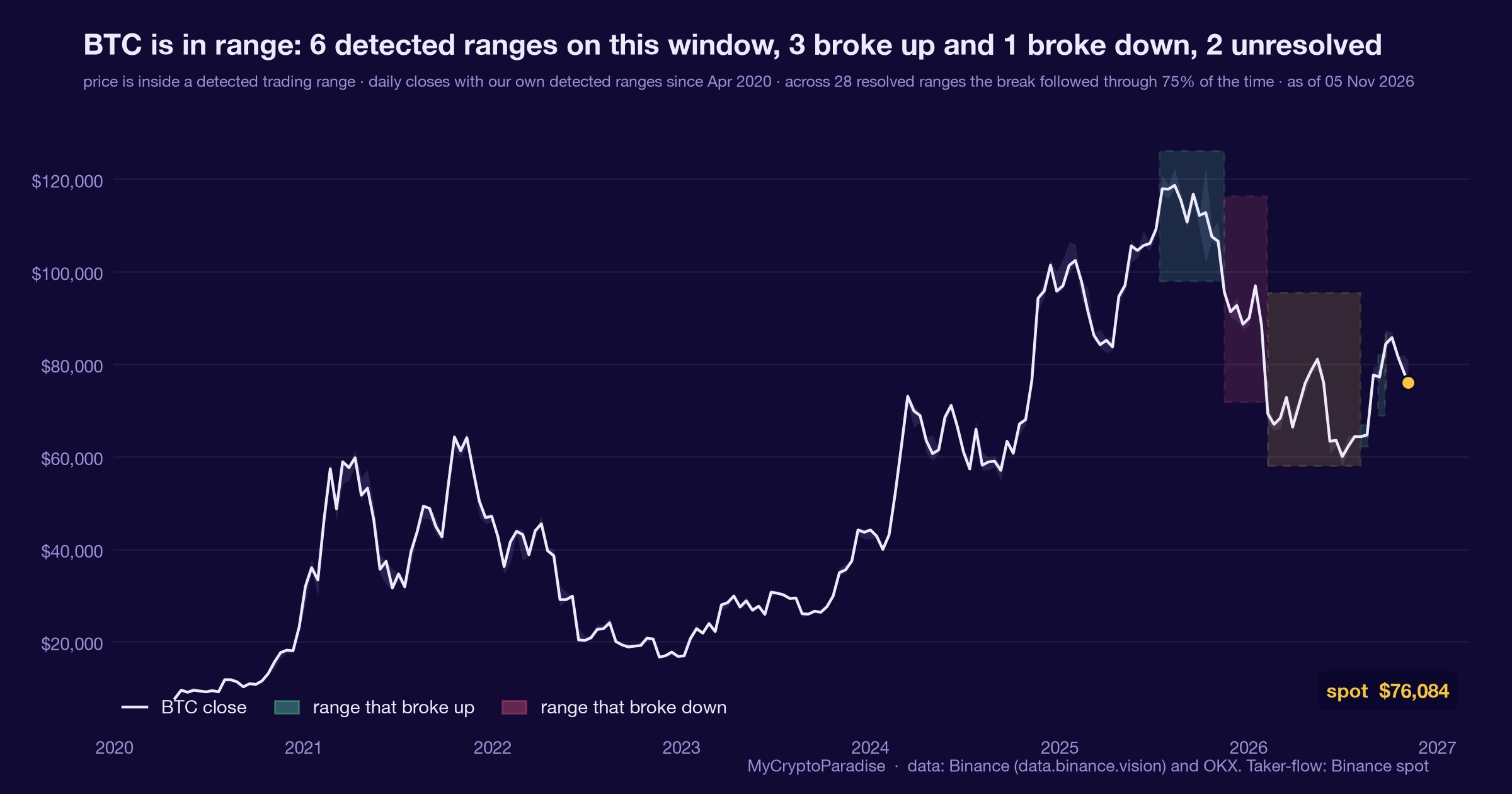
The contrast is the point. The same tape shows Bitcoin longs paying 10.9 percent annualized, Ethereum longs 7.8 percent, and 86 percent of tracked markets funding positive against a baseline near 30 percent, with median funding around 8.3 percent. BTC sits near $75,848 with $31.5 billion in open interest (OI).
At the other pole, XMR longs pay an extreme 88 percent annualized. BZ is the mirror image: not a crowd leaning long into strength, but a short side paying hundreds of percent a year to hold, while the median market pays single digits.
A single reading this far from the pack is a flag before it is a trade. The size of the fee measures how badly one side wants out of being wrong.
What is different here
The ParadiseTeam does not screenshot a scary funding number and call it a signal. We read it against the whole tape, name the market it sits on, re-verify the feed against our own recon series, and grade it over the days that follow, so you see whether the fuel drained or fired.
Extreme funding is not a countdown to a squeeze
The obvious misreading is that minus 450 percent APR is an automatic bounce waiting to happen. It is not. Funding that deep can persist for days on a thin or troubled market, because the shorts paying it may simply be right about the direction.
This is one input. It sits alongside open interest, spot absorption and the broader funding breadth, and on an obscure market it is the reading that most needs the others before it means anything.
There is also the plain possibility that the market itself is the story. A fee this extreme usually lives on a small, illiquid name, where a handful of positions can bend the rate far past anything the broader tape would tolerate.
A fee is evidence of pressure, never proof of release. The question funding answers is who is uncomfortable, not when they capitulate.
We have seen a short-paid extreme drain before
A fortnight ago we flagged SAND shorts paying a comparable extreme near minus 477 percent APR, and we watched it. By mid-October our reading had it at minus 292.7 percent: it cooled, the rate drifting back toward the pack as shorts covered, rather than detonating into a squeeze.
That is the honest base case for a reading like this: more of these extremes decay than ignite, which is exactly why we grade them rather than trade them on sight. BZ may be the exception; the fee says the pressure is real either way.
So we file BZ the same way: a reading logged, dated and watched, with the next funding prints as the referee. If it fires, the receipt is here; if it fades, that receipt is here too.
Draining fuel and detonating fuel look identical at the peak. Only the direction of the next few funding prints tells them apart.
Reading funding extremes yourself, step by step
- Open the live funding rates tracker and sort markets by annualized rate to find the single most short-paid and most long-paid names.
- Check whether a deeply negative rate belongs to a large, liquid market or a thin, obscure one, because thin markets distort.
- Read the extreme against the breadth: note what share of all markets fund positive and where the median rate sits.
- Compare the raw feed figure with a recon or series reading, and when they disagree, trust the reconciled number.
- Track the rate across the next several funding prints to see whether the fuel is draining toward the pack or deepening.
Most people stop at the scary headline rate and never check liquidity. A minus 400 percent reading on a market nobody trades is noise wearing a costume.
Every number above is checkable against the live data. Start with the live crypto funding rates, then cross-read the MCP Insights hub and the Crypto Fear and Greed Index.
Act and invalidate
| Scenario | What confirms it | What kills it |
|---|---|---|
| Short squeeze fires | Rate snaps toward pack as price lifts | Price keeps sliding, rate stays deep |
| Fuel drains quietly | Rate decays with no price pop | Rate deepens as new shorts pile in |
| Shorts were right | Price falls, funding stays deeply negative | Funding flips positive, shorts cover |
Posture: Defensive, and for most readers no trade at all. An obscure market paying this fee is a flag to watch funding, not a venue to size into; the highest-probability action here is to let the next few prints decide.
Frequently asked questions
What does minus 450 percent funding actually mean?
It means shorts on BZ are paying roughly 450 percent annualized, charged every few hours, simply to hold their position. The figure is a fee rate, not a price move, and it signals that bearish leverage is unusually crowded and expensive to maintain.
Is extreme negative funding a reason to go long?
Not on its own. A well-paid short side is squeeze fuel, but that fuel often decays quietly as shorts cover instead of igniting a rally. On a thin market the shorts may also simply be correct about direction.
Why does the raw feed differ from your reading?
The source feed logged minus 438 percent while our reconciled funding-extremes series read minus 450.6 percent. Feeds carry venue lag and sampling quirks, so where the two disagree we publish the recon number and tell you both figures.
How does BZ compare to the rest of the market?
It is the mirror image of the tape. On 6 November, 86 percent of tracked markets funded positive, Bitcoin longs paid about 10.9 percent annualized, and XMR longs paid 88 percent, while BZ shorts paid hundreds of percent to stay short.
What would tell you the setup has resolved?
Watch the next several funding prints. A rate snapping toward the positive pack as price lifts points to a squeeze; a rate decaying with no price move means the fuel drained; a deepening rate means shorts are adding conviction.
Crypto trading involves substantial risk and is not suitable for everyone. Nothing here is financial advice; it is education only. Never risk more than you can afford to lose.
The private Extras feed, where the funding-extremes reading, market-wide funding breadth and the squeeze-fuel gauge update intraday with their invalidation levels, is part of PRO Paradiser, the intelligence layer behind the ParadiseFamilyVIP strategies.






Join the discussion
No comments yet. Members, share how you are reading this.