

In short
Bitcoin ETF net flows are the daily dollar balance of creations and redemptions in US spot bitcoin funds: money in on a green day, money out on a red one. Our MCP Insights ETF flow data, a model estimate, show a net $430.2 million out on 5 November 2026, a five-session total of minus $1,513.1 million, and a 30-day net that has flipped to minus $1,706.3 million from the positive $1,656.1 million we quoted on 10 October. We read this as a defensive headwind, not a crash and explicitly not a bottom. We publish a miss here: on 30 October we leaned mildly constructive after the funds absorbed a falling market, and the outflow wave that followed cut against that lean. Base rates are not wired, so we quote no frequency. This piece shows you how to read ETF flows yourself, and mark the level that would flip it.
Key facts
- Latest session net flow
- -$430.2M
- Net flow over the last five sessions
- -$1.51B
- Cumulative net flow since January 2024
- $56.18B
- What would prove this read wrong
- A positive flow week that lifts the 30-day net back above zero, or the Coinbase premium turning decisively US-led while daily nets return toward flat.
- Reading taken
- 05 November 2026
- Source
- Our MCP Insights tools, from Farside Investors and SoSoValue. Upstream data published by Farside Investors
Flows are creations and redemptions, not sentiment
US spot bitcoin ETFs issue and retire their own shares as demand changes: when buyers arrive, authorized participants create new shares and the fund buys bitcoin; when holders leave, those participants redeem shares and the fund sells.
The net flow is the dollar balance of that daily plumbing. A net inflow means creations won; a net outflow means redemptions did, and the fund was a net seller into the market that session.
A flow number measures plumbing, not conviction. It tells you what the wrapper did, not what every holder believes, and a redeemed share is one someone else was willing to take.
The 30-day net has turned decisively red
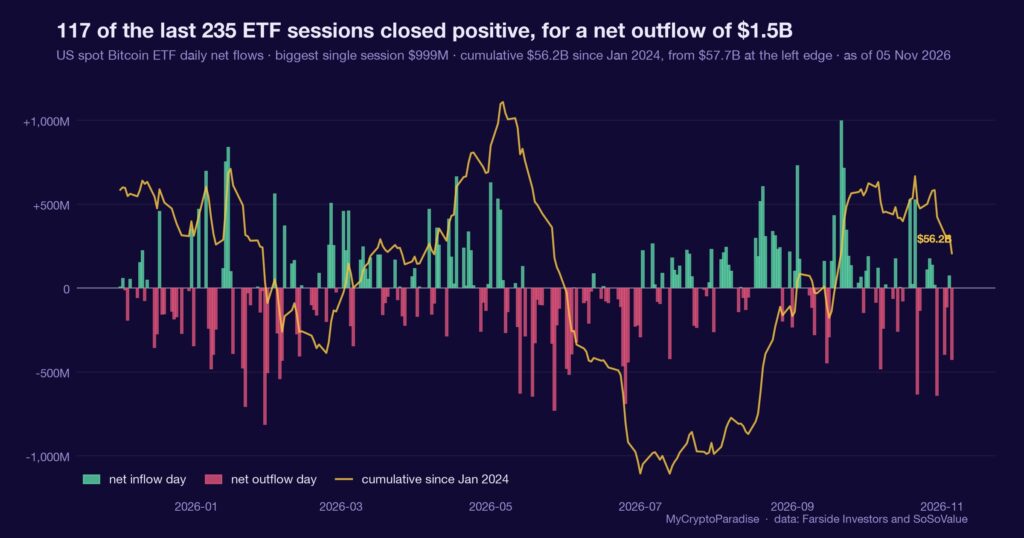
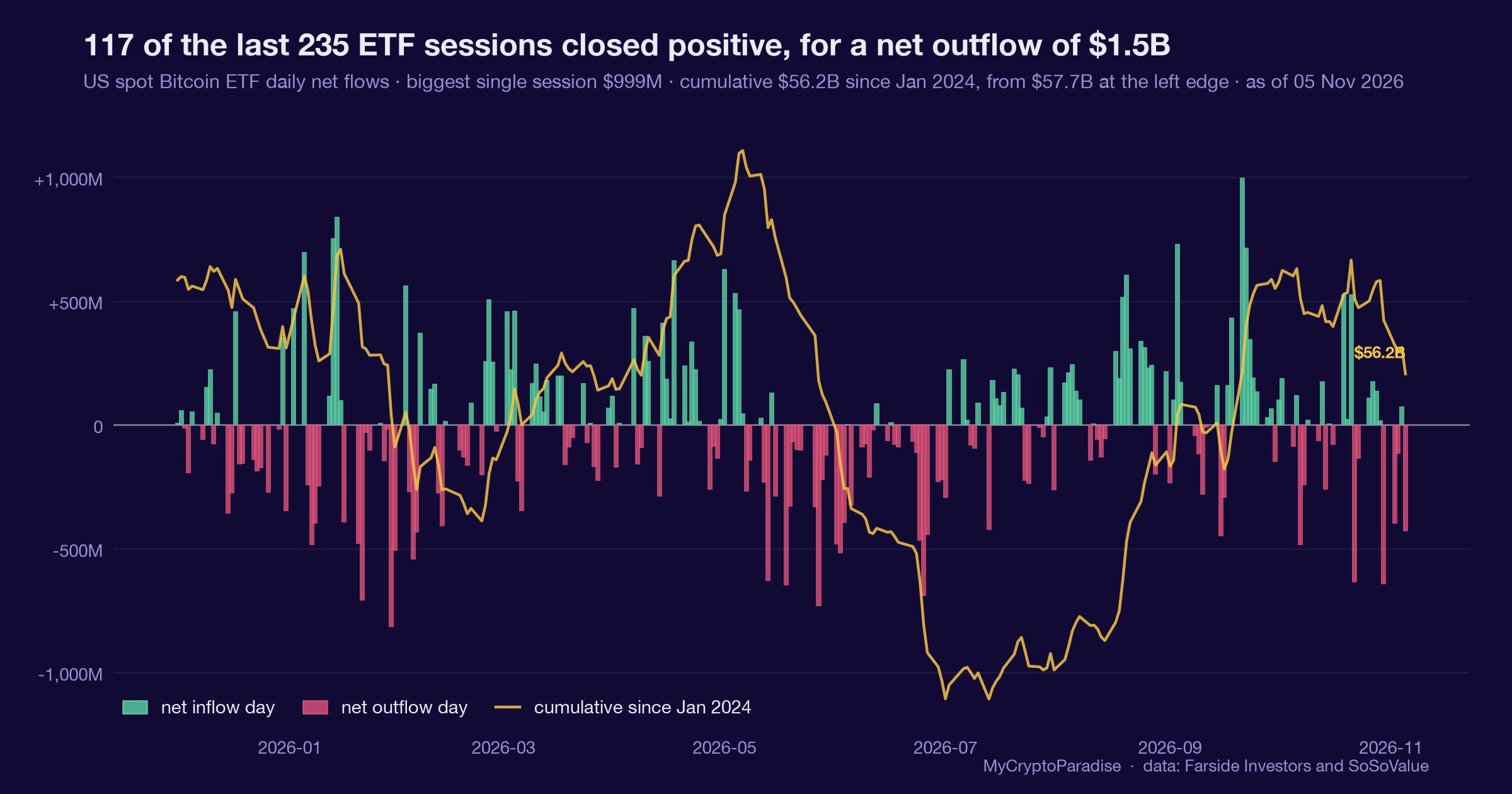
Our MCP Insights ETF flow data, a model estimate flagged as not yet gate-cleared, show US spot bitcoin ETFs shed a net $430.2 million on 5 November 2026, extending a one-day redemption streak.
Across the five sessions to 5 November the complex gave up $1,513.1 million, our recon reading, and the week to that date already stood at a net $869.8 million out before the final session closed.
The number that reframes the month is the 30-day net: minus $1,706.3 million to 5 November, against the positive $1,656.1 million we quoted on 10 October. BlackRock’s fund carried a 30-day net of minus $420.1 million and Fidelity’s minus $598.3 million.
A single red day is weather. A 30-day net crossing from plus $1.7 billion to minus $1.7 billion in a month is a change of season.
An outflow wave is not a verdict on price
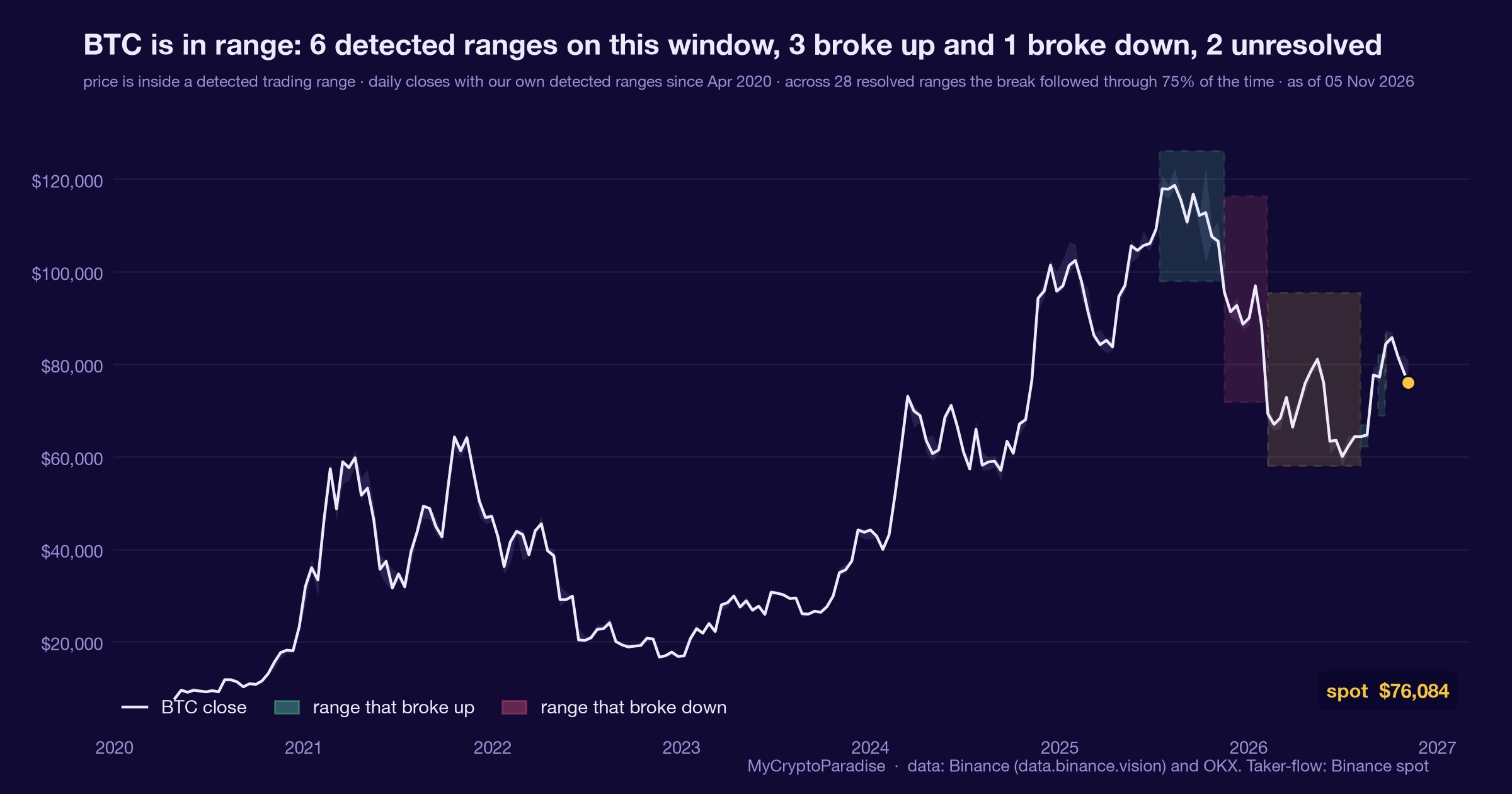
The obvious misread is that redemptions guarantee lower prices. Spot did fall 3.18 percent over the same five-day window, our reading, so flows and price aligned this time; alignment is not causation.
The Coinbase premium, the gap between US Coinbase pricing and offshore venues, reads a mild minus 0.02 percent, and the 6 November session closed offshore, with only three of twenty-two sessions since 8 October US-led, our reading. US demand is soft, not collapsing.
Flows tell you the wrapper sold. They do not tell you who bought, and someone bought every share that was redeemed.
What is different here
The ParadiseTeam does not read a single red week as a crash or a single green day as a floor: we track the 30-day net, the issuer split and the Coinbase premium together, flag every estimate that has not cleared its gate, and size the lean with an invalidation level rather than a prediction.
Where this leaves our October read
On 30 October we read these flows as neutral with a mild constructive lean, after the funds absorbed a falling market. The outflow wave that followed cut against that lean, and we publish it rather than quietly revise it.
This is one input. It sits alongside funding, the Coinbase premium and spot order flow, and today it is the one turning hardest against the market.
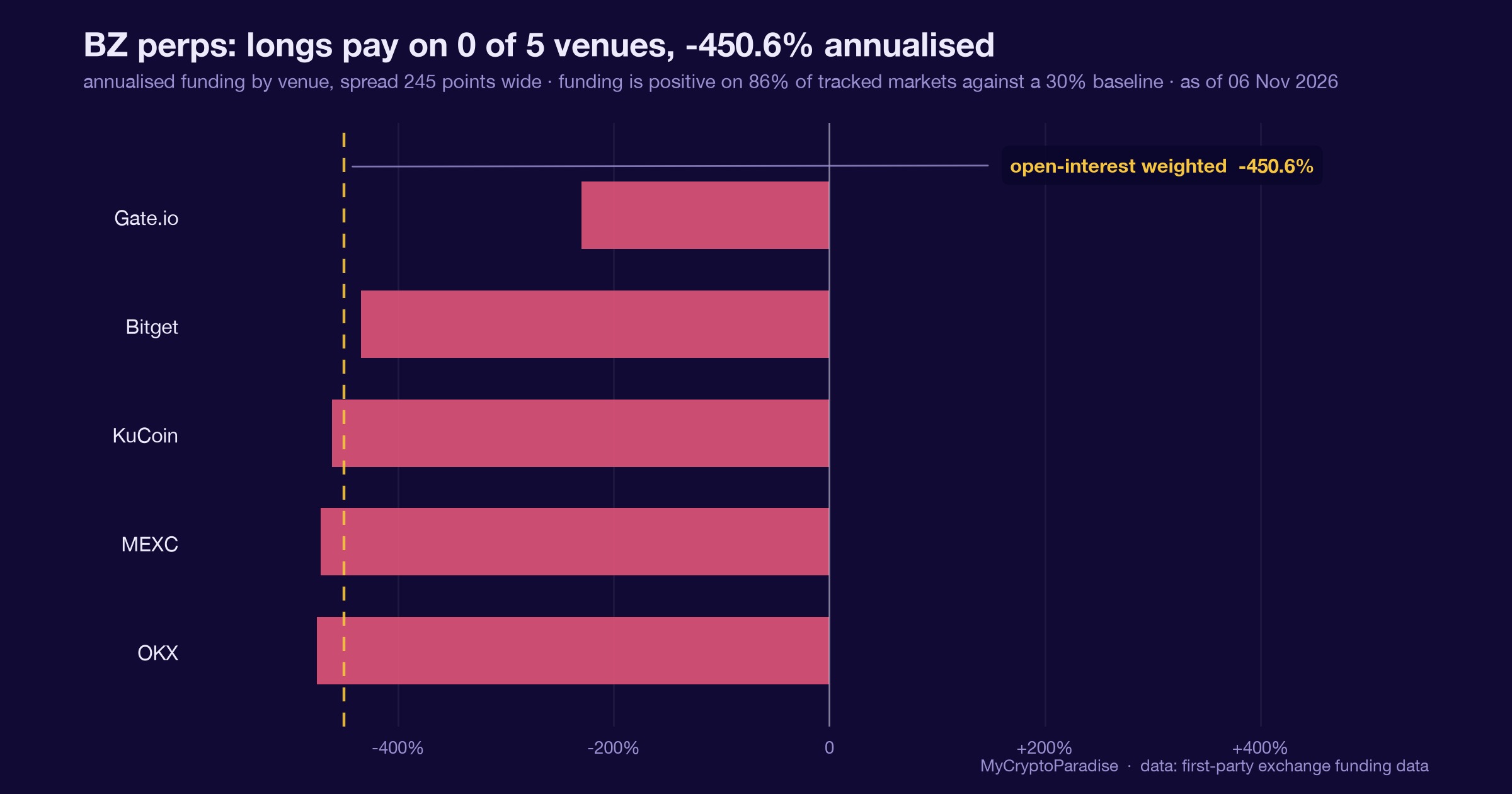
Our order-flow read sits in a churn state, a model estimate between clear regimes, while perpetual funding runs a positive 2.97 percent annualized with longs still paying: no crowded-short fuel waiting to snap the market higher.
A read that only reprints its right calls is a highlight reel. The month it got wrong is the month that prices the next one.
One fund still carries the whole complex
Strip the week back to its parts and the concentration shows. Our fund-level data put BlackRock’s cumulative share of net inflows at 116.6 percent, which is only possible because the rest of the twelve funds are a net drag on the cumulative total.
So a BlackRock-led outflow is not one issuer among many softening: it is the load-bearing fund stepping back. Fidelity’s 30-day net of minus $598.3 million deepens it, and Grayscale’s mini fund shed a further $67.3 million over the month.
Concentration cuts both ways. The fund that can drag the net negative alone is the same one that can lift it, which is why the issuer split belongs next to the headline, not beneath it.
Reading Bitcoin ETF flows yourself, step by step
- Open our Bitcoin ETF flow tracker and read the latest daily net, not the single largest outflow a feed quotes.
- Switch to the cumulative curve and check whether the 30-day net is rising or falling, because one day is noise.
- Split the flow by issuer: a complex-wide outflow is heavier than one large fund rebalancing against the rest.
- Cross-check the Coinbase premium gauge to see whether US spot demand is leading or lagging the offshore venues.
- Mark the streak or weekly net that would reverse the read, and write it down before you act on it.
The step people skip is the issuer split: a single fund can drag the whole net negative while the rest of the complex quietly adds, which changes what the number means.
Every number above is checkable against the live data. Start with the Bitcoin ETF flow tracker, then cross-read the MCP Insights hub and the Crypto Fear and Greed Index.
Act and invalidate
| Scenario | What confirms it | What kills it |
|---|---|---|
| Outflows persist | 30-day net stays below zero | A positive flow week |
| Flows stabilise | Daily nets return toward flat | Another $400M-plus redemption day |
| Demand rotates back | Coinbase premium turns US-led | Premium holds offshore |
Posture: Defensive while the 30-day net sits negative and US spot demand lags offshore: this reads as a headwind, not a reversal, and for most the highest-probability action remains no new risk.
Frequently asked questions
What does a Bitcoin ETF outflow actually mean?
It means redemptions outpaced creations that day, so the fund sold bitcoin to meet them. It is a measure of the wrapper’s daily plumbing, not a direct vote on price, and a redeemed share still found a buyer on the other side.
Is the 30-day net more reliable than one day?
A single session is weather. The 30-day net smooths the daily noise into a trend, and ours crossing from plus $1.7 billion to minus $1.7 billion inside a month is the reading that reframed an otherwise ordinary red day.
Why not treat these flows as a forecast?
Our flow series carries a model-estimate flag that has not cleared its calibration gate, and no base rate is wired for this event class. We can state where the pressure sits today; we cannot quote a historical frequency for what follows.
Does the Coinbase premium confirm the outflows?
Partly. The premium reads mildly offshore, with only three of twenty-two sessions since 8 October closing US-led, our reading. That says US spot demand is soft, which is consistent with the redemptions rather than a separate confirmation of them.
What would flip this read to constructive?
A positive flow week that lifts the 30-day net back above zero, or the Coinbase premium turning decisively US-led, would end the headwind. Until one of those prints, the defensive lean holds, and one green day on its own does not count.
Crypto trading involves substantial risk and is not suitable for everyone. Nothing here is financial advice; it is education only. Never risk more than you can afford to lose.
The private Extras feed, where the ETF flow tide, the issuer split and the Coinbase premium update intraday with invalidation levels attached, is part of PRO Paradiser, the intelligence layer behind the ParadiseFamilyVIP strategies.












Join the discussion
No comments yet. Members, share how you are reading this.