

Listen: the breakdown
Developing story: This story is still unfolding. We are tracking it and will update this article as more details are confirmed.
Market briefing: Market briefing. Trump has warned Gulf states to prepare for escalation if there is no Iran ceasefire this week. Bitcoin barely moved, trading near 64,421 dollars, and that flat response is the story.
- Trump warned Gulf states to prepare for escalation without an Iran ceasefire this week.
- Bitcoin sat near $64,421, almost unchanged on the day, while ETH held near $1,861.
- A heavy geopolitical headline that fails to move price often masks quiet positioning underneath.
Trump's Iran warning to Gulf states should rattle risk assets, yet Bitcoin sits flat near $64,421. When fear does not move price, who is really absorbing it?
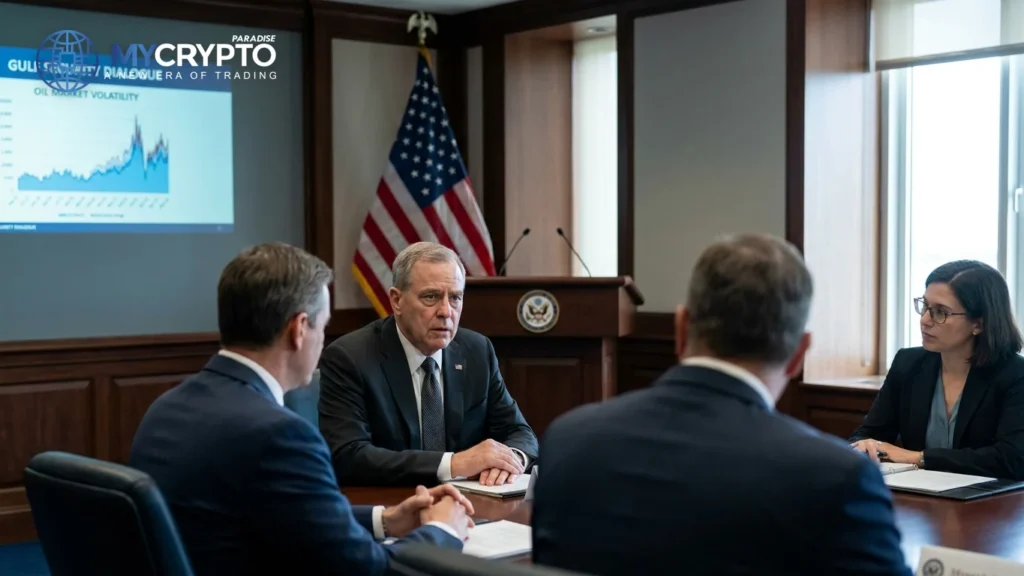
A former US president has told Gulf states to prepare for escalation if there is no ceasefire with Iran this week. On paper, that is a serious risk-off headline.
Bitcoin's answer was a shrug. BTC traded near $64,421, essentially flat on the day, down a fraction on the hour. Ethereum held near $1,861 and was actually slightly green over 24 hours.
This extends a theme we have tracked all day. Missile launches, sirens in Jordan, fighter jets landing, nuclear accusations. One heavy Middle East headline after another, and crypto keeps holding its ground.
The new element here is escalation framed as a deadline. A one-week ultimatum gives the market a clock to watch, which is different from a single event that has already happened.
What changed structurally is not price. It is the gap between the size of the headline and the size of the reaction. That gap is where the interesting information lives.
When a market this leveraged ignores a war-adjacent warning, it usually is not because traders are calm. It is because an existing structural bias is filtering the news before it reaches the tape. We read that bias as short-term caution beneath a steady surface.
Why a flat tape hides the pressure
Geopolitical risk in an oil-heavy region normally travels through one channel first: uncertainty. Uncertainty raises the cost of holding leveraged bets on anything, crypto included.
The usual chain runs from tension, to risk-off sentiment, to deleveraging in the riskiest assets. Crypto sits at the far, most volatile end of that chain.
So the textbook reaction to a Gulf escalation warning would be a quick flush lower. We did not get one. That absence matters more than a move would have.
When a market refuses to fall on bad news, two readings compete. Either buyers are genuinely strong, or sellers are patient and waiting for a better exit. The flat print alone cannot tell you which.
Here is the transmission mechanism we actually care about. A one-week ultimatum keeps a background bid of anxiety alive. That anxiety encourages traders to add hedges and, more importantly, to add leverage in both directions.
Leverage is the real fuel. Geopolitical headlines rarely move Bitcoin by themselves, but they thicken the layer of stops and liquidations that a later move can run through.
So the driver here is not the missile or the message. It is the leverage that fear like this quietly invites onto the book, waiting to be collected.
How the flush would travel through crypto
If this geopolitical anxiety does convert into a move, it travels in a familiar order. Bitcoin leads, Ethereum follows, and altcoins pay the highest toll.
BTC near $64,421 is the anchor. A risk-off deleveraging event would pressure Bitcoin first, because it is the most liquid door everyone tries to leave through at once.
Ethereum, near $1,861, tends to lag Bitcoin lower by a beat, then move harder in percentage terms. Its slight green today does not exempt it from a broader flush.
Altcoins are the tail that gets whipped. In a leveraged unwind, thin order books mean small sell flows produce large drawdowns, so alts typically fall further and faster than BTC.
The mechanism is liquidity, not sentiment. When leveraged longs are forced to close, exchanges sell into whatever bids exist, and those bids sit at predictable levels below price.
That is why the flat reaction is not comforting. It leaves the leverage in place rather than clearing it, so the potential energy for a cascade is still loaded.
We have watched enough cycles to know the pattern. The headline that does nothing today is often the alibi for the move tomorrow, once someone decides to press the stops that fear has stacked up.
What confirms or cancels the squeeze
The cleanest thing to watch is not the news feed. It is how Bitcoin behaves around its nearby levels over the next sessions.
Confirmation of the cautious read would be BTC losing the immediate support band and accelerating, rather than drifting. A quick, liquidation-driven drop toward the lower support zone would fit the squeeze thesis.
We would also watch funding and open interest. If price dips while leveraged longs get flushed and funding cools, that is the deleveraging doing its work, which is constructive for a later recovery.
Invalidation is just as important, and we hold it honestly. If Bitcoin reclaims its nearby resistance and holds it as support, the squeeze idea weakens fast.
A firm reclaim of the higher resistance shelf would tell us the leverage got absorbed without a flush, and that buyers, not patient sellers, were behind today's calm.
On the geopolitical clock, watch whether the week passes with a ceasefire or with escalation. Either outcome removes the ambiguity that currently keeps hedges and leverage elevated.
The honest framing: this is an interpretive setup, not a confirmed catalyst. No single event today forced a move, so we are reading positioning, not reacting to a print. Levels, not headlines, will settle the argument.
What the muted reaction says about positioning
The ParadiseTeam reads this flat response through one frame: leverage being absorbed near current price. That is the through-line connecting today's quiet tape to our near-term caution.
With BTC near $64,421, the immediate support we are watching sits at $63,600 to $63,200. A break and acceleration through there would signal the long squeeze is underway, not merely feared.
The deeper zone we treat as a genuine buying region is $60,000 to $59,000. If geopolitical anxiety helps flush leveraged longs into that band, it likely benefits patient smart money accumulating from panicking retail.
Stops are the key. Retail longs added on dips tend to park their protective orders just under obvious support, which is exactly where a squeeze would aim.
On the upside, we mark near-term resistance around $64,900, then $67,000 as the more important medium-term shelf. Reclaiming and holding those flips our short-term caution off.
The divergences support the wait. Short-term momentum shows a bearish tilt, while the higher timeframe still leans constructive, which is why we frame a dip as opportunity rather than trend change.
So this Iran warning changes little on its own. It simply reinforces a backdrop where longs are vulnerable first and stronger hands buy lower second. Probabilities, not promises, and support is where the argument gets decided.
Track it live: our live crypto funding rates and the crypto liquidation heatmap both update in real time, so you can watch this shift for yourself.
Related coverage
For exact entries, targets, and stop losses with full risk management, that is what ParadiseFamilyVIP is for. New to reading these moves? Start with our crypto trading strategies guide.
ParadiseTeam is monitoring the market situation closely, and we are taking these developments into consideration while building our trading tactics inside ParadiseFamilyVIP.
Crypto trading involves substantial risk. Prices are volatile and you can lose money. This article is educational and is not financial advice. Past performance does not guarantee future results.
Where does Bitcoin go next from here?
How the Paradisers are calling it
The first call is still open
Free account, no password. Members just sign in.







Join the discussion
No comments yet. Members, share how you are reading this.