

Listen: the breakdown
Market briefing: Trezor's shipping partner Skladon was breached, exposing data on 27,000 orders across non-US regions. BTC sat near $64,661, down 0.3% on the day, unmoved by the leak.
- Skladon breach exposed data tied to 27,000 Trezor orders
- US customers unaffected, but many other countries are exposed
- BTC near $64,661 and ETH barely moved on the news
A Trezor shipping partner breach just leaked data on 27,000 orders, turning known hardware-wallet owners into fresh phishing targets. So does the market care at all?
Your keys stayed safe. Your address did not.
Trezor's shipping partner, a logistics firm called Skladon, suffered a data breach. The incident exposed information tied to 27,000 orders. This is a vendor leak, not a compromise of the devices themselves. No seed phrases, no private keys, no funds were ever in reach.
The nuance matters. Skladon handles fulfilment and shipping, so the exposed records are order and delivery details, not wallet secrets. A hardware wallet protects what sits inside it. The cardboard box it arrived in is a different story, and that box can quietly tell the world who you are.
Skladon does not ship to the US, so American Trezor customers sit outside this exposure. The leak instead spans buyers across many other countries. That spread is the real character of the breach: not one region hit hard, but a thin layer of risk smeared across a long list of jurisdictions.
The downstream threat is social, not financial. Anyone whose data leaked is now a confirmed self-custody holder. That makes them an attractive target for tailored phishing emails, fake support messages, and in rare cases physical scams. The attacker no longer guesses who owns crypto. The shipping manifest told them.
Markets, meanwhile, did almost nothing. BTC traded near $64,661, down a fraction on the day. ETH edged slightly higher. A privacy incident at a shipping vendor is not a repricing event, and the tape treated it exactly that way.
The parcel that names the holder
The real damage here is informational, not monetary. A breach that exposes order data does not drain a single wallet. It simply converts anonymous buyers into a known, targetable list of self-custody owners.
That distinction drives everything. Crypto's security model rests on keeping keys offline and private. Trezor delivered on that part. The weak link was further up the chain, at a fulfilment partner whose systems were never the headline product, yet still held customer identities.
This is the uncomfortable truth of supply chains. You can harden the device to near-perfection and still leak through the courier. A privacy failure at the edge of an ecosystem can undo some of the trust the core product spent years building.
For exposed customers, the mechanism of harm is straightforward. A scammer who knows you bought a hardware wallet can craft a far more convincing lure. Fake firmware updates, fake recovery prompts, and spoofed support all become easier when the attacker already knows what you own.
Still, keep the scale honest. This is 27,000 order records, concentrated in a single product category, with no funds at risk and the US entirely excluded. It is a serious operational and reputational matter for the people involved.
It is not a market event. There is no liquidity transmission, no change in supply, no shift in institutional flow. The chain from breach to BTC price simply does not connect, and pretending otherwise would be dishonest.
Markets shrug at a vendor leak
Price barely registered this. BTC was trading near $64,661 as of the brief, down about 0.35% on the day and up a touch on the hour. ETH sat near $1,830, modestly green. That is a quiet, mixed tape, not a reaction.
That non-response is the point. A hardware-wallet shipping breach carries no macro channel. It does not tighten liquidity, trigger outflows, or force any desk to rebalance. So BTC, ETH, and alts all keep doing whatever the broader tape was already doing.
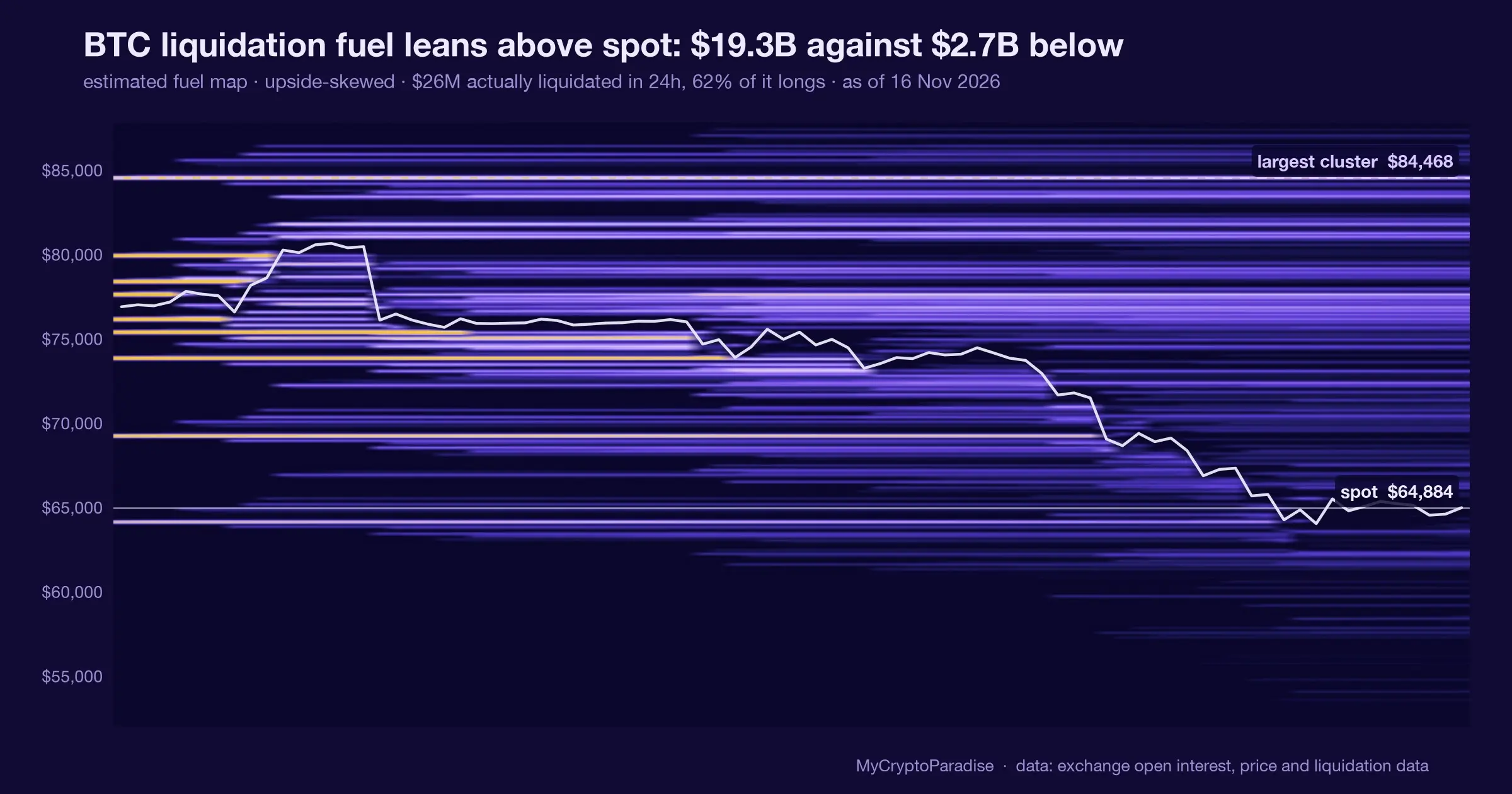
Contrast this with the real drivers moving crypto right now. Leverage, funding, and forced liquidations are steering price far more than any privacy headline. This story simply sits outside that machinery.
We would be cautious about any attempt to tie the two together. There is no evidence the market treated this as a trust shock to self-custody, no measurable fear or relief in the price, and no chatter spike. Flat-to-mixed is exactly what a non-event looks like.
If anything, the muted reaction is quietly reassuring. The market has learned to separate a vendor's data problem from the integrity of the underlying asset. A few cycles ago, the same headline might have been spun into a self-custody scare.
So for BTC and ETH, the read is simple. This breach changes nothing structural. The levels that matter were set by positioning and liquidity long before Skladon's name appeared, and they still are.
Phishing now the genuine downstream threat
Watch the inbox, not the chart. The meaningful follow-through from this breach is social engineering, not price. Exposed customers should expect a rise in targeted phishing dressed up as official Trezor contact.
The tell of a scam will be urgency and a request. Real hardware wallets never ask for your seed phrase, through any channel, ever. Any message prompting a recovery-phrase entry, a fake firmware patch, or a surprise support call should be treated as hostile by default.
Confirmation that this stays contained looks like silence. No further leaked systems, no secondary dumps of the data, and no credible reports of drained wallets linked to the exposure. That would mark it as a closed, keys-safe incident.
Invalidation of that calm read would be different. Evidence that seed-related data was somehow involved, or a wave of successful phishing conversions, would escalate this from a privacy nuisance to a genuine user-safety problem. Nothing in the confirmed facts points there yet.
On the market side, there is frankly little to watch. This story has no price trigger, so BTC and ETH will continue to trade on leverage, liquidations, and macro, not on breach updates.
The practical takeaway is operational hygiene. Affected holders outside the US should assume their status as owners is now public. Tighten email vigilance, verify every update at the source, and route nothing sensitive through unsolicited messages. The device is fine. The guard that matters now is human.
Operational risk sits far from price
The ParadiseTeam frames this cleanly: a shipping-vendor breach is an operational risk, not a trading input. It does not touch our levels, our bias, or the liquidity picture. So we file it under security hygiene and keep our eyes on the tape that actually matters.
That tape is still cautious. BTC was near $64,661, sitting right at the $64,000 zone we have flagged as the next support after $69,000 gave way with no reaction. Our standing weekly bias stays bearish, with the $55,000 to $44,000 exchange-of-hands band as the deeper magnet.
None of that moves because of Skladon. The current decline reads as liquidation-driven, crowded longs getting flushed, rather than fresh whale distribution. A privacy leak does not add or subtract from that pressure.
Here is the honest nuance. Whales slowed their aggressive selling over the past 24 hours near this support, hinting at slow, early re-accumulation. That is a positioning signal, and it has nothing to do with this breach.
We stay skeptical of any bullish spin until funding resets toward zero or negative and price confirms inside the $44K to $64K zone. Retail is still longing the drop with positive funding, which is the setup that keeps getting liquidated.
For this story specifically, the read is flat. No edge, no trap, no smart-money footprint. Treat it as a reminder to protect your own perimeter, then return to the levels that genuinely decide the next leg.
The read behind this: we framed this story through our own market analysis, Bitcoin Crash to $44K or Bounce First?
Track it live: our live crypto funding rates and the Crypto Fear and Greed Index both update in real time, so you can watch this shift for yourself.
Related coverage
For exact entries, targets, and stop losses with full risk management, that is what ParadiseFamilyVIP is for. New to reading these moves? Start with our crypto trading strategies guide.
ParadiseTeam is monitoring the market situation closely, and we are taking these developments into consideration while building our trading tactics inside ParadiseFamilyVIP.
Crypto trading involves substantial risk. Prices are volatile and you can lose money. This article is educational and is not financial advice. Past performance does not guarantee future results.
Will the Skladon leak push exposed holders off hardware wallets?
How 1 Paradiser is calling it
The first call is still open
Free account, no password. Members just sign in.










Join the discussion
No comments yet. Members, share how you are reading this.