


Listen: the breakdown
Developing story update (November 17, 2026, 07:37 UTC):
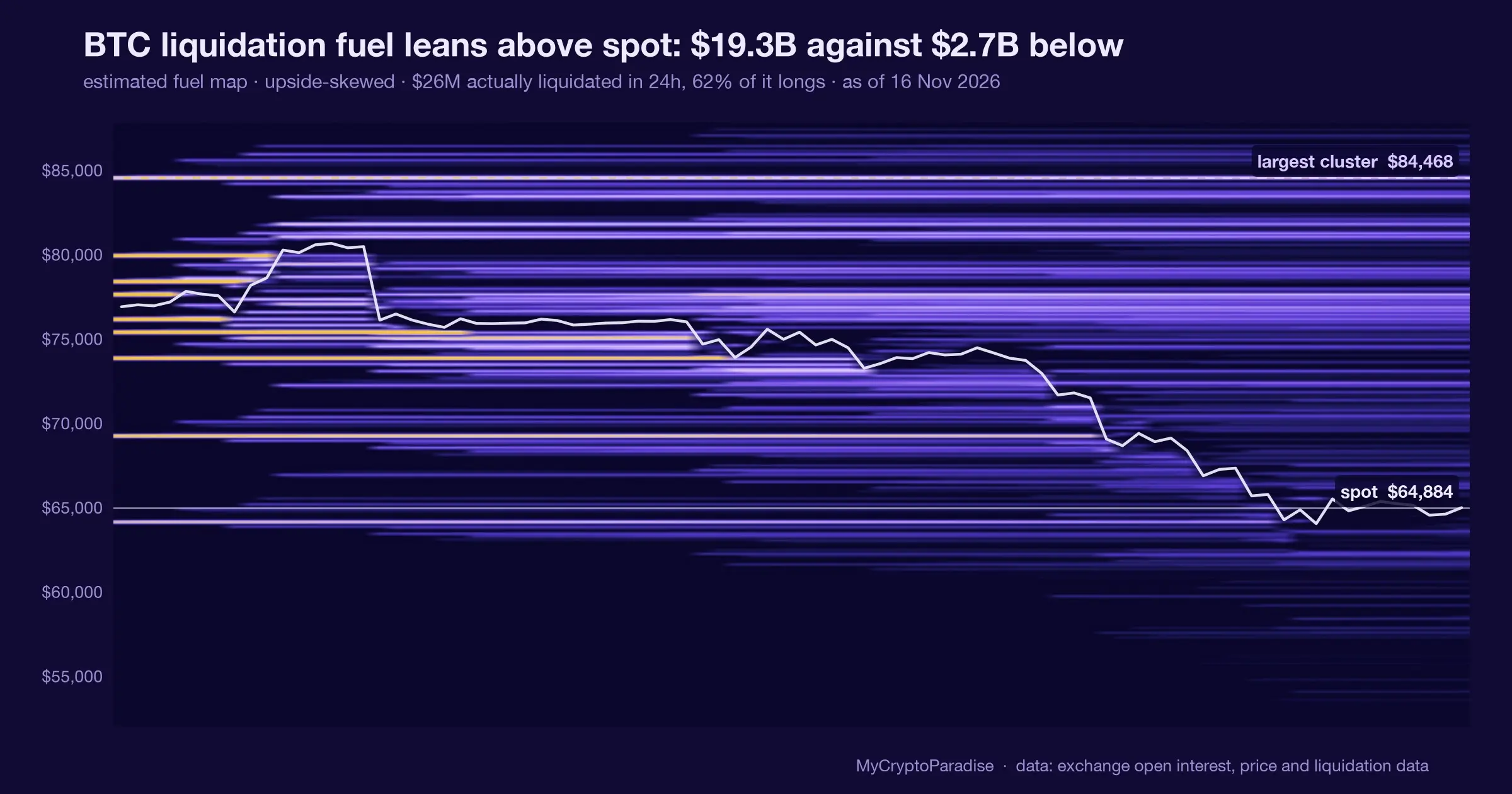
Grayscale’s research desk has added more detail behind its earlier case for compelling entry points: its own proprietary crypto valuation indicators have flipped from overbought to oversold over the first two weeks of November, and its market-cap-weighted industry index is down roughly 18% across the same stretch, broadly in line with Bitcoin’s drawdown toward the $64,000 area.
For traders this is a valuation-based framing from an institutional research voice, not disclosure of actual buying flows. Price action remains flat to slightly lower (BTC near $64,600, down about 0.4% on the day), so there is still no confirmation that real accumulation is following the call. Treat the oversold reading as a probability signal, not a guarantee of a bottom.
What to watch now: Whether the oversold valuation reading is followed by genuine spot demand, or price keeps drifting without flow confirmation.
Market briefing: Grayscale's research head calls the selloff a compelling entry point, with BTC near $64,387 after a roughly 17% drop. The call blames stablecoin outflows and AI-stock spillover, yet the crowd stays silent.
- Grayscale's head of research frames current crypto prices as compelling entry points
- The cited drawdown: BTC down roughly 17% to about $64,000 in early November
- Named causes are stablecoin outflows after a Binance hack and AI-stock spillover
A Grayscale research head just called this dip a compelling entry point near $64,000. The quote is loud, the crowd is silent. So who is really listening?
Grayscale's head of research has put a label on the selloff. He calls current crypto prices compelling entry points. Bitcoin had fallen roughly 17% to about $64,000 in early November, and he reads that drop as an opportunity rather than a warning.
The firm names two culprits for the decline. First, stablecoin outflows following a Binance hack, which drained exchange liquidity. Second, spillover selling from AI-linked equities, where risk appetite had already turned. Put together, the story is a liquidity squeeze that dragged BTC lower regardless of any crypto-specific flaw.
That is a clean narrative. It is also a convenient one for a firm whose business depends on people buying.
What stands out is not the call itself but the quiet around it. A prominent institutional voice declares a bottom, and the crowd barely stirs. Social chatter shows no rush to agree or argue. BNB, the asset tied to the exchange in the hack narrative, was trading near $590.96 with no acute stress, up a modest 0.2% on the day.
That gap matters structurally. When a loud buy signal meets near silence, it usually means one of two things. Either smart money is quietly positioning before the crowd notices, or a single analyst is talking into a room that has already checked out. The price level in the quote is accurate, our live feed confirms the roughly $64,000 area. The conviction behind it is what remains unproven.
A single institutional voice against near silence
The call rests on a liquidity-stress chain, and that chain is worth tracing. A Binance hack pulls stablecoins off exchanges. Thinner stablecoin reserves mean less dry powder to absorb selling. Add AI-equity weakness bleeding into risk assets, and you get forced selling into a shallow book. BTC slides toward $64,000 not on broken fundamentals but on drained liquidity.
That distinction changes everything for a trader. A fundamentals-driven drop questions the asset itself. A liquidity-driven drop questions the plumbing around it. The second kind tends to reverse once outflows stop, which is exactly why an institutional voice would call it an entry point.
But here is the honest caveat. This liquidity story comes from a single reported statement. The other evidence we gathered does not corroborate a distinct stablecoin-stress panic or clear AI-contagion spiral. BNB shows no acute stress at all.
So we hold the facts and the framing apart. The 17% drawdown to roughly $64,000 is confirmed. The named causes and the compelling entry point verdict are one firm's interpretation, not settled truth.
For the broader market, the mechanism still points bullish on its own terms. A dip explained by temporary liquidity stress, not structural damage, is the kind institutions buy. The question is whether real flows follow the words, or whether this stays a well-phrased opinion circulating while everyone else waits.
A buy call landing in thin, quiet tape
On its own facts, this call leans constructive for crypto. An institution labelling a 17% drop a buying opportunity is, by definition, a signal to accumulate, not to flee. If flows confirm it, BTC is the first beneficiary, since it absorbs institutional buying before anything else.
The transmission runs in the usual order. BTC stabilises first as large buyers step into the liquidity gap. ETH follows once BTC holds, because capital rotates down the risk curve only after the anchor steadies. Alts come last, and only if conviction broadens beyond a single quote.
Right now, that broadening is missing. BNB sits near $590.96, barely moved, which tells us the exchange-hack narrative is not spreading fear through the asset most exposed to it. No alt is pricing in either panic or relief.
That quiet cuts both ways. Thin participation means a genuine institutional bid could move price quickly, with few sellers left after a 17% flush. It also means a lone voice can echo without anyone acting on it.
The bullish case here is real but conditional. It needs corroboration from flows, not just framing from a press line. A dip-buy call carries weight when buying shows up on the tape. Until it does, this is a reason to watch closely, not a confirmation that the floor is in. The direction of the story is up; the strength of it is still unwritten.
Where real buying would have to surface
The cleanest confirmation is corroborating flow, not more commentary. Watch stablecoin balances returning to exchanges after the hack-driven outflows. Rebuilding reserves would mean dry powder coming back, which supports the entry-point thesis directly.
Next, watch funding. If the market is truly bottoming on institutional buying, positioning should cool rather than crowd. A reset in funding rates toward neutral would tell us leverage is flushing out, leaving a healthier base for the bid Grayscale is describing.
Sentiment is the third tell. A buy-the-dip call gains force when extreme fear starts turning, not when it deepens. If the crowd stays checked out and price grinds lower, the call ages into just another confident forecast that the tape ignored.
Invalidation is specific. A clean loss of the roughly $64,000 area, with BTC accelerating toward lower support rather than holding, would say the liquidity stress is not done and the entry was called early.
Watch BNB too. If the exchange tied to the hack narrative suddenly shows stress it is not showing now, the liquidity story gets heavier, not lighter.
The simplest signal is the one we keep returning to. Does buying actually appear, or does the quote remain the only loud thing in a quiet room? One analyst calling a bottom is a data point. Flows following that call would be the event. Until the two line up, treat the compelling entry point framing as a thesis on trial.
A contrarian call measured against the weekly trend
The ParadiseTeam holds two things at once here. The call is directionally plausible, and the market structure still demands caution. BTC was trading near $64,387 as this landed, right on the $64,000 support that sits at the 0.786 Fibonacci retracement, our next charted support zone. An institutional voice calling an entry here is calling it at a level that matters.
That said, our weekly read stays bearish, expecting one more leg before a macro bottom. The wider exchange-of-hands zone sits between $55,000 and $44,000, a target standing since $121,000. A compelling entry point at $64,000 does not cancel that lower zone; it may just be early.
The positioning picture backs the caution. Funding rates remain positive and crowded long even as price falls, which means retail is still catching the knife, not capitulating. The current decline looks liquidation-driven from trapped longs, not fresh institutional distribution. Fear readings hit extreme levels for the first time in sixty-three days.
So who benefits? Whales slowed aggressive selling near this support over the past day, an early sign of slow re-accumulation, not confirmation. Smart money tends to wait in stablecoins to absorb forced selling before the next leg up.
Our read: a credible call at a real level, but the stops sit below crowded longs. We want funding resetting toward zero or negative, and price holding this zone, before treating any bottom as confirmed rather than hoped for.
The read behind this: we framed this story through our own market analysis, Bitcoin Crash to $44K or Bounce First?
Track it live: our live crypto funding rates and the Crypto Fear and Greed Index both update in real time, so you can watch this shift for yourself.
Related coverage
For exact entries, targets, and stop losses with full risk management, that is what ParadiseFamilyVIP is for. New to reading these moves? Start with our crypto trading strategies guide.
ParadiseTeam is monitoring the market situation closely, and we are taking these developments into consideration while building our trading tactics inside ParadiseFamilyVIP.
Crypto trading involves substantial risk. Prices are volatile and you can lose money. This article is educational and is not financial advice. Past performance does not guarantee future results.
Is this call early smart money, or one analyst talking into the void?
How 4 Paradisers are calling it
The first call is still open
Free account, no password. Members just sign in.












Join the discussion
No comments yet. Members, share how you are reading this.