

Listen: the breakdown
Developing story update (September 25, 2026, 14:37 UTC):
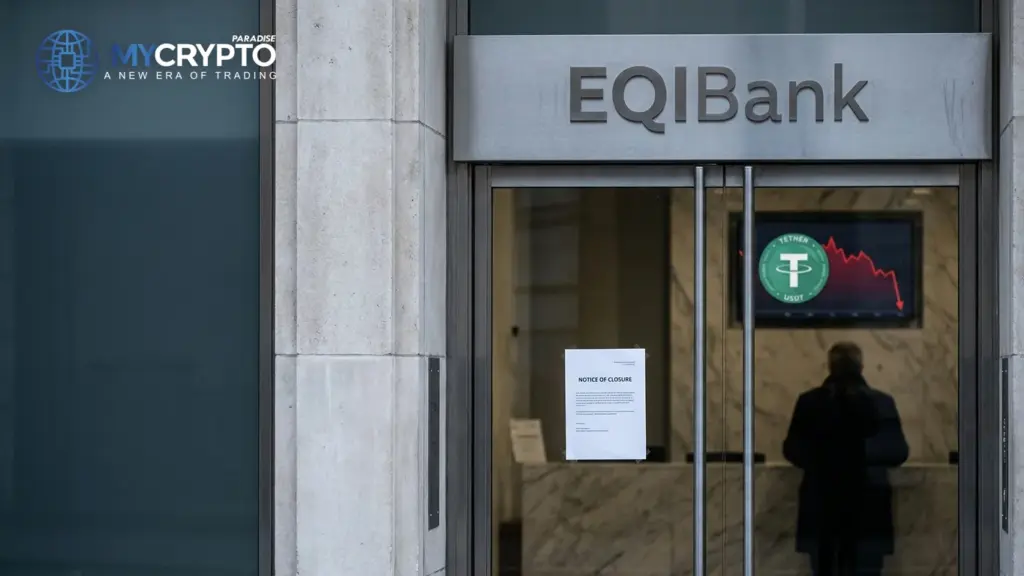
Tether confirms minimal EQIBank exposure following $89M US asset seizure
Developing story: This story is still unfolding. We are tracking it and will update this article as more details are confirmed.
Market briefing: Tether has funds stuck at EQIBank as the offshore lender faces liquidation risk, yet BTC held near $84,571 and ETH near $2,692. The ParadiseTeam reads that calm as distribution, not strength.
- Tether has funds stuck at EQIBank, which faces liquidation risk after U.S. authorities seized linked assets.
- EQIBank is fighting to recover $89 million seized from U.S. payment provider accounts.
- BTC held near $84,571 and ETH near $2,692, shrugging off the counterparty scare and this week's $350M Bitget hack.
Tether has funds stuck at EQIBank, and the offshore lender now faces liquidation risk after asset seizures. The market barely blinked. Should it have?
Tether has funds stuck at EQIBank. That single line should stop any trader mid-scroll. EQIBank, an offshore banking partner, now faces liquidation risk after U.S. authorities seized assets linked to it.
The bank is fighting to recover $89 million seized from U.S. payment provider accounts. If those seizures continue, EQIBank could be pushed into formal liquidation proceedings. Tether's exposure sits inside that fight, and the size of the trapped funds is not yet clear.
What is clear is the pattern. Counterparty risk rarely announces itself politely. It leaks out through one bank, one seizure at a time.
This lands in a jittery week. Crypto exchange Bitget just lost $350 million from its hot wallets, the year's largest single drain. Now a stablecoin plumbing story arrives on top of it.
Yet BTC was trading near $84,571 as of the print, up 0.2% on the day, with ETH around $2,692. The market shrugged. That shrug is the real story.
A stablecoin as systemic as Tether hitting banking trouble should register somewhere in price. Instead retail keeps buying strength, apparently confident that this time the plumbing holds.
One Ethereum whale did not share that confidence. Wallet 0x8c58 sold 42,005 ETH, cutting its stack to 9,996 ETH worth about $26.8 million, selling into the broader decline. A recent ETH liquidation printed at $2,663.36.
So we have two crowds. One is offloading quietly. The other treats a counterparty warning as background noise. History suggests only one of them is usually right.
Why stablecoin plumbing risk reaches every chart
Tether is not just another token. It is the settlement layer under most of crypto trading. Traders quote pairs in it, park cash in it, and move between exchanges through it. So any crack in Tether's banking rails is a crack under the whole market's feet.
The mechanism runs through trust and liquidity. If confidence in a stablecoin's backing wobbles, holders rush to redeem or rotate. That pressure pulls real dollars out of the banking partners holding the reserves. A bank already facing seizures and liquidation risk is the last place that pressure wants to land.
Here is the transmission chain. EQIBank exposure raises counterparty concern. Counterparty concern tightens liquidity across exchanges. Tighter liquidity makes every position more fragile, because there is less depth to absorb a rush for the exit.
None of this requires Tether to fail. It only requires traders to start pricing the possibility. Markets move on perceived risk long before any confirmed loss.
That is why we frame this as a warning sign, not a verdict. The confirmed facts are narrow: funds stuck, a bank in trouble, $89 million contested. The systemic read is ours, and we label it as analysis, not fact.
The uncomfortable part is timing. Counterparty stress tends to surface when leverage is highest and complacency is deepest. A press release can always sound calm. A balance sheet under seizure rarely is.
How the risk cascades from BTC to alts
Start with the plumbing, then watch the pipes. If Tether liquidity tightens, the first pressure shows in spreads and depth, not headlines. Order books thin out. Slippage widens. That is the quiet phase.
BTC feels it first because BTC is the deepest, most collateralised asset. When liquidity tightens, leveraged longs get squeezed toward the nearest pool of stops. BTC was near $84,571 as of the print, sitting below the $88,000 resistance we track. A market that cannot reclaim resistance on this kind of news is telling us something.
ETH sits one rung down the risk ladder. It reacts harder to liquidity stress because its buyer base is thinner. The 0x8c58 whale trimming 42,005 ETH into weakness, plus a liquidation printing at $2,663.36, both fit a picture of larger holders reducing risk while price holds up.
Alts sit at the bottom of the ladder and take the worst of any cascade. They rally last and bleed first. In a genuine liquidity squeeze, alt order books can gap lower fast, because market makers pull quotes exactly when they are needed most.
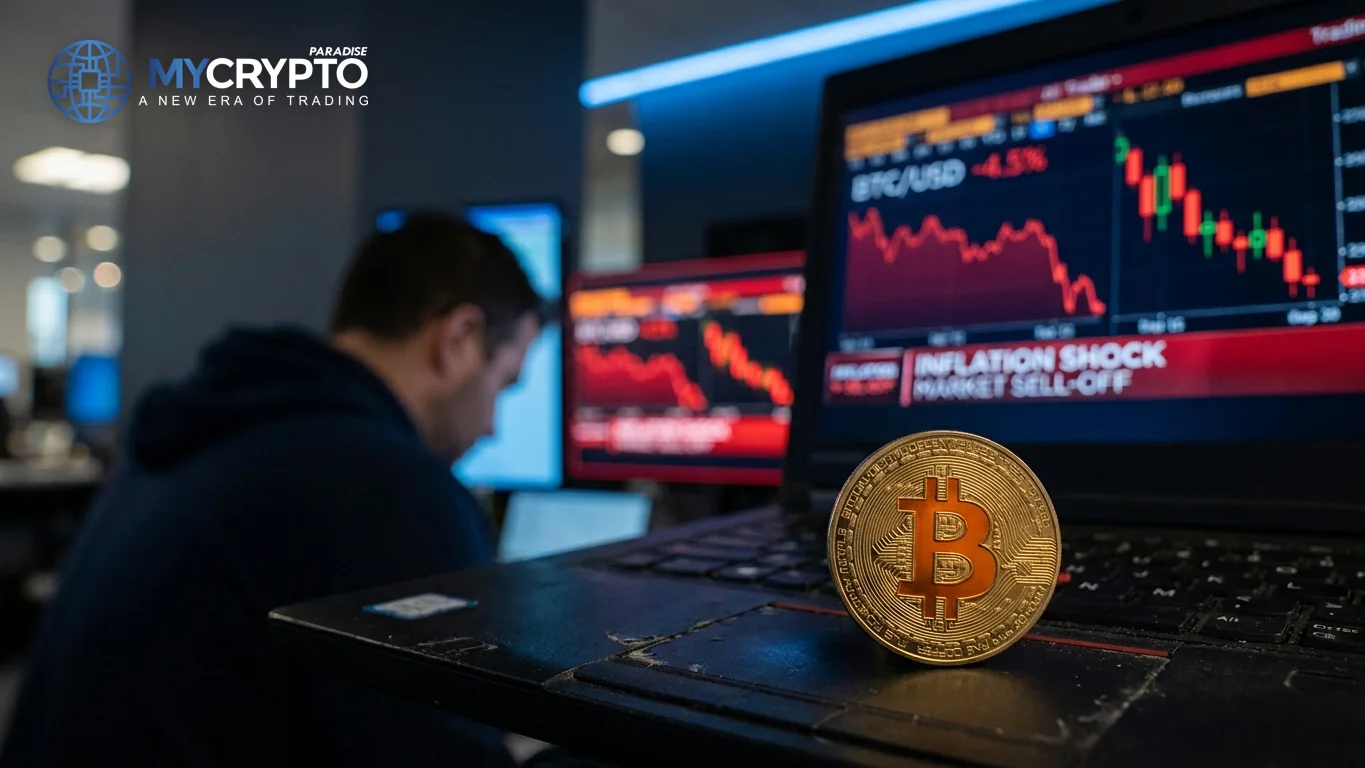
The tell to respect is the non-reaction. Bitget lost $350 million and Tether banking trouble surfaced, yet price barely moved. Bad news absorbed in extreme greed is not strength. It is often distribution, smart money handing coins to retail buying the resilience, before risk re-prices in one move rather than many.
What confirms or invalidates the downside read
Watch stablecoin behaviour before you watch candles. Unusual stablecoin flows onto exchanges, signs of redemption pressure, or a widening gap between a stablecoin and its dollar peg would confirm the counterparty concern is spreading. That is your early warning, ahead of price.
On the chart, the level that matters is $88,000. BTC reclaiming and holding above $88,000 would invalidate the immediate bearish read and open a path toward the $99,000 resistance. Until that reclaim, every rally into $88,000 is suspect, not a green light.
The downside markers are clear. A decisive loss of current support that sends BTC toward the $67,000 liquidation zone would confirm risk is re-pricing. Below that, our map points to the $44,000 to $55,000 region as the exchange-of-hands, the capitulation zone where smart money tends to reaccumulate.
For ETH, keep the $2,663.36 liquidation level in view. Repeated failures there, with whales still trimming, would point to distribution rather than accumulation.
Sentiment is the quiet confirmer. As long as the crowd stays in extreme greed and dismisses counterparty stories, the conditions for a sharp re-pricing stay loaded. A shift to fear, ironically, would be healthier.
One honest caveat. There is no single confirmed same-day catalyst forcing a move. This is an interpretive read of structure and flow, not a claim that Tether news alone will crack the market. Watch the confirmations. Let price, not the narrative, cast the deciding vote.
What EQIBank risk means for liquidity
The ParadiseTeam reads this through one lens: smart money distributing into retail greed, with counterparty risk as another reason to lighten up. This Tether news does not create the bearish structure. It reinforces it.
Ground it in price. BTC was near $84,571 as of the print, below the $88,000 resistance and well under $99,000. The market absorbing a stablecoin banking scare and a $350 million exchange hack without falling is not the flex retail thinks it is. Bad news landing softly, near resistance, in extreme greed, is a classic distribution fingerprint.
Here is who is doing what to whom. Larger holders, like the whale cutting 42,005 ETH, appear to be handing risk to a crowd that keeps buying strength. Retail is providing the exit liquidity. That is the mechanism, not a moral judgement.
Where do the stops sit? Beneath current support, stacked toward the $67,000 zone. Those pools are exactly what a liquidity-tightening event tends to hunt. The ParadiseTeam sees the deeper $44,000 to $55,000 region as the more meaningful exchange-of-hands, where aggressive reaccumulation becomes the higher-probability behaviour.
The invalidation is honest and specific. A clean reclaim of $88,000 would force us to respect upside probability and step back from the bearish read.
Until then, the ParadiseTeam bias stays defensive: protect open longs by trailing the SL (stop-loss) toward breakeven, avoid chasing strength into resistance, and let the counterparty story remind you that complacency is a position, not a strategy.
The read behind this: we framed this story through our own market analysis, Can Bitcoin Reach a New High at $169K?
Track it live: our crypto liquidation heatmap and the Crypto Fear and Greed Index both update in real time, so you can watch this shift for yourself.
Related coverage
For exact entries, targets, and stop losses with full risk management, that is what ParadiseFamilyVIP is for. New to reading these moves? Start with our crypto trading strategies guide.
ParadiseTeam is monitoring the market situation closely, and we are taking these developments into consideration while building our trading tactics inside ParadiseFamilyVIP.
Crypto trading involves substantial risk. Prices are volatile and you can lose money. This article is educational and is not financial advice. Past performance does not guarantee future results.
Does BTC lose the $67K zone before it reclaims $88K resistance?
This is how 17 Paradisers are calling it. Tap your call.
No calls on this one yet. Tap yours to be the first.
Free account, no password. Members just sign in.
Follow this topic: Crypto liquidation news · Stablecoin news






Join the discussion 36
i wonder if the bigger players already knew this was coming, you know, before it even hit the news 🤔 it always makes me think like that
Totally, Grace! It's like they already have the cheat codes for the game, right? 🎮 I always wonder about the domino effect on other platforms too 📉.
Yeah, I wonder if the retail side ever gets a fair shake then... like, with all that info out there already 📉
man, counterparty risk still gets me sometimes. I always forget until I'm already in deep, then it's like "oh, right!" 🤦♂️ you guys ever get that?
Wondering if the distribution angle here accounts for the increasing redemption pressure and if this pushes T-bill allocation even higher... 🤔
I'm actually seeing this as more of a distribution risk than supply. It's making me really nervous about centralized options even for stablecoins 🥺.
distribution risk?! what about the actual, immediate liquidation risk for normal people caught up in that mess, yuki?! 🤦♂️ thats the real issue here.
That's a good point about distribution risk, Yuki. I was also thinking about how this could impact confidence in other smaller stablecoins too... like outside of USDT.
so is the counterparty risk always there... even with the bigger players... like this. i was just wondering.
samuel, thats a bit rich mate 🙄 counterparty risk aint some fine print thing you miss, its always there, lurking. its the whole damn game 🎲. 😠
all this just reinforces why I'm cautious about anything not actual sats, and always move coins off exchanges whenever possible.
Counterparty scare = more distribution" 😬? When my brother sends money, all I see is "more headache" until it lands in Dakar 😅. This just makes the rails look shaky, no? 🛤️🤷♀️
Oh, Amara, sorry, but I see it differently! If the rails look shaky, doesn't that make people want to hold their own bags, not send them out to distribute?!
marta, "hold their own bags" is not how remittances work 🤷♀️. if my brother can't send €100 for rent, that means *less* distribution, not more, because it never even left his pocket 🤔. who wants to use rails they dont trust?? 🚧💸
Haha Amara, *shaky rails* is a good way to put it! 😬 For me, it always feels like the next domino is waiting to fall somewhere else too 📉🤔
Amara you hit it, these counterparty risks just raise the friction and slow down movement especially on the exchange side when funds are held up from clearing.
distribution?? 🤦♂️ it's not "distribution" if it's trapped in a bank's liquidation, Amara. that's just a bad bet, pure and simple. 💸📉
Bad bet" for the *user* trying to send money, exactly! 🙄 My point is, the minute a stablecoin transfer hits a snag like this, it looks just like a regular bank wire getting stuck. 🙅♀️ Same old headaches! 😩
been there... buddy blew himself up on a leveraged long when he didnt read the fine print... hard lesson. stability is the main thing.
yeah stability is key to avoid those blowups. with this EQIBank news im watching redemption flow shifts closely
leverage is just a tool, Ray... it amplifies whatever setup you have. good or bad.
kinda surprised ParadiseTeam says distribution here 📉🤔 I feel like this news should make people scared to *deposit* into stablecoins, not sell them 💸🤷♀️
So, is this EQIBank debit going to hit the redemption balance sheet for Tether, or are we looking at a write-off? My wife will just ask if that means less *my* USD. 😂
i dont understand the idea of "distribution" from this. people talk about leverage like its a game, but its other peoples money often, and then what happens when the bank blows up?! Ray, your friend was lucky.
yeah this just shows why i gotta keep checking all my sources, not just trust the first headline. too many little things can mess up your day... 🤦♂️
Exactly. It's not just the headlines; you have to look at the on-chain flows to see how the market is truly responding.
lol yeah, totally! 😅 but also the bank run risks, like, sometimes thats the actual catalyst for the market to move, not just the headlines right? 🚀
This is why you stay liquid, always.. never trust a third party with size.
Ugh, this is why I'm always looking at the on-chain stuff for USDT, you know? 😬 Too many times I learn about these things too late! 😭💸
Carlos, on-chain data for USDT is good o 🧐 but then you still have to worry about the legal stuff and where Tether parks their cash. 😩⚖️ That can also blow up. 💥📉
jesus another reminder why leverage is just the bookies wih nicer screens 🤦♂️ learn it the hard way once, never again 💸 this isnt "distribution" its just ppl getting burned by counterparty risk imo. 🔥
this liquidation risk just highlights why borrowing is pain, especially for folks who only see upside and dont read the small print like ray says
idk, "more distribution" here feels like a stretch 🤔. four-hour noise is not a signal.
is the market now expecting a supply shift with this news, or is the liquidation risk still too early to quantify?
Kenji, good question on the supply shift… I'm also thinking about what this means for other stablecoins in the short term, if this worry spreads a bit…
Kenji - The supply side is a factor, but the immediate concern is how quickly that USDT capital can redeploy. Cash flow matters more than theoretical supply right now.