

In short
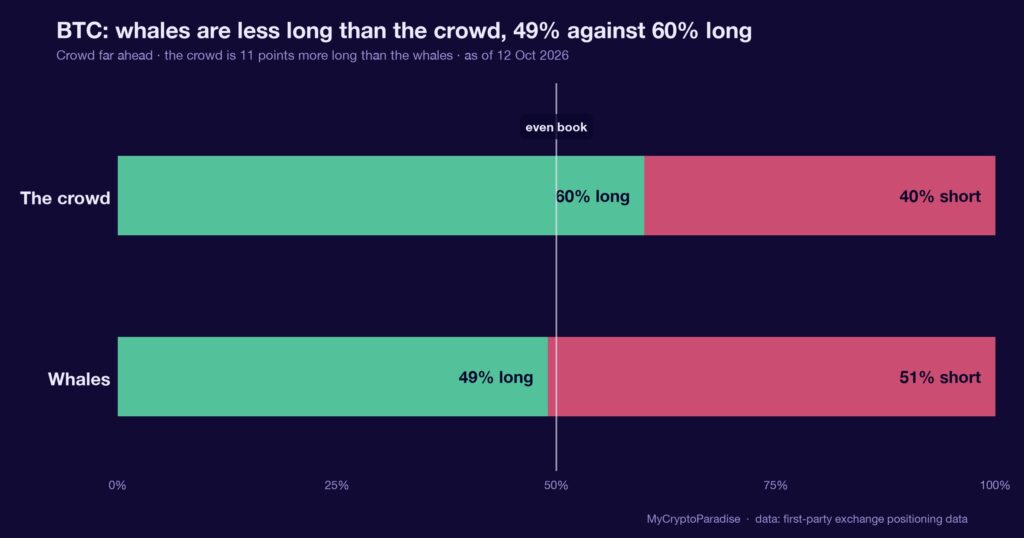
Whale flow is the aggregate of large on-chain and derivatives orders, read as a cohort rather than as any single trade. On 12 October 2026 the MCP on-chain Insider feed flagged one bearish position: a $35.6 million Bitcoin short at 13x leverage. Before repeating it, we checked our own tape. Over the prior 24 hours our MCP Insights whale radar logged net buying of $23.99 million across 70 orders on 11 venues, and the largest single order was a $37.45 million buy, not a sell. Our whale index reads 64 on the buy side, in the 82nd percentile of the last 30 days. So we called it constructive, not a reversal: one leveraged short is a position, not a cohort. The crowd sitting 60 percent long against whales at 49 percent is the honest caution. This piece shows you how to read whale flow yourself.
Key facts
- Whale long share on BTC
- 49%
- Crowd long share on BTC
- 60%
- Crowd minus whales, long share
- +11 points
- Positioning read
- Crowd far ahead
- What would prove this read wrong
- Our net 24-hour whale flow flipping back to selling with the whale index leaving the buy side (spot lean below zero) for a full session, or whales turning net sellers while the crowd stays 60 percent long.
- Reading taken
- 12 October 2026
- Source
- Our MCP Insights tools, from our own MCP Insights first-party data
One order is not a cohort
Whale flow is a reading about a group, not about a trade. A single large order tells you what one participant did; the cohort tells you what the balance of large money is doing. The two answer different questions, and confusing them is the most common error in reading a flow alert.
A headline built on one position borrows the drama of size and quietly drops the context of direction. The cohort is the context.
Our tape was net buying while one whale faded
On 12 October 2026 the MCP on-chain Insider feed reported a $35.6 million Bitcoin short opened at 13x leverage. Our MCP Insights whale radar read the opposite balance. Over the prior 24 hours it logged $215.69 million bought against $191.70 million sold, a net $23.99 million of buying across 70 orders on 11 venues.
The largest single order of the day was a $37.45 million buy on a Bybit perpetual, not a sell. No whale position was liquidated in either direction. Our whale index sits at 64 on the buy side, with a spot lean of 0.93 and positioning in the 82nd percentile of the last 30 days.
Size makes a headline; direction makes a read. The tape had both, and they pointed opposite ways.
What is different here
The ParadiseTeam does not repeat a flow alert until our own radar confirms it. A headline names one order; we read the 24-hour cohort, the whale index and the funding carry before we form a lean. When the single trade and the balance disagree, we publish the disagreement, not the louder half.
A leveraged short cuts both ways
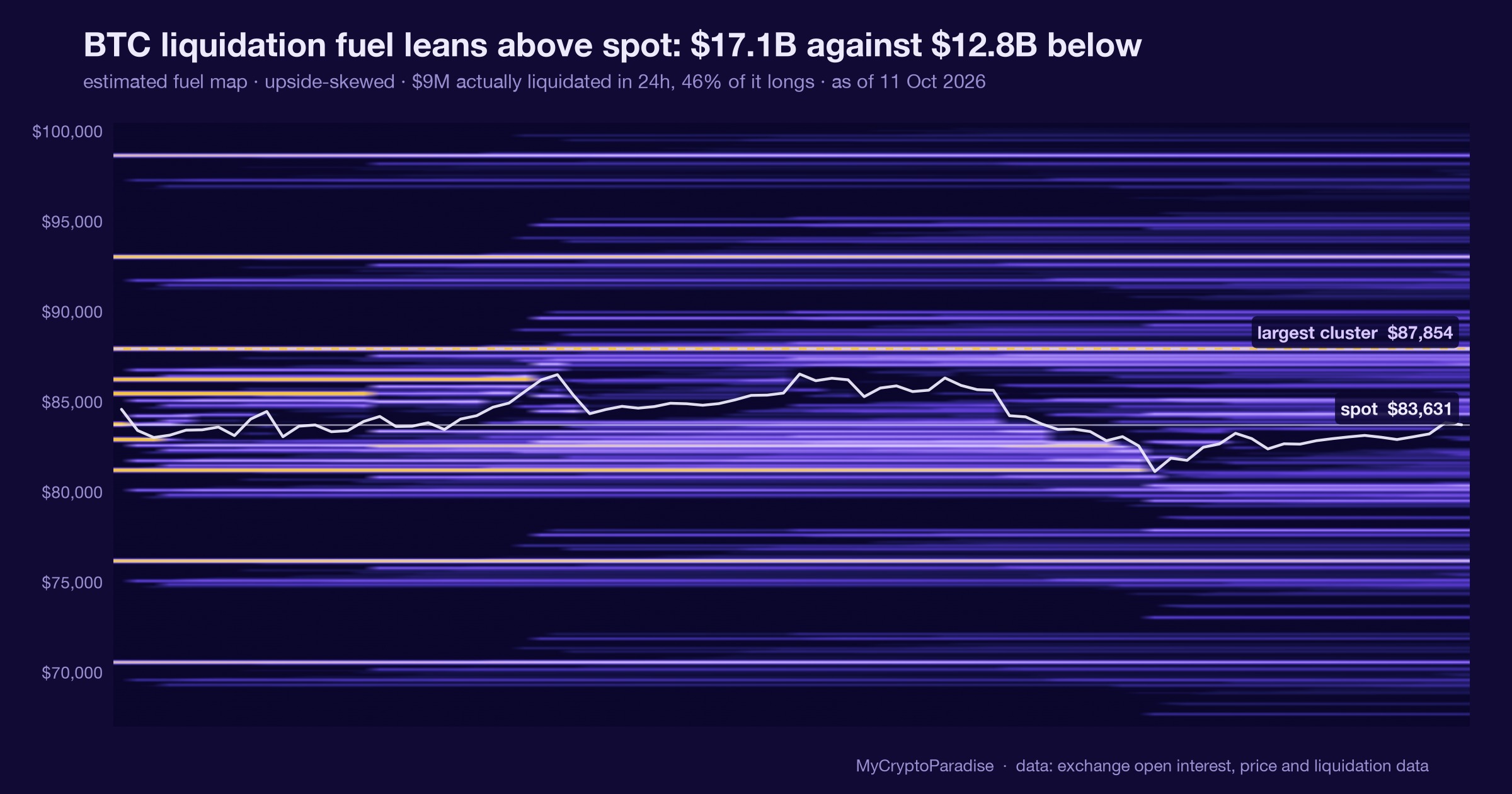
A $35.6 million short at 13x is not only a bearish view. It is also fuel: leverage that size needs price to fall to stay solvent. If price rises instead, the position turns into a forced buyer at its liquidation level.
Our radar also logged a perpetual sweep above $50 million on Bitcoin in the same window, and seven giant events on the day. Size is arriving on both sides; the question is never whether whales are active, but which way the balance leans.
The same order reads as conviction on the way down and as kindling on the way up. Which one it is depends on the cohort around it, not on its own size.
The crowd is longer than the whales
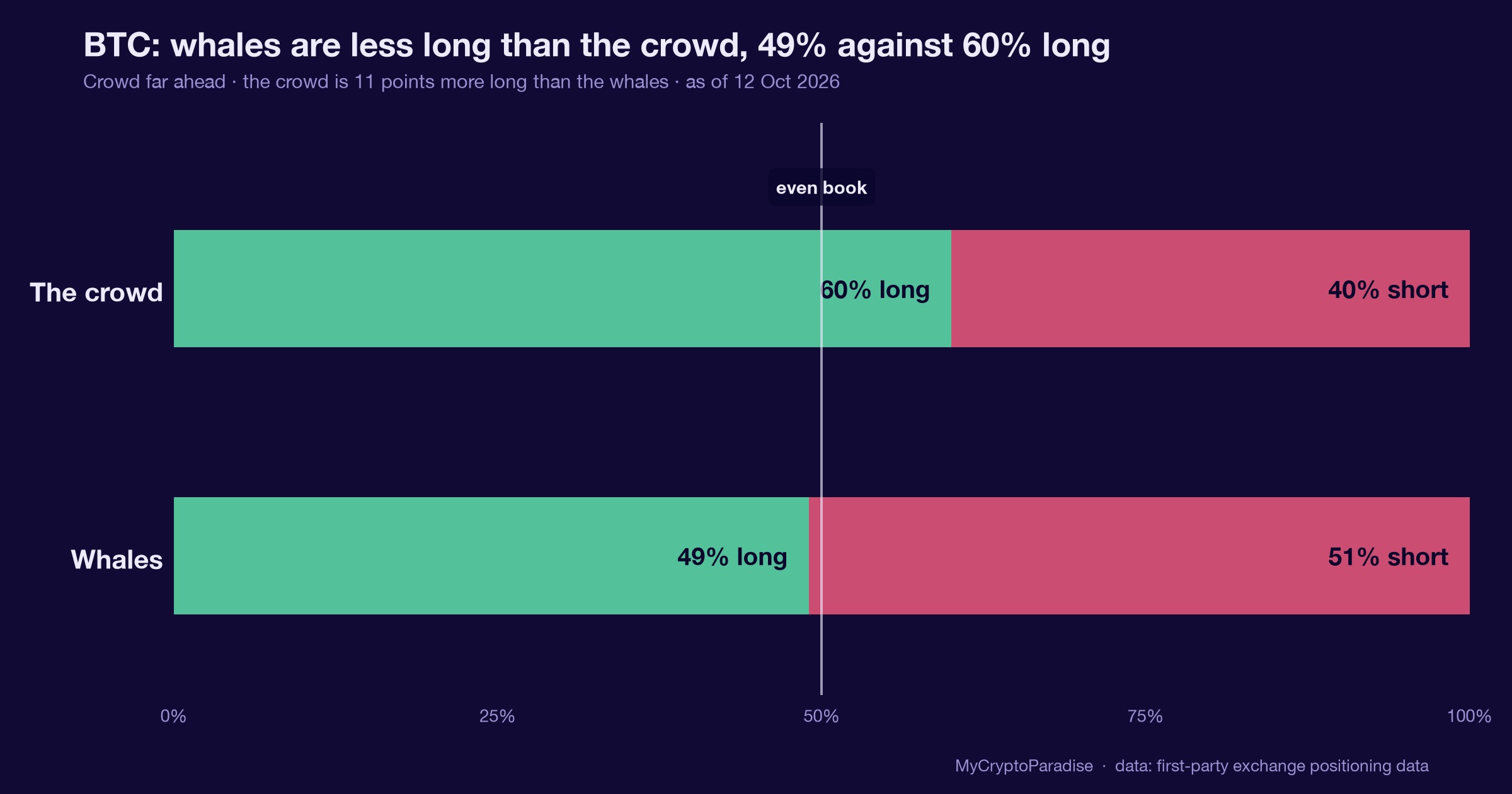
The sharper split is not one short against a buying tape. It is the crowd against the whales. Our positioning read shows the crowd 60 percent long while whales sit at 49 percent, a gap of 11 points with the crowd far ahead.
Funding sits at roughly 4 percent a year with longs paying shorts, so the crowd is paying a small carry to hold its lean. That is the carry framing: the single short is being paid to wait, while the whale cohort accumulates spot, which costs no funding at all.
This is one input. Whale flow sits alongside funding, open interest (OI) and spot absorption, and today it disagrees with the single bearish headline while agreeing with the funding carry. A gauge is a probability weight on a bias, never the bias itself.
Our last whale read saw the opposite tape
One week ago, on 5 October, this same feed called a $77.2 million buy aggressive accumulation, and our radar disagreed from the other side: the cohort was then net selling $30.54 million. Today the tape has flipped. The net is positive, the whale index has moved to the buy side, and spot absorption is strong.
A flip in the tape is not a trend; it is one session reversing another. We mark it, we do not marry it, and the invalidation below is what tells us if it holds.
Reading whale flow yourself, step by step
- Start with the cohort, not the headline: pull net 24-hour whale flow before you react to any single order.
- Separate buys from sells and note the largest order on each side, with its venue and whether it was spot or perpetual.
- Check the whale index and its percentile: a buy-side score near the top of 30 days is accumulation, not noise.
- Compare whale positioning against the crowd: when the crowd is longer than whales, treat the crowd’s lean as the weaker hand.
- Read funding last: it tells you which side is paying to hold, and a small positive rate means longs carry the cost.
The step most skip is the percentile. A $35 million order sounds enormous in isolation, but against a 30-day book it may be an ordinary day’s size.
Every number above is checkable against the live data. Start with the MCP Insights hub, then cross-read the Crypto Fear and Greed Index and the live crypto funding rates.
Act and invalidate
| Scenario | What confirms it | What kills it |
|---|---|---|
| Cohort keeps accumulating | Net flow stays positive | Net flow flips negative |
| Crowd long unwinds | Whale gap narrows | Crowd 60%+ holds, whales sell |
| Short becomes fuel | Price reclaims and squeezes | Price breaks the short’s level down |
Posture: Posture is modestly constructive but unleveraged: the cohort is buying and the crowd’s long is the weaker hand, yet a single flip in net flow resets the read. Size positions for the lean, not for certainty.
Frequently asked questions
Does a $35.6 million short mean Bitcoin is going down?
Not on its own. One leveraged short is a single participant’s view, and over the same 24 hours our radar logged net buying of $23.99 million with the largest order a $37.45 million buy. The cohort leaned the other way.
What is the whale index telling us today?
It reads 64 on the buy side, in the 82nd percentile of the last 30 days, with a spot lean of 0.93. In plain terms, large money is accumulating spot more than it has on most days this month.
Why does the crowd being long matter here?
Our positioning read shows the crowd 60 percent long while whales sit at 49 percent, an 11-point gap. When smaller accounts commit harder to a direction than larger ones, the larger ones usually keep the room to be right.
How can one short position push price up?
A short at 13x leverage needs price to fall to stay solvent. If price rises into its liquidation level instead, the exchange closes it by buying, so the same position that bet on a drop becomes a forced buyer on the way up.
What would change this read?
A clean flip in our net 24-hour whale flow back to selling, with the whale index leaving the buy side for a full session, would retire the constructive lean. A widening crowd-whale gap with whales turning sellers would do the same.
Crypto trading involves substantial risk and is not suitable for everyone. Nothing here is financial advice; it is education only. Never risk more than you can afford to lose.
The private Extras feed, where the whale radar, whale index and positioning split update intraday with their invalidation levels, is part of PRO Paradiser, the intelligence layer behind the ParadiseFamilyVIP strategies.










Join the discussion
No comments yet. Members, share how you are reading this.