

Listen: the breakdown
Update on this developing report (September 02, 2026, 23:38 UTC):
Our sources confirm new details in the ongoing lawsuit against Tether. Plaintiffs now explicitly allege the $42.4 million USDT freeze occurred without a formal court order, in addition to being before a seizure warrant. This clarification could intensify scrutiny on stablecoin issuers’ operational protocols and their interactions with law enforcement.
Tether has also expanded its public statement, asserting the case is a baseless attempt to interfere with its crucial work alongside global law enforcement agencies. This stronger denial reinforces their position that the lawsuit lacks merit.
Despite these clarifications, the broader market impact remains contained, with minimal price movements in major cryptocurrencies. Traders should continue to monitor regulatory developments for any shifts in stablecoin oversight.
What to watch now: Monitor any further legal filings or official statements from Tether or the plaintiffs regarding the alleged court order absence.
Update on this developing report (September 02, 2026, 22:54 UTC):
Tether has issued a statement clarifying its operational policy regarding law enforcement cooperation. The company confirmed it works with global law enforcement agencies, specifically mentioning the Department of Justice.
This statement provides context to the ongoing lawsuit where plaintiffs allege Tether froze $42.4 million USDT based on an informal request from U.S. law enforcement, prior to a formal warrant.
What to watch now: Monitor for further official statements from Tether or initial court responses regarding their law enforcement cooperation policy.
Update on this developing report (September 02, 2026, 22:12 UTC):
New information confirms the alleged informal request to Tether, which led to the freezing of $42.4 million USDT, came from Homeland Security Investigations (HSI). This detail specifies the U.S. law enforcement agency involved in the plaintiffs’ allegations.
For traders, this clarification adds specificity to the ongoing lawsuit but does not fundamentally alter the initial assessment of regulatory uncertainty surrounding stablecoin operations. The core allegations and Tether’s defense remain unchanged, suggesting no immediate shift in market sentiment related to this specific development.
What to watch now: Watch for any official statements from HSI or further legal filings that might elaborate on the nature of the informal request.
Update on this developing report (September 02, 2026, 21:50 UTC):
Our sources confirm new details regarding the ongoing lawsuit against Tether. The plaintiffs are now explicitly seeking not only damages but also the disgorgement of reserve yield, clarifying the financial scope of their demands.
This development underscores the potential financial implications for Tether should the lawsuit proceed unfavorably, adding a layer of scrutiny to its operational transparency and reserve management. Traders should note this specific claim as it could influence future sentiment around USDT’s stability.
What to watch now: Watch for any official response from Tether regarding the specific claims for damages and reserve yield disgorgement.
Update on this developing report (September 02, 2026, 20:46 UTC):
Our sources confirm the lawsuit against Tether, alleging an unlawful freeze of $42.4 million USDT, was officially filed on August 31. This provides a specific timeline for the legal proceedings.
What to watch now: Traders should monitor further developments in the legal proceedings as the case progresses.
Update on this developing report (September 02, 2026, 20:01 UTC):
A key detail in the lawsuit against Tether has been clarified. Our latest information confirms the complaint was filed on August 31, 2024, correcting previous reports that indicated a 2025 filing date.
This update means the lawsuit, which alleges Tether froze $42.4 million USDT across 10 Ethereum addresses, was initiated in 2024 concerning an event purportedly occurring on October 30, 2025. This unusual timeline, where a lawsuit precedes the alleged event by over a year, adds a unique dimension to the ongoing legal challenge.
Tether continues to maintain the case is without merit. Traders should observe how this clarified timeline impacts market sentiment and any further legal proceedings, particularly regarding the specifics of the alleged pre-warrant freeze.
What to watch now: Traders should monitor for further clarifications on the lawsuit's timeline and any market reaction to the unusual chronology of events.
Update on this developing report (September 02, 2026, 19:18 UTC):
Tether has issued a more detailed response to the lawsuit alleging a pre-warrant freeze of $42.4 million USDT. The company now states the case is a “baseless attempt to interfere with Tether’s important work with global law enforcement,” reinforcing their earlier claim of no merit.
All other core details of the lawsuit, including the alleged freeze amount, addresses, and timing, remain consistent with our initial report. The legal challenge continues to highlight the ongoing scrutiny on stablecoin operations and their interaction with law enforcement.
Traders should monitor Tether’s legal defense and any potential market sentiment shifts as this case progresses, particularly concerning the broader implications for centralized stablecoin issuers.
What to watch now: Watch for further legal filings from Tether and any market reaction to their expanded defense.
Update on this developing report (September 02, 2026, 18:13 UTC):
New details confirm the lawsuit against Tether was officially filed on August 31, alleging the freeze of $42.4 million USDT occurred after an informal request from U.S. law enforcement, specifically Homeland Security Investigations (HSI).
Tether has issued a strong rebuttal, stating the case has no merit and is a baseless attempt to interfere with its ongoing cooperation with global law enforcement agencies.
This official response from Tether adds a new dimension to the ongoing regulatory scrutiny of stablecoins. Traders should continue to monitor legal proceedings for any impact on stablecoin market sentiment and broader crypto asset stability.
What to watch now: Watch for further legal developments in the Southern District of New York and any subsequent market reactions to Tether's defense.
Update on this developing report (September 02, 2026, 17:07 UTC):
Our sources now confirm the precise amount of USDT alleged to have been frozen by Tether in the ongoing lawsuit is 42,417,785.62 USDT. This refines the previously reported figure of approximately $42.4 million.
Further details indicate the plaintiffs allege this freeze occurred more than three months before any U.S. seizure warrant or court order was issued. This provides a more specific timeframe for the alleged pre-warrant action.
What to watch now: Traders should monitor the court proceedings for any official response from Tether or further clarification on the alleged informal law enforcement requests.
Update on this developing report (September 02, 2026, 16:24 UTC):
New details in the ongoing lawsuit against Tether reveal that the alleged informal request to freeze 42.4 million USDT came specifically from Homeland Security Investigations (HSI). This clarifies the source of the U.S. law enforcement request mentioned in the original complaint.
HSI is known for its investigations into financial crimes and illicit finance, adding a layer of specificity to the regulatory scrutiny Tether faces. This development underscores the increasing pressure on stablecoin issuers to comply with U.S. law enforcement requests, even in the absence of formal warrants.
Traders should continue to monitor this case closely, as the identification of HSI could influence perceptions of regulatory oversight on stablecoin operations and potentially impact broader market sentiment regarding centralized stablecoin reliability.
What to watch now: Watch for any official statements from Tether or HSI regarding the alleged informal request and its implications for stablecoin operations.
Update on this developing report (September 02, 2026, 15:41 UTC):
New details have emerged regarding the lawsuit against Tether, confirming the case was filed in the U.S. District Court for the Southern District of New York. This specifies the jurisdiction for the ongoing legal challenge concerning the alleged freezing of $42.4 million USDT.
Additionally, our sources confirm the complaint was officially filed on August 31, 2026. This provides a concrete timeline for the legal action, which alleges Tether acted on an informal request from U.S. law enforcement months before a warrant was issued.
What to watch now: Traders should monitor court filings for further details and any official response from Tether regarding these specific dates and jurisdiction.
Update on this developing report (September 02, 2026, 13:06 UTC):
New detail on the Tether case: the roughly 42.4 million USDT that plaintiffs say was frozen is now tied to a wider $61 million fraud probe, based on our sources. That reframes the freeze as part of a larger investigation rather than an isolated action against the two Thai account holders.
For traders the practical read is unchanged. This remains a governance and headline risk around a centralized stablecoin issuer, not a de-pegging event. USDT continues to trade at par and there is no confirmed operational impact on redemptions.
What to watch now: Any official Tether response, or confirmation of how much of the $61M probe touches other addresses or issuers.
Market briefing: A new lawsuit accuses Tether of freezing 42.4 million USDT without a warrant, reviving the centralization risk under every stablecoin. Bitcoin traded near 76,573, down about 1.8 percent on the day, as the story fed a cautious tape.
- A lawsuit in the U.S. District Court for the Southern District of New York alleges Tether froze 42.4 million USDT on an informal request, with no warrant or court order.
- The freeze hit ten Ethereum addresses on October 30, 2025, and sits inside a wider 61 million dollar fraud probe.
- The story is not the amount but the mechanism: the largest stablecoin can be switched off, and that is a liquidity risk traders rarely price.
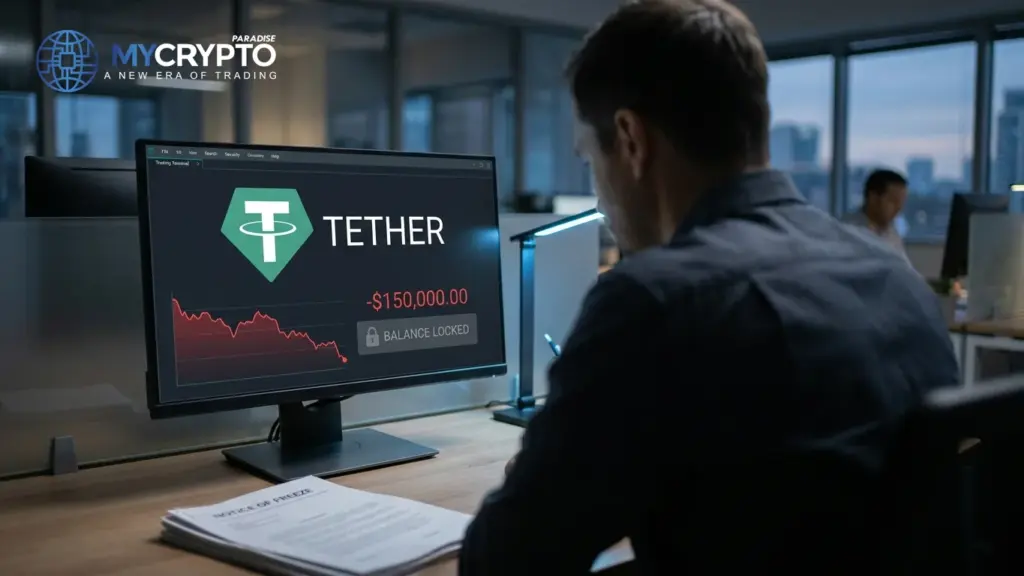
A Tether freeze lawsuit now claims the issuer locked 42.4 million USDT with no warrant, only a phone call. If a stablecoin can be switched off on request, how safe is your liquidity?
Tether can freeze your money with a keystroke. A new lawsuit in the U.S. District Court for the Southern District of New York asks a harder question: can it do so without a warrant?
Two Thai businessmen, Nutthawat Rukthammachalern and Natthawat Kasamvilas, filed the claim. They allege Tether froze 42.4 million USDT across ten Ethereum addresses on October 30, 2025. The freeze, they say, followed an informal request from U.S. law enforcement. No warrant. No court order.
We covered the filing earlier today. What is new here is the mechanism, not the money. The complaint targets the how, not just the how much.
The funds sit inside a 61 million dollar fraud probe. That context matters, and we are not litigating guilt. The legal fight is over process: whether a private issuer should freeze assets on a phone call.
Tether has always held this power. Its contract lets it blacklist addresses. Most holders never read that clause. They assume a dollar-pegged token behaves like a dollar in their pocket.
It does not. USDT is a liability on someone else's balance sheet, and that someone can switch it off.
For traders, the number to remember is not 42.4 million. It is the reminder that the largest stablecoin is a permissioned system wearing a bearer-asset costume.
A frozen wallet needs no warrant
USDT is the plumbing. Roughly every crypto trade routes through it in some form. When trust in the pipe wobbles, the whole system feels it.
This case attacks the pipe's weakest joint: discretion. The claim is that Tether acted on a request, not an order. If an agency can freeze balances by asking nicely, then every large USDT holder now carries a new tail risk.
That risk does not stay in one wallet. It re-prices the collateral that funds leverage across exchanges. Traders post USDT as margin. Market makers hold it to quote both sides. If holding it feels less safe, they hold less.
Less stablecoin float means thinner books. Thinner books mean sharper moves in both directions. The market becomes easier to push.
Here is the macro backdrop. Regulators are circling stablecoins worldwide, and issuers are under a microscope. This lawsuit hands that scrutiny a concrete, sympathetic story: ordinary account holders locked out without due process.
We separate fact from read. The freeze and the filing are confirmed. The claim that it dents broad liquidity is our analysis, not a settled outcome.
Still, the direction of the pressure is clear. Confidence in the settlement layer is a slow, quiet asset. It builds over years and drains in headlines. This is one of those headlines.
Stablecoin trust leaks into BTC liquidity
Bitcoin wears this first, because it is the market's pressure gauge. BTC traded near 76,573 as the story spread, down about 1.8 percent on the day. Small on its own. Telling as part of a pattern.
We do not claim this single lawsuit dumped the price. The facts confirm no single same-day catalyst. This is one weight added to a tape that was already heavy.
ETH took the harder hit, down about 3.4 percent near 2,373. That fits the usual order. When stablecoin risk rises, the assets furthest out on the risk curve bleed fastest, and Ethereum sits a step beyond Bitcoin.
Alts sit a step beyond that. Many trade only against USDT. If desks trim stablecoin exposure, the thinnest alt books lose bids first. Spreads widen, and slippage punishes anyone who market-sells into fear.
Watch open interest, or OI, the total value of open futures contracts. A drop with rising OI means fresh shorts pressing the story. A drop with falling OI means longs getting flushed, which is often closer to a bottom than a top.
The reflexive loop is the danger. Fear over the settlement layer trims liquidity. Thin liquidity amplifies the next move. That move deepens the fear. This is how a modest headline becomes an outsized candle in a fragile market.
Confirmation hides below the 58K shelf
The next weekly candle close is the tell. Our broader read looks for a bearish engulfing to confirm on the weekly, and this news gives sellers a reason to press it.
Resistance sits at 79,000. Price already failed there, printing a shooting star on the daily and weekly. Reclaiming 79,000 would put the bearish case on hold. Until then, rallies look like sellers borrowing time.
The line that matters below is 58,000. A clean break under it opens the path our analysis has flagged toward 44,000. Losing 58,000 on rising volume would be the confirmation, not a wick that snaps back the same day.
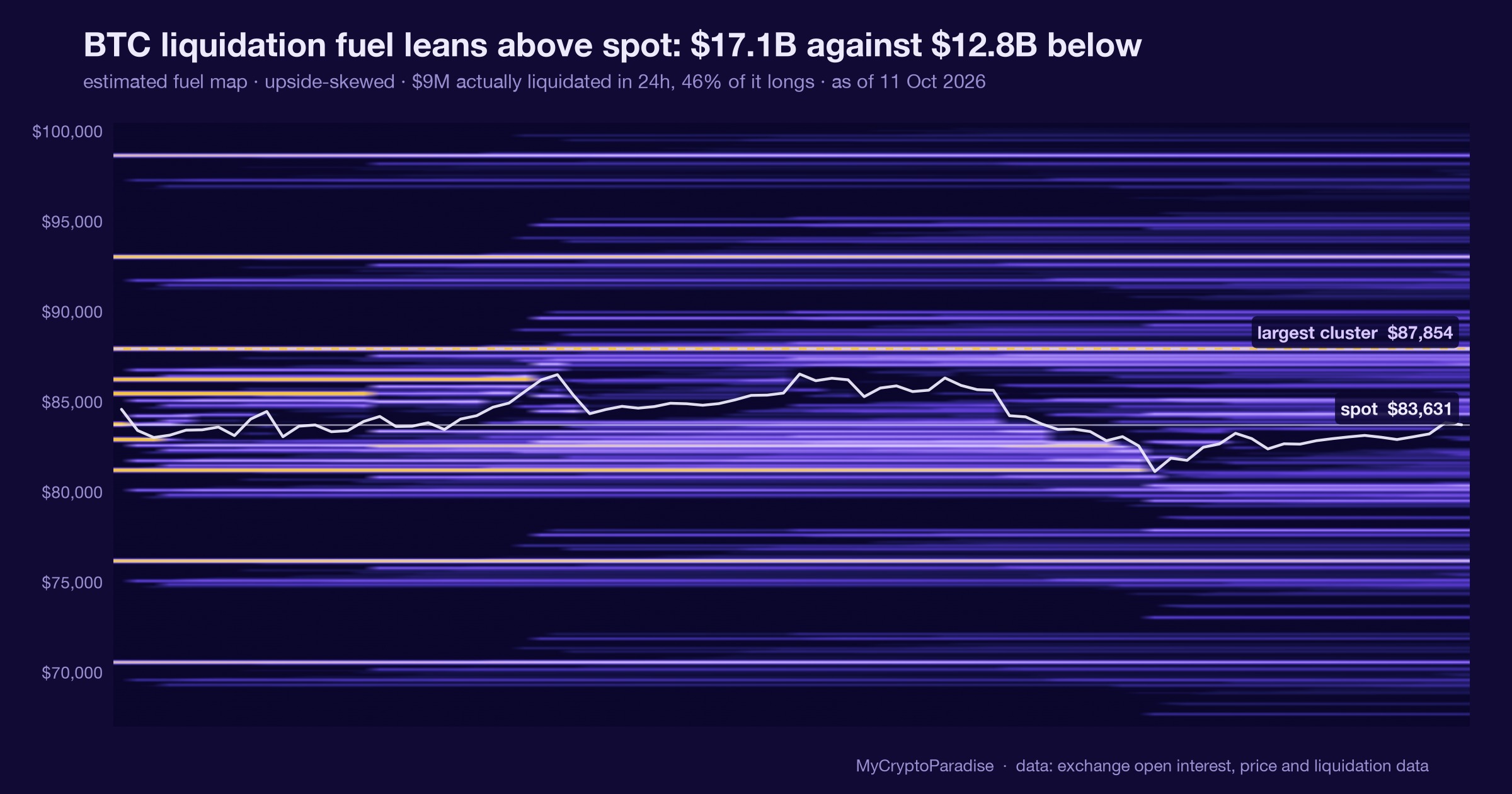
Liquidation clusters frame both edges. Longs stack near 57,000, shorts near 83,000. Price hunts the fuel. Market makers are incentivized to reach whichever pool is fatter, and right now the long-side stops below look inviting.
Invalidation is honest and simple. A decisive reclaim above the prior high, north of 79,000, would break the bearish structure. At that point the distribution read weakens, and forcing shorts becomes a losing fight.
Watch stablecoin behavior too. If USDT trades at a visible discount, or if large holders shuffle balances between exchanges, that is real fear in the plumbing. A steady peg, by contrast, says the market read this as noise. Both outcomes are on the table. We weight the downside.
Reading warrantless freezes through smart money
Fuel, not trigger. The ParadiseTeam treats this lawsuit as one more log on a bearish fire, arriving while retail piles into longs and calls the bottom. That is exactly the crowd behavior that tends to precede a flush.
Our medium-term bias stays bearish. We expect one more leg lower toward 44,000 before any real continuation. This story does not create that path. It greases it.
Consider the tape. BTC was near 76,573 as of the read, rejected from 79,000, sitting above the 58,000 shelf. That is distribution territory in our view: smart money selling into eager buyers while a clean fear narrative sits ready to be deployed.
Here is the edge. A stablecoin scare is textbook FUD to shake weak hands. If it drives capitulation into the 44,000 region, that is not where we would expect smart money to keep selling. That is where we would expect it to accumulate, from the same retail longs being liquidated on the way down.
So we read strength here as suspect and weakness here as expected. The invalidation is a reclaim of 79,000, which would flip the structure and force us to respect the buyers.
Risk first, always. Define your stop-loss, or SL, before the entry, keep your risk-to-reward, or R:R, honest, and let the market prove the thesis rather than assuming it. Probabilities, never certainties.
The read behind this: we framed this story through our own market analysis, Bitcoin Fails at $79K: Who Is Selling?
Track it live: our live crypto funding rates and the Crypto Fear and Greed Index both update in real time, so you can watch this shift for yourself.
Related coverage
For exact entries, targets, and stop losses with full risk management, that is what ParadiseFamilyVIP is for. New to reading these moves? Start with our crypto trading strategies guide.
ParadiseTeam is monitoring the market situation closely, and we are taking these developments into consideration while building our trading tactics inside ParadiseFamilyVIP.
Crypto trading involves substantial risk. Prices are volatile and you can lose money. This article is educational and is not financial advice. Past performance does not guarantee future results.
Does the Tether freeze lawsuit push Bitcoin toward the 44K flush?
This is how 37 Paradisers are calling it. Tap your call.
No calls on this one yet. Tap yours to be the first.
Free account, no password. Members just sign in.
Follow this topic: Stablecoin news









Join the discussion 16
See, this is why i'm still using mostly fiat to dca into things 😅, or keeping my stables off exchanges. A bit of a faff but worth it 🇮🇪🤞.
Oh wow, I remember when I used stablecoins to send money back to Da Nang 🇻🇳, this kinda news makes me check my small txs again just in case 🥶. My family really needed those cheap transfers! 🙏📉
It's true, that 42M figure is a lot... I move my small earnings to stablecoins, so this kind of news makes me check everything a few times. Still seems useful though.
Yeah, 42 million is a lot... but liquidity remains strong, and for me, it was always the only option when home banks shut down. The bigger picture here is still network resilience...
i always log my stablecoin txs on a separate blockchain explorer anyway, its just standard practice for me now.
Yes, and those logs are only as useful as the liquidity still available to you on an exchange.
Yeah, I totally do this too! 😅 And always check the actual contract address before you connect to anything new ✍️. So many scams out there! 🔥
i dont understand why they say the freeze was before a US warrant, its a global token right.
does a situation like this, if proven, really change the fundamental thesis for stablecoins as an onramp, or is it more a matter of choosing the right issuer?
It's not just the issuer, Priya. The underlying asset peg mechanism is key. Can the 1:1 be robustly audited and invalidated, or is it a black box?!
It means anyone with pesos, seeing their value disappear, needs to be careful where they park their capital. A dollar that stays a dollar feels like solid ground to me.
It’s true that a stablecoin tries to stay a dollar, Diego, but what about the risk of trusting someone else with your capital? 😟
Wait, 42 million USDT frozen without a warrant 🤦🏾♀️🤯? That definitely changes the math for my brother's transfers home. Are we sure this is progress?? 🤷🏿♀️🌍
Amara, if this is true... then it makes me think about how long it might take to unfreeze funds... if it happens.
Means less stable than a stablecoin... more like a bank account.
this is why my exit plan checklist now includes a separate line for "verify stablecoin liquidity and freeze risk" before any new trade is even considered