

Listen: the breakdown
Developing story update (September 02, 2026, 23:37 UTC):
Our sources confirm that U.S. Treasury Secretary Scott Bessent has announced expanded bond buybacks, providing specific context to the ‘Bessent move’ previously reported.
This action coincides with Bitcoin’s price coming under pressure due to a broader bond market rout, adding a direct macroeconomic factor to current market dynamics.
Furthermore, specific drivers for Bitcoin’s recent rally have been identified, including a weaker US dollar, softer bond yields, renewed spot ETF demand, and the ongoing debasement trade narrative.
What to watch now: Monitor the bond market rout's persistence and its impact on Bitcoin's price action, alongside the sustainability of recent rally drivers.
Developing story update (September 02, 2026, 22:55 UTC):
Ray Dalio, a prominent investor, has weighed in on Treasury Secretary Bessent’s expanded bond buybacks, suggesting they signal an approaching debt crisis. He recommends gold and bitcoin as hedges, adding a significant voice to the ‘debasement trade’ narrative.
Our sources indicate that while optimism is present, the market is currently characterized by active trader and analyst debate, rather than widespread retail mania or panic. This suggests a more measured environment than some headlines imply, with sentiment below late-August extremes.
Looking back, Bitcoin posted a strong 28% gain in August, reinforcing its recent upward momentum despite current minor price pressures.
What to watch now: Monitor how Dalio's comments influence institutional sentiment and watch for any further shifts in market characterization beyond current optimism.
Developing story update (September 02, 2026, 22:11 UTC):
Our sources confirm U.S. Treasury Secretary Scott Bessent has announced expanded bond buybacks, a government intervention expected to excite crypto investors. Notably, Ray Dalio views this move as a signal of an approaching debt crisis, prompting his recommendation for gold and bitcoin.
The market environment is now characterized by active trader and analyst debate, rather than broad retail mania or panic. While optimism is present, it remains below the extremes seen in late August, suggesting a more measured sentiment despite recent price action.
What to watch now: Monitor the market's reaction to Bessent's bond buybacks and Dalio's recommendation, particularly how it influences the ongoing debate among traders and analysts.
Developing story update (September 02, 2026, 21:07 UTC):
Our sources confirm Bitcoin is now experiencing pressure from a bond market rout, with price swings intensifying. This provides a new layer of context to the current market dynamics, as the initial surge above $80,000 was previously supported by factors including a weaker US dollar, softer bond yields, renewed spot ETF demand, and the debasement trade.
While the market continues to grapple with these influences, our read remains consistent: smart money is likely in a distribution phase, absorbing retail buying pressure. The current environment, marked by ‘Greed’ in the Fear & Greed Index, aligns with our expectation of a potential flush towards liquidation clusters.
What to watch now: Monitor the ongoing bond market rout and its continued impact on Bitcoin price action and volatility.
Developing story update (September 02, 2026, 20:44 UTC):
Our sources confirm a new external factor influencing Bitcoin’s recent price action. The cryptocurrency experienced a slump as oil surged to a three-month high, attributed to new Iran strikes. This development provides a specific geopolitical and commodity-driven context to Bitcoin’s short-term volatility.
Despite this, the broader market narrative remains centered on U.S. Treasury Secretary Scott Bessent’s expanded bond buybacks and Ray Dalio’s view of an approaching debt crisis, which continues to position Bitcoin as a recommended asset. Overall market sentiment holds at ‘Greed’, reflecting persistent optimism among retail investors.
Traders should closely monitor global oil prices and any further geopolitical escalations, as these could introduce additional volatility. We continue to observe the $79,000 resistance level for signs of smart money distribution, as previously noted.
What to watch now: Monitor oil prices and geopolitical developments for continued impact on Bitcoin's short-term volatility.
Developing story update (September 02, 2026, 19:40 UTC):
U.S. Treasury Secretary Scott Bessent has expanded his commentary, now indicating expectations for Tokyo and the Bank of Japan to intervene in support of the falling yen. This adds a new dimension to global liquidity discussions, suggesting a broader focus on currency stability that could indirectly influence risk assets like Bitcoin.
Our sources also highlight specific drivers behind Bitcoin’s recent surge above $80,000, including a weaker US dollar, softer bond yields, renewed spot ETF demand, and the ongoing debasement trade narrative. These factors provide crucial context for understanding the market’s recent movements and the current consolidation phase.
While these developments offer more detail, our smart money perspective remains consistent. The current price action, including the slight dip, aligns with a distribution phase, as retail optimism continues to build on these perceived bullish catalysts. We anticipate smart money leveraging this sentiment before a potential deeper correction.
What to watch now: Monitor global central bank actions and their impact on liquidity, alongside continued spot ETF demand.
Developing story update (September 02, 2026, 18:57 UTC):
Our latest intelligence reveals a notable shift in the macro environment impacting Bitcoin. We are now seeing intensified Bitcoin price swings, directly correlated with a broader bond market rout. This marks a change from earlier observations where softer bond yields were seen as a supportive factor for the rally.
This development introduces a new layer of volatility for Bitcoin. Traders should be aware that the bond market’s instability is now a significant driver, potentially leading to more pronounced price fluctuations.
What to watch now: Monitor bond market stability and its continued impact on Bitcoin's volatility.
Developing story update (September 02, 2026, 18:34 UTC):
A significant development sees Ray Dalio, a prominent investor, interpreting Treasury Secretary Bessent’s expanded bond buybacks as a sign of an approaching debt crisis. Dalio explicitly recommends both gold and Bitcoin as hedges against this potential scenario, reinforcing the debasement trade narrative for crypto investors.
Further supporting Bitcoin’s recent rally are identified macro factors including a weaker US dollar, softer bond yields, and renewed spot ETF demand. However, recent geopolitical events, specifically new Iran strikes driving oil to a three-month high, have been cited as a factor in Bitcoin’s short-term slump, introducing new volatility drivers.
What to watch now: Monitor institutional reactions to Dalio's debt crisis warning and the ongoing impact of geopolitical events on commodity prices and Bitcoin's volatility.
Developing story update (September 02, 2026, 17:09 UTC):
The Crypto Fear & Greed Index has shifted significantly from ‘Extreme Fear’ (24) to ‘Greed’ (63). This indicates a notable change in retail sentiment, aligning with our previous assessment of a retail-driven rally.
Bitcoin has shown strong recent performance, gaining 16% since last week and 28% in August, pushing it to a three-month high. This surge above $80,000 was a key factor in the sentiment shift.
Despite these gains and the prevailing ‘Greed,’ our analysis remains consistent. We continue to view this as a potential distribution phase by smart money, with market makers likely to target lower liquidation clusters.
What to watch now: Monitor for signs of smart money distribution and potential liquidation cascades as retail sentiment shifts to 'Greed'.
Developing story update (September 02, 2026, 16:03 UTC):
U.S. Treasury Secretary Scott Bessent has now publicly stated expectations for Tokyo and the Bank of Japan to intervene and support the falling yen. This new development adds another layer to the global liquidity narrative, as central bank actions in major economies can influence capital flows into risk assets like Bitcoin.
While Bessent’s expanded bond buybacks previously signaled potential liquidity boosts, his focus on the yen suggests broader currency market volatility and potential for coordinated central bank efforts. Traders should monitor how these macro shifts might impact investor sentiment and the broader appetite for crypto.
Our analysis continues to suggest that smart money is likely distributing into retail optimism, leveraging any perceived macro tailwinds to offload positions before a potential capitulation event. The $79,000 resistance remains a key level to watch for any sustained bullish reversal.
What to watch now: Watch for any confirmed actions from the Bank of Japan regarding the yen and their potential ripple effects on global liquidity and risk asset demand.
Developing story update (September 02, 2026, 14:15 UTC):
A new macro lever has entered this story. The U.S. Treasury Secretary now says he expects Tokyo and the Bank of Japan to step in to support the falling yen, adding a currency-policy dimension on top of the bond buybacks that framed our original piece.
For traders this matters because BoJ intervention or a policy shift can move global risk appetite fast, tightening or loosening dollar liquidity that Bitcoin trades against. Bitcoin is holding near $77,200, still below the key $79,000 resistance we flagged, so the currency angle is a probability skew to watch rather than a confirmed direction.
What to watch now: Any concrete BoJ or Tokyo move on the yen, and whether BTC can reclaim $79,000 or loses it toward the flush zone.
Developing story update (September 02, 2026, 12:43 UTC):
The story has firmed up around a concrete policy step. U.S. Treasury Secretary Scott Bessent has announced expanded bond buybacks, a move markets typically read as a liquidity injection rather than a tightening shock. That reframes the earlier ‘price shock’ framing: added liquidity has historically leaned supportive for risk assets, including crypto.
Price action, however, has barely moved on the headline. Bitcoin sits near $76,800, roughly flat over the last hour and down about 1.2% on the day, holding the same range it traded before the announcement. Based on our sources, that muted response is the tell traders should weigh: if fresh liquidity is not lifting price, it may be getting absorbed by sellers distributing into strength.
Context worth keeping in view: Bitcoin is still up around 16% over the past week and roughly 28% across August, so this pullback comes after a strong run. The risk we flagged remains that this liquidity backdrop can be used as cover for a deeper flush toward lower support before any sustained accumulation.
What to watch now: Whether the bond-buyback liquidity actually lifts price or gets absorbed by sellers near $76,800.
Market briefing: U.S. Treasury Secretary Scott Bessent expanded bond buybacks as a global bond rout gathered pace, and Bitcoin was trading near $76,308 after a sharp rejection from above $80,000.
- Bessent expanded bond buybacks while a global bond rout and rising oil stoke inflation fears.
- Bitcoin surged above $80,000, a three-month high, then slumped back to $76,308.
- ETF inflows of $217 million met a $79,000 rejection, our read: distribution, not a breakout.
Source: U.S. Department of the Treasury
A Bessent buyback plan looks like fresh liquidity, yet Bitcoin was rejected hard from $80,000 and now sits near $76,308. Is this fuel for bulls or a trap for late longs?
U.S. Treasury Secretary Scott Bessent announced expanded bond buybacks. On paper, that reads as liquidity walking back into the room. Markets like liquidity, and crypto usually likes it most of all.
But the backdrop is messier than the headline. A global bond rout is gathering pace. Oil just surged to a three-month high after fresh Iran strikes, adding to inflation pressure rather than easing it. So the same week hands traders both a liquidity promise and a tightening scare.
Bitcoin met that noise with a violent round trip. It surged above $80,000, a more than three-month high, capping a 16% weekly gain and a 28% run in August. Then it was rejected and slumped. As of this writing it was trading near $76,308, down about 2.2% on the day.
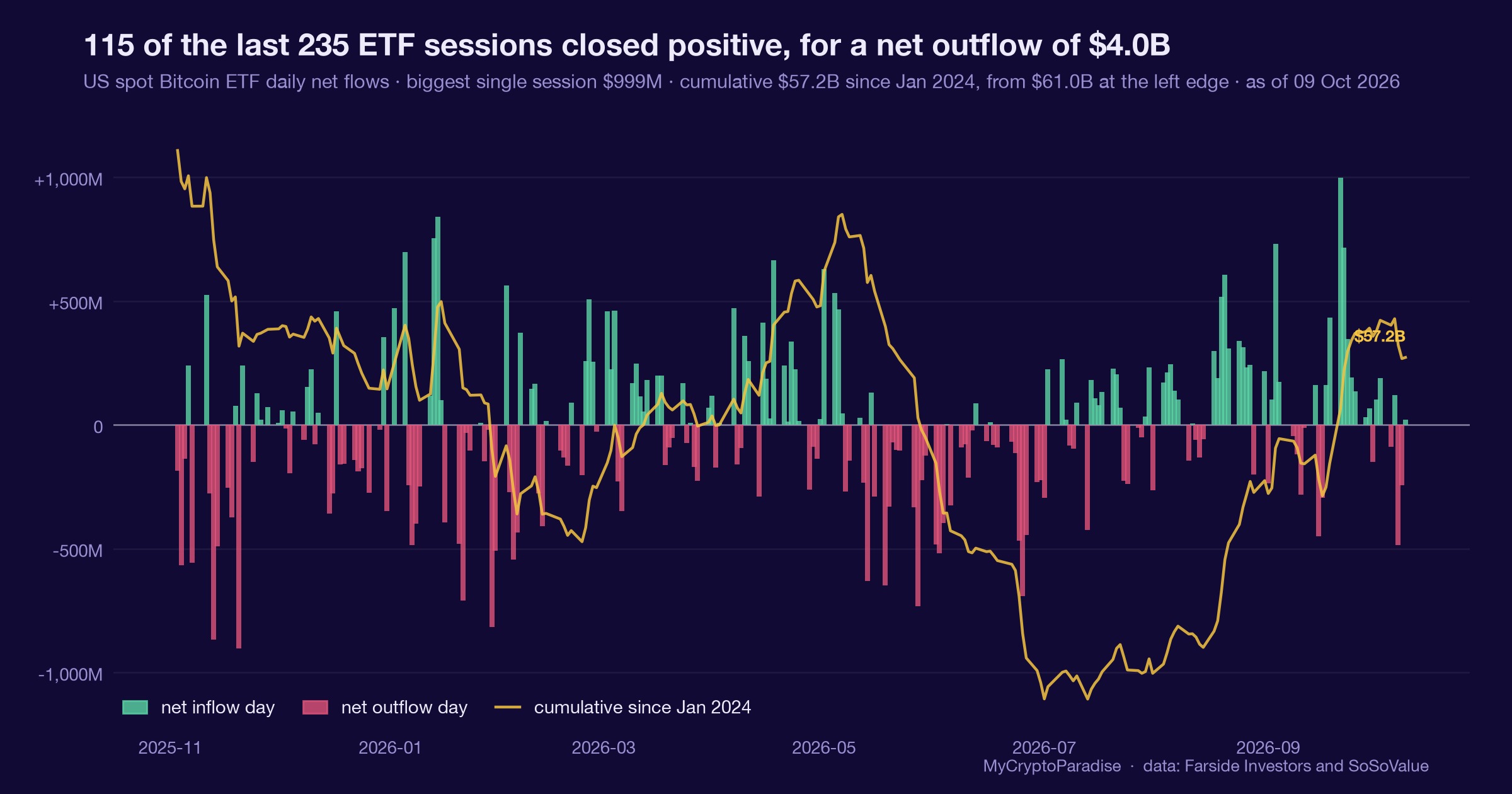
Sentiment had already sprinted the other way. The fear gauge recovered sharply from a reading of 24, Extreme Fear, printed when Bitcoin traded near $64,664. ETFs even logged $217 million of inflows on Monday, snapping a nine-day inflow streak that an outflow had just broken.
Here is the honest part. There is no single confirmed catalyst behind this specific slump. The buyback plan, the bond rout and the oil spike all pull in different directions at once. What we can read is the structure: a fast rally into resistance, a fast rejection, and a crowd that had just started to relax.
Two liquidity signals pulling opposite ways
The transmission chain here runs through the dollar and through yields, not through a single price. Expanded bond buybacks can inject liquidity by lifting bond demand and softening yields. A weaker dollar and softer yields have supported crypto rallies before, so the bullish reflex is understandable.
The problem is what sits on the other side of the ledger. A global bond rout means yields are being pushed up, not down. Surging oil feeds inflation, and inflation is the argument for tighter policy, not looser. So Bessent's buybacks arrive as a counter-narrative inside a tightening storm, and the two forces partly cancel.
There is also a quality-of-liquidity question. Buybacks that lean on short-term debt buy calm now and borrow risk from later. That is a familiar trade in every cycle: relief today, refinancing worry tomorrow.
For risk assets, conflicting macro signals are not neutral. They are cover. When the direction is genuinely unclear, price can be pushed toward wherever the most stops sit, and the tape blames macro afterward.
That is why this matters beyond one candle. Bitcoin is being asked to price a liquidity injection and a bond rout in the same breath. A clean break needs one story to win. Right now neither has, and an unresolved macro backdrop tends to favour whoever controls the order book over whoever is chasing the headline.
How the rejection ripples from BTC to alts
Start with Bitcoin, because it set the tone. The move above $80,000 looked like confirmation to anyone who had waited through Extreme Fear at $64,664. Then the rejection erased the celebration and dragged price back to $76,308.
That sequence matters more than the level. A sharp rally that fails fast traps the buyers who arrived last. Their stops now sit below, and a market that knows where stops sit rarely leaves them alone for long.
Ethereum inherits this directly. ETH tends to move as leveraged beta on BTC, so a Bitcoin rejection usually hits ETH harder on the way down. When the leader stalls at resistance, the follower's late longs are the first to feel pressure.
Alts are the sharp end. Thinner books mean the round trip that cost Bitcoin a few percent can cost smaller tokens far more. The same ETF inflows that cheer Bitcoin holders do almost nothing for the long tail, so alt liquidity thins exactly when volatility rises.
The $217 million ETF print deserves a cool eye. Real demand, yes, but a single day after a broken nine-day streak is a flicker, not a trend. Selective inflows meeting steady selling is precisely how a distribution phase looks from the outside: money arrives, price does not follow, and the supply keeps coming. So the impact reads less like a breakout and more like a test of who blinks first.
The 79K reclaim versus the 58K break
The cleanest line is $79,000. That is where the rally was rejected, and reclaiming it decisively is what would put bulls back in charge. Until then, every push toward it is a level to prove, not a level to trust.
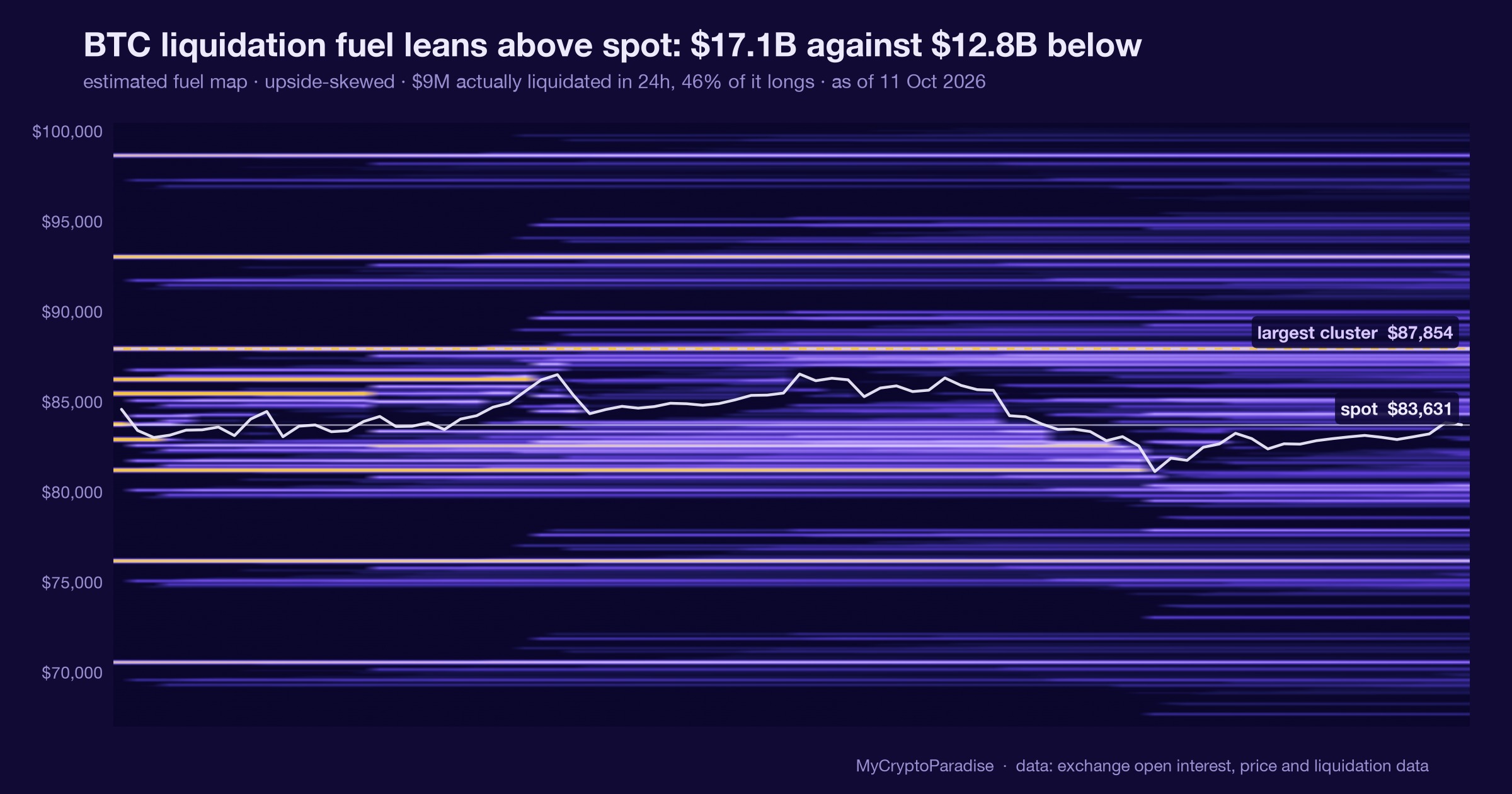
On the downside, watch $58,000. A break below it would confirm the bearish structure and open the path toward deeper targets. The zone around $57,000 is where long liquidations cluster, so a flush there can feed on itself.
Structure gives an early warning too. A shooting star printed on the daily and weekly at $79,000, and a bearish weekly candle needs the next close to confirm. A confirmed bearish engulf on the weekly would be a heavier tell than any single day's move.
Invalidation keeps us honest. A strong reclaim and hold back above the recent high would break the bearish thesis, and we would respect that rather than argue with price. Direction is a probability, not a promise.
Watch the ETF tape as well. If the $217 million day extends into a genuine multi-day run while price climbs, the distribution read weakens. If inflows dribble in while price fades, that is the trap tightening.
Above all, watch behaviour, not headlines. If retail keeps adding longs into resistance while spot demand stays thin, the setup for a capitulation stays intact, whatever the buyback plan promises next.
What the failed 80K push says about supply
The ParadiseTeam is leaning bearish here, and the buyback headline does not change that lean. Our current lens has Bitcoin rejected at $79,000, with the recent surge above $80,000 reading as distribution rather than escape velocity.
At $76,308, price is caught between the $79,000 ceiling and a $58,000 shelf we expect to break. The failure to hold above $79,000 is the tell: bullish macro news arriving while price stalls at resistance is the textbook shape of smart money selling into strength.
Who benefits and who is exposed. Retail piled into longs on the rally and the ETF headline, prematurely calling the bear trend over. That crowd's stops sit lower, and the liquidation cluster near $57,000 is exactly the kind of target market makers are incentivised to reach. So the mechanism is simple to name. Conflicting macro gives cover, the $79,000 rejection provides the level, and long liquidations provide the fuel.
Our medium-term read still points lower, toward a possible flush to $44,000, where we would expect aggressive accumulation once retail capitulates. That is a scenario, not a certainty.
Invalidation is clean and non-negotiable: a decisive reclaim and hold above the recent high would break this thesis, and we would flip. Manage risk with defined SL (stop-loss) placement and sane R:R (risk-to-reward), because a two-sided macro tape punishes conviction that ignores the exit.
The read behind this: we framed this story through our own market analysis, Bitcoin Fails at $79K: Who Is Selling?
Track it live: our live crypto funding rates and the Crypto Fear and Greed Index both update in real time, so you can watch this shift for yourself.
Related coverage
For exact entries, targets, and stop losses with full risk management, that is what ParadiseFamilyVIP is for. New to reading these moves? Start with our crypto trading strategies guide.
ParadiseTeam is monitoring the market situation closely, and we are taking these developments into consideration while building our trading tactics inside ParadiseFamilyVIP.
Crypto trading involves substantial risk. Prices are volatile and you can lose money. This article is educational and is not financial advice. Past performance does not guarantee future results.
After the 80K rejection, where does Bitcoin go next from here?
This is how 17 Paradisers are calling it. Tap your call.
No calls on this one yet. Tap yours to be the first.
Free account, no password. Members just sign in.












Join the discussion 9
Dem bond market sh*t is confusing me so much rn 📉😭 I remember when i first started and bought some of those things... 🤦♀️ never again. BTC levels looking tricky 👀.
i feel you aisha, the bond market is just not my mental model 😵💫 especially when the fed starts playing around with rates!
bessent expanding buybacks right now seems like a bad call to me bond market looks like it has more room to drop
nah, i see it as smart timing. liquidity for a bounce, like clearing cache before a big update ✨
liquidity for a bounce needs a floor to bounce from this doesnt look like the floor to me it looks like a falling knife
A floor is a perceived pattern, not a hard stop, Tommy. It's about finding the point where the existing structure is weak enough for a new one to load in. This move creates that space. 💥
man, i remember seeing bitcoin around 60k and thinking it was too high to jump in... guess i was wrong on that 😅. these charts are wild.
I always measure my positions in sats, even when the broader market is focused on these bond market gyrations. Seems the key levels remain the same regardless.
if bessent's looking at buybacks now, that invalidates the bear case faster than these bond yields dropping. seems premature !!