


Listen: the breakdown
Market briefing: A critical Cosmos EVM flaw drained six chains of $5.72 million and emptied TAC's entire staking pool. Bitcoin sat near $76,612, down 1.8 percent, as systemic risk pressed on smaller altcoins.
- A critical Cosmos EVM balance flaw drained six chains of $5.72 million between August 20 and 25.
- One transaction moved TAC's entire bonded pool, 2,985,651,403.40 TAC, on August 22.
- August logged $136 million lost across 50 incidents, keeping altcoin liquidity under real pressure.
A Cosmos EVM exploit just drained six chains and emptied TAC's entire staking pool in a single transaction. When shared code fails, who really pays for it?
A single line of shared code just cost six blockchains at once. Between August 20 and August 25, attackers exploited a critical balance-handling flaw in the Cosmos EVM module. The module powers many chains that never wrote it themselves, so one bug became everyone's bug.
TAC was one of the six networks caught in the blast radius. On August 22, a single transaction moved TAC's entire staking bonded pool, 2,985,651,403.40 TAC, straight out of the system. An entire validator-backed pool, gone in one confirmation.
The wider damage was smaller in dollars than the headlines suggested. Across all six chains, the flaw drained a total of $5.72 million. Cosmos Labs had already warned that every blockchain running the shared module was exposed, which turns this from a surprise into a known risk that arrived on schedule.
One detail deserves a straight face. The attacker moved $50 million in NES tokens from Nesa Chain to Ethereum, yet the actual haul barely reached $60,000. The tokens existed on paper; the buyers to absorb them did not. Thin liquidity turned a nine-figure exit into pocket change.
That gap between notional and realised is the real lesson here. Exploits look enormous when you count tokens and small when you count exit liquidity. For traders, the number that matters is what a seller can actually get, not what a block explorer displays.
The event lands in a rough month. August recorded $136 million lost across 50 separate incidents, a steady drumbeat of failure in the plumbing beneath prices.
One shared module cracked six chains
The danger here is not one broken chain. It is one broken dependency shared by many. The Cosmos EVM module is common infrastructure, so a single balance-handling flaw exposed every network that trusted it. That is systemic risk in its purest form: the failure travels faster than any patch.
Cosmos Labs had warned that every chain running the module was vulnerable. So the exploit was less a shock and more a countdown. When a known critical flaw sits unpatched across live networks, capital treats the whole category as suspect, not just the chains that were hit.
That perception is the transmission mechanism. Risk-off sentiment does not need every altcoin to be exploited. It only needs traders to ask which token they hold that runs on shared, potentially fragile code. Uncertainty alone thins bids and widens spreads.
Emergency validator halts made the fragility visible. Chains froze to stop the bleeding, which protects funds but also signals that the ground can shift under a position without warning. A halted chain is a position you cannot exit.
Stack this on a month of $136 million in losses and the message compounds. Infrastructure risk is not a tail event this cycle; it is a recurring line item. Capital flows toward assets with fewer moving parts, and away from the long tail where a single dependency can void the whole book overnight.
Where the liquidity actually drained to
Start with the direct victims. Smaller Cosmos EVM tokens, including TAC, absorbed the first hit as holders reassessed whether the underlying chain was even safe to hold. When an entire staking pool can leave in one transaction, the token's floor becomes a question, not a given.
The Nesa Chain example shows how this cascades. A $50 million on-paper move realised only $60,000 because the order book collapsed under the weight. In thin markets, forced selling does not find buyers; it finds air. Prices gap rather than glide.
Bitcoin barely acknowledged the event directly. It traded near $76,612, down 1.8 percent on the day, moved far more by macro and its own liquidation map than by a $5.72 million drain on niche chains. BTC is the flight-to-safety trade inside crypto, not the casualty.
That split is the point. Capital leaving vulnerable altcoins does not vanish. Some rotates to BTC and to majors like BNB, near $683 and roughly flat, while some simply exits to the sidelines. Either way, the long tail bleeds relative strength.
ETH sits in the middle of this map. It is the settlement layer the Nesa tokens fled toward, which quietly reinforces its role as the exit ramp when smaller chains wobble. The structure rewards size and punishes fragility, and this exploit widened that gap another notch.
Patches, halts and the next weak chain
The first confirmation to track is the patch and the halts. If affected chains ship a fixed module and resume cleanly, the story narrows to a contained incident and altcoin fear should ease. Watch whether validators restart with confidence or with hedges.
Invalidation of the calm scenario looks different. If a seventh chain running the same module reports a drain, or a halted network struggles to reopen, the systemic reading strengthens and risk-off sentiment broadens. One more domino changes the category, not just a coin.
On Bitcoin, the levels do the talking. A decisive move below $58,000 would confirm the pressure our lens has flagged, opening the path lower. Reclaiming and holding above $79,000 would instead invalidate the bearish structure and force a rethink.
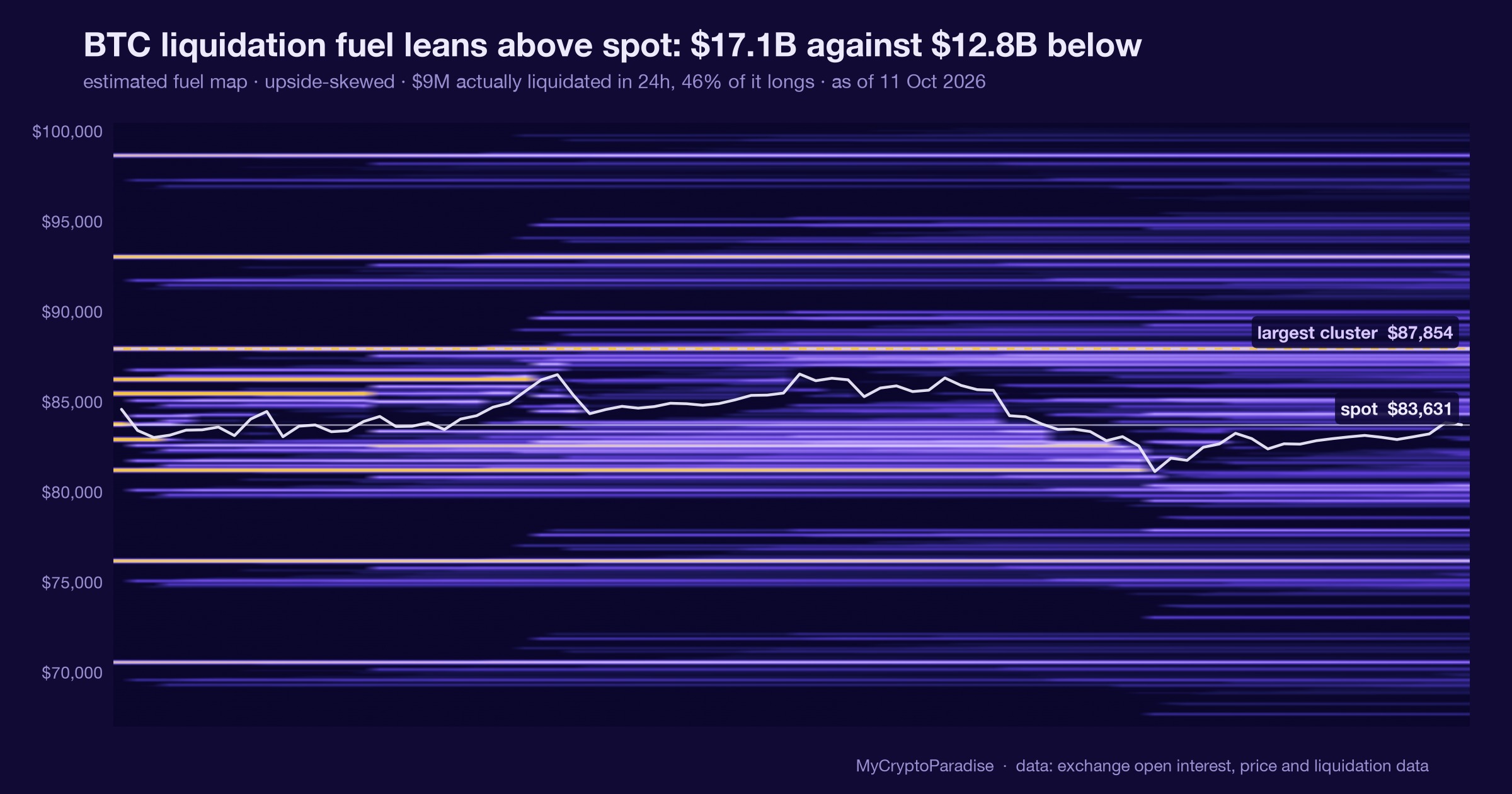
Watch the liquidation clusters closely. Longs are stacked near $57,000 and shorts near $83,000, and market makers are incentivised to reach for whichever pool is easier to hit. Those magnets, not the exploit headline, will steer the next fast move.
For the affected tokens specifically, liquidity is the tell. If bids stay thin and spreads stay wide after any patch, the market is pricing lasting distrust, and bounces should be treated as exits rather than recoveries. Healthy volume returning would be the genuine all-clear.
Until then, the honest read is patience. A single confirmation, up or down, resolves more than a week of speculation about what the exploit means.
What a $60K haul reveals about liquidity
The ParadiseTeam reads this exploit as confirmation of the fragility beneath the surface, not as a direct driver of Bitcoin. BTC sat near $76,612 as of 10:27 UTC, still boxed under resistance at $79,000 and above the $58,000 level we expect to break. This drain does not move those numbers; it reinforces the risk-off backdrop around them.
The smart-money-versus-retail lesson is written in that $60,000 haul. Notional size means nothing without exit liquidity, and thin altcoin books let sophisticated players push prices hard on small flow. Retail sees a $50 million headline; the market saw pocket change and a warning.
Our bias stays bearish, with one more flush toward $44,000 the base case before continuation. Retail is piling into longs and calling the bear trend over early, which is exactly the fuel a liquidation sweep toward the $57,000 long cluster would need.
We treat vulnerable, low-liquidity tokens as the weakest links in that thesis. Where a single dependency can empty a pool in one block, the ParadiseTeam favours capital preservation over hunting a bounce.
Invalidation is clean and specific. A reclaim above $79,000 flips the structure, and until then any pump reads as distribution into strength, not a bottom. We plan to watch for real accumulation only after capitulation, not before it.
The read behind this: we framed this story through our own market analysis, Bitcoin Fails at $79K: Who Is Selling?
Track it live: our Crypto Fear and Greed Index and the live crypto funding rates both update in real time, so you can watch this shift for yourself.
Related coverage
For exact entries, targets, and stop losses with full risk management, that is what ParadiseFamilyVIP is for. New to reading these moves? Start with our crypto trading strategies guide.
ParadiseTeam is monitoring the market situation closely, and we are taking these developments into consideration while building our trading tactics inside ParadiseFamilyVIP.
Crypto trading involves substantial risk. Prices are volatile and you can lose money. This article is educational and is not financial advice. Past performance does not guarantee future results.
After this Cosmos EVM exploit, where does BTC head next from here?
This is how 13 Paradisers are calling it. Tap your call.
No calls on this one yet. Tap yours to be the first.
Free account, no password. Members just sign in.











Join the discussion 3
This is why I prefer to keep my assets off-exchange, especially when new shared modules are introduced. Session opens remain my focus.
i watch these small exploits closely it reminds me of the coffee rust in 2012 when a little problem became a big one for some farms
It's exactly these kinds of exploits that make me a bit nervous to move beyond my current small positions. I'm always watching how projects respond to these situations.