


Listen: the breakdown
Developing story: This story is still unfolding. We are tracking it and will update this article as more details are confirmed.
Market briefing: A US enforcement freeze tied to the Xinbi marketplace pushed Telegram to ban a batch of premium usernames worth seven to eight figures. Crypto barely blinked: BTC held near $84,624, down about 1.9 percent on the day.
- Telegram removed a batch of premium usernames worth a reported seven to eight figures, all tied to the Xinbi Guarantee marketplace.
- The ban followed a US DOJ freeze of over $52 million in crypto linked to Xinbi, a platform tied to roughly $24.2 billion in flows since 2022.
- BTC held near $84,624 and ETH near $2,682, a muted reaction that reads as contained scrutiny rather than systemic risk.
A Telegram username ban followed a $52 million US crypto freeze tied to one marketplace. BTC held near $84,624 right through the headline. So is scrutiny a real threat here, or just weather?
Telegram just removed a batch of premium usernames from its marketplace. The set reportedly carried value in the seven to eight figure range. Each handle had traded like digital real estate: short, memorable, and scarce.
The names traced back to one owner, Xinbi Guarantee, a Chinese Telegram marketplace. That operator sits at the center of a far larger story.
United States authorities froze more than $52 million in crypto linked to Xinbi. The freeze followed scrutiny of a platform tied to roughly $24.2 billion in transactions since 2022. Those are not small numbers for an operation most traders had never heard of. So the ban is not a content-moderation footnote. It is the visible edge of an enforcement action that reached across borders and into crypto rails.
Here is the honest part. We cannot independently confirm every detail of the freeze or the exact handles pulled. The core claims arrived fast, as these things do, and verification tends to lag the headline.
What we can confirm is the price tape. BTC was trading near $84,624 as of the latest read, down about 1.9 percent on the day. ETH sat near $2,682, softer by roughly 2.7 percent.
Neither move screams panic. The market, it seems, filed this under routine scrutiny rather than systemic threat. That reaction itself is the signal worth reading.
A $52 million freeze and its reach
Enforcement on this scale rarely stays sealed inside one marketplace. A $52 million freeze and a $24.2 billion transaction trail tell regulators exactly where crypto rails get abused. That knowledge shapes the next rulebook, and the one after it, which is how a single case becomes an industry-wide tightening.
The transmission runs through sentiment first. When authorities demonstrate they can freeze on-chain funds tied to a large operator, every compliance team takes note. Exchanges tighten listings. Payment processors review counterparties. Liquidity providers widen their screens for anything that smells of sanctioned flow.
That caution carries a cost. Risk capital that might have rotated into speculative corners hesitates instead. The effect is tiny per headline, but it compounds across a steady drumbeat of enforcement.
This is the quiet tax of scrutiny. It does not crash markets. It thins the oxygen.
For traders, the mechanism matters more than the specific marketplace. Xinbi is not a household name, and its removal changes nothing about Bitcoin's supply or demand directly. What changes is the perceived regulatory temperature.
A hotter temperature favors quality over junk. Capital drifts toward BTC and large caps when the perimeter tightens, and away from the low-float, high-story tokens that thrive on loose attention. That rotation is subtle today. It tends to show up over weeks, not hours.
A contained shock against a nervous tape
BTC absorbed the freeze news without much flinching. Price held near $84,624, down a modest 1.9 percent, while ETH eased to $2,682, off about 2.7 percent. For a headline carrying nine-figure and multi-billion-dollar numbers, that is a shrug.
The read is straightforward. Markets price the probability of contagion, not the drama of the announcement. Here that probability looks low, because the funds and handles belonged to one illicit operator, not to an exchange holding customer assets.
Still, the tilt is mildly negative. Enforcement headlines rarely bid crypto up. They add a thin layer of caution that shows first in the majors, then ripples outward.
BTC tends to lead. When scrutiny rises, it often holds better than the rest, acting as the perceived safe corner of a risky asset class. ETH follows a half step behind, which the 2.7 percent slide roughly reflects.
Alts sit at the far end of the whip. Low-float tokens with thin order books feel sentiment shifts hardest, and a regulatory chill pulls speculative bids first. If this story has any downstream teeth, it bites the long tail, not the head.
The honest caveat: we see no single confirmed catalyst linking today's dip to this specific ban. The 24-hour softness fits broader positioning as much as this headline. We read direction, not a clean cause.
Where contained enforcement could turn contagious
The $85,000 ceiling is the line that frames everything next. BTC was trading just beneath it near $84,624, inside a zone that has repeatedly stalled rallies and clustered liquidations. How price behaves here tells us whether scrutiny matters or fades.
Confirmation of weakness would look like BTC rejecting $85,000 again and losing the $82,000 defense zone on rising volume. That combination would suggest the risk-off tint is sticking, with sellers using any enforcement headline as cover to distribute.
Invalidation is cleaner. A decisive reclaim of $85,000, followed by a push through the $87,000 prior high, would say the market has fully discounted this story. At that point the ban becomes trivia, and structure takes over.
Watch the follow-through on enforcement itself. A one-off freeze is contained. A pattern of similar actions against larger platforms would change the calculus and deserve a heavier weight.
Volume is the tell. Quiet drift means apathy. A spike means someone cares.
Keep an eye on alt behavior relative to BTC. If low-caps bleed while BTC holds, that is the regulatory-chill rotation showing up in real time. If everything moves together, this headline is just noise inside normal positioning.
We are not treating this as a trend-changer. We are treating it as a temperature check, and the thermometer sits right at $85,000.
What scrutiny means near the $85K ceiling
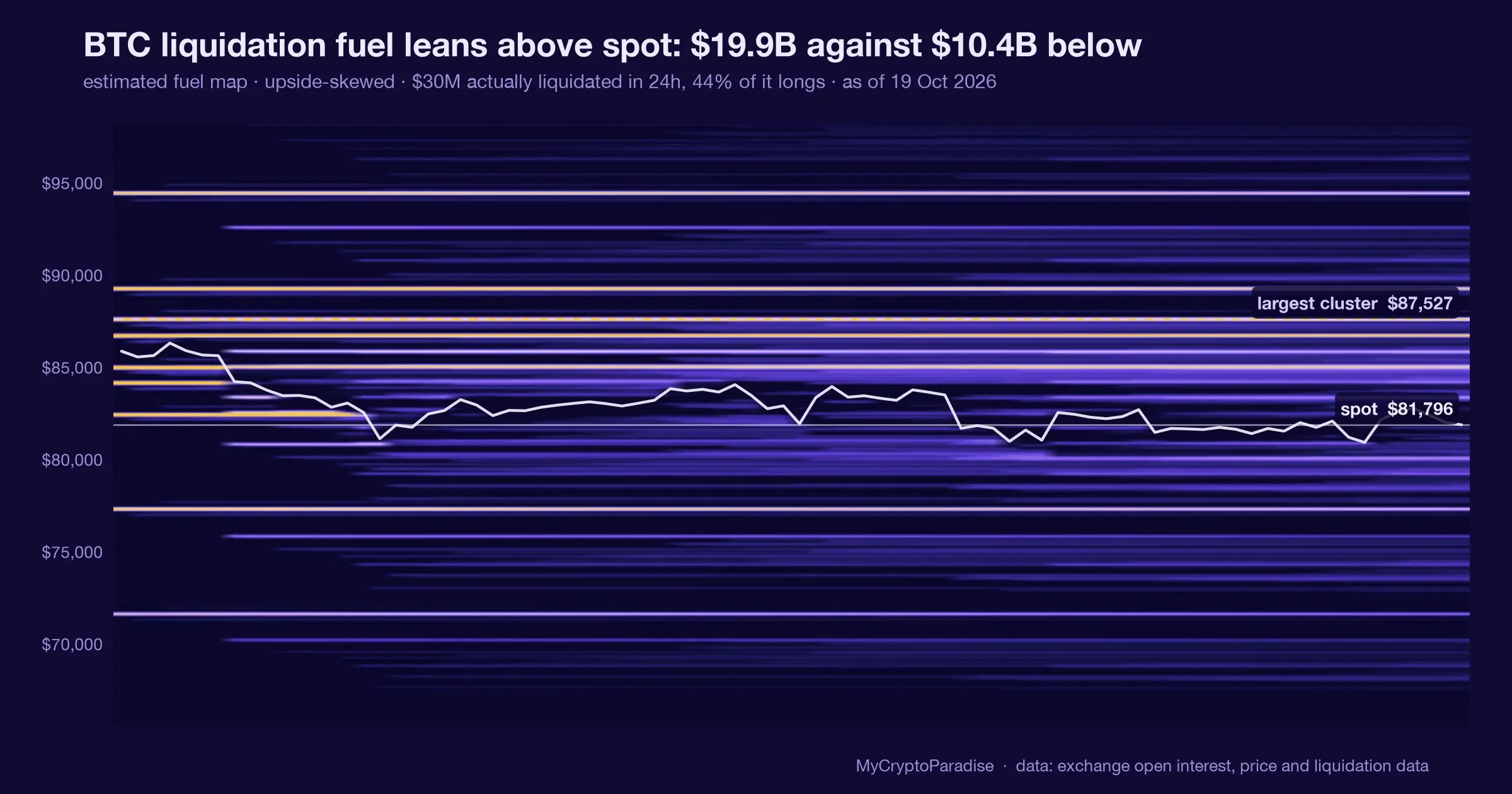
At $84,624, BTC sits just under a ceiling the ParadiseTeam has tracked closely. The $85,000 area is both resistance and a liquidation cluster, the kind of level where late longs get flushed and patient money reloads. An enforcement headline landing here adds friction, not a new direction.
The ParadiseTeam's standing read stays constructive toward $90,000. Bullish divergence on the MACD (moving average convergence divergence) and firmer participation argue for an eventual push through $87,000 toward that target. This ban does nothing to break that structure. Xinbi's problems are not Bitcoin's.
But caution is warranted at the ceiling. The RSI (relative strength index) has not respected the bullish divergence cleanly, which keeps a bear-trap scenario alive. Into that ambiguity, a scrutiny headline hands nervous retail a reason to sell exactly where smart money prefers to accumulate.
Here is where stops sit. Long SL (stop-loss) orders cluster below $82,000, the defense zone. Short stops rest above $85,000 and again near $87,000. A sweep in either direction will likely target that resting liquidity before the real move begins.
The ParadiseTeam's bias: treat $85,000 as the decision point, not this news. If BTC reclaims it with volume, the $90,000 magnet pulls. If it rejects and $82,000 breaks, the bullish case pauses. The enforcement story is background weather, and the chart still holds the vote.
The read behind this: we framed this story through our own market analysis, Bitcoin at $82K: Is $90K About to Trigger?
Track it live: our live crypto funding rates and the Crypto Fear and Greed Index both update in real time, so you can watch this shift for yourself.
Related coverage
For exact entries, targets, and stop losses with full risk management, that is what ParadiseFamilyVIP is for. New to reading these moves? Start with our crypto trading strategies guide.
ParadiseTeam is monitoring the market situation closely, and we are taking these developments into consideration while building our trading tactics inside ParadiseFamilyVIP.
Crypto trading involves substantial risk. Prices are volatile and you can lose money. This article is educational and is not financial advice. Past performance does not guarantee future results.
Will BTC reclaim $85K next, or slip to the $82K defense zone?
This is how 22 Paradisers are calling it. Tap your call.
No calls on this one yet. Tap yours to be the first.
Free account, no password. Members just sign in.









Join the discussion 34
This type of enforcement action is why I focus on self-custody and avoid holding assets on any platform I don't fully control.
priya, totally. gotta keep your own keys, especially when the institutional flows get... unpredictable. makes me think of back home, sometimes it's the only way to move anything 🇱🇧.
yes priya self custody is key, but also check the off-ramps work *before* you need them.
definitely watching the flow of stablecoins after something like this. seems like the primary on-chain impact will be there.
the link to BTC enforcement is a bit fuzzy here, where in the plan is this connection made clear. Seems like a stretch to me.
The link is pretty clear if you look at the enforcement *pattern*, Anna. They're mapping the flows, and BTC is the main highway. 🛣️
The market will reprice this, not opinions. Liquidiy is always the final word.
It's a little scary how fast things can change, I keep a close eye on any platform I use now after that one client payment failed. 😅 So much to learn!
That is a good point, Yuki. The fundamental value of any platform's offerings, not just its price, would need to change for my view to shift.
It's a bit worrying to see this kind of action. I don't really understand how a username ban helps with a freeze... surely it's the funds they care about, not the names? Sorry if that's a silly question.
for me, Marta, it looks more like a message than a freeze 🤔 like, "we can find you anywhere" 🚩 but maybe its both! 🤷♂️
Yeah, the regulatory whack-a-mole gets faster alright 😵💫. Watching how these moves affect liquidity is key for me, gotta keep an eye on the exits 👀.
Totally Liam! For real-world rails, those off-ramps are EVERYTHING 💰. If users can't get their cash out, what are we even doing here? 🤔
The first time I saw one of those "frozen asset" news stories, my stomach dropped like I'd forgotten to pay the water bill. Never again! 😅 Self-custody is the only way for anything serious.
so what is the one level that matters here
The angle here completely misses the point. This isn't about BTC; it's about centralization risk amplifying enforcement's reach. How is BTC even a factor beyond being the currency chosen?!
This is an interesting debit to privacy, but I'm curious: does this enforcement action create any credit for alternative, genuinely decentralized communication platforms? 🤔
The implications for liquidity always bear watching when such actions occur. Ultimately, it is the movement of capital that reveals conviction.
Even if a chart is perfect... the regulators will always be watching the off-ramps closely, as Katya says. Makes sense.
Yes, exactly! And those off-ramps are where they can really see everything, I think. So hard to stay private then. Sorry, just thinking out loud!
huh, this reminds me of the early days when everyone worried about *anything* impacting off-ramps 😅. always good to watch the real-world usage flow 👀.
amara its not just off-ramps but what happens when the exchange itself goes down or locks up
i dont think this means much for btc flow the enforcement action is on a side street for specific platforms not the main artery. it's just another off-ramp getting surveilled like Katya said.
it makes sense to monitor the off-ramps closely. if you cant log it, its not real anyway.
I disagree on monitoring off-ramps so closely. My logs focus on entry and exit logic, not the fiat side... for me, that's a separate ledger...
Totally, and it makes you wonder about the long-term impact on trust in these platforms too... like if folks will hesitate more. 😟
I'm sorry, Katya, but I don't think it's just about logging. Even if it's "real," the ban still changes how we might use Telegram for crypto, doesn't it?
If I understand you, you are saying that logging is irrelevant because the ban changes functionality regardless. The functionality is verifiable only through system logs, Marta. Without that data, how can we assess any change?
I am sorry, Katya, but I meant the ban itself changes how people feel about using Telegram for crypto, not just what's logged. You are right that logs show functionality, of course. But some changes aren't just technical.
still tracking capital flows through Tether and Circle reports more than anything else, this feels like an attempt to trace the money's last mile... like Katya said.
This reminds me of when I first started and didn't even know where to check if my trades were clearing properly. The numbers are everything.
i remember when the banks here would block wire transfers for a week just on suspicion, this is a different kind of slow down. it happens in cycles.
Wow, this definitely makes you think about all the different ways things can just disappear... 😨 like what Katya said about logging it. I'm just trying to learn how to keep track of everything... 😅
I remember the early days of DeFi a bit, and I wonder how this kind of enforcement will shape future decentralized apps. Maybe it will make developers more cautious??