


Listen: the breakdown
Market briefing: Strive added 1,107 Bitcoin at an average of $85,396, lifting its stack to 27,462 BTC and a top-five treasury rank. BTC held near $85,419, up about 0.6%, barely reacting to a nine-figure buy.
- Strive bought 1,107 BTC at an average of $85,396, its second straight purchase.
- Total holdings now reach 27,462 BTC, placing Strive among the top five treasury companies.
- BTC traded near $85,419 with a muted reaction, a sign of quiet supply absorption.
Strive just added 1,107 Bitcoin near spot, pushing its treasury past 27,462 coins and into the top five. The market barely moved. So who is quietly buying while whales sell?
Strive just bought another 1,107 Bitcoin. The treasury company paid an average of $85,396 per coin. That purchase lifts its total stack to 27,462 BTC. It is the firm's second consecutive buy that we have observed, and it places Strive among the top five treasury companies by Bitcoin held.
Strive sits inside the orbit of Vivek Ramaswamy, the American entrepreneur and politician. The company treats Bitcoin as a core reserve asset, not a trade. Each purchase is a balance sheet decision, slow and deliberate, rather than a punt on next week's candle.
Here is the part that matters. The average entry of $85,396 is almost exactly where Bitcoin trades now. BTC changed hands near $85,419 as we wrote this, up about 0.6% on the day. Strive did not chase a breakout. It bought into a quiet, range-bound tape.
The market barely blinked. A nine-figure bid would once have moved the room. This time price ticked up a fraction of a percent over the hour and the day. Big buyers absorbing supply without fanfare is usually a feature, not a failure.
Structurally, every coin Strive locks away is a coin the open market cannot buy back cheaply. Treasury accumulation shrinks the free float. It does not guarantee a rally. It does quietly change who owns the supply, and at what conviction, which is the slower story underneath the price.
Corporate treasuries keep draining tradable Bitcoin supply
Treasury buying is how Bitcoin demand turns structural instead of speculative. When a company moves coins onto its balance sheet, those coins leave the tradable float. Strive's 1,107 BTC now sit in long-term hands. That supply will not flip back to the market on the next 5% bounce.
Multiply that behavior across the top five treasury holders and the effect compounds. Each buy thins the pool of coins available at current prices. Sellers then meet a shallower order book. The same dollar of new demand pushes price further when float is scarce.
This is the adoption narrative made concrete. Bitcoin as a corporate reserve asset is no longer a slide in a pitch deck. It is 27,462 coins on one firm's books, bought deliberately and disclosed openly.
The macro read is simple. Persistent treasury demand acts like a slow, price-insensitive bid. It does not care about the daily RSI (relative strength index). It buys on schedule, which is the opposite of how retail behaves.
There is a catch worth naming. One firm's buying does not override broad market liquidity. If the wider tape tightens, scarce float cuts both ways and thin books fall faster too. Treasury conviction is a tailwind, not a floor. It shifts the odds over months, not the price over hours.
Where a 1,107 coin bid actually lands
Direct demand lands on BTC first. Strive's bid is a straight purchase of spot Bitcoin, not a derivative. That removes coins from exchanges rather than adding paper leverage. Spot-led demand is the healthier kind, because it does not stack fragile positions that liquidate on a wick.
The first-order effect here is bullish for Bitcoin. A top-five treasury holder buying a second time in a row signals conviction, not a one-off. Steady absorption at these levels tightens the available supply right where price is consolidating.
ETH tends to follow BTC's lead on sentiment, not on this specific flow. No Ethereum was bought here. But a credible corporate reserve story lifts the whole asset class. When Bitcoin looks like a treasury standard, the capital that later rotates into ETH feels less speculative.
Alts sit at the far end of the chain. They get no direct bid from Strive. They get the second-order spillover, if risk appetite holds and BTC stays firm. That spillover is real but fragile, and it is the first thing to vanish when Bitcoin wobbles.
The muted price reaction is the tell. A nine-figure buy that moves price 0.075% in an hour means supply is being absorbed quietly, not fought over. That is accumulation, not a chase. Retail often mistakes the silence for a lack of demand.
The 88k resistance still caps this bounce
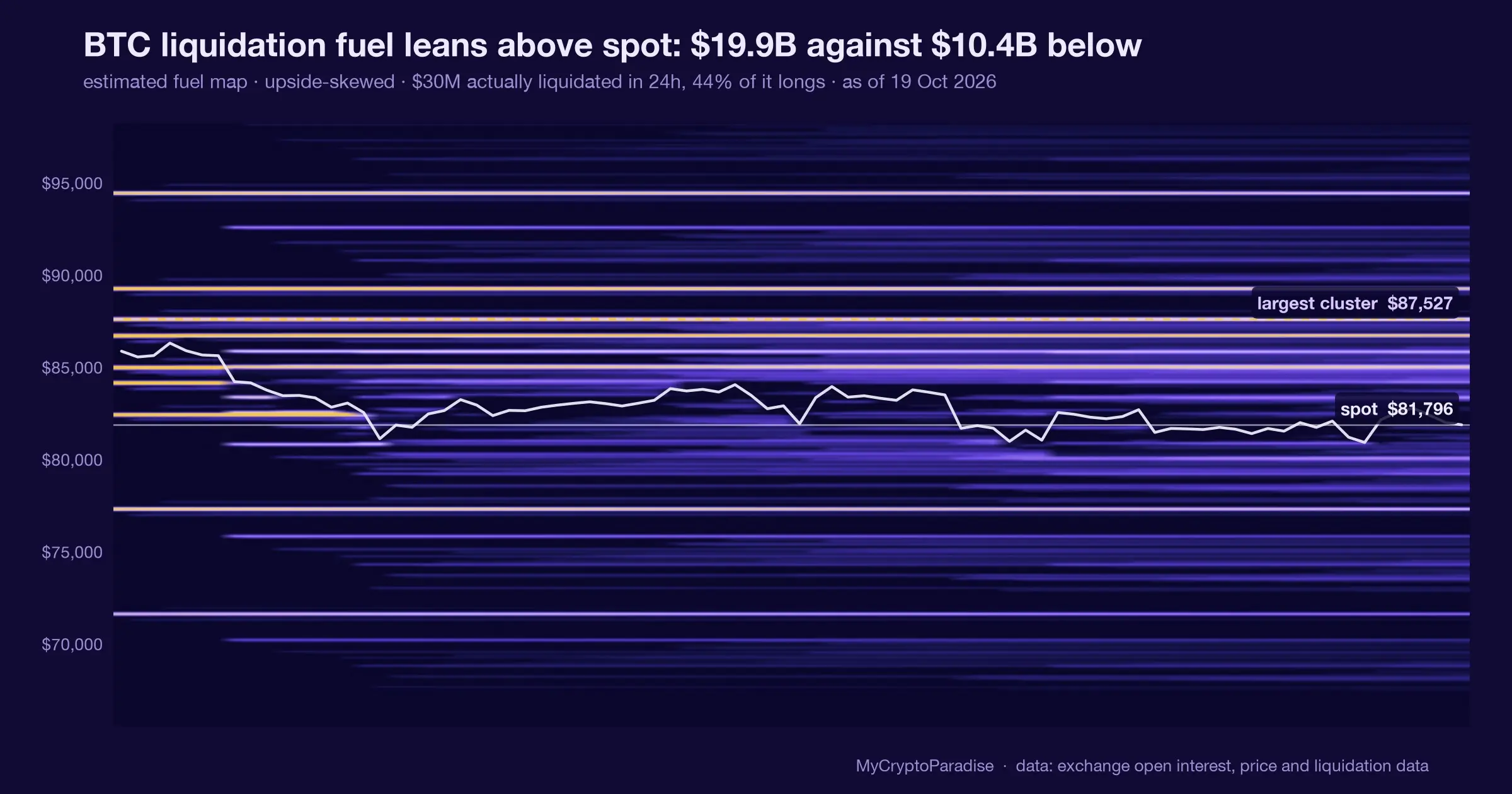
Confirmation starts with the $88,000 to $90,000 resistance zone. If BTC pushes up from $85,419 and clears that band on real volume, the treasury bid plus a squeeze of fearful shorts would be doing its work. A clean break and hold above $90,000 would validate the accumulation read.
Invalidation sits below. If price loses the $82,000 support zone on heavy volume, Strive's entry near $85,396 goes underwater and the structural bid is not enough to hold the line. A decisive breakdown there flips the near-term picture regardless of who is buying.
Watch the quality of any rejection at resistance. A sharp three-wave stall into $88,000 to $90,000 reads as distribution. A grinding, higher-volume push through reads as genuine demand. The structure of the move tells you more than the headline buy does.
Volume is the referee. A rally on fading volume into resistance is a trap. A breakdown on expanding volume through support is the real thing. Treasury buying can slow a decline. It cannot manufacture momentum on its own.
Also watch whether a third consecutive purchase surfaces. Two buys is a pattern forming. A third would confirm a programmatic accumulation schedule, the kind that keeps absorbing supply through dips. That would matter far more than any single print.
Accumulation meeting a whale cohort that sells
The ParadiseTeam treats this as targeted accumulation inside a market where most whales are still selling. The split matters. Roughly 65% of whale flow leans sell, yet Strive is firmly on the buy side. That is one disciplined reserve buyer pushing against a broadly distributing cohort.
Ground it in price. BTC traded near $85,419 as of our read, with Strive's average entry at $85,396, almost the same number. They bought the current level, not a dip. That shows conviction, and it puts their cost basis right in the firing line of the $82,000 support zone.
The ParadiseTeam's standing lens is cautiously constructive for a bounce off that $82,000 support, where fearful retail and steady absorption can squeeze price higher. But the macro caution holds into $88,000 to $90,000. That zone is where whale selling has room to meet any rally.
So this buy fits the bounce thesis without rewriting it. Smart money absorbing supply near support is the fuel for a move toward resistance. The risk is that the same resistance is exactly where the selling cohort waits to offload into strength.
Net read, framed as probability not promise: the purchase strengthens the floor more than it guarantees a ceiling break. A reserve buyer defends dips. It does not clear a wall of distribution alone. Respect the $82k floor and the $88k to $90k wall as the two edges of this range.
The read behind this: we framed this story through our own market analysis, Can Bitcoin Bounce From Support?
Track it live: our live crypto funding rates and the Crypto Fear and Greed Index both update in real time, so you can watch this shift for yourself.
Related coverage
For exact entries, targets, and stop losses with full risk management, that is what ParadiseFamilyVIP is for. New to reading these moves? Start with our crypto trading strategies guide.
ParadiseTeam is monitoring the market situation closely, and we are taking these developments into consideration while building our trading tactics inside ParadiseFamilyVIP.
Crypto trading involves substantial risk. Prices are volatile and you can lose money. This article is educational and is not financial advice. Past performance does not guarantee future results.
Where does BTC go first from here: break 90k or lose 82k support?
This is how 20 Paradisers are calling it. Tap your call.
No calls on this one yet. Tap yours to be the first.
Free account, no password. Members just sign in.








Join the discussion 8
It's always the quiet accumulation that matters more, isn't it? I usually wait for a few candles to confirm that a larger player has actually started buying, not just made a one-off splash. 🤔🧘
yes the quiet buys. its like they dont want to spook the market while they fill up their bags.
It's fascinating how these bigger buys just keep happening. Makes you wonder if it affects smaller portfolios differently, or if I'm just overthinking again. Sorry!
Marta, it definitely highlights the importance of consistent stacking, no matter the size of your sat position. Every sat counts.
Wow, another big one 🤩! I'm always looking at the daily accumulation, especially when prices stay stable 📉, it's a good sign for me ✨.
i see it differently, stable prices during accumulation often just mean liquidity is low 🤔 - not necessarily a strong buy signal for me.
But Chloe, low liquidity makes daily accumulation *more* significant, not less 🤔! It shows strong hands buying even without big price moves 📈, which is a bullish signal for future growth 🔥.
Olivia, low liquidity during accumulation *limits* the scope of accumulation, it doesn't amplify its significance !! It's more like a small private transaction than a market-wide trend. Just because a few hands are strong doesn't mean the interface is responsive, you know ?!