

In short
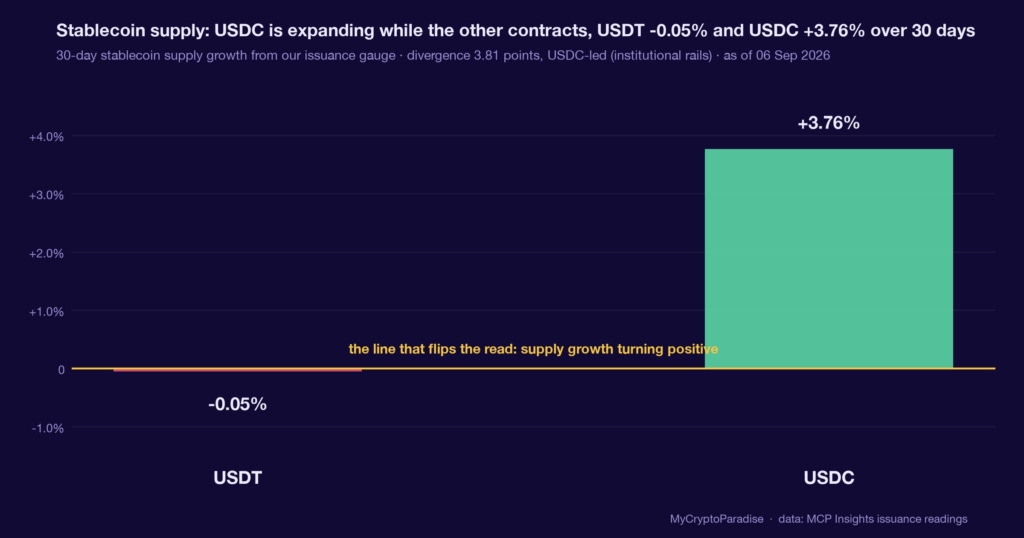
Stablecoin issuance is the pace at which dollar-pegged tokens like USDC and USDT are minted or burned, and it is the clearest read on whether fresh cash is arriving to buy crypto. Our MCP Insights reading on 6 September 2026 shows a split: USDC supply grew 3.76 percent over 30 days while USDT supply was flat, at minus 0.05 percent, a 3.81 point gap. The only fresh dollar fuel this month came through institutional rails, not the broad offshore base. We read this as neutral with a defensive lean, and we did not call it a top: narrow demand is not the same as no demand. The Coinbase premium sat at minus 0.0052 percent, its 30th percentile, which we tag distribution into strength. This piece shows you how to read stablecoin issuance yourself, and where it stops being the higher-probability view.
Fresh dollars have to be minted first
A stablecoin is a token pegged to the dollar. It exists only when someone wires cash to an issuer and that issuer mints new units. Issuance is simply that minting rate, tracked over time.
When supply expands, dollars are queuing to enter crypto. When it contracts, capital is walking back out. The direction is the first thing to read.
But two tokens with the same peg can tell opposite stories about who is buying. The gap between them is the signal, not either number alone.
On 6 September the mint split in two
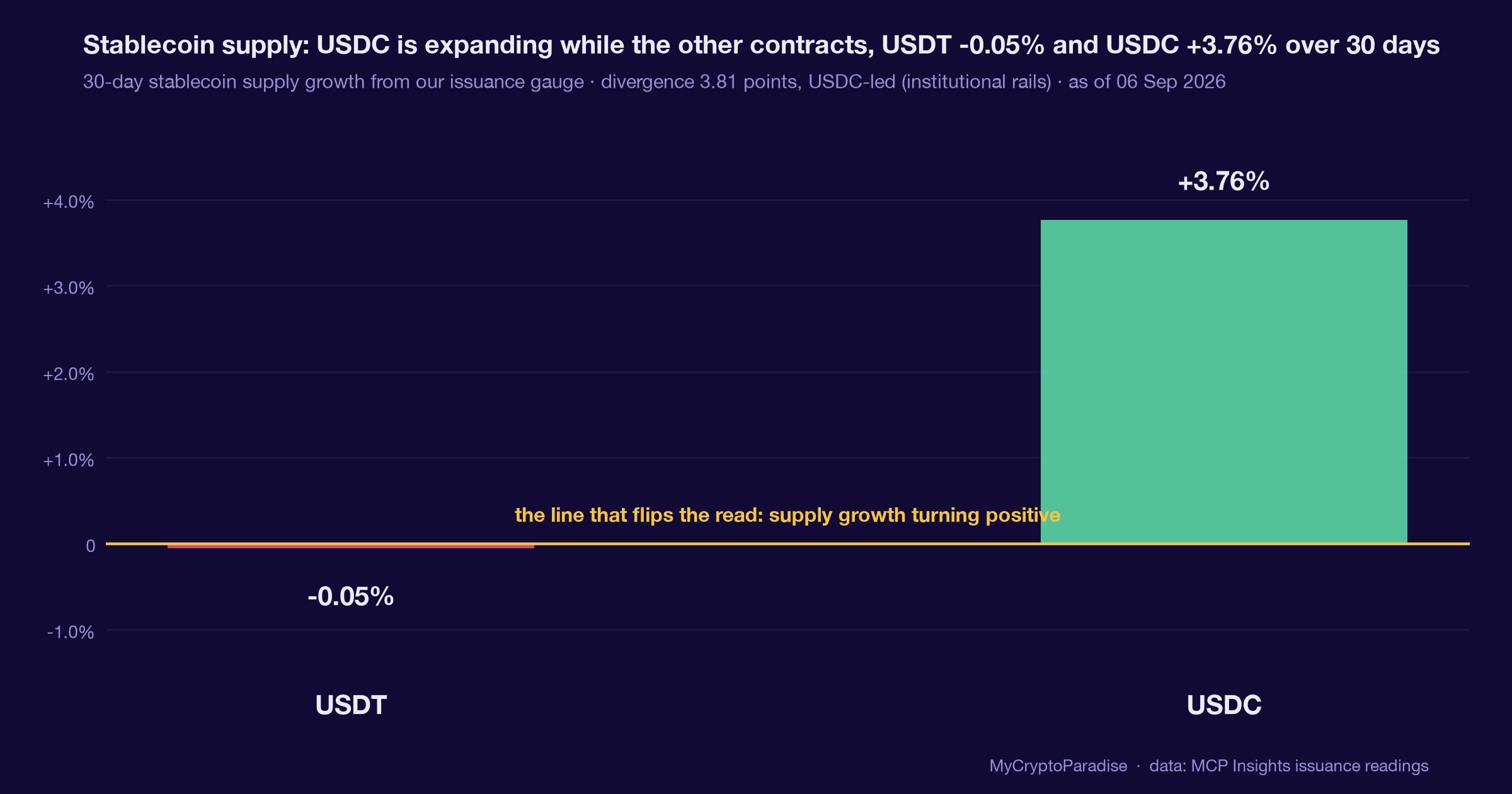
Per our MCP Insights issuance reading on 6 September 2026, USDC supply expanded 3.76 percent over the trailing 30 days. USDT supply sat flat, at minus 0.05 percent. The divergence is 3.81 percentage points, and it is USDC-led.
USDC grows through regulated banking channels, so this is institutional money. The offshore base that USDT tracks added nothing.
Our Coinbase premium gauge, the price of Bitcoin on a US venue against an offshore one, read minus 0.0052 percent. That is a gap of minus 4.18 dollars, with Bitcoin near 79,949.
It sits at its 30th percentile over 90 days, a z-score of minus 0.06, and we tag it distribution into strength. The Korean premium ran hotter at 0.93 percent, a z-score of 1.98.
Ether told the calmer version: a premium of plus 0.0064 percent, its 49th percentile, near 2,494 dollars. One month of data is a photograph, and today it shows who is at the table.
What is different here
The ParadiseTeam does not treat total stablecoin supply as one number. We split the mint by token, because USDC and USDT answer to different buyers, and we cross-check it against our own Coinbase premium reading. A single supply figure hides the one thing that matters here: who is actually adding dollars.
USDC growth is not a green light
The easy misread is to see 3.76 percent USDC growth and call it dry powder stacking for a rally. It is fuel, but it is narrow fuel.
When only the institutional token expands and the broad offshore base stalls, participation is thin. Thin participation is how strength gets distributed into, rather than chased higher.
The premium agrees with that caution. At its 30th percentile and tagged distribution into strength, US spot buyers are not leading; they are selling into the bid.
A rising Korean premium at a z-score of 1.98 is retail reaching, which usually arrives late. Breadth is what turns a lean into a move.
One input, and today it disagrees
This is one indicator. It sits alongside funding, open interest (the total value of live derivatives contracts) and the premium, and today the issuance split and the premium say the same defensive thing.
State the asymmetry plainly. The only expanding source of dollars this month is institutional, and it is expanding while the larger base does nothing at all.
That is a lean toward patience, not panic. Real cash is still arriving; it is simply not broad, which is worth one line of risk and no more.
A gauge that shows which door the money uses is worth more than one that only counts the money. The door is the tell.
Where this stops being the higher-probability read
Watch the offshore token, not the price. The read inverts the moment USDT 30-day issuance turns clearly positive alongside USDC: that is broad demand returning, and it would change the posture.
A second confirmation would be the Coinbase premium reclaiming its upper range, above roughly its 60th percentile. That would show US spot buyers stepping up rather than fading every bid.
Until then, the honest posture is patience. Narrow fuel can still lift price, but it does so without a cushion, and it can reverse the moment the one open door closes.
A read that only quotes the confirming half of the data is decoration. The disagreeing half is what sizes the risk.
Reading stablecoin issuance yourself, step by step
- Pull the 30-day supply change for USDC and USDT separately, never the blended total, because the blend hides which buyer is active.
- Subtract one from the other to get the issuance divergence in percentage points, and note which token is leading.
- Check the sign: expanding supply means dollars queuing to buy, while contracting supply means capital is leaving the market.
- Cross-read it against the Coinbase premium, our gauge of US spot demand, to confirm whether institutions back the mint or fade it.
- Mark the level or condition that would flip your read, so a lean stays a lean and never hardens into a forecast.
Most people skip step one and read total supply. The blend can look flat while USDC surges and USDT drains, which is exactly today’s picture.
Every number above is checkable against the live data. Start with the live crypto funding rates, then cross-read the MCP Insights hub and the Crypto Fear and Greed Index.
Act and invalidate
| Scenario | What confirms it | What kills it |
|---|---|---|
| Narrow institutional bid holds | USDC keeps expanding, USDT flat | USDT growth turns clearly positive |
| Distribution continues | Premium stays sub-median | Premium reclaims its 60th percentile |
| Froth cools | Korean premium mean-reverts | Korean z-score pushes above 3 |
Posture: Defensive while fuel arrives through one door only. Real dollars are still entering, so this is patience, not exit. Keep size small until the offshore base joins.
Frequently asked questions
What does stablecoin issuance actually measure?
It measures how fast dollar-pegged tokens are being minted or burned. Minting happens when cash is wired to an issuer, so rising issuance means fresh dollars are arriving to buy crypto, while falling issuance means capital is heading for the exit.
Why separate USDC from USDT?
Because they serve different buyers. USDC grows mostly through regulated US banking channels used by institutions, while USDT grows through offshore and retail demand. When one expands and the other stalls, the blended total hides which side is actually adding money.
Is rising USDC supply bullish for Bitcoin?
It is constructive but not conclusive. Fresh institutional dollars are supportive, yet a durable rally usually needs broad participation. With the offshore base flat and US spot distributing, the buying is narrow, which is a lean toward patience rather than a reason to chase.
What is the Coinbase premium telling us here?
It sat near flat at its 30th percentile on 6 September 2026, which we tag distribution into strength. In plain terms, United States spot buyers are selling into every bid rather than leading price higher, a cautious posture rather than an aggressive one.
What would change this read?
USDT issuance turning clearly positive alongside USDC would mark broad demand returning, and a Coinbase premium reclaiming its upper range would confirm US buyers stepping up. Either shift would move this from a narrow, defensive lean toward a broader, constructive stance.
Crypto trading involves substantial risk and is not suitable for everyone. Nothing here is financial advice; it is education only. Never risk more than you can afford to lose.
The private Extras feed, where the stablecoin issuance split, the Coinbase premium and the Korean premium update with their invalidation levels, is part of PRO Paradiser, the intelligence layer behind the ParadiseFamilyVIP strategies.








Join the discussion 3
i remember early discussions about stablecoin 'onramps' for the gulf states, an important bridge that still needs more robust structural support.
it’s always “institutions” or "offshore" when the retail money dries up for these things, but it was just regular people getting rugged on so many of them!! 😠
it's hard to see these as "on-ramps" when artists still have so little protection for their work if someone mints it without permission!! 😡 marketplaces just shrug, it's not a friendly ecosystem for creators yet.