

In short
Stablecoin exchange flows are the market’s dry powder: when stablecoins move onto exchanges, buying capacity is arriving; when they leave, capital is exiting to cold wallets or fiat. Our on-chain flow reading for 3 September 2026 is split. August brought roughly $1 billion of net stablecoin inflows to the largest venue, yet the year still shows about $5.1 billion of net outflows there and more than $16 billion drained from major exchange reserves overall. Bitcoin rose near 25 percent in August to about $78,900 regardless. We called this bearish-leaning on liquidity, not a top call: one green month does not refill a year of outflows. Our MCP Insights Coinbase premium sits neutral at its 14th percentile, and new issuance is USDC-led, not retail USDT. This piece shows you how to read stablecoin flows yourself, and the level that flips the read.
Stablecoins are the market’s dry powder
A stablecoin is a dollar parked on-chain, waiting to be spent. When those dollars move onto exchanges, they are buying power arriving at the counter. When they move off, capital is leaving the table for cold storage, yield, or a bank.
So exchange stablecoin flows are a liquidity gauge, not a price signal. Rising reserves mean fuel is being staged; falling reserves mean the fuel is being carried away, whatever price happens to be doing that week.
Flows describe the tank, not the road. A rally can run on a near-empty tank for a while, but the gauge tells you how far it can go before the next refill.
August refilled a little; the year drained a lot
Per the on-chain stablecoin-flow reading we track, August delivered more than $1 billion of net stablecoin inflows to the largest exchange, which alone carries about 71 percent of all exchange stablecoin flow.
Set against the year, that same venue still shows roughly $5.1 billion of net outflows, and major exchange reserves overall have shed more than $16 billion across 2026.
Price ignored it. Bitcoin gained close to 25 percent in August and trades near $78,900 on 3 September 2026, per our MCP Insights premium read, yet that read is not confirming the strength: the Coinbase premium sits at minus 0.01 percent, its 14th percentile, tagged distribution into strength.
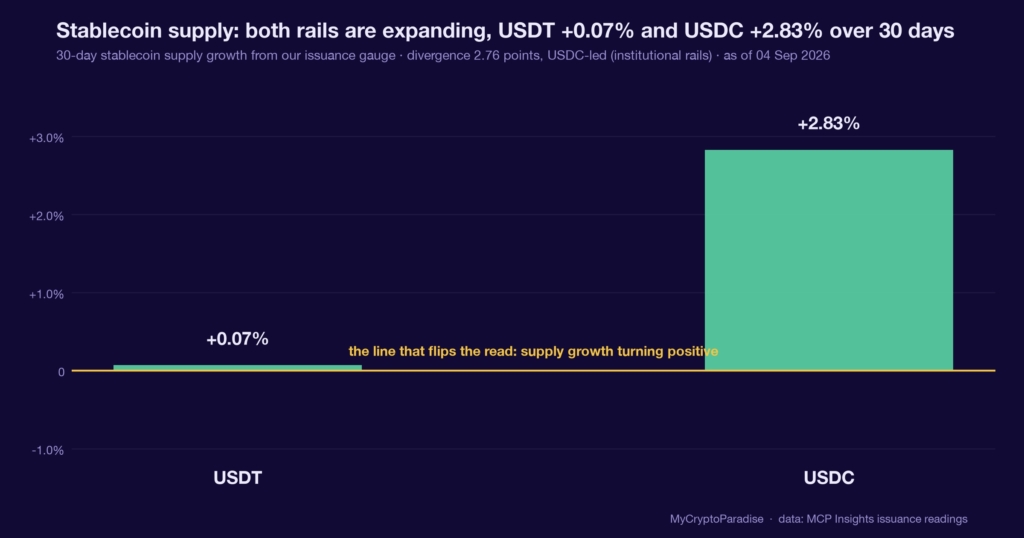
The issuance split is the tell. USDC supply grew 2.83 percent over thirty days while USDT grew 0.07 percent, a 2.76-point gap our data labels USDC-led, institutional rails.
New dollars are being minted, but not the retail dollars that usually chase a 25 percent month. Fresh capital on institutional rails stages and hedges; it does not FOMO.
One green month is not a demand recovery
The easy read is bullish: inflows turned positive in August and price ran 25 percent, so buyers must be back. The scale argues otherwise. Roughly $1 billion of monthly inflow sits against more than $16 billion carried off exchange reserves this year.
It also matters who is buying. The premium at its 14th percentile says US spot is meeting the rally with supply, not chasing it, and the USDC-over-USDT issuance split says the new money is institutional and patient, not retail and impulsive.
A rally that lacks fresh, eager dollars can still rise. It simply has less underneath it, and less underneath is exactly what a liquidity gauge exists to measure.
What is different here
The ParadiseTeam does not read one month of inflows as demand returning. We weigh August’s roughly $1 billion against the year’s $16 billion exodus, cross-check the Coinbase premium and USDC-versus-USDT issuance, and treat a single green print as a blip until two months confirm it.
What the drain does and does not tell you
Here is the honest limit: base rates for stablecoin-flow regimes are not wired into our data yet, so we are not quoting how often a liquidity drain preceded a correction. Without that sample, this is a described condition, not a measured frequency.
What we can state is direction. Dry powder is contracting, demand is weakening, and the marginal new dollar is institutional rather than retail: that is a headwind, worth one line of risk rather than a forecast.
This is one input. It sits alongside funding, open interest and the Coinbase premium, and this week it is the reading arguing the 25 percent month is running on a tank nobody is refilling. More of those layers live inside PRO Paradiser.
A headwind is not a wall. It is a reason to size smaller and watch the refill line, because the read flips the moment the dollars come back.
Reading stablecoin exchange flows yourself, step by step
- Start with the trend, not the month: pull net stablecoin flows for the year, then the last thirty days separately.
- Weight the move by venue share: a shift on the exchange holding most stablecoin flow means more than the same shift elsewhere.
- Separate exchange-reserve change from total supply change: coins can leave an exchange yet stay minted, which is storage, not destruction.
- Split issuance by coin: USDC growth signals institutional rails, while USDT growth is closer to retail demand.
- Cross-check against price and the Coinbase premium before concluding: flows set context, they do not time entries.
Most people skip step three and read every exchange outflow as bearish. Coins leaving for cold storage or yield are not the same as coins being sold.
Every number above is checkable against the live data. Start with the MCP Insights hub, then cross-read the Crypto Fear and Greed Index and the live crypto funding rates.
Act and invalidate
| Scenario | What confirms it | What kills it |
|---|---|---|
| Liquidity headwind holds | Net outflows persist, premium below 20th percentile | Two straight months of net inflows |
| Rally coasts on thin fuel | Price holds near $78,900, funding cools | USDT issuance and premium both turn up |
| Corrective phase opens | Reserves keep falling, demand weakens further | Exchange reserves stabilise and climb |
Posture: Defensive until the flows turn. The higher-probability path while dry powder contracts is caution and smaller size, not chasing a rally the liquidity data is not funding.
Frequently asked questions
What are stablecoin exchange flows?
They track stablecoins moving onto or off exchanges. Inflows mean dollars are staged to buy; outflows mean capital is leaving for cold storage, yield or fiat. As a group, they gauge the buying power available to the market rather than predicting any single price move.
Is a stablecoin outflow always bearish?
No. Coins can leave an exchange for self-custody or yield and still exist on-chain, which is storage rather than selling. It becomes a genuine headwind only when total supply also stalls and demand weakens, as the 2026 year-to-date outflow figures show.
Why did Bitcoin rise if liquidity is leaving?
Price and dry powder can diverge for months. August added roughly $1 billion of inflows and Bitcoin gained near 25 percent, but that single month sits against more than $16 billion drained from exchange reserves this year, so the underlying fuel base kept shrinking.
What is the difference between USDC and USDT growth?
USDC supply grew 2.83 percent over thirty days while USDT grew 0.07 percent. USDC expansion signals institutional, patient capital on regulated rails; flat USDT suggests the impulsive retail demand that usually sustains a fast rally is largely absent right now.
What would flip this read to constructive?
Two consecutive months of net stablecoin inflows to major exchanges, exchange reserves stabilising and then climbing, and the Coinbase premium recovering above its 40th percentile. Until those align, the liquidity backdrop stays a headwind rather than a tailwind for price.
Crypto trading involves substantial risk and is not suitable for everyone. Nothing here is financial advice; it is education only. Never risk more than you can afford to lose.
The private Extras feed, where the stablecoin-flow trend, the Coinbase premium and the USDC-versus-USDT issuance split update with their invalidation levels, is part of PRO Paradiser, the intelligence layer behind the ParadiseFamilyVIP strategies.










Join the discussion 7
yep, seeing stablecoins move like this, for real value, feels like when my family first kept dollars in an app 🚀 a proper lifeline that was. love it. ✨
curious about the premium split between centralized and decentralized stablecoins. data from last month seemed to indicate more of a divergence there than the article implies.
...this feels like a real shift, seeing stablecoins used more for actual payments and less as just exchange liquidity. For my family, digital dollars were everything. 🇱🇧
I always look for the other side of this, what else could be driving the stablecoin moves. Still think about the downside, always.
This all lines up with my weekly closes logic; less stablecoins on exchanges often means more actual use happening out there. I really hate trying to read into the four-hour charts, that's just noise! 🫠
what matters is the one level to trade from, everything else is just noise.
It's good to see stablecoins finding their footing for payments, that means real purchasing power protection for so many. For me, a dollar that stayed a dollar overnight was everything.