


Listen: the breakdown
Developing story update (October 31, 2026, 06:19 UTC):
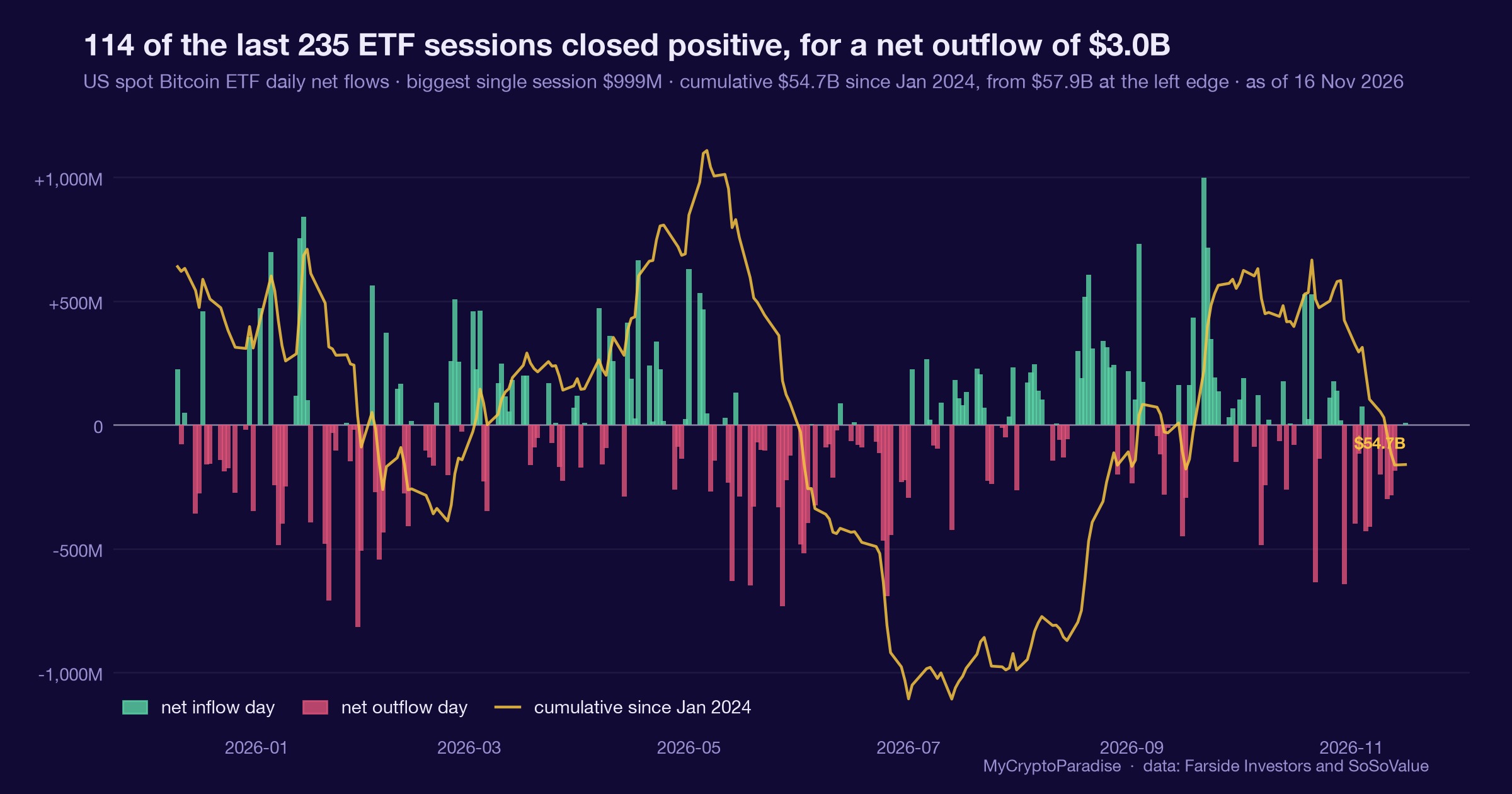
Update: the $643 million redemption snapped a four-session run of net inflows into the spot Bitcoin ETFs, so this is a break in trend rather than the continuation of an existing outflow stretch. It now stands as the largest single-day Bitcoin ETF net outflow since June 25, with the prior comparable print near $635 million.
For context on scale, total net assets across the spot Bitcoin ETFs were around $98.14 billion as of October 30. Traders should treat the broken inflow streak plus the size of this single day as a probable sign of near-term institutional de-risking, not confirmation of hidden accumulation at lower prices.
What to watch now: Whether BTC ETF flows flip back positive next session or the Ethereum outflow streak extends past five days.
Market briefing: U.S. spot Bitcoin ETFs saw $643M in net outflows on October 30, with Ethereum products losing another $156M. BTC was trading near $77,187, down about 1.7% on the day.
- U.S. spot Bitcoin ETFs recorded $643M in net outflows on October 30 (ET)
- BlackRock's IBIT led with the single largest daily outflow at $234M
- Spot Ethereum ETFs lost another $156M the same session, roughly $800M combined
Spot Bitcoin ETFs just bled $643M in one session, led by the largest issuer. So why did the price barely flinch when the institutional bid pulled back?
The numbers are blunt. U.S. spot Bitcoin ETFs recorded $643 million in net outflows on October 30. Spot Ethereum ETFs lost another $156 million the same session. Combined, roughly $800 million walked out of both wrappers in a single day.
The lead came from the biggest name in the room. BlackRock's IBIT posted the single largest daily net outflow among spot Bitcoin ETFs at $234 million. When the largest issuer is also the largest redeemer, that tells you where the marginal seller sat.
ETF flows have become the daily pulse of traditional-finance appetite for crypto. For much of this cycle, that wrapper absorbed supply and provided a steady, non-spot bid. A print this size says that bid paused, and briefly reversed.
Yet here is the part that keeps us honest. BTC was trading near $77,187, down only about 1.7% on the day, and ETH near $2,239 was essentially flat. The hourly moves were close to zero.
That gap matters. Eight hundred million dollars of redemptions would usually leave a bigger mark on spot. It did not. So the story is institutional flow cooling, not a disorderly rush for the exits. The money stepped back from the ETF door. It did not stampede through it.
Institutional bid cooling behind the redemptions
The driver here is simple. ETF redemptions remove one of the main non-spot demand channels that has quietly carried this cycle. Strip out that buyer and the marginal demand picture thins, even if nothing else changes.
Treat the daily ETF flow as a proxy for how traditional finance feels about risk. A combined $800 million pull across BTC and ETH products reads as a mild retreat in that appetite, not a vote of confidence. It is one data point, but it is a clear one.
The concentration sharpens it. When the single largest outflow comes from the single largest issuer, the pullback is not scattered noise at the edges. It is the central player trimming exposure.
This is where the chain runs. Fewer ETF creations means less fresh capital converting into underlying BTC and ETH. Less conversion means thinner support for spot on the days supply arrives. The wrapper stops soaking up coins, and the slack has to land somewhere.
We read the macro effect as a demand pause, not a demand collapse. Flows are volatile by nature, and one red session does not define a trend. But the direction of this specific print is negative on its own terms, and we see no offsetting accumulation signal tied to it. On the facts in front of us, the institutional door swung the wrong way.
Thinner ETF demand drags BTC and ETH
BTC felt it first, and lightly. A 1.7% slip on an $800 million combined redemption is a soft reaction, not a cascade. The ETF seller leaned on price without breaking it.
ETH tracked the same soft tone, only quieter. Near $2,239 and effectively flat, it absorbed a $156 million outflow without flinching. When the second-largest asset barely registers a nine-figure pull, the selling is orderly, not panicked.
Alts tend to inherit this mood with a lag. They correlate tightly to BTC and ETH spot, so a cooling bid at the top of the stack usually drains a little air from everything below it. Expect the same muted drift rather than sharp dislocation, unless spot cracks a level that matters.
Here is the honest read on who moved. This was a redemption by the ETF buyer, not aggressive dumping into thin books. The flow cooled off the demand side, which pressures price gently, rather than forcing it.
That distinction shapes the liquidity picture. A disorderly exit stacks market sells and hunts stops. A quiet redemption simply removes a bid and lets price settle. So far this looks like the latter. The institutional channel went flat for a session, and spot shrugged it off with a small discount rather than a crisis.
Flows that confirm a deeper retreat
One red session is a data point. A run of them is a trend. The first thing we watch is whether the next few days of ETF flows extend this outflow or snap back to net creations.
Confirmation of a real retreat would be consecutive sessions of net redemptions, especially if IBIT keeps leading them. That would tell us the largest institutional holder is still trimming, and that the demand pause has legs. Watch the second asset too, because sustained ETH outflows alongside BTC would widen the message.
Invalidation looks different. A quick return to net inflows, or a session where creations outpace redemptions, would mark this as a one-off wobble rather than a shift. Flows are noisy, and a single issuer rebalancing can distort a day.
The spot tell is just as important. If BTC holds its footing near current levels while flows stay negative, that resilience says spot demand is quietly offsetting the ETF seller. If spot starts sliding in step with the redemptions, the two are reinforcing each other, and that is the more bearish combination.
Watch the reaction, not just the headline number. A big outflow that price ignores is less dangerous than a smaller one that price obeys. The market already told us something today by barely moving. Whether it keeps that composure through a second and third red print is the question that decides this.
Reading the muted spot reaction near support
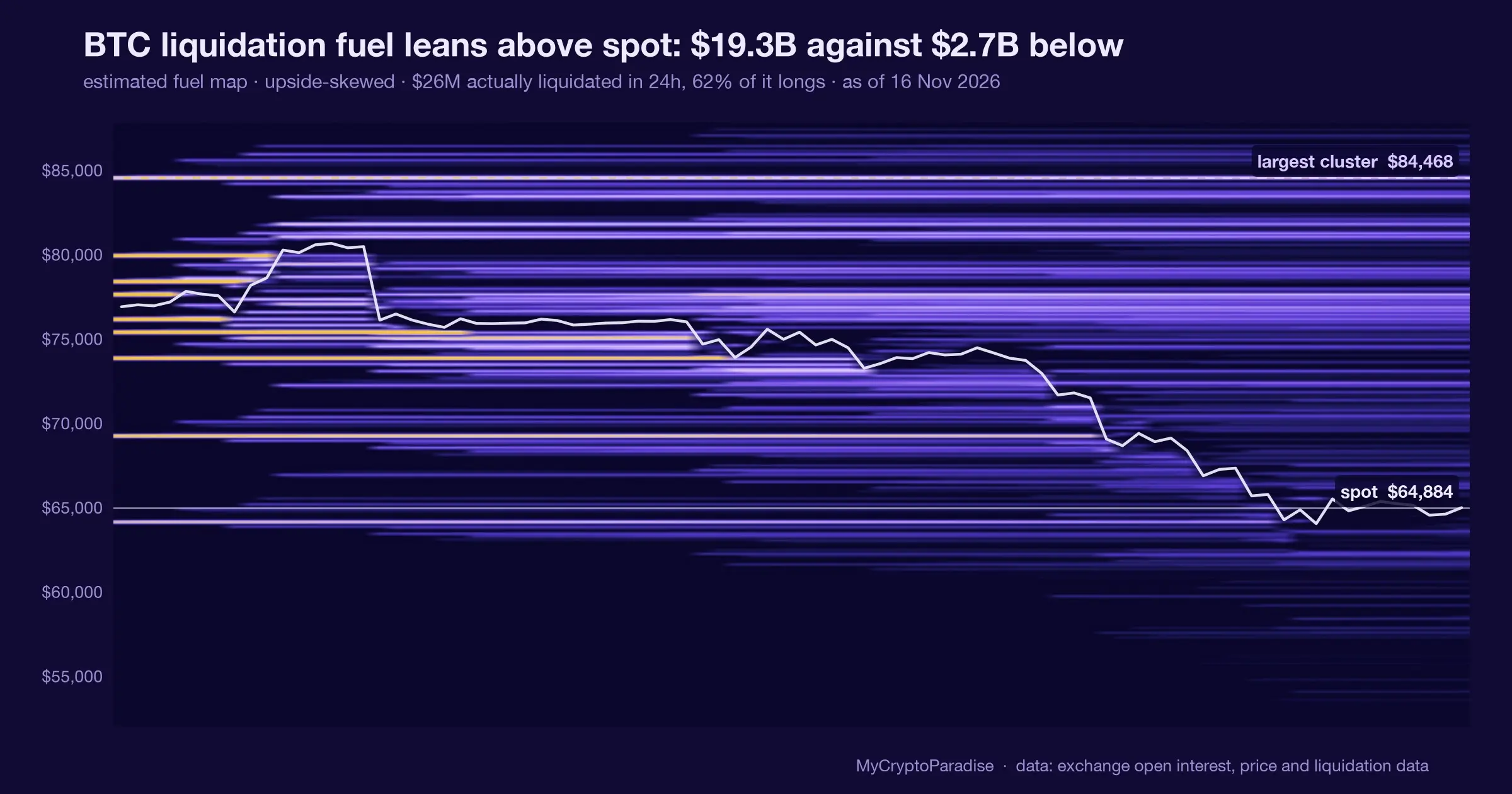
The ParadiseTeam frames this print against a market that is already propped at support, not floating in mid-air. BTC was trading near $77,187 as of the day's read, sitting just under the $79,000 liquidation cluster it has been testing. The outflow pressures a market already leaning on buyers.
That context cuts both ways. A $643M redemption pushes on the demand side, yet spot barely gave ground, which fits what we see underneath: smart money absorbing supply at support while retail stays largely on the sidelines. The ETF seller stepped back, and the bid below did not break.
We still respect the bigger bearish structure. Price is retesting resistance for a third time, and there is far more liquidation liquidity stacked above than below, so a soft ETF print into that setup does not flip our medium-term caution.
The level map stays clean. $79,000 is the cluster and the zone where smart money already sold a bounce in profit, so strength into it can meet selling, not celebration. Lose the current footing and $71,000 is the prior reaccumulation shelf we watch next.
The honest takeaway: this is a negative flow data point, but a controlled one. Institutional money cooled, retail did not panic, and support held. We read that as flow draining quietly, not capitulation, and we let the next few sessions of flows and the $79,000 reaction settle the direction.
The read behind this: we framed this story through our own market analysis, Is Bitcoin Ready for a Bigger Rally?
Track it live: our crypto liquidation heatmap and the Crypto Fear and Greed Index both update in real time, so you can watch this shift for yourself.
Related coverage
For exact entries, targets, and stop losses with full risk management, that is what ParadiseFamilyVIP is for. New to reading these moves? Start with our crypto trading strategies guide.
ParadiseTeam is monitoring the market situation closely, and we are taking these developments into consideration while building our trading tactics inside ParadiseFamilyVIP.
Crypto trading involves substantial risk. Prices are volatile and you can lose money. This article is educational and is not financial advice. Past performance does not guarantee future results.
Do spot Bitcoin ETF flows stay negative or flip back to inflows next?
How 11 Paradisers are calling it
The first call is still open
Free account, no password. Members just sign in.
Follow this topic: Bitcoin ETF news












Join the discussion 7
lol the 2019 version of me would've bought the dip on that and called it a plan 😅 these days i just watch the ether funds bleed on my phone before the shift starts and go back to pulling pints, way less stressful, honestly 🍺
Ha, the pint line is honestly the best part 🍺 i wonder if the ether side bleeds slower on weekends though, my cousin in da nang swears the market feels calmer when the shift is off 🤔
Ah, the $643M outflow headlines always make my kitchen-table heart flutter a little 😅 I still remember how small my first stablecoin payment felt, and I'm glad someone at my size can watch these numbers without feeling lost!!
Honestly I check the Dakar side first, whether stablecoin transfers into the corridor slow down or keep humming 🤔 ETF numbers tell me what Wall Street is doing, not what families are sending 📊
Outflows like that always make me think of the first bitcoin I bought after a good season, it felt like the first money that was fully my call. Still, a $643M day tells me more about who's selling than where it goes next, so I'd watch the levels around 77k before reading anything into it.
Seeing IBIT bleed while the ether funds bled too makes me wonder if this is one large holder rebalancing or just a crowd getting nervous. I'd want to know who is actually selling before reading much into it.
Is that the same holder you'd expect to see on the ETH side too, or does the timing suggest two separate desks? I'd want the creation and redemption data for both before guessing, since those flows would show whether this was a basket rebalance or plain redemptions.