

Listen: the breakdown
Market briefing: Russia's Finance Ministry has paid its first wages in digital rubles, a state CBDC milestone. Crypto barely blinked: BTC sat near $84,933, up 0.4 percent on the day.
- Russia's Ministry of Finance paid its first employee wages in digital rubles on October 1, 2026.
- Payments run through accounts on the Bank of Russia platform, and taking part is voluntary.
- A central bank digital currency is state money, not crypto, so BTC and ETH showed no real reaction.
Source: Bank of Russia
Russia just paid its first state wages in digital rubles, a real CBDC milestone. So why did crypto markets barely move when the news landed?
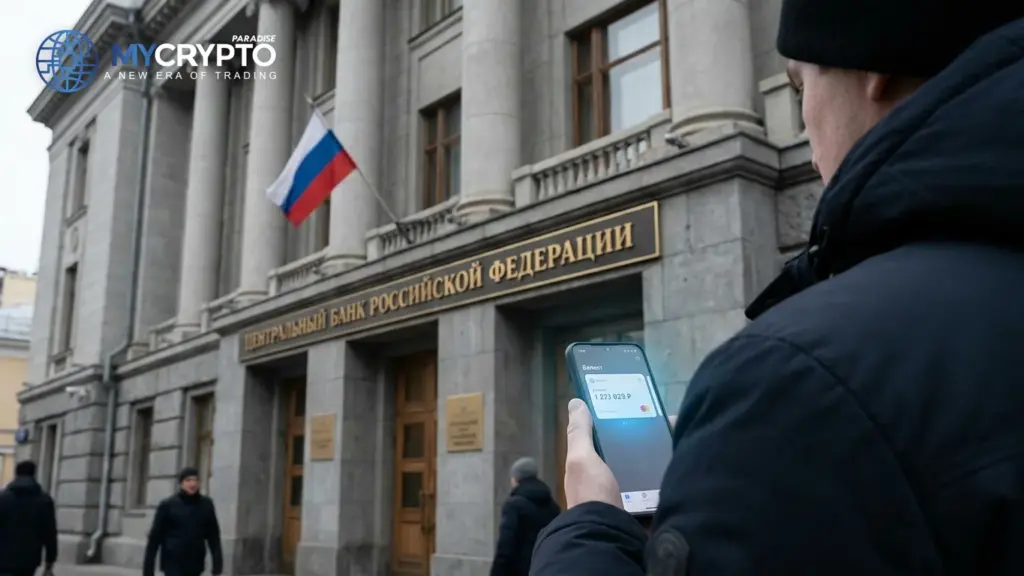
Russia's Ministry of Finance has started paying some of its own employees in digital rubles. The first of these salary payments went through on October 1, 2026, settling into accounts opened on the Bank of Russia platform. For now the scheme is voluntary, so staff choose whether their pay arrives as a central bank digital currency or in the ordinary way.
This is the digital ruble moving from pilot slideware into actual payroll. A state body paying real people real wages in a CBDC is a different weight class from a press release about intentions. The money left the test harness and reached a bank account someone can spend.
It matters because the digital ruble is being built by the Bank of Russia and the Ministry of Finance together, and this payroll step wires the currency directly into the budget process. That is the quiet part of every CBDC rollout: once salaries flow through it, the rails become load-bearing. Still, we should be precise about what this is and is not. A central bank digital currency is centralized, state-issued money. It is the opposite design philosophy to Bitcoin, which answers to no finance ministry on earth.
So the honest read is a milestone for national digital money, not a catalyst for crypto. The market agreed in the most direct way it can: by doing almost nothing at all.
A state currency moves into live payroll
The transmission from a digital ruble payroll to global crypto liquidity is, on the facts, very thin. A CBDC is centralized money issued and controlled by a central bank. It competes with cash and commercial bank deposits, not with Bitcoin or Ethereum.
That distinction is the whole story here. Money flowing into digital ruble accounts is not money flowing out of the global crypto pool. It is the same rubles, in a new wrapper, inside a closed national system.
Where this does matter is the longer arc of financial sovereignty. Every government that puts its own currency on digital rails gains tighter control over how money moves, settles, and is monitored. That is a structural shift in the plumbing of state finance, and it is worth tracking over years.
But a structural shift measured in years is not a liquidity event measured in days. There is no new buyer of BTC here, no fresh collateral, no change to dollar liquidity or rate expectations. The channels that actually move crypto, global liquidity, risk appetite, and the dollar, are untouched by this announcement.
The broader CBDC narrative does feed one real debate for crypto holders. State digital money and decentralized assets are increasingly framed as rivals for the future of payments. That framing is a slow-burning macro theme, not a same-week driver. Treat this as a data point in the sovereignty story, not a reason to reposition.
Reading crypto's flat response to the news
The cleanest evidence for this story's impact is the price itself. As of the latest read, BTC was trading near $84,933, up about 0.4 percent over 24 hours. ETH sat around $2,693, also up roughly 0.4 percent. That is noise, not a reaction.
When a genuine liquidity driver hits, you see it cascade: BTC moves first, ETH follows, and alts amplify the swing in both directions. None of that chain fired here. The lead asset barely twitched, so there was nothing for ETH or the alt complex to amplify. That absence is the signal. Smart money is not treating a CBDC payroll as a reason to accumulate or to distribute, because it changes none of the variables that price crypto risk.
Retail, for its part, has no clear angle to trade either. There is no squeeze setup, no supply shock, no inflow story attached to this event. A headline with the words Russia and digital currency can sound dramatic, yet the order book simply shrugged.
There is also a distribution question worth retiring early. This is not bullish news stalling at resistance, and it is not bearish news printing into support. It is adoption of state money that sits entirely outside the crypto market structure. So the market impact is best stated plainly: negligible, and correctly so. The flat tape is the market pricing this as a CBDC story, not a crypto one.
Signals that would change the picture
What would make a CBDC story actually matter for crypto? The honest answer is a second-order policy move, not the payroll itself. Watch for whether a digital ruble rollout arrives alongside tighter rules on private crypto, because restriction, not adoption of state money, is the channel that touches prices.
Confirmation that this stays a non-event looks like exactly what we see now: BTC and ETH continuing to trade on their own technical and liquidity map, indifferent to the headline. If the tape keeps ignoring CBDC updates, the market has told you where it files them.
The thing that would invalidate the calm read is a shift from voluntary to mandatory, or a push to settle cross-border trade in CBDC at scale. That would start to reroute real flows and deserve a fresh look.
We would also watch for contagion in framing. If major economies accelerate their own CBDC timelines in response, the state-money-versus-crypto debate sharpens, and sentiment can move even when fundamentals do not.
For now, keep the watchlist focused where the money actually is. The drivers that matter for your positions this week are global liquidity, the dollar, and crypto's own chart structure. A Russian payroll run in digital rubles is not on that list. In short, track the policy that could follow, not the payroll that already happened. The event is confirmed and closed; its relevance to crypto is still waiting for a reason to exist.
What a state CBDC means for liquidity
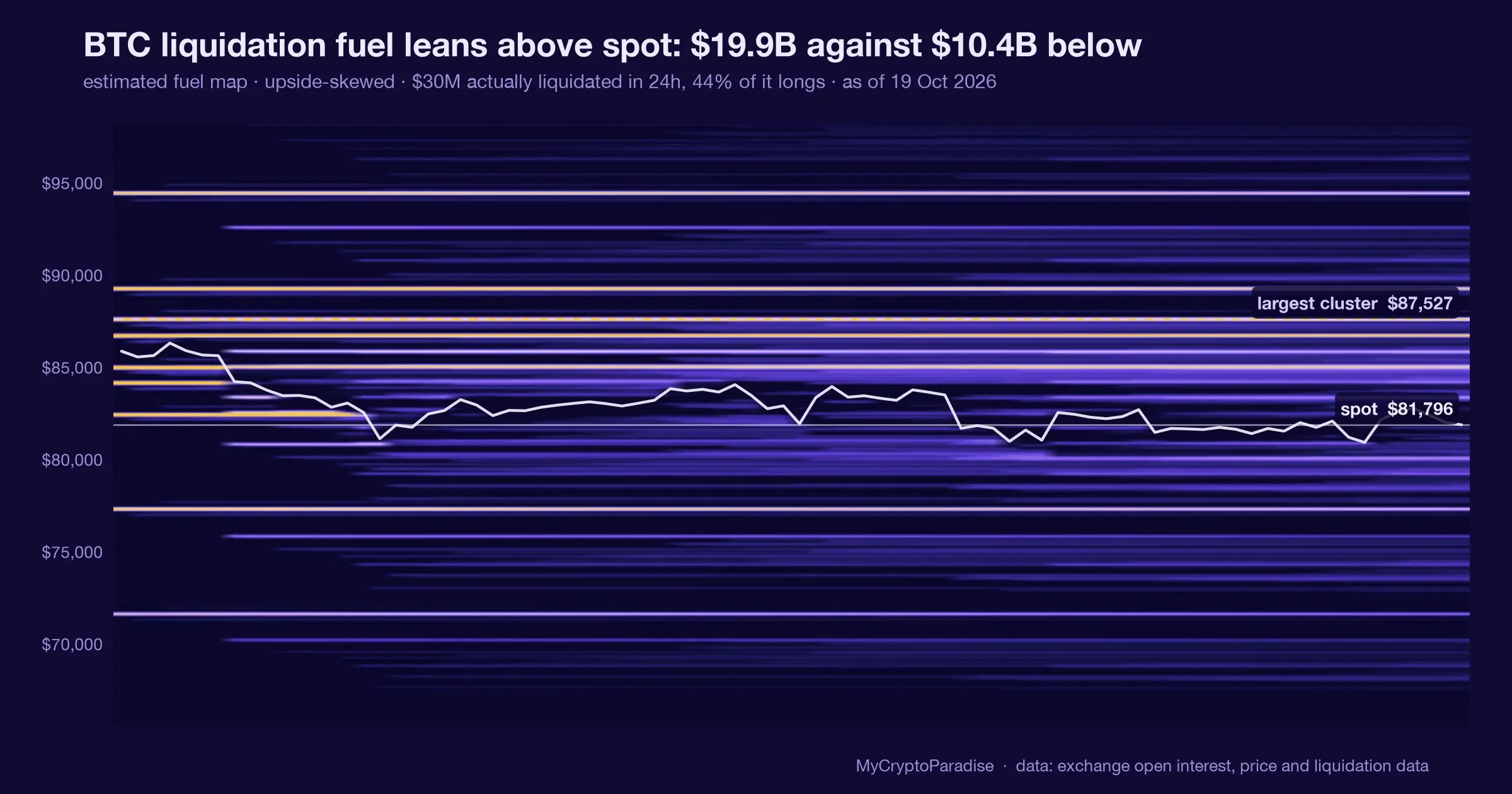
The ParadiseTeam reads this as a headline to set aside, not a variable to trade. A digital ruble payroll does not add or drain a single dollar from global crypto liquidity, so it does not touch the levels that actually govern BTC right now. Those levels are where our attention stays. BTC was near $84,933 as of the latest read, sitting between support around $82,000 and the resistance band at $88,000 to $90,000. This news moves none of those lines.
Our standing lens is the context, and it has nothing to do with Russia. We see scope for a short-term bounce from support near $82,000, helped by fearful retail and by selling being absorbed down there. But whales remain net sellers into strength, roughly 65 percent selling against 35 percent buying. That is why we respect the $88,000 to $90,000 zone far more than any CBDC headline. If price reaches it, that band is where distribution tends to show up, independent of today's story.
The practical point is discipline about what is noise. A trader who repositions on a state payroll announcement is reacting to drama, not to flow, and the flat tape already made that case for us. So keep the plan anchored to structure. Watch volume and reaction at resistance, watch how any rejection is shaped, and let liquidity, not a sovereignty headline, decide the next move.
The read behind this: we framed this story through our own market analysis, Can Bitcoin Bounce From Support?
Track it live: our Crypto Fear and Greed Index and the live crypto funding rates both update in real time, so you can watch this shift for yourself.
Related coverage
For exact entries, targets, and stop losses with full risk management, that is what ParadiseFamilyVIP is for. New to reading these moves? Start with our crypto trading strategies guide.
ParadiseTeam is monitoring the market situation closely, and we are taking these developments into consideration while building our trading tactics inside ParadiseFamilyVIP.
Crypto trading involves substantial risk. Prices are volatile and you can lose money. This article is educational and is not financial advice. Past performance does not guarantee future results.
Does state CBDC adoption matter for crypto prices over the next year?
This is how 18 Paradisers are calling it. Tap your call.
No calls on this one yet. Tap yours to be the first.
Free account, no password. Members just sign in.










Join the discussion 39
yeah but barely reacting to a c d b c dont mean its not a big deal for self custody if it takes off
that's a fair point Tommy... but for me, a cbdc getting real traction is a big deal for self custody if it takes off. its all about the off-ramps in the end...
I don't know, this "barely reacted" take feels a bit dismissive 🤔. Even small moves can be telling if you zoom out. Four-hour noise is not a signal.
Totally, Ingrid! I've been watching the 15-min chart for clues... small changes can build up. 📈
They pay us in levs... always will be. Other countries playing with this, just another brick in the wall... I watch the bigger picture.
i saw the headline 📰 and thought "this is huge!" but then I zoomed in on the charts 🔍 and barely saw a blip 📉. maybe its a long term thing? 🤔
The market's reaction here isn't surprising. A state-controlled digital currency introduces a new layer of friction rather than removing it.
na, I agree with Samuel 👆. my eyes are glued to the London session 💹, so CBDCs are just noise to me tbh 🤷♀️. unless the 15m chart shows me sumn, I’m not even looking. 🔥
I'm still looking at on-chain data to see if these digital ruble payments actually settled. I wonder if the volume numbers reflect this yet.
yeah i saw this one too. thought it might give us a little pop but nah 📉 still just crickets out there. what's everyone else seeing?
it's not about the news, it's about the bid. how much liquidity is actually there for these digital rubles to move anything.. ?
i also dont see much movement from this... it feels like central bank digital currency just wont move the needle much for real crypto... is that what others think too?
Samuel, I understand your point regarding the lack of immediate market reaction. However, the significance of a CBDC is not in its instant impact, but in its potential to alter the global financial landscape over time.
yea, this just means a national ledger, not decentralised value, so why would we expect market movement?!
Oh, I was wondering about that too, Samuel. I guess I thought maybe this would make more people curious about *any* digital currency, even if it's not exactly crypto itself? Sorry if that's a silly question.
I respectfully disagree, Samuel. CBDCs will likely have a significant impact on Bitcoin as a flight to sovereignty, even if the daily price action is not yet reflecting it.
i am curious if this payment was a single transaction or if it represents a sustained shift in daily operations. that would be more telling.
I am not sure "milestone" is the right word here. Is it really a true CBDC test if the system is closed off from the global Swift network?
Katya, its a good point you make. where is the written protocol for what constitutes a "true test" in a global system 🔬
exchanges would be my first place to check for flows on this too Samuel, but this is a fiat CBDC which wouldnt touch crypto orderbooks, so no movement there
Mei Lin, what invalidation did you use for this position?
is the central bank now the direct counterparty to the worker's salary account i wonder how that changes the balance sheet for the commercial banks
yeah i was watching the charts too but barely a wiggle 📉. almost had a panic buy for teh first time in ages 😅. guess its a waiting game. 🕰️
Yes, good point Liam… I was wondering if it's because it's only public sector salaries, not private. 🤔
yeah I also thought the chart would jump... it's like a good reminder not to just chase every big headline, right? 😅 I always check the volume after news.
Barely reacted" is accurate, but why would we expect BTC to move at all here?! This is a closed loop, not some new capital entering. What's the falsifiable argument for a reaction??
true, it feels like this is more about a nation optimizing its existing payment rails, rather than expanding the overall crypto pie.
I keep checking the charts when I see news like this, even small headlines. I guess the low volume makes sense, but I still expected something. 🤔 Sorry if that's a silly question.
Hey Marta, I totally get that feeling! I was watching too... wonder if the timing of the news had an impact, like weekend trading or something? 🧐
I just track dollar liquidity on the offshore markets for bigger picture stuff. This is more of a domestic story for Russia than a global market mover... Samuel is right.
The true liquidity impact of these moves always waits for the market to price in the "why" and "how much," not just the "what." Anticipation is rarely the catalyst.
You learn more watching how things don't move... it's about what the market discounts.
I think you're right, Ray! It's like the market already "knew" this would happen, or maybe it just wasn't a big enough surprise for crypto to react much to, you know?
The "barely reacted" take feels a little off when a government is moving to control purchasing power so directly. That always matters.
i wonder if the lack of reaction is partly because a lot of us just assume this kind of thing will happen eventually anyway, so its not really news for crypto markets??
It’s true, even seeing a new CBDC in action doesn't shift perp premiums much. My morning check confirms the basis remains fairly flat across major pairs.
I wonder if the barely-there reaction is actually the news itself, not what it's about. Like bad UX: if it’s too hard to connect the dots, users just give up. 🤷♀️
I keep reminding myself to check for bigger timeframes when news like this drops, not just the immediate candles. It helps keep things in perspective.
This is a closed system. How much of that "digital ruble" can actually leave Russia, let alone convert to something else?