

Developing story update (July 25, 2026, 00:12 UTC):
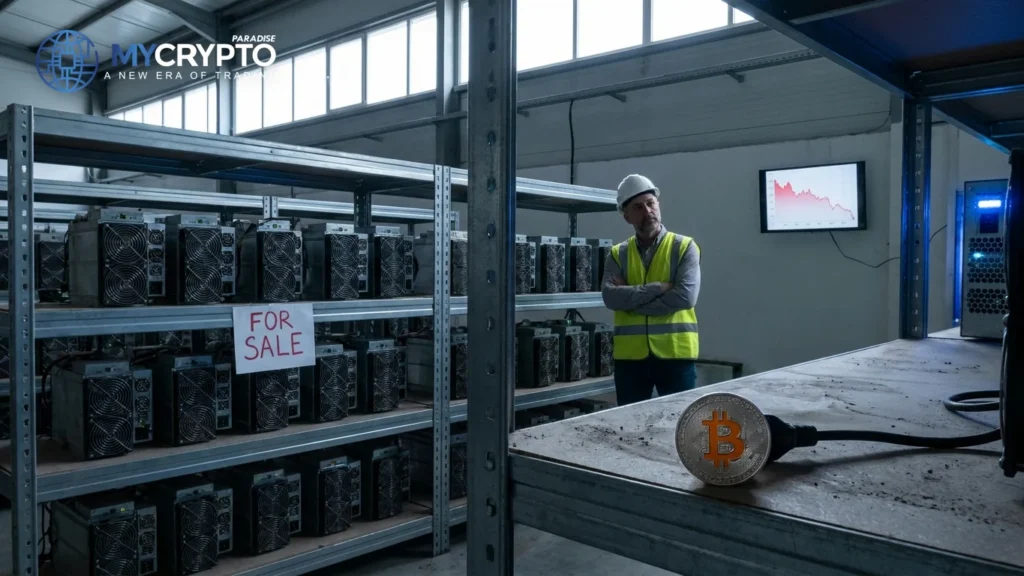
Poolin, once the world's largest BTC mining pool, has filed for Chapter 11 bankruptcy, listing $173M in debt based on our sources.
Two West Texas mining sites are up for auction with a $52M opening bid.
Listen: the breakdown
Market briefing: Poolin filed Chapter 11 with up to $500M in liabilities and a $52M Texas mining sale. BTC slipped to $63,800, now testing our $63,000 support.
- Poolin filed for Chapter 11, listing liabilities of up to $500M.
- The filing seeks to sell two Texas mining sites for just $52M.
- BTC fell to $63,800, down 1.7% on the day, pressing $63,000 support.
Poolin's bankruptcy fire sale just dragged Bitcoin to its $63,000 support test, with up to $500M in liabilities on the table. Is this retail capitulation or a bottom forming?
Poolin has filed for Chapter 11 bankruptcy. Once a top Bitcoin mining pool, it now lists liabilities of up to $500M.
The filing also seeks to sell two Texas mining sites for $52M. That is a thin price for the machines and megawatts it took to build them.
We flagged Poolin's distress earlier today. What is new is the scale and the detail: half a billion in liabilities, and a fire sale of hard assets to raise cash.
BTC did not shrug this time. Price slipped to $63,800, down 1.7% on the day and 1.1% in the last hour.
That drop matters because of where it landed. BTC is now pressing the $63,000 zone we treat as immediate support.
A mining pool selling rigs for $52M is not a bullish press release. It is a balance sheet meeting reality.
Structurally, this is the mining sector exhaling. Distressed operators sell coins and hardware to survive, which adds supply into a nervous tape.
Retail reads the headline and sells. Every cycle produces a name that once looked untouchable and now files paperwork instead.
So the question is not whether Poolin is stressed. It clearly is. The real question is who ends up holding the Bitcoin that stressed miners are forced to release.
Why mining distress leaks into Bitcoin liquidity
Mining is the market's leverage in physical form. Rigs run on borrowed money and thin margins.
When a pool like Poolin fails, the transmission is simple. Distressed miners raise cash by selling coins and hardware.
That selling hits an already fragile bid. It adds supply exactly when confidence is low.
The $52M Texas sale tells you the priority is liquidity, not price. Sellers who need cash do not wait for a good level.
This is why mining stress matters beyond mining. It signals the marginal producer is underwater at current prices.
Historically, miner capitulation clusters near macro bottoms, not tops. The weakest hands leave the field when costs exceed revenue.
Our read frames this as part of a broader capitulation phase. Retail and stressed institutions are being shaken out.
That does not make the news bullish on its face. A $500M liability list is a real loss for real creditors.
But the macro effect is a supply flush. Forced sellers hand coins to whoever is patient and liquid.
Smart money does not need a comfortable story. It needs weak holders and a price near support. Poolin's bankruptcy supplies both.
How the selloff moves BTC then alts
BTC felt it first. Price bled to $63,800 and is now testing the $63,000 support we watch closely.
The move is orderly, not a crash. That distinction matters. A slow bleed into support looks more like absorption than panic dumping.
Forced selling from distressed entities can exaggerate short moves. Thin liquidity lets small flows push price further than usual.
If $63,000 breaks and holds below, the next magnet sits at $59,000 to $60,000. That is our secondary wave stopping zone and major medium-term support.
ETH tends to follow BTC's lead here, only amplified. When BTC tests support, ETH usually tests harder and bounces harder.
Alts sit at the end of the whip. They fall fastest on mining-driven fear because their bids are thinnest.
For alts, this is a liquidity story, not a fundamentals story. Nothing about Poolin changes an altcoin's roadmap.
The cascade is the point. One stressed pool pressures BTC, BTC pressures ETH, and ETH pressures the long tail.
Retail typically sells the alt bottom into this exact sequence. They confuse a liquidity flush with a broken thesis.
The coins do not vanish. They rotate from forced sellers to patient buyers, which is how bottoms are quietly built.
What confirms reaccumulation versus a deeper flush
Watch $63,000 first. That is our immediate 4hr (four-hour) support and the line that keeps the near-term structure intact.
A daily close below $63,000 opens the door to $59,000 to $60,000. We would treat that lower zone as the real test, not a failure.
Confirmation of accumulation would show up in spot buying pressure. We want spot bids absorbing the forced supply, not leverage chasing.
Net Unrealized Profit and Loss (NUPL) dropping below zero would fit the capitulation script. It signals the average holder is underwater and giving up.
Invalidation is different. A clean reclaim of $69,000, our medium-term resistance, would say the flush is done early.
We also watch how BTC behaves around $59,000 to $60,000. A firm rejection of lower prices there confirms the secondary wave read.
The bearish signal to respect is a slice through $59,000 that does not recover. That would put the $44,000 macro zone in play.
$44,000 is where we see the exchange of hands, the mining electricity floor. It is a level, not a prophecy.
So the map is simple. Hold $63,000, healthy. Lose it toward $59,000, expected. Lose $59,000 with no bounce, respect the deeper flush.
What the fire sale means at support
The ParadiseTeam reads Poolin's collapse as fuel for capitulation, not a reason to abandon the bigger structure.
BTC was trading near $63,800 as of the latest print, pressing our $63,000 immediate support. That is where the story gets interesting.
Bearish news landing on support, with retail already fearful, usually means smart money is doing the buying. Poolin's forced selling hands them cheaper coins.
We still expect a possible final flush toward $59,000 to $60,000. A mining bankruptcy is exactly the kind of headline that tends to produce one.
Below that, $44,000 remains our macro exchange of hands zone. We are not calling for it, only respecting it if $59,000 fails.
Who benefits here? Patient buyers with cash. Who gets hurt? Leveraged holders whose stops sit just under $63,000 and $59,000.
That is where the liquidity pools sit. Forced selling tends to run price into those stops before it reverses.
Our medium-term bias stays constructive toward $69,000, then $79,000, if support holds. The long-term map still points higher.
None of this is a promise. It is a probability framework. Support can break, and risk always comes first.
We treat mining distress as a symptom of the bottoming process, not the end of it.
Track it live: our crypto liquidation heatmap and the Crypto Fear and Greed Index both update in real time, so you can watch this shift for yourself.
Related coverage
For exact entries, targets, and stop losses with full risk management, that is what ParadiseFamilyVIP is for. New to reading these moves? Start with our crypto trading strategies guide.
ParadiseTeam is monitoring the market situation closely, and we are taking these developments into consideration while building our trading tactics inside ParadiseFamilyVIP.
Crypto trading involves substantial risk. Prices are volatile and you can lose money. This article is educational and is not financial advice. Past performance does not guarantee future results.
Where does BTC go next after the Poolin fire sale hit $63,000 support?
This is how the Paradisers are calling it. Tap your call.
No calls on this one yet. Tap yours to be the first.
Free account, no password. Members just sign in.











Join the discussion
No comments yet. Members, share how you are reading this.