

Listen: the breakdown
Developing story update (September 20, 2026, 08:38 UTC):
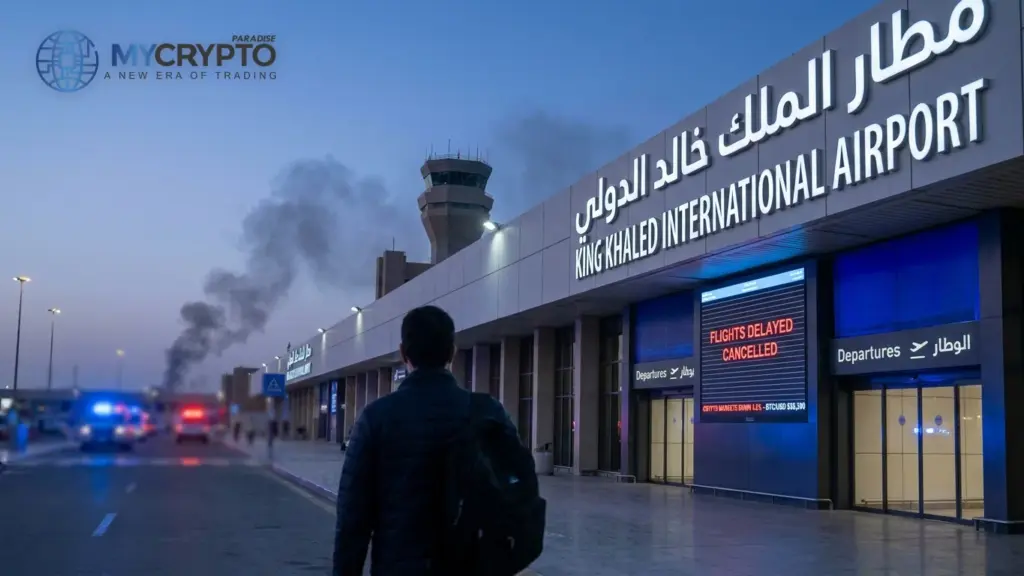
The attacking side has now publicly claimed responsibility for the barrage, and the scope is wider than first reported: the same wave of ballistic missiles targeted the Red Sea port of Yanbu in addition to Riyadh. Damage and casualty reports remain unchanged, with the fuel-storage fire near King Khalid International Airport contained and defenses reported to have intercepted the missile aimed at the capital.
For traders the read is unchanged. A second named target widens the geopolitical footprint but the crypto reaction stays muted: Bitcoin holds near 80,300 and Ethereum near 2,577, both still down on the day with no fresh hourly move. Based on our sources this remains a regional flare-up the market is treating as noise rather than a liquidity catalyst, and probabilities still favor range-bound action until a deeper flush arrives.
What to watch now: Whether additional targets or energy-infrastructure damage emerge that could move oil and risk sentiment.
Developing story update (September 20, 2026, 07:54 UTC):
Update: the Houthi movement has now publicly claimed responsibility for the missile attack on Riyadh, upgrading what was earlier reported to an owned claim. Saudi air defenses still report the missile intercepted and destroyed, with a fuel depot fire near King Khalid International Airport and no casualties reported.
President Trump has cut his Camp David weekend short by a full day, a signal worth watching for how seriously Washington is treating the escalation. Even so, crypto has not moved on it: BTC is holding around $80,325 and ETH near $2,576, both down under 1% on the day, essentially unchanged from when we first published.
Our read is unchanged. This remains a background risk input rather than a single catalyst. Smart money stays cautious and sidelined in stablecoins while retail momentum keeps the tape firm, and the muted reaction to a live geopolitical shock probably tells you more about positioning than about the headline itself.
What to watch now: Whether any further official US or Saudi response escalates the situation enough to finally force a risk-off move in crypto.
Developing story update (September 20, 2026, 06:50 UTC):
Update: the Yemen-based Houthis have claimed responsibility for the ballistic missile attack on Riyadh. Saudi Arabia’s military coalition says its air defenses intercepted and destroyed the missile, and there are no reports of casualties or damage, though a reported strike on a fuel depot at the airport caused delays.
For traders this trims the tail risk: an intercepted missile with no confirmed damage is a de-escalation relative to a direct hit, and price action reflects that. BTC sits near $80,332 and ETH near $2,572, both drifting slightly lower on the day rather than breaking down, consistent with a market absorbing the headline without panic.
Our read is unchanged. Smart money that has largely distributed into stablecoins is likely to treat this as one more reason to stay patient rather than a fresh catalyst. Watch for any Saudi or Iranian follow-on statement, since a confirmed escalation, not this contained event, would be what shifts risk appetite.
What to watch now: Any official Saudi or Iranian follow-on statement signaling escalation rather than a contained, intercepted strike.
Developing story: This story is still unfolding. We are tracking it and will update this article as more details are confirmed.
Market briefing: Smoke over Riyadh airport and Iran's top military alert put the Gulf on edge, yet crypto stayed calm. BTC held near $80,450, down about 0.6 percent, with ETH near $2,579.
- Iran declared 'Code 100', its highest military alert, as a reported missile struck Riyadh airport
- Trump cut short Camp David; at least 11 US embassies issued Gulf security alerts
- BTC held near $80,450 (-0.6% 24h), ETH near $2,579 (-1.6%), with no panic selling yet
Smoke over Riyadh airport, Iran on its highest alert, and Trump racing back to the White House. So why is crypto barely moving through the Gulf conflict?
Smoke rose over Riyadh airport. Reports point to a Houthi ballistic missile aimed at the Saudi capital, and flames were seen at the site. This is the sharpest turn yet in a Gulf story that had been building all day.
Hours earlier, Iran declared "Code 100," its highest level of military alert for all armed forces. We flagged that alert this morning. What is new now is the physical strike and the speed of the response around it.
US President Donald Trump cut short his visit to Camp David and returned to the White House. At least 11 US embassies across the Middle East, West Asia, and the Gulf issued security alerts and warnings for travel disruption. Diplomats do not clear a region for a rumor.
Iran has also said it wants the Saudi-Yemen war to end and has conveyed conditions for closing the conflict. So two signals now sit side by side: maximum alert, and an offered off-ramp. Markets rarely price both cleanly at once.
Crypto has stayed oddly calm through it.
Bitcoin traded near $80,450 as of the latest read, down about 0.6 percent on the day and barely moved in the last hour. Ether sat near $2,579, off about 1.6 percent. No flight, no scramble, just a market holding its breath and waiting to see which of those two signals wins.
Why a Gulf strike drains risk appetite
Geopolitics moves crypto through liquidity, not headlines. A missile on a Gulf capital raises the odds of a wider war. That pushes global capital toward safety: dollars, short-dated bonds, sometimes gold. Risk assets get sold first and asked questions later.
Bitcoin still trades as a risk asset in these moments, not a safe haven. The digital-gold story reads well in a newsletter. The tape says otherwise the moment embassies start issuing alerts.
Higher regional risk also lifts oil and energy uncertainty. That feeds inflation fear, which complicates rate cuts, which tightens the very liquidity that funds speculative bids. The chain runs from a runway in Riyadh to the marginal buyer of an altcoin.
There is a second layer that matters just as much. Iran's stated wish to end the Saudi-Yemen war is a real de-escalation signal. If its conditions gain traction, the risk premium can drain as fast as it built, and today's caution reverses. That two-way risk is exactly why patient capital would rather wait than guess.
Uncertainty is the tax here. Someone always pays it.
From safe havens to crypto selling pressure
BTC sets the tone, and BTC is the calmest thing on the screen. Down about 0.6 percent on the day with a flat hour tells us the selling is orderly, not forced. That looks like absorption, not capitulation.
ETH is weaker, off roughly 1.6 percent, which is the normal pattern. When risk appetite thins, capital leaves the higher-beta majors before it touches BTC. Ether leading the downside is the market quietly ranking safety.
Alts sit at the end of this chain. They need spare liquidity and a confident crowd to rally, and a Gulf strike removes both at once. Expect thin bids, wider spreads, and sharper wicks in smaller caps if the headlines worsen from here.
The real tell will be follow-through. If BTC accelerates lower on the next escalation headline, leverage is unwinding and the risk-off read is confirmed. If it shrugs and grinds back toward resistance, the market has already decided this stays contained.
For now, the market is treating a missile like a rounding error.
Escalation or an off-ramp decides price
Escalation is the first thing to track. A second strike, a direct Iran-US exchange, or a closure of shipping lanes would turn today's calm into a genuine risk-off flush. Those are the headlines that move price, not the alert on its own.
De-escalation is the mirror image. If Iran's conditions to end the Saudi-Yemen war gain traction, the risk premium unwinds quickly. That could hand crypto a relief bounce, though into resistance, not out of it.
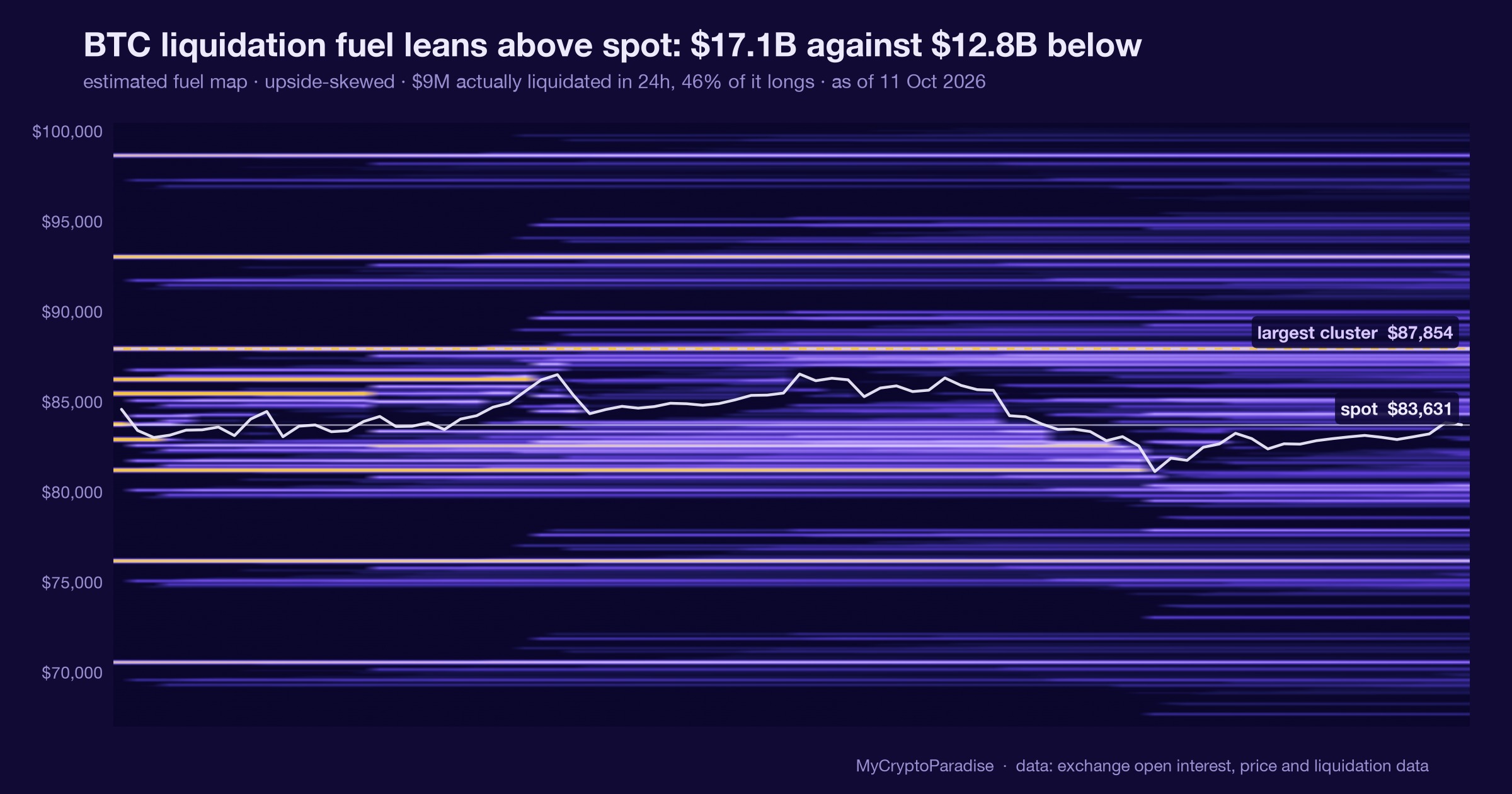
Watch the $82,000 to $84,000 zone on BTC closely. That is where price stalled before, and a liquidation cluster near $83,400 sits right inside it. A geopolitical shock makes a clean break through that zone far less likely, because buyers hesitate exactly when they need to commit.
On the downside, $75,000 is the line that has been defended. A decisive loss of it on escalation news would open the path toward the deeper macro levels we have flagged for weeks. Hold it, and this stays a range trade rather than a trend break.
Oil and the dollar will front-run all of it. Watch them first, before the crypto candle even prints.
What the strike means near resistance
The ParadiseTeam frames this through one lens: bearish news, but retail is greedy, not afraid. The Fear and Greed reading sits near extreme greed while price hides below resistance. That is the wrong crowd posture for a durable bottom.
Our macro bias stays bearish, and this strike does not change it. Smart money, the spot buyers who set macro bottoms, largely distributed earlier and now holds mostly USDT. They are waiting for real capitulation, meaning NUPL (Net Unrealized Profit and Loss, the aggregate of paper gains and losses across holders) turning negative. Today's orderly 0.6 percent dip is nowhere near that.
With BTC near $80,450, the $82,000 to $84,000 resistance is the battleground. A geopolitical shock is the perfect excuse for that zone to reject again. That would confirm the lack of follow-through we have been watching, and rejections into a greedy crowd usually mark distribution, not accumulation.
Invalidation is clean and worth respecting. A reclaim of $82,000 to $84,000 with genuine follow-through, driven by de-escalation rather than fear, would force us to respect a shift. Losing the defended $75,000 support on escalation would instead confirm the downside.
Smart money is not chasing this. Neither, this week, are we.
The read behind this: we framed this story through our own market analysis, Can Bitcoin Break Resistance This Time?
Track it live: our Crypto Fear and Greed Index and the live crypto funding rates both update in real time, so you can watch this shift for yourself.
Related coverage
For exact entries, targets, and stop losses with full risk management, that is what ParadiseFamilyVIP is for. New to reading these moves? Start with our crypto trading strategies guide.
ParadiseTeam is monitoring the market situation closely, and we are taking these developments into consideration while building our trading tactics inside ParadiseFamilyVIP.
Crypto trading involves substantial risk. Prices are volatile and you can lose money. This article is educational and is not financial advice. Past performance does not guarantee future results.
Where does BTC go next as the Gulf conflict escalates?
This is how 28 Paradisers are calling it. Tap your call.
No calls on this one yet. Tap yours to be the first.
Free account, no password. Members just sign in.









Join the discussion 3
So if the VIX is moving like Mateusz says, does that imply more of a flight to safety, or just more volatility everywhere? przepraszam.
So if this blows up, my invalidation on any long is a 1% daily move on the VIX, no questions asked.
woah... this is the kinda news that makes me check my charts right away... always felt like these global events are such a big part of the picture. 😲