

Listen: the breakdown
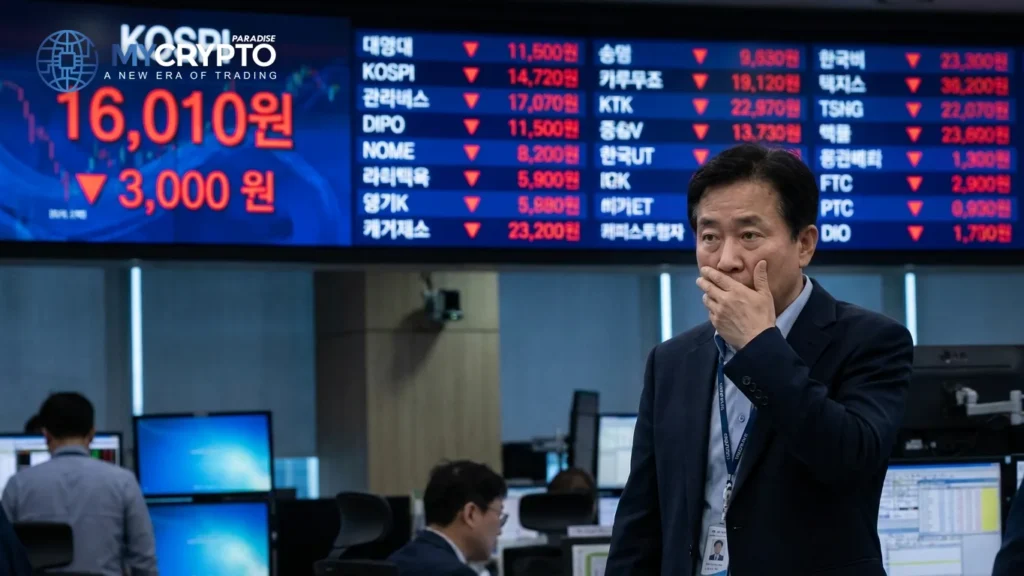
Market briefing: South Korea slammed the brakes on the KOSPI after an 8% plunge, its eighth circuit breaker this year, and crypto flinched. BTC sits near 63,200, down 3% on the day, while ETH holds around 1,877.
- KOSPI fell more than 8% on July 28, forcing a 20-minute trading halt, its eighth circuit breaker of 2026.
- SK Hynix's U.S.-listed ADR slipped below $140 as Asian risk appetite drained fast.
- BTC eased to $63,200 and ETH to $1,876.9 as the equity shock bled into crypto sentiment.
A KOSPI circuit breaker just froze Korean stocks for 20 minutes, and crypto felt the chill. Is this retail fear handing smart money a discount, or the first crack of a deeper slide?
South Korea pulled the emergency brake on July 28. The KOSPI benchmark index fell more than 8%, tripping a circuit breaker that halted trading in listed shares for 20 minutes. It was the eighth such halt of 2026, and the market barely blinked at the number by now.
At the center sat SK Hynix. Its U.S.-listed ADR (American Depositary Receipt, a foreign stock traded on a U.S. exchange) slipped below $140, a level that would have looked unthinkable to the same crowd cheering the artificial intelligence trade a few months ago.
The halt is a circuit designed to cool panic, not fix it. Trading stops, everyone catches their breath, and the selling usually resumes with slightly steadier hands. What matters for us is not the Korean tape itself. It is what an 8% single-session drop in a major Asian benchmark signals about global risk appetite.
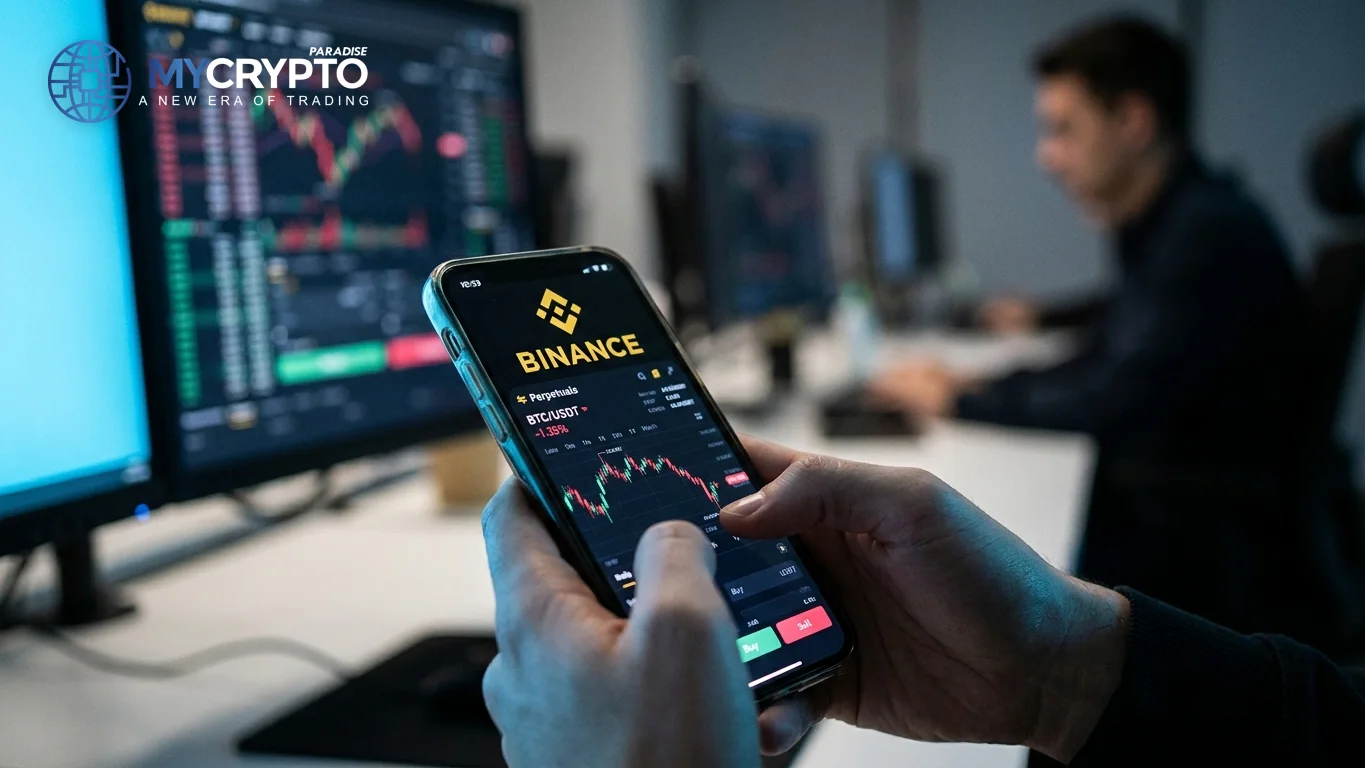
Crypto answered quickly. Bitcoin eased to $63,200, down 3% over 24 hours. Ethereum slipped to $1,876.9, down 3.6%. Neither move is dramatic, but the correlation is the tell: when Asian equities gap lower, leveraged risk everywhere gets trimmed first.
This is the fourth risk-off thread we have tracked today, and it rhymes with the rest. A jittery Fed tone, liquidations at resistance, and now a foreign equity shock all point the same way. Fear is doing the heavy lifting. The question is who is buying while it does.
Why an Asian equity halt reaches crypto
The transmission runs through risk appetite, not through any direct link between chips and coins. When a benchmark like the KOSPI drops 8% in a session, global allocators reprice everything they own. Asian risk assets lead, then the selling spreads to whatever is easiest to sell fast. Crypto trades around the clock, so it becomes the pressure valve for fear that cannot yet vent in closed Western markets.
SK Hynix falling below $140 matters beyond one company. It is a proxy for the artificial intelligence and semiconductor euphoria that carried Asian indices higher all year. When the market's favorite growth story wobbles, the message is that liquidity is tightening and patience is thinning. That is the real driver here: a global shift from greed toward caution. Tighter liquidity means less speculative capital chasing the riskiest corners of the market, and crypto sits at the far end of that spectrum.
Eight circuit breakers in a single year is not normal. It tells you volatility has become structural, not incidental. Each halt trains retail to expect the next one, which feeds the reflex to sell first and think later.
For traders, the lesson is simple. This was not a crypto story that started in crypto. It arrived from Seoul, rode the risk-off wave, and landed on Bitcoin's doorstep as a 3% dip. Understanding the source keeps you from mistaking a sentiment shock for a broken chart.
How the risk-off wave hit BTC then alts
The cascade followed the usual order. Asian equities cracked first, sentiment soured, and Bitcoin took the initial hit as the market's most liquid risk proxy. BTC's 3% slide to $63,200 is measured, not a crash, which tells you this was position-trimming rather than forced capitulation.
Ethereum did what it usually does under pressure. It fell harder, down 3.6% to $1,876.9, because higher-beta assets amplify whatever Bitcoin does. When fear rises, capital rotates toward the perceived safety of BTC and away from ETH and the long tail.
Alts felt it worse still. They always do. In a risk-off wave, the assets furthest from safety bleed fastest, and thin liquidity turns a modest sell order into an outsized candle. This is the mechanical reason alt drawdowns look violent even when Bitcoin barely moves.
Notice what did not happen. There was no disorderly liquidation spiral, no cascade of long stops blowing out in seconds. The move was orderly, which matters. Orderly selling near support is often smart money quietly reducing retail exposure, not smart money panicking.
Here is the uncomfortable pattern. Retail tends to sell an external shock like this into weak hands, right as the price approaches a level where larger players want inventory. The KOSPI halt gave nervous holders a reason to exit. Whether that reason ages well depends entirely on what happens at support next.
What confirms accumulation versus a deeper slide
The next few sessions decide which story this is. The first thing to watch is whether Bitcoin holds the $61,000 to $60,000 support band. A firm defense there, especially with shrinking sell volume, would suggest the KOSPI shock was absorbed and buyers stepped in.
Watch how Asian markets open next. If the KOSPI stabilizes and SK Hynix reclaims ground, the risk-off impulse loses its engine, and crypto's dip likely looks like noise in hindsight. A second halt or a fresh leg lower would flip the read fast.
Volume tells the truth that price hides. A bounce on rising volume confirms real demand. A bounce on thin volume is just a lack of sellers, which fails at the first serious test of resistance.
Invalidation is honest and specific. A daily close below $60,000 would break the support thesis and open the door toward the $55,000 region, the top of the deeper macro zone we have flagged. That is the level where a dip becomes a trend.
Confirmation looks different. Reclaiming $65,600, the resistance that has rejected price repeatedly, would tell you buyers overpowered the fear and the risk-off scare was a shakeout. Between those two lines sits the whole debate. Until one breaks, patience beats prediction, and forcing a trade into an external shock is how good accounts get chopped.
What the KOSPI shock means for BTC positioning
The ParadiseTeam reads this through a simple lens: an external fear catalyst arriving while Bitcoin sits above support is rarely the top of a move. It is more often the shakeout before one. Our working bias stays cautiously constructive for a final push toward the $69,000 to $79,000 zone in the short to medium term.
Apply that to today. BTC was trading near $63,200 as of this print, comfortably inside the range and above the $61,000 to $60,000 support we care about. The KOSPI halt scared retail into selling exactly where larger players prefer to add. That is the mechanism, not a promise.
Stops matter here. After a 3% flush, sell-stops now cluster under $61,000 and again beneath $60,000. Smart money knows where that liquidity sits, and price often reaches for it before turning. A wick into that zone that snaps back would strengthen the accumulation read, not weaken it.
We hold a genuine two-sided view. On the weekly timeframe we still expect a retrace toward the $44,000 to $55,000 macro bottom eventually. So this dip could be the launchpad for the $69K push, or the opening move of that larger retrace.
The deciding line is $60,000. Above it, we treat weakness as opportunity into strength. A clean close below it, and we respect the downside and step aside. Probabilities, not certainties, and the chart votes before we do.
Track it live: our Crypto Fear and Greed Index and the crypto liquidation heatmap both update in real time, so you can watch this shift for yourself.
Related coverage
For exact entries, targets, and stop losses with full risk management, that is what ParadiseFamilyVIP is for. New to reading these moves? Start with our crypto trading strategies guide.
ParadiseTeam is monitoring the market situation closely, and we are taking these developments into consideration while building our trading tactics inside ParadiseFamilyVIP.
Crypto trading involves substantial risk. Prices are volatile and you can lose money. This article is educational and is not financial advice. Past performance does not guarantee future results.
Where does BTC go from here after the KOSPI risk-off shock?
This is how the Paradisers are calling it. Tap your call.
No calls on this one yet. Tap yours to be the first.
Free account, no password. Members just sign in.





Join the discussion
No comments yet. Members, share how you are reading this.