

Listen: the breakdown
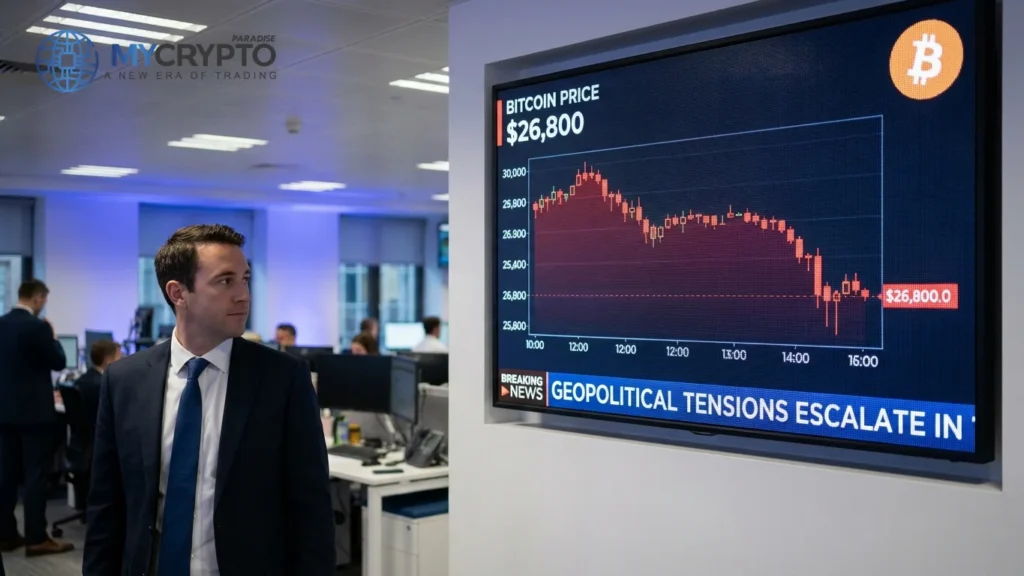
Market briefing: Iran has rejected a US ceasefire proposal carried to Tehran by Iraq's Prime Minister, yet crypto barely moved. Bitcoin sits near $65,291, down just 1.2 percent on the day.
- Iran rejected a US ceasefire proposal delivered to Tehran by Iraq's Prime Minister.
- The rejection follows claims that Iran was privately begging for a deal, and 12 straight nights of US strikes.
- BTC held near $65,291 and ETH near $1,876, a muted reaction that tells us more than the headline does.
Source: U.S. Department of State
Iran rejects the ceasefire, and this time a Prime Minister carried the offer himself. Five months in, the market yawned. So why does the calm matter more than the conflict?
We covered Iran's ceasefire rejection earlier today. This is the update, and the new detail changes the tone.
The proposal was not a phone call. Iraq's Prime Minister carried it to Tehran in person, a serious diplomatic channel for a serious offer. Iran rejected it anyway.
That rejection lands awkwardly next to earlier claims that Iran was, in the words of the US Secretary of State, begging for a deal both directly and indirectly. Publicly begging and privately refusing are hard to reconcile. Someone's narrative is doing more work than the facts.
The backdrop is heavy. The conflict is approaching five months. The US has struck Iranian military targets on twelve straight nights. On paper, this is exactly the kind of headline that should shake risk assets.
And yet Bitcoin was trading near $65,291, down only 1.2 percent over twenty four hours, with no change at all in the last hour. Ethereum sat near $1,876.
That is the story. Not the rejection itself, but the market's refusal to care. A war entering its fifth month has become background noise, priced and absorbed.
For traders, muted reactions to loud headlines are the ones worth reading closely. They tell you who is actually setting price, and it is not the newsfeed.
Why a five month war stopped moving price
The transmission from Middle East conflict to crypto runs through global liquidity and risk appetite. When a shock hits, capital flees to dollars and Treasuries, and risk assets bleed.
That mechanism still works. It just needs a genuine escalation to fire.
What we have here is continuation, not escalation. Iran rejecting a ceasefire keeps the existing conflict running. It does not open a new front, close a strait, or spike oil in a way that forces central banks to respond.
Markets price surprises, not repetition. The twelfth straight night of strikes carries far less shock than the first. Each headline in a long war moves the needle less, because the risk premium was built in months ago.
So the liquidity effect is thin. There is no fresh dollar squeeze, no sudden flight from risk, no macro trigger large enough to override the crypto market's own internal structure.
This is why crypto shrugged. The same numbness showed up when the market ignored a fresh round of tariffs across sixty nations this week. Big headlines, small reactions, a pattern worth respecting.
The honest read is that this geopolitical news is a background factor, not the driver of price. Treating it as the reason for every candle is how retail talks itself into bad trades.
How the muted flush played out across majors
Start with Bitcoin, because it leads. BTC absorbed the headline and held near $65,291. A 1.2 percent daily dip and a flat hourly candle is not fear. It is indifference.
That matters. When the largest, most liquid asset barely registers a war headline, the smaller ones have no reason to panic on fundamentals alone.
Ethereum told a slightly different story. ETH fell around 3.2 percent on the day to near $1,876, a sharper slide than BTC. That gap is not about Iran. It is ETH's usual higher beta showing through in a soft tape.
When risk cools even mildly, ETH and the alts fall faster than Bitcoin. The headline simply gave an already tired ETH an excuse.
Alts sit at the end of this chain. With no real liquidity shock upstream, there was no violent cascade down the risk curve, just the ordinary drift you would expect on a quiet, slightly negative day.
The key point is what did not happen. No stop cascade, no capitulation wick, no leveraged unwind. The feared flush never arrived.
When a market braces for a flush that does not come, that failed break often traps the shorts who positioned for it. The absence of a move is itself the move.
What confirms calm and what would break it
Watch the majors, not the newswire. The cleanest tell is whether Bitcoin keeps holding above the $61,000 reversal region on the daily.
As long as BTC stays above that zone, this remains a structural market, not a geopolitical one, and the headline stays background noise.
Invalidation of the calm would look mechanical, not verbal. A real close below $61,000 on rising volume, alongside a genuine risk-off move in oil and equities, would tell us the conflict has finally escalated into something markets must price.
Until both of those move together, treat single headlines as noise.
On the upside, watch the $70,000 resistance. If price grinds up toward it while war headlines keep landing and getting ignored, that is strength quietly building, not weakness.
A reaction at $70,000 would tell us more about this market than any ceasefire statement.
Also watch oil. It is the real channel between this conflict and your portfolio. A sharp, sustained oil spike is the one development that could convert these headlines into an actual liquidity event.
So far, oil has not delivered that shock. Watch it before you watch Tehran.
The discipline here is simple. Let confirmation come from price and correlated markets, not from the emotional pull of a breaking banner.
What this quiet tape signals about positioning
The ParadiseTeam reads this rejection as a non-event for our structure, and the muted price action confirms it.
With BTC near $65,291, price sits above the $61,000 reversal point where some reaccumulation already happened, and below the $70,000 resistance we are watching closely. The war headline changes none of those levels.
Our medium term lens still allows a push toward the $79,000 magnet, the CME gap and C-wave target. A geopolitical headline that fails to move price does nothing to cancel that path, and it may quietly clear out shorts who bet on a flush.
Here is the mechanism. Retail trades the banner and braces for war. Smart money trades the structure and absorbs the minor selling that fear provides, without changing a thing.
We still expect the larger story to be a capitulation later, into the $55,000 to $44,000 zone, where the heaviest reaccumulation is planned. This headline neither brings that forward nor pushes it back.
So the read is patience, not reaction. Above $61,000, structure stays intact. A confirmed break below it, paired with real macro stress, is what would matter.
Risk note: this is analysis, not a signal or advice. Size for the scenario you can be wrong in, define your invalidation before you enter, and never let a headline set your stop for you.
Track it live: our Crypto Fear and Greed Index and the crypto liquidation heatmap both update in real time, so you can watch this shift for yourself.
Related coverage
For exact entries, targets, and stop losses with full risk management, that is what ParadiseFamilyVIP is for. New to reading these moves? Start with our crypto trading strategies guide.
ParadiseTeam is monitoring the market situation closely, and we are taking these developments into consideration while building our trading tactics inside ParadiseFamilyVIP.
Crypto trading involves substantial risk. Prices are volatile and you can lose money. This article is educational and is not financial advice. Past performance does not guarantee future results.
With war headlines ignored, where does BTC head next from $65k?
This is how the Paradisers are calling it. Tap your call.
No calls on this one yet. Tap yours to be the first.
Free account, no password. Members just sign in.






Join the discussion
No comments yet. Members, share how you are reading this.