

Listen: the breakdown
Market briefing: India's stablecoin premium just hit 6.4%, with buyers paying near 101 rupees for a digital dollar worth about 94.6. BTC sat near $82,739, barely moved, but the demand signal is real.
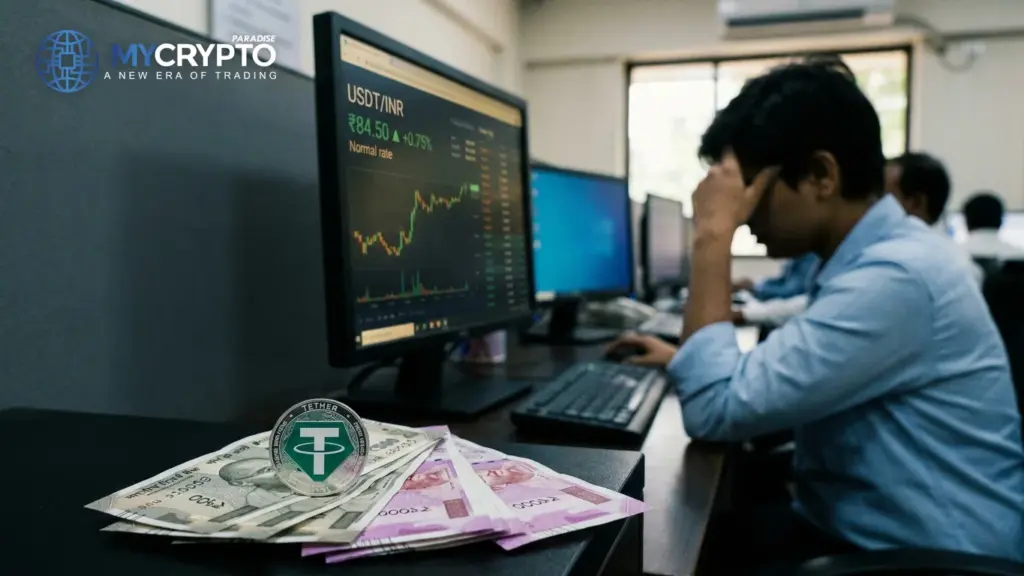
- USDT traded at a 6.40% premium in India, near ₹100.89 against a fair value close to ₹94.63.
- USDC ran even hotter, a 6.89% premium at ₹101.45, as local dollar demand outpaced token supply.
- No single same-day catalyst; we read it as a structural hunger for crypto-based dollar access.
India's stablecoin premium just reached 6.4%, with buyers overpaying nearly 6,000 rupees per 100,000 to hold a digital dollar. So what is that premium really telling us?
India just showed the world what urgency looks like in a stablecoin. Buyers there paid a 6.40% premium for USDT this week. The token changed hands near ₹100.89. Its fair value sat closer to ₹94.63. That gap is not a rounding error.
USDC told the same story, only louder. Its premium reached 6.89%, with an indicative price of ₹101.45. Indian buyers chose to overpay for a digital dollar rather than wait. On a 100,000 rupee purchase, that premium adds roughly 6,000 rupees of pure cost.
Three forces stacked up here. Local demand for dollar-pegged assets ran hot. Local supply of those tokens stayed thin. Exchange costs did the rest. Together they pushed the peg well above its global anchor against the rupee.
This is not one confirmed headline event. It is a pattern we read, not a single verified catalyst.
Still, the structure matters. When people pay 6% over par for a dollar substitute, they are voting with real money. They want dollar exposure, and they want it through crypto rails. That kind of demand rarely vanishes quietly. Meanwhile BTC sat near $82,739, almost flat on the day, indifferent to the drama unfolding one market away.
A currency hedge hiding inside a stablecoin
A stablecoin premium is a pressure gauge. It measures how badly a market wants dollars it cannot easily get. In India, that pressure now reads at 6.40% for USDT and 6.89% for USDC. Both numbers point the same way.
Traders there are not speculating on Tether. They are reaching for dollar exposure. Local currency volatility and tight capital rules make that exposure hard through traditional banking. Crypto rails offer a faster, cleaner door.
That creates a localized liquidity divergence. The same token that trades at par globally trades 6% richer against the rupee. The peg holds against the dollar, but it bends against local supply and demand.
For us, the signal beats the noise. A premium this wide tells us demand is outrunning available tokens inside one of the largest emerging markets on earth. People pay up only when the alternative, waiting or using slower channels, costs them more.
That is the quiet part worth hearing. Emerging-market dollar hunger is a real, recurring force under crypto adoption. It does not move BTC on a Tuesday. But it widens the base of users who treat stablecoins, and the exchanges behind them, as everyday infrastructure. A deeper base today tends to mean a steadier bid tomorrow.
Reading the premium as emerging market demand
Let us be honest about the timing first. This premium carries no direct, immediate pull on global BTC or ETH prices. The brief confirms that, and the charts agree.
BTC traded near $82,739, up a flat 0.04% on the day. ETH sat at $2,438, down about 0.3%. Neither flinched at a rupee-denominated spread. Markets this size do not turn on one corridor.
So the impact is slower and structural. Sustained stablecoin demand in India feeds the same pool of dollar liquidity that eventually buys spot. When that demand converts, BTC usually drinks first. It is the deepest, most liquid entry point for new capital.
ETH tends to follow once BTC steadies. Alts come last and loudest, living on the liquidity that trickles down after the majors have moved. A premium in Mumbai is a long way up that chain, but it sits at the right end of it.
Smart money reads this differently from retail. Retail sees a strange local price. The patient capital sees an arbitrage, buying cheap dollars globally and selling them richer into India, and an adoption data point worth logging.
Neither group expects a candle today. Both file it under demand that compounds. That is the honest read: fuel, not a match.
Signals that widen or close the gap
The first thing to watch is whether this premium sticks. A 6% gap that holds for days means structural demand, not a one-off squeeze. That would confirm our read.
If the premium collapses back toward par within a session or two, treat it as a short-lived liquidity crunch. Thin supply can spike a price fast and fade just as fast. That outcome invalidates the adoption story and leaves us with noise.
Watch for the gap spreading. If other emerging markets start showing similar stablecoin premiums, the signal grows from local to regional. Broad dollar hunger across several corridors is a far stronger tell than one country alone.
Keep an eye on supply response too. Fresh USDT and USDC flowing into Indian exchanges should compress the premium naturally. If it stays wide while supply arrives, demand is genuinely overwhelming the float.
Regulation is the wildcard. A premium this visible invites official attention to capital flows and crypto dollar access. Any tightening could choke the channel; any clarity could widen it. We will treat policy moves as the real catalyst, separate from this reading.
Finally, map it against global flows. If stablecoin market caps keep climbing while premiums persist, the two together build a credible inflow thesis. One number alone proves nothing. The pattern across all of them is what we trust.
Where the premium sits against BTC resistance
The ParadiseTeam treats this as a demand reading, not a trigger. It tells us who wants dollars. It does not tell us when BTC breaks out.
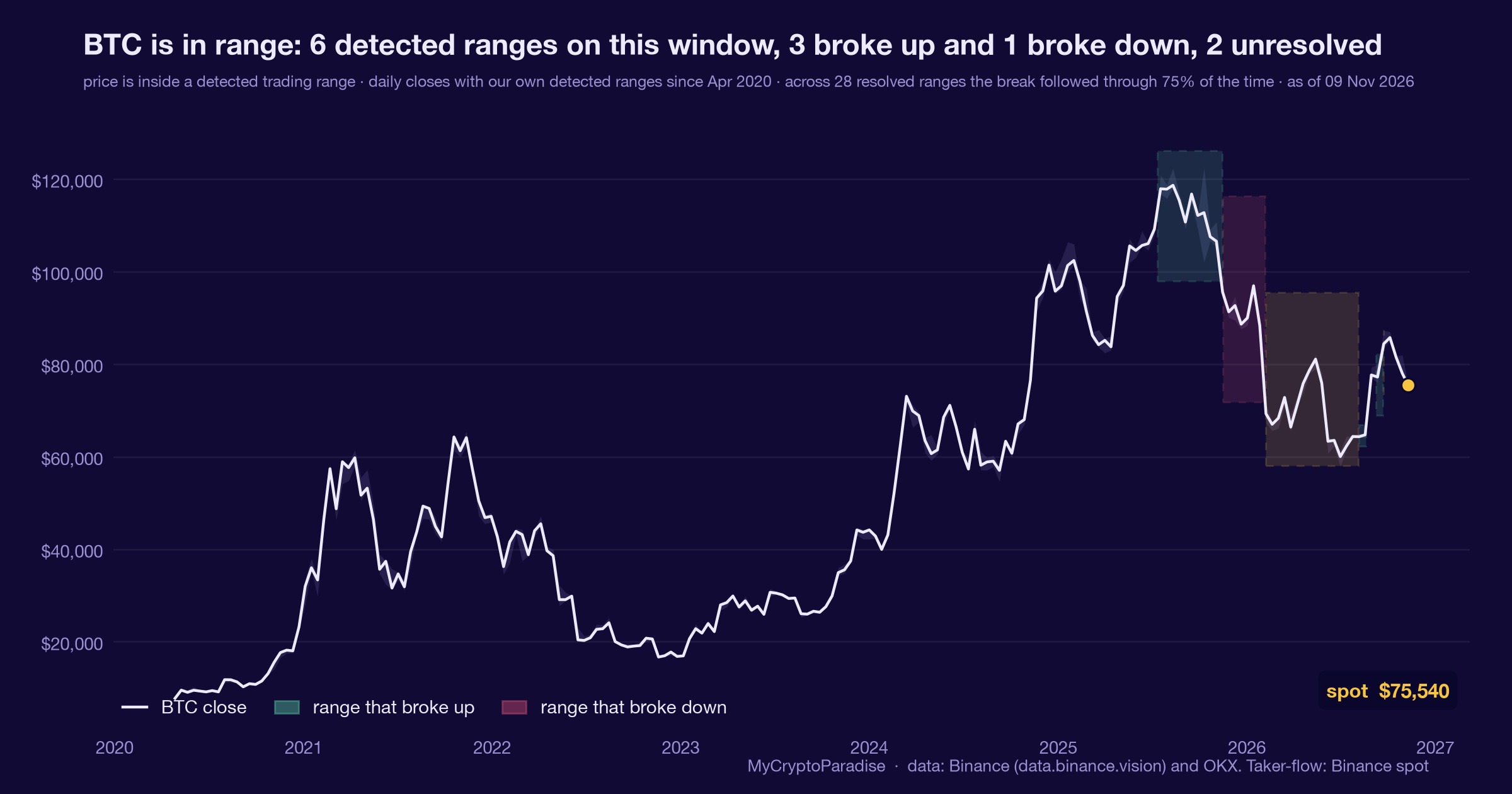
Context matters more here than the number. BTC was trading near $82,739 as of the latest read, which lands it squarely inside the $82,000 to $84,200 resistance band that recently turned red. Strength arriving into known supply is exactly where sellers wait.
Our standing lens stays cautious. Whales have leaned heavily toward selling, roughly 67% over 24 hours, which looks like distribution rather than panic. Emerging-market demand is a slow tailwind. It does not cancel that overhead pressure overnight.
That said, bears are losing steam. Multiple bullish divergences are forming on the medium timeframe as momentum fades. That raises the odds of a push toward $90,000 before any larger rejection.
Structure guides the risk. The $73,000 level is the line that matters below; a clean break there would change market structure and reopen the $44,000 reaccumulation zone. Above, $84,200 then $90,000 are the walls to clear.
So the premium changes one thing for us. It deepens the bid under dips, because real buyers keep paying up for crypto dollar access. It is quiet fuel, not an instant lift. We let the levels, not the headline, decide the entries. Patience beats paying a premium of your own.
The read behind this: we framed this story through our own market analysis, Can Bitcoin Recover From This Support?
Track it live: our live crypto funding rates and the Crypto Fear and Greed Index both update in real time, so you can watch this shift for yourself.
Related coverage
For exact entries, targets, and stop losses with full risk management, that is what ParadiseFamilyVIP is for. New to reading these moves? Start with our crypto trading strategies guide.
ParadiseTeam is monitoring the market situation closely, and we are taking these developments into consideration while building our trading tactics inside ParadiseFamilyVIP.
Crypto trading involves substantial risk. Prices are volatile and you can lose money. This article is educational and is not financial advice. Past performance does not guarantee future results.
Does India's stablecoin premium stay above 5% from here?
How 18 Paradisers are calling it
The first call is still open
Free account, no password. Members just sign in.
Follow this topic: Stablecoin news







Join the discussion 27
Yeah, that extra bit for stablecoins here really highlights how much people value that option - it reminds me, nothing is boring by default, only by design. Quite a signal, actually 🤔.
Ugh, this reminds me of when my coworker kept harping on about the local premium for something completely different. It's just more noise if you're not looking at weekly closes, right? 🤔
Local premiums can also reflect exchange-specific liquidity conditions at session open, not just weekly closes. Price action often diverges.
Premium is normal 🤔. People just want something stable, I remember how it felt when my family first got theirs. 📈✨ Hannah, you're lucky to buy without it! 😅
Totally! And that demand for stability just gets stronger when there's currency volatility in their own countries... makes sense they pay more for it. 💯
It's not about luck, Hannah. It's about protecting your purchasing power. Aisha, that feeling of stability is everything, isn't it?
Aisha, I totally get that! 🥹 It's so true, having those stable coins really makes a big difference for families. Glad to hear it helped yours too! 💪
Yeah, that premium makes total sense for anyone just trying to keep their money from disappearing. It's like finding solid ground.
it really highlights how important stability is, especially for folks worried about local currency devaluation.
yeah, it tracks... that demand for digital dollars in places like India, it's about so much more than charts... it's about options, about getting money where it needs to go when banks just cant.
Nadia, you articulate the core thesis well. It is indeed about the optionality that stablecoins provide, especially in our context.
wonder if its more about avoiding the local currency than just wanting dollars, that's what i see back home sometimes
always thought of that premium as just a tax on bad planning. kinda reminds me of my first time buying USDT, almost paid way too much. 🤦♂️
yeah, that premium can def hit you if you arent paying attention... its why I always compare a few exchanges now before a stablecoin purchase. 📊
It is true that poor planning can extract a premium. However, the current demand dynamic in India suggests this is less about individual choices and more about a market condition.
This premium differential for emerging markets is a data point I track closely. It offers a clear signal for local fiat liquidity issues.
Definitely, Katya. I’ve seen this premium jump even higher, sometimes, when local exchanges struggle with their own USD reserves.. It's a key indicator.
Exactly! It's like a friction coefficient on the UI, showing where user access is really bottlenecked. 📈
Wow, that premium for USDT in India is huge! 😲 For me, digital transfers solved so many issues sending money home. 💸 Glad to see people finding solutions. ⬆️
Oh, that's interesting... I always try to buy my stablecoins without a premium, so this extra cost for Indian buyers is quite a lot! 🤔
i dont think its an "extra cost" in the traditional sense, more like a function of the local supply/demand dynamics for USD exposure. the premium implies a persistent bid.
i understand the supply/demand part, but if people are paying more than 1:1 for a stablecoin, its definitely an extra cost they have to absorb, no? its like a hidden fee... 😕
The premium is a good read on local demand. Arbitrage opportunities become limited at that level.
Or are we simply seeing an increased *cost* for liquidity in a less efficient market, not necessarily demand? Where are the spreads on the other side?
Premium like this, especially during volume surges, always signals weak liquidity for me. Doesn't matter if it's Rotterdam port slots or stablecoins, same dynamics.
Blimey, that's a fair old premium teh lads are paying over there 🤔💸 always keep an eye on these regional diffs for sure 👀⬆️. Cheers Hannah for pointing it out!
haha, funny you mention that Liam, the true cost often involves factoring in those withdrawal fees too, which can make the premium even stickier on the books. 😉