

Listen: the breakdown
Market briefing: Frax says its Burn Engine is live, using protocol revenue to buy back and burn FRAX, with frxETH revenue flowing in from Q4. It lands into a risk-off tape, with BTC near $70,813 after a 4.3% daily slide.
- Frax says its Burn Engine is live, using protocol revenue to programmatically buy back and burn FRAX
- frxETH revenue is scheduled to begin feeding the engine from Q4, per the project's Q3 report
- A supply-reducing mechanic on paper, but self-reported with no independent price or volume confirmation yet
The Frax Burn Engine is live, routing protocol revenue into a programmatic FRAX buyback and burn. But does a supply cut matter when no price data has confirmed a single buyer yet?
Frax Finance says its Burn Engine is now live. For the first time in the protocol's history, it is using meaningful protocol revenue to programmatically buy back and burn FRAX, the project's own token.
The detail that matters came with the timing. In its Q3 report, Frax confirmed that frxETH revenue will begin flowing into the Burn Engine starting in Q4. So the mechanic is not a one-off. It is designed as a recurring drain on circulating supply, funded by what the protocol actually earns rather than by emissions or treasury hand-waving.
That framing is deliberate. For years, most token economies promised value accrual and delivered inflation. A revenue-funded burn is the opposite pitch: fewer tokens over time, paid for by cash flow, with the maths visible on-chain.
Here is the honest part. Every word of this arrives from the protocol's own announcement. We have no independent confirmation of the engine's funding mechanics, and no FRAX price or volume data in hand showing how the market actually responded.
That gap is the whole story. A buyback and burn is a textbook bullish tokenomics upgrade, and we treat the design as a genuine positive for FRAX. But a design is not a bid. Until real buying shows up in price and volume, the deflationary claim remains a claim, however elegant the slide deck.
The news also drops into a nervous tape, with BTC down sharply on the day and ETH lower beside it.
Why a revenue funded burn changes FRAX supply
The mechanism matters because it changes where FRAX demand comes from. Most buyback-and-burn programs are funded by token emissions or a shrinking treasury, which quietly dilutes holders while claiming to reward them. Frax's version is meant to be funded by frxETH revenue, meaning real yield the protocol earns, redirected into open-market buying of its own token.
If that holds, the transmission is clean. Revenue buys FRAX. FRAX gets burned. Circulating supply falls. Each unit of future demand then meets a smaller float, which is the entire logic of deflationary tokenomics.
The Q4 timing is the lever. frxETH revenue only starts feeding the engine next quarter, so today's launch is the switch, not yet the flow. The size of that flow, once live, decides whether this is a structural supply drain or a rounding error dressed as one. This is also narrow by nature. It is a single protocol altering its own token's supply schedule. There is no evidence that a FRAX-specific burn transmits to broader crypto liquidity, to BTC, or to ETH, which are trading on separate drivers entirely.
So keep the scope honest. For FRAX holders, a credible, revenue-funded burn is a fundamental upgrade worth watching. For the wider market, it is a tokenomics story, not a macro one, and it should be read as exactly that rather than stretched into a reason the whole board moves.
How the burn reads against a risk off tape
Taken on its own facts, this is a supply-reducing event for FRAX, and that leans constructive for the token. Fewer coins chasing the same demand is the bullish base case, and a revenue-funded engine is the more durable version of it.
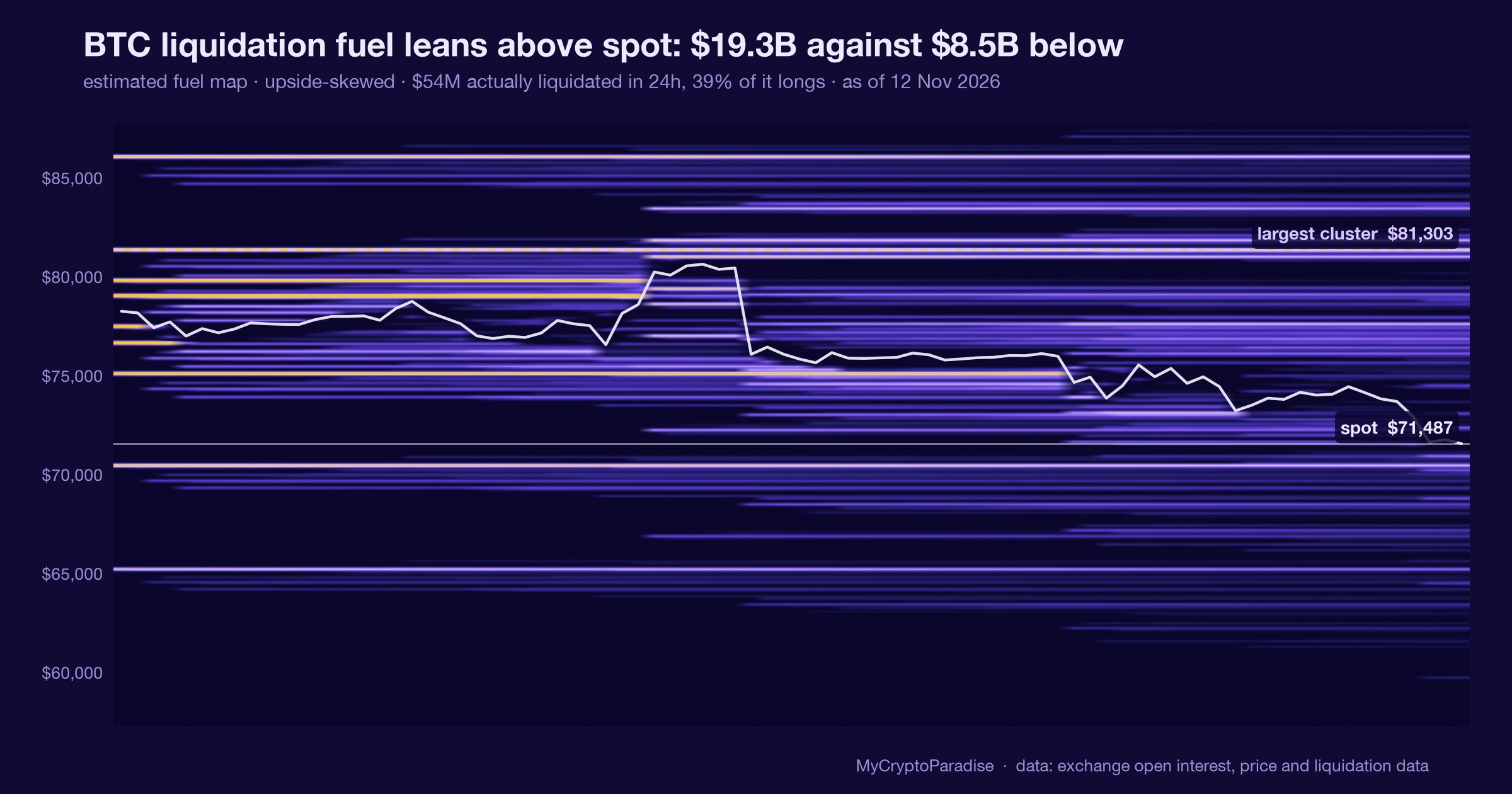
But the backdrop refuses to cooperate. BTC was trading near $70,813 as of the brief, down 4.3% on the day, with ETH near $2,002 and also lower. When the majors bleed, altcoin tokenomics upgrades rarely get the clean reception they deserve. Liquidity flows down the risk curve from BTC to ETH to alts, and right now that current is running the wrong way.
That is the practical catch. A deflationary design cannot force a bid in a tape where capital is retreating up the quality ladder, not down it. The burn narrows supply; risk-off sentiment narrows demand at the same time.
There is also the confirmation gap. We have no FRAX price or volume reading to tell us whether buyers showed up or whether the announcement simply drew attention. A buyback that nobody front-runs and nothing confirms is, for now, a promise with a start date.
None of this makes the mechanic bearish for FRAX. It makes it a genuine positive waiting on evidence. The cleanest read: structurally supportive for the token over time, muted in the near term while the broader market sells and no price data has yet corroborated real demand.
What confirms the burn beyond the announcement
The first thing to watch is whether the flow is real. The engine is switched on, but frxETH revenue only begins feeding it in Q4. So the confirmation is not the launch post. It is on-chain evidence of actual buybacks and burns, at a size that moves the circulating supply rather than nudging it.
Volume is the tell. A revenue-funded burn that matters should eventually leave fingerprints: sustained FRAX buying, a measurable drop in float, and demand that does not vanish once the announcement cycle fades. Absent that, we hold the bullish design as unconfirmed, because a buyback is only as credible as the cash flow behind it.
Invalidation is quieter but just as important. If Q4 arrives and the revenue redirected into the engine is trivial, or if burns stall, then the deflationary thesis thins out fast. A supply cut that barely registers is a headline, not a catalyst.
Watch the setting too. This news is useful in isolation, but it is not why the broader market moved today, and it will not insulate FRAX from a risk-off tape in the majors.
One last filter, learned the hard way across cycles. When a project reports its own good news with no independent corroboration and no price confirmation, the design can be excellent and the reception still muted. Let the chain and the tape, not the announcement, tell you whether real demand arrived.
What the burn means for liquidity and positioning
The ParadiseTeam reads this as a fundamentally constructive supply change for FRAX that still has to prove itself against a tape pointed the other way. The design is sound. The timing, into a risk-off session, is awkward.
Start with the majors, because they set the weather. BTC was near $70,813 as of the brief, sitting just above the zone our standing daily view has flagged: the $69,000 upper support boundary, then $64,000 below it, with $76,000 now acting as reclaimed resistance from below. Until BTC shows a confirmed bullish momentum turn, our bias stays cautious, and altcoin good news tends to underperform in exactly that regime.
That caution is a lens, not a verdict on FRAX. A revenue-funded burn is genuinely supply-reducing, and we treat it as a positive for the token on its own merits.
Here is the discipline. Smart money does not reward a press release; it rewards flow. The same way spoofed demand has been used to trap crowded, over-leveraged longs in the majors, an unconfirmed burn can draw attention before any real bid arrives. Reward the chain, not the announcement.
So the positioning read is patient. Treat the Burn Engine as a structural tailwind for FRAX that strengthens if Q4 revenue and on-chain burns confirm it, and stays a narrative if they do not. And do not let one altcoin's tokenomics upgrade distract from where BTC trades into the $69,000 to $64,000 zone, which still governs broad risk appetite.
The read behind this: we framed this story through our own market analysis, Bitcoin to $69K or Back Above $76K?
Track it live: our Crypto Fear and Greed Index and the live crypto funding rates both update in real time, so you can watch this shift for yourself.
Related coverage
For exact entries, targets, and stop losses with full risk management, that is what ParadiseFamilyVIP is for. New to reading these moves? Start with our crypto trading strategies guide.
ParadiseTeam is monitoring the market situation closely, and we are taking these developments into consideration while building our trading tactics inside ParadiseFamilyVIP.
Crypto trading involves substantial risk. Prices are volatile and you can lose money. This article is educational and is not financial advice. Past performance does not guarantee future results.
Does the Frax Burn Engine draw real on-chain demand once Q4 revenue flows in?
How 1 Paradiser is calling it
The first call is still open
Free account, no password. Members just sign in.









Join the discussion
No comments yet. Members, share how you are reading this.