


Listen: the breakdown
Market briefing: Spot Bitcoin ETF outflows hit a fifth straight day, $299.8 million out on Wednesday and roughly $1.44 billion over the week. BTC was trading near $71,426, down 3.4% on the day, as the regulated bid keeps fading.
- Spot Bitcoin ETFs saw $299.8 million of net outflows on November 11, a fifth straight losing session
- Five sessions have now drained close to $1.44 billion, with IBIT leading the redemptions
- Year-to-date outflows near $1.1 billion would mark the first net-losing year since launch
Spot Bitcoin ETF outflows just stretched to a fifth straight session, with roughly $1.44 billion gone and BTC sliding toward support. Is the regulated bid quietly breaking down?
Spot Bitcoin exchange-traded funds (ETFs) just posted a fifth straight day of net outflows. Wednesday, November 11, 2026, saw $299.8 million leave the funds. The selling did not ease. It accelerated.
IBIT led the exit with roughly $269.7 million in redemptions. GBTC followed at about $39.1 million. MSBT was the only fund with a net inflow that day, one green square in a field of red.
Zoom out and the picture hardens. Across five sessions, close to $1.44 billion has walked out of the regulated wrapper. This is not a single bad print. It is a full week of institutions stepping back from the primary buy channel for Bitcoin.
Year-to-date, these funds now sit near $1.1 billion in net outflows. That would mark the first losing year since the products launched. The debut era of relentless inflows has, at least for now, stalled.
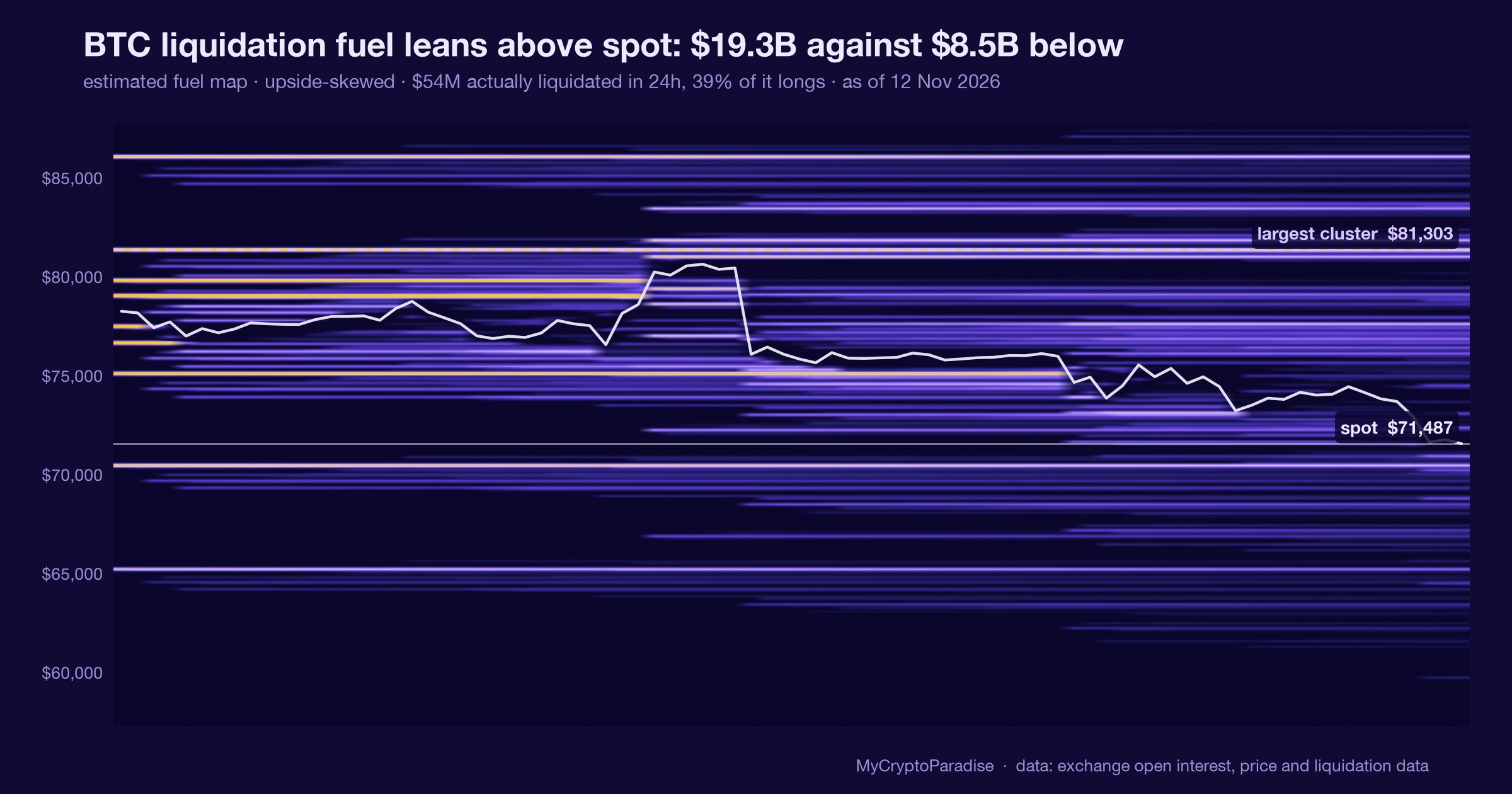
BTC was trading near $71,426 as of the latest read, down 3.4% on the day.
The transmission is plain. Fewer dollars arriving through the ETF means thinner spot demand underneath price. When that regulated bid fades for an entire week, Bitcoin loses one of its steadiest sources of support. The flows and the chart are telling the same story, and neither is flattering.
Why fading ETF demand pressures Bitcoin
The spot ETF is the cleanest pipe institutions use to own Bitcoin. Money in means persistent spot buying. Money out means the opposite. So a five-day outflow run is a direct read on big-money appetite, not noise.
For most of the launch window, these funds were a one-way street. Dollars arrived, shares were created, and authorized participants bought spot to back them. That steady mechanical bid cushioned every dip. This week, the machine ran in reverse.
Redemptions force the opposite flow. Shares are destroyed, and the underlying Bitcoin is sold back into the market. Five sessions of that, led by the largest fund, means the regulated channel has flipped from a buyer to a seller.
The year-to-date figure sharpens the point. Near $1.1 billion has left on the year, the first net-losing year since these products existed. Institutional demand through the wrapper is not just pausing. It is unwinding.
That matters because retail cannot replace it. The ETF bid was the adult in the room, absorbing supply day after day. Remove it, and price has to find demand somewhere thinner and less reliable. In a market already soft, that is a meaningful change in who is actually buying.
How the outflow run hits liquidity
Start with BTC, because this is BTC's bid vanishing. Spot ETF selling thins the layer of demand that normally defends dips. With $1.44 billion pulled in a week, every small sell-off meets less support than it did a month ago. That shows up as a price that cannot hold a bounce. BTC slid 3.4% on the day and sat near $71,426, drifting toward the next major support test rather than reclaiming lost ground.
ETH feels this second-hand. When the flagship's institutional bid weakens, risk appetite across the majors cools with it. Capital does not rotate into ether during a de-risking week. It steps toward the exit alongside Bitcoin.
Alts sit at the end of the line, as always. They trade on borrowed liquidity, and that liquidity is drying up at the source. A risk-off tape in BTC usually drains the thin order books of smaller tokens fastest.
There is no sign of quiet absorption underneath this run. No fund is mopping up what IBIT is shedding. That absence matters. A dip someone is buying looks different from a dip everyone is feeding into, and this one reads like the latter.
For now the chain is simple. Institutions sell the wrapper, spot support thins, BTC leads lower, and the rest of the market follows the leader down.
Signals that confirm or break the streak
The first thing to watch is whether the outflow streak hits a sixth session. Five days is a trend. A sixth, with IBIT still leading, would confirm institutions are not done selling and keep the pressure on spot.
A single positive day proves little on its own. Flows are noisy, and one green print inside a losing week can be rebalancing rather than conviction. We want to see inflows that stick, across more than one fund, before calling the run over.
Price action matters just as much as the flow data. If BTC keeps grinding lower while outflows continue, the two are confirming each other, and sellers stay in control. That is the path of least resistance right now.
Invalidation looks different. A clear return to net inflows, paired with BTC reclaiming lost levels on real volume, would suggest the regulated bid is coming back. That combination, flows and price turning together, is the honest tell.
Watch the breadth too. MSBT was the only fund green on Wednesday. If that widens to several funds pulling in money, the character of the week changes.
Until then, the base case is continuation. A week of selling through the primary channel does not usually reverse on a single quiet day, and nothing in the data yet argues that it has.
What a week of redemptions means for positioning
The ParadiseTeam reads this flow data against a daily chart that was already leaning lower. BTC was trading near $71,426 as of the latest read. The ETF exit strips out the one bid that might have defended price here.
That lines up with a move toward the $69,000 to $64,000 support zone. The $69,000 upper boundary is the first and most important test. Above price, $76,000 stands as reclaimed-from-below resistance and the level that would need to go to challenge this view.
Retail stays crowded in longs, with funding near +10%. Smart money used spoofed buy walls to fake demand, let retail pile in, then pulled the bids. The ETF data is the institutional echo of that same message: nobody large is stepping in to catch this.
So we treat any bounce skeptically without volume behind it. Rallies into $76,000 look more like places where bigger players offload than places they accumulate. Stop-losses (SL) from trapped longs cluster below $69,000, exactly where liquidity pools and where a slide tends to aim.
A reclaim of $76,000 on genuine volume, with momentum turning up, would force a rethink. Short of that, the risk-to-reward (R:R) still favors the downside continuation, and the flow numbers are not arguing otherwise.
The read behind this: we framed this story through our own market analysis, Bitcoin to $69K or Back Above $76K?
Track it live: our live crypto funding rates and the Crypto Fear and Greed Index both update in real time, so you can watch this shift for yourself.
Related coverage
For exact entries, targets, and stop losses with full risk management, that is what ParadiseFamilyVIP is for. New to reading these moves? Start with our crypto trading strategies guide.
ParadiseTeam is monitoring the market situation closely, and we are taking these developments into consideration while building our trading tactics inside ParadiseFamilyVIP.
Crypto trading involves substantial risk. Prices are volatile and you can lose money. This article is educational and is not financial advice. Past performance does not guarantee future results.
What breaks first: the ETF outflow streak or $69K support?
How 1 Paradiser is calling it
The first call is still open
Free account, no password. Members just sign in.
Follow this topic: Bitcoin ETF news












Join the discussion
No comments yet. Members, share how you are reading this.