

Listen: the breakdown
Developing story update (November 12, 2026, 16:33 UTC):
Update: The specifics behind the $1.1 billion MARA sale are now on the record via an SEC filing. The company sold 13,597 BTC at an average of roughly $81,039 per coin, well above the current spot near $71,837. That reframes the move: these coins left at a higher market, not into today’s weakness.
Based on our sources, around $750 million of the proceeds went to repaying bitcoin-backed loans, which frees up previously pledged collateral. The remainder is earmarked for AI infrastructure and up to $500 million in potential share buybacks. This reads more like balance-sheet management from strength than forced distribution.
For traders, the overhang question shifts from this one sale to the pattern. If more miners rotate from mining toward AI, further treasury liquidation could weigh on supply over time, even when an individual sale like this one is not itself distressed.
What to watch now: Watch whether other miners follow with BTC treasury sales to fund AI, which would add supply pressure.
Market briefing: MARA has sold 1.1 billion dollars of Bitcoin as more miners pivot toward AI, adding fresh supply while BTC trades near 72,026 dollars, down 2.8 percent on the day.
- MARA sold $1.1 billion in BTC as miners rotate balance sheets toward AI
- The sale adds real spot supply into a tape already down 2.80% on the day
- The 2018 and 2022 bottoms are a historical analogy, not proof this supply is absorbed
MARA just sold $1.1 billion in Bitcoin as miners pivot to AI, and bulls are already calling it 2018 all over again. But is a historical analogy really proof these coins get absorbed?
MARA just sold $1.1 billion of its BTC. That is not a rumour. It is a confirmed treasury move from one of the largest listed miners.
The timing feeds a familiar worry. More mining companies are shifting their focus toward AI infrastructure. Balance sheets built to mint coins now chase compute instead. So the coins come out, and the market has to swallow them.
BTC was trading near $72,026 as of this report, down 2.80% on the day. We cannot pin that decline on this one sale. The honest read is simpler: a soft tape met a large, quantifiable supply event, and the two now share a headline.
The bulls already have their counter-story ready. They point to 2018 and 2022, when miners buckled under cost pressure and some went bankrupt. Both stretches later became generational buying opportunities. The analogy is tidy. It is also just an analogy.
Here is the part worth slowing down for. A miner selling is not an accumulator buying. Miners are historically price-insensitive sellers. They move coins to cover electricity and debt, not to time a bottom. So this is supply leaving a known holder and landing in the open market.
What we do not yet have is the other side of the trade. No volume print, no on-chain signature showing who absorbed $1.1 billion. Until that appears, a historical comfort blanket does not turn a liquidation into demand. We treat it as real overhang first, and let the data argue otherwise.
Miner balance sheets rotate from coins to compute
Miners sit at the supply source of Bitcoin. They are the only holders who receive new coins every block, so what they do with those coins shapes net float. When a large miner sells $1.1 billion at once, it thickens the supply side at the exact moment demand needs to be strongest.
The rotation into AI matters beyond the dollar figure. It tells you where the marginal miner now sees a better return. Compute for AI models, not hashing for block rewards. That is capital reallocating away from Bitcoin's own security budget and toward a different industry entirely.
For traders, the mechanism is liquidity. A price-insensitive seller does not wait for a good level. They hit bids to raise cash, which drains the order book and widens the path lower. Thin miner-side demand removes a historical floor under the market.
None of this guarantees a crash. Supply events get absorbed all the time when real buyers step up. But absorption is a fact you confirm with volume, not a story you assume from the past.
The structural point is overhang. A known, motivated seller signals that more coins can reach the market as other miners follow the same AI playbook. That overhang sits on sentiment even when price is flat. It is the difference between a market that can breathe and one carrying a weight it has not yet set down.
Fresh supply meets an already soft tape
BTC wears this first. Added spot supply lands on a market already down 2.80% on the day, so the sale compounds existing softness rather than fighting it. The near-term risk is straightforward: more coins for sale, thinner miner-side support, a clearer path toward lower levels if buyers stay cautious.
ETH inherits the pressure by beta. When BTC leaks supply and conviction, capital rarely rotates bravely into the second-largest asset. It waits. We have already watched ETH bleed this week while fresh liquidity lines failed to lift it, and a miner overhang gives that weakness another reason to persist.
Alts sit at the end of the chain, and they feel it hardest. They trade as leveraged bets on BTC direction. A supply event that pressures Bitcoin pulls liquidity up the risk curve and out of smaller tokens first. Shallow books there turn a mild BTC slip into a sharper alt drawdown.
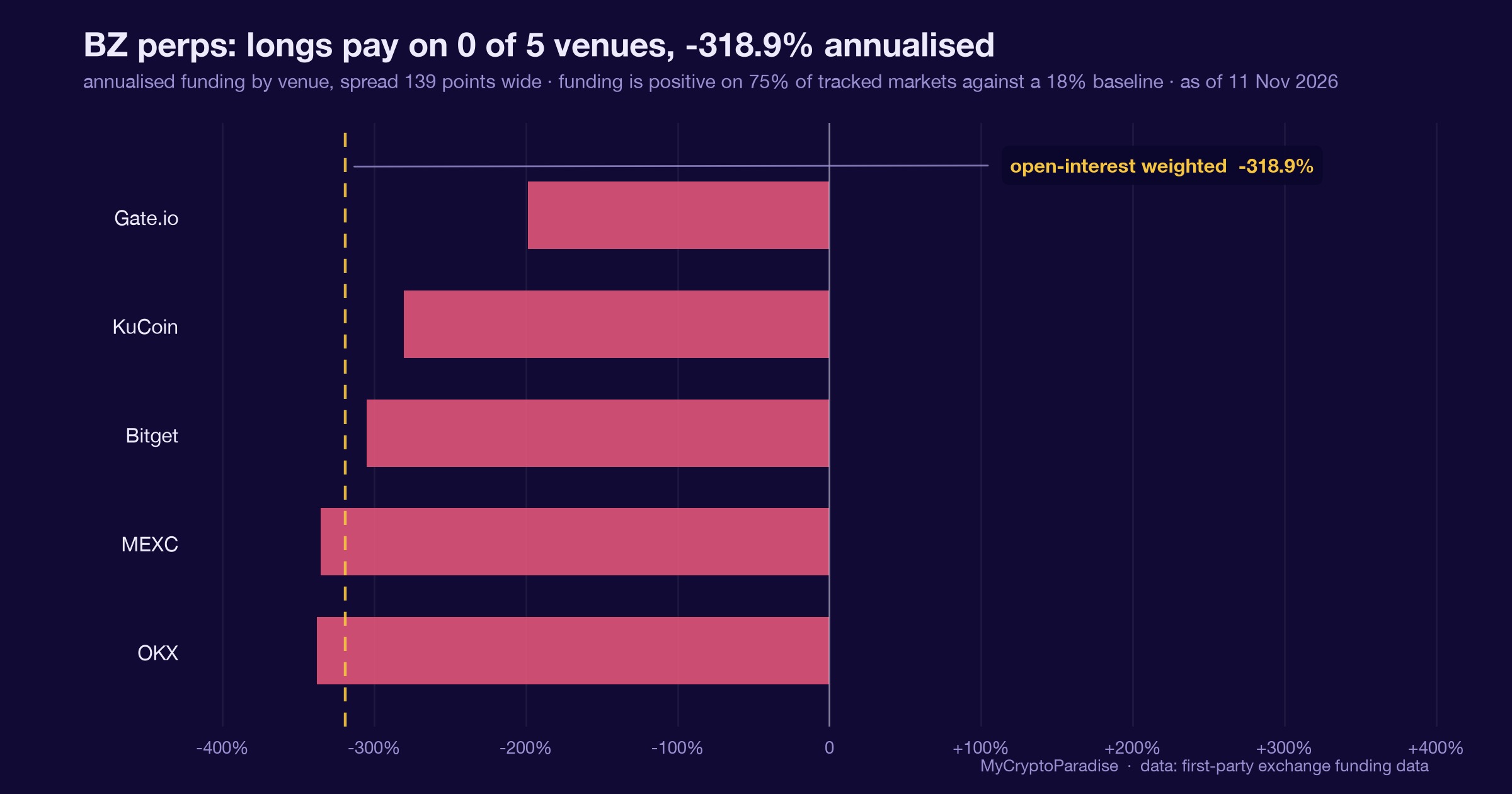
The crowd positioning sharpens the risk. Funding across majors has been stretched, with longs crowded and paying to stay in. Fresh supply into crowded longs is how you get forced selling, not a gentle dip.
So the realistic sequence is BTC softness first, ETH following by correlation, alts amplifying last. None of it is destiny. But a $1.1 billion seller with no confirmed buyer on the other side is a headwind, and pretending otherwise is how retail ends up holding the overhang.
Volume decides absorption or lingering overhang
Volume is the whole argument. If this supply gets absorbed, you will see it: heavy buy-side volume lifting price back through recent levels, not a quiet drift. The absence of that volume is itself the tell that the overhang still sits unsold.
Watch how BTC behaves near $69,000. That upper boundary of the support zone is the line that matters most right now. A clean, high-volume defence there would argue real buyers are stepping into miner supply. A limp, low-volume touch that breaks argues the opposite, and opens $64,000 underneath.
On the upside, $76,000 is the level that flips the story. It broke as support and now reads as resistance from below. Reclaiming it on genuine volume, not a thin leverage spike, would weaken the overhang thesis badly. We have not seen that buying power yet.
Funding tells you when the crowd cracks. Longs are stretched and paying to hold. If a squeeze clears them while price holds, the market gets lighter and healthier. If funding stays hot into falling price, the fuel for forced selling is still loaded.
Finally, watch the other miners. One $1.1 billion sale is a data point. A pattern of miners rotating into AI and selling coins turns a single overhang into a trend. More AI-pivot announcements would confirm the supply story. A pause, plus volume absorbing this sale, would quietly invalidate it.
Reading the sale against crowded longs
The ParadiseTeam treats this sale as supply, not a reason to buy the dip. The 2018 and 2022 comparison is a comforting story. On its own facts, a price-insensitive miner moving $1.1 billion is overhang until volume proves absorption.
Our standing daily read stays bearish into the $69,000 to $64,000 support zone. This sale does not contradict that read. It feeds it. A fresh, motivated seller is exactly the kind of fuel that carries price toward that zone rather than away from it.
Positioning is the trap here. Retail longs are crowded, with funding stretched near +10%, lured in earlier by demand that smart money showed then pulled. A large supply event into that crowded book is how those longs get squeezed, not rewarded.
BTC was trading near $72,026 as of this report. We watch $69,000 as the first real test and $76,000 as the resistance that would have to break, on volume, to flip the tone. Neither has happened.
The honest frame: do not let a historical analogy do the work that data has not. If this were smart money accumulation, volume and a bullish momentum cross would show it. We see neither yet. Three bearish divergences and no bullish cross still describe the backdrop. Until buyers prove themselves against this $1.1 billion, we read the sale as a weight on price, and we stay patient rather than brave.
The read behind this: we framed this story through our own market analysis, Bitcoin to $69K or Back Above $76K?
Track it live: our live crypto funding rates and the Crypto Fear and Greed Index both update in real time, so you can watch this shift for yourself.
Related coverage
For exact entries, targets, and stop losses with full risk management, that is what ParadiseFamilyVIP is for. New to reading these moves? Start with our crypto trading strategies guide.
ParadiseTeam is monitoring the market situation closely, and we are taking these developments into consideration while building our trading tactics inside ParadiseFamilyVIP.
Crypto trading involves substantial risk. Prices are volatile and you can lose money. This article is educational and is not financial advice. Past performance does not guarantee future results.
Is MARA's $1.1bn sale real overhang or a bottom signal?
How 3 Paradisers are calling it
The first call is still open
Free account, no password. Members just sign in.











Join the discussion
No comments yet. Members, share how you are reading this.