

In short
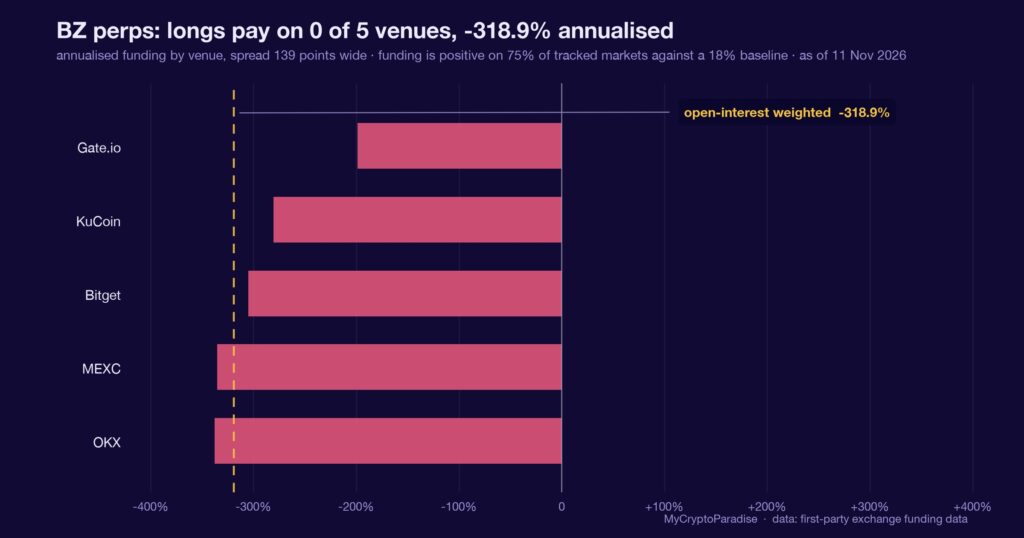
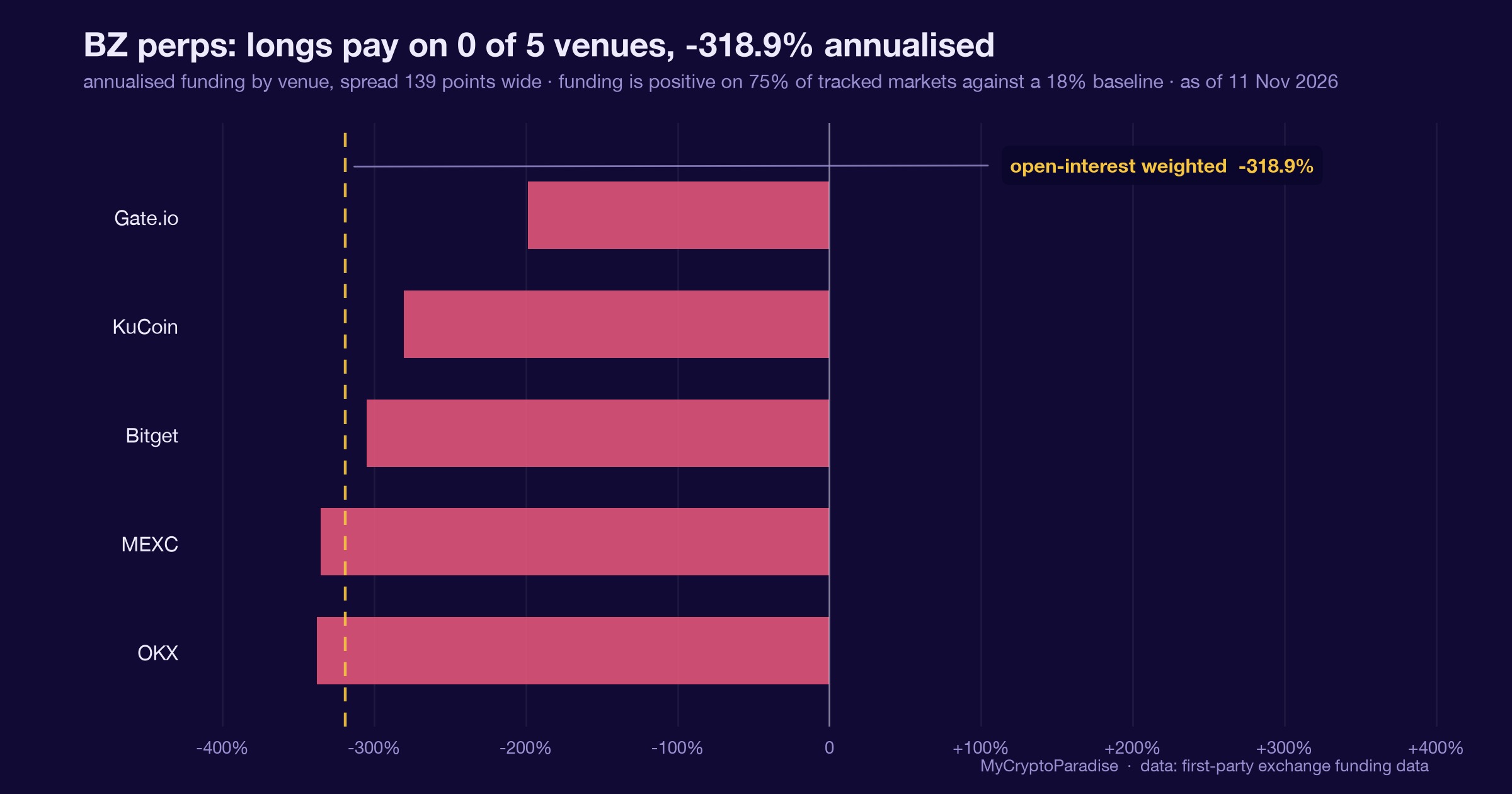
Funding is the fee that longs and shorts swap on a perpetual futures contract. A deeply negative rate means shorts are paying longs to stay short. On 11 November our MCP Insights funding-extremes reading has BZ shorts paying 320.7 percent annualized (APR), the most short-paid rate across 2,242 tracked markets. XMR longs pay 186.1 percent at the opposite tail. We called the aggregate neutral, explicitly not a buy trigger. Bitcoin funding sits near neutral at 4.07 percent, and 75 percent of markets fund positive, so the extremes are isolated rather than a regime. Five days ago we leaned constructive on BZ at 450.6 percent; the rate has since decayed toward the pack with no upside confirmation, the first half of that read failing. This piece shows you how to read funding extremes yourself, tail by tail.
A funding rate is a crowding tax
A perpetual futures contract never expires, so an exchange needs a tether to keep its price near spot. That tether is the funding rate: a small fee the crowded side pays the other, over and over, to discourage the imbalance.
When the rate runs deeply negative, shorts are the crowd, and they pay longs to keep their position open. The payment is the market pricing how badly one side wants to hold a bet that costs it to carry.
A funding rate does not tell you where price goes. It tells you who is paying to stay, and that is a different, humbler fact.
Both tails scream while the middle stays calm
Per our MCP Insights funding-extremes series on 11 November, BZ shorts pay 320.7 percent annualized, the most short-paid rate across all 2,242 markets we track. The raw feed quoted minus 313 percent; our recon series wins at minus 320.7.
At the other tail, XMR longs pay 186.1 percent to stay long. Those are the loud ends. The middle is quiet: Bitcoin funding sits at 4.07 percent, balanced, with open interest (OI) near $28.5 billion and spot at $74,620. Ethereum reads 5.15 percent, mild long crowding.
Breadth confirms the calm. Funding is positive on 75 percent of tracked markets, with a median of 7.45 percent annualized. Only 18 percent sit near the flat line.
Two markets pay triple-digit rates. More than two thousand do not. The extreme is a local fire, not the weather.
What is different here
The ParadiseTeam reads a funding extreme as a crowding tax to be graded over days, not a one-tap trade. Most screens flash the single most negative rate as a trade; we check breadth, the opposite tail and the prior print before we weight it at all.
Someone is paying this toll every hour
A triple-digit annualized rate is not abstract. On BZ, every hour a short holds, it pays the long side a slice of that 320.7 percent. The position bleeds carry whether or not price moves.
That bleed is the squeeze fuel. Shorts this underwater have an incentive to cover, and any sharp bid forces the covering faster, which is how a thin market snaps. The same logic runs in reverse for XMR longs paying 186.1 percent.
Fuel is not ignition. A tank of it can sit untouched for weeks, and the rate alone never tells you the day.
A 320 percent short-pay is not a buy button
The obvious misread is to treat the most negative rate on the board as an automatic long. It is not. A rate that extreme usually means the market is small, thin, or event-driven, and the carry can stay punishing far longer than a position can fund it.
This is one input. It sits alongside open interest, spot absorption and the broad funding breadth, and today it is the reading that most disagrees with the calm aggregate. A single funding print is a probability weight on a bias, never the bias itself.
A rate that only one side is paying tells you about pressure, not timing. Pressure without a trigger is just a number waiting.
Our BZ lean is decaying, as promised
Five days ago we leaned constructive on BZ, with shorts paying 450.6 percent and a written invalidation: the rate decaying back toward the pack with no upside move. That is now happening.
The rate has eased from 450.6 to 320.7 percent, and we have no confirming price leg to show for it. Half of the invalidation has printed. The lean is weaker today than it was, and we say so.
A read you grade out loud while it fades is worth more than one you only quote while it works.
Reading a funding extreme yourself, step by step
- Start with breadth: check what share of tracked markets fund positive, because one wild rate against a calm tape is noise.
- Find both tails, not just the loud one; the hottest long matters as much as the most-paid short.
- Read the extreme against the market’s own size and venue count, since a thin market distorts an annualized rate.
- Compare today’s print to the same market days ago, so you see whether the extreme is building or decaying.
- Write the invalidation before you act: the rate easing with no price move is the read quietly failing.
The step people skip is step four: a single screenshot of 320 percent feels decisive, but only the change since the last print tells you direction.
Every number above is checkable against the live data. Start with the live crypto funding rates, then cross-read the MCP Insights hub and the Crypto Fear and Greed Index.
Act and invalidate
| Scenario | What confirms it | What kills it |
|---|---|---|
| BZ squeeze fires | Sharp bid, rate snaps positive | Rate eases with flat price |
| Extreme just decays | Funding drifts to the pack, no move | A real upside break on volume |
| Broad tape stays calm | Breadth holds near 75 percent positive | Crowding spreads past the two tails |
Posture: For most, the two tails are a watch, not a trade, and the calm aggregate keeps size small. The BZ lean is weaker than last week and carries one line of risk at most.
Frequently asked questions
What does a negative funding rate actually mean?
A negative funding rate means short positions are paying long positions to keep the trade open. On a perpetual contract this fee recurs continuously. A deeply negative number shows that shorts are crowded and bleeding carry, though it says nothing certain about where price travels next.
Why is BZ funding so much more negative than Bitcoin?
BZ is a small, thin market where one-sided positioning swings the rate violently, so it reached minus 320.7 percent annualized. Bitcoin is deep and balanced near 4.07 percent. The gap reflects liquidity and crowding, not a hidden message about the broader market.
Is an extreme short-pay a reason to go long?
Not on its own. An extreme rate marks pressure, not timing, and thin markets can stay punishing far longer than a position can fund. We treat it as one probability weight among several, confirmed or denied by breadth, the opposite tail and the prior print.
What would prove this funding read wrong?
Two things. The rate easing back toward the positive pack with no upside price move would show the squeeze fuel dissipating untouched. Alternatively, crowding spreading beyond the two tails into Bitcoin and the breadth figure would turn an isolated extreme into a genuine regime.
How often should I check funding extremes?
Funding updates through the day, so a daily glance catches most meaningful shifts. What matters is not the snapshot but the direction of change: compare each reading to the last. Our live funding tracker shows the current rates and how they are moving across markets.
Crypto trading involves substantial risk and is not suitable for everyone. Nothing here is financial advice; it is education only. Never risk more than you can afford to lose.
The private Extras feed, where the funding-extremes tails, the breadth read and Bitcoin’s balanced carry update intraday with their invalidation levels, is part of PRO Paradiser, the intelligence layer behind the ParadiseFamilyVIP strategies.







Join the discussion
No comments yet. Members, share how you are reading this.