

Developing story update (August 01, 2026, 10:31 UTC):
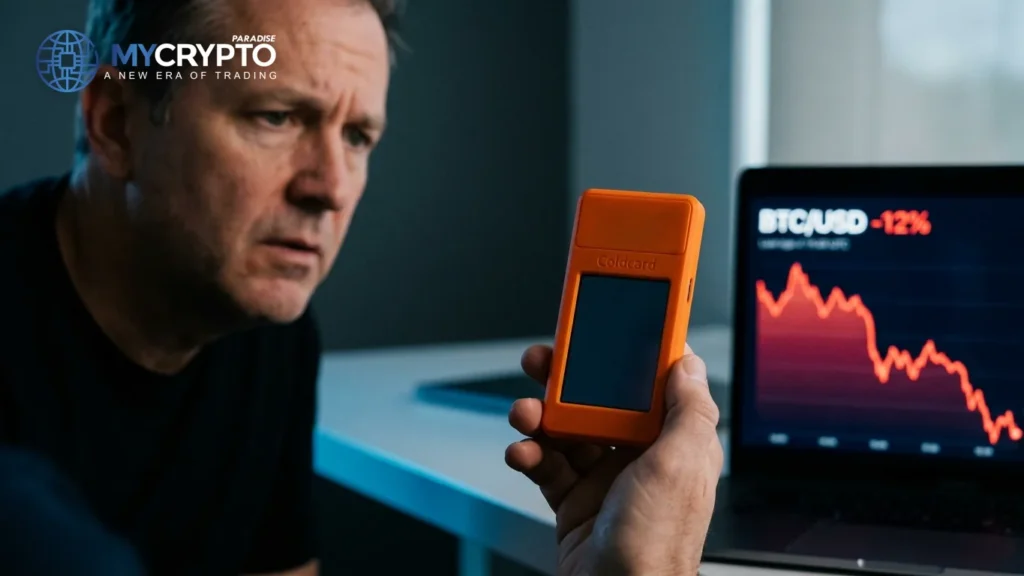
New on-chain detail has firmed up the picture behind the Coldcard incident. Based on our sources, the theft traces to a firmware bug that let attackers rebuild users’ seed phrases, and more than 594 BTC (about $38 million) was drained from affected wallets. The attacker then consolidated 562 BTC into a single address.
For traders, the direct read-through to BNB stays limited: price is holding near $582 with a shallow 24-hour drift, so this looks like a security-confidence story rather than a Binance-specific catalyst. The larger risk is a broader self-custody scare that could spark modest, short-lived selling if retail reacts to headlines about hardware-wallet safety.
What to watch now: Whether the self-custody scare spreads into broader BTC selling or stays contained to Coldcard users.
Listen: the breakdown
Market briefing: Binance founder CZ is telling holders to split funds across multiple wallets after a $70 million Coldcard exploit. BTC was near $63,051 as of 09:41 UTC, barely moved, and the fear is doing the heavy lifting.
- CZ urges wallet diversification after a $70 million Coldcard hardware exploit.
- A firmware bug let thieves rebuild seeds and drain 594 BTC from users.
- BTC held near $63,051 while self-custody fear spread across retail.
CZ just told holders to spread their coins after the Coldcard exploit drained $70 million. So is this genuine fear at support, or a gift for patient buyers?
Binance founder Changpeng Zhao, known as CZ, has told crypto holders to split their funds across multiple wallets. The advice arrived after a $70 million exploit hit popular Coldcard hardware devices. A firmware bug let attackers rebuild seed phrases and quietly drain Bitcoin.
We have already reported the mechanics of this breach today. The new development is not the loss itself. It is the most recognisable name in the industry using the moment to reframe self-custody as a diversification problem, not a device problem.
The numbers are settled. Over 594 BTC, worth roughly $38 million, was stolen from Coldcard users, and the full tally has since climbed to about $70 million. The attacker consolidated 562 BTC into a single address, which is the kind of tidy consolidation that rarely accompanies good news.
Coldcard maker Coinkite, through its chief executive NVK, told affected users to generate entirely new wallets and move their funds using updated best practices. That is sound guidance. It also quietly confirms that the old keys are now a liability.
CZ's message extends that logic to everyone. If a single trusted device can fail, concentration is the real risk, not the brand on the box.
For traders, the story is less about firmware and more about trust. When the crowd starts questioning where their coins are safest, sentiment moves before price does. That gap between fear and the actual tape is where the interesting decisions get made.
Why a firmware bug shakes self-custody trust
The transmission here runs through confidence, not order books. A hardware wallet is meant to be the safe end of crypto, the place you retreat to when exchanges wobble. A $70 million firmware exploit attacks that assumption directly.
When CZ amplifies the story with a diversification call, he moves it from a niche security incident to a market-wide trust question. That matters because trust is the invisible collateral behind every long-term hold. Shake it, and some holders reconsider whether they want the responsibility of self-custody at all.
There are two honest paths from here. Some frightened holders move coins onto exchanges or spread them thinner, which is friction but not selling. Others decide the whole exercise is too fragile and reduce exposure, which is selling. That second group is the one that feeds a dip.
There is a quieter subplot too. Fresh research showed an advanced model halving the security of a candidate post-quantum algorithm in about 60 hours. On its own that is a lab result, not a threat to your keys today. Stacked on top of a live exploit, it thickens the FUD, the fear, uncertainty and doubt that pushes retail to act before it thinks.
None of this changes Bitcoin's supply, issuance, or the macro backdrop. It changes how tightly people hold. That is why a security story with no macro content can still create real liquidity, because scared coins are loose coins, and loose coins are what larger players wait for.

How the fear filters into BTC and alts
Start with the tape, because it is the least emotional part of this. BTC was trading near $63,051, down about 0.9 percent on the day as of 09:41 UTC. A $70 million theft and a warning from the industry's biggest name, and Bitcoin barely flinched.
That muted reaction is the signal. It usually means the coins moving are retail-sized and already nervous, not the deep pools that actually set direction. Fear is loud; the price is quiet.
BNB, CZ's own ecosystem token, sat near $584.33, down about 0.8 percent on the day and 0.7 percent on the hour. So even the coin most tied to the messenger shrugged. The market is treating this as a custody story, not a valuation story, and that distinction keeps the damage contained.
Down the risk curve, the effect is more psychological than mechanical. Alts do not have a firmware bug, but they inherit the mood. When self-custody feels unsafe, appetite for smaller, less liquid positions cools first, so alt volatility can rise even without direct exposure.
Here is the asymmetry we watch. Genuine forced selling from spooked holders creates supply into a market where larger buyers are already positioned lower. That is not a crash; it is a transfer. The nervous hand off to the patient one, and the price often ends up back where it started once the headline ages, which this one is already doing.
What confirms accumulation versus real weakness
The first thing to watch is whether fear turns into flow. If exploit stories keep landing and BTC still refuses to break down, that is quiet strength, and it tells you the selling is shallow.
The cleaner tell is behaviour around support. Our lens marks a reaccumulation zone near $61,000, with a deeper buying band from $61,000 down to $59,000. If FUD drags price into that zone and it is bought quickly, on rising spot volume, that is absorption, not capitulation.
Volume is the referee here. Higher lows in price should carry higher lows in volume on spot exchanges to trust them. A bounce on thin volume is a fake-out waiting to happen.
On the upside, watch how price handles $69,000, an area with many overhead confluences and natural shorting interest. A push there that stalls on a bearish divergence would read as distribution, not strength.
The hard line is $62,500. That level is the invalidation for the current bullish structure. A decisive close beneath it changes the story from healthy shake-out to genuine breakdown, and we would respect that.
There is also the boring but important operational watch. Affected Coldcard users still need to migrate to new wallets, so a second wave of coin movement is likely as they rotate keys. That on-chain noise can look dramatic on a chart. Separate housekeeping migrations from real selling before you react to a sudden spike in transfers.
What this FUD means near the reaccumulation zone
The ParadiseTeam reads this exploit as a sentiment event arriving at an inconvenient moment for retail and a convenient one for size. Bitcoin near $63,051 sits just above our $61,000 reaccumulation zone, and just above the $62,500 line that invalidates the current bullish structure. That is a narrow, honest range, and it frames everything.
Here is the mechanism. A trusted device fails, the industry's loudest voice says diversify, and less experienced holders feel their coins are suddenly unsafe. Some of them sell into that discomfort. That supply lands right where larger players have signalled they want to reaccumulate, which is the textbook transfer from fear to patience.
So the ParadiseTeam treats a FUD-driven dip toward $61,000, and the $61,000 to $59,000 band beneath it, as a zone to study for strength, not to chase in panic. Confirmation is spot volume rising as price holds, not a hopeful wick.
We stay risk-first. A clean daily close below $62,500 flips the read, and the eventual macro downside near $44,000 remains on the map for later. This is a probability, not a promise.
The wider target of $79,000 only stays alive while price defends this floor and volume backs each higher high. A move into $69,000 that stalls on the bearish MACD divergence would look like distribution into retail relief, not a green light. Trust the tape over the headline; the headline is already fading.
Track it live: our Crypto Fear and Greed Index and the crypto liquidation heatmap both update in real time, so you can watch this shift for yourself.
Related coverage
For exact entries, targets, and stop losses with full risk management, that is what ParadiseFamilyVIP is for. New to reading these moves? Start with our crypto trading strategies guide.
ParadiseTeam is monitoring the market situation closely, and we are taking these developments into consideration while building our trading tactics inside ParadiseFamilyVIP.
Crypto trading involves substantial risk. Prices are volatile and you can lose money. This article is educational and is not financial advice. Past performance does not guarantee future results.
Does the Coldcard FUD dip get bought near the $61k zone or break lower?
This is how the Paradisers are calling it. Tap your call.
No calls on this one yet. Tap yours to be the first.
Free account, no password. Members just sign in.








Join the discussion
No comments yet. Members, share how you are reading this.