

Listen: the breakdown
Market briefing: Another centralized exchange, Bitmart, has announced its closure, following BitMEX. BTC sits near $64,415, up 0.5 percent, unmoved by the headline.
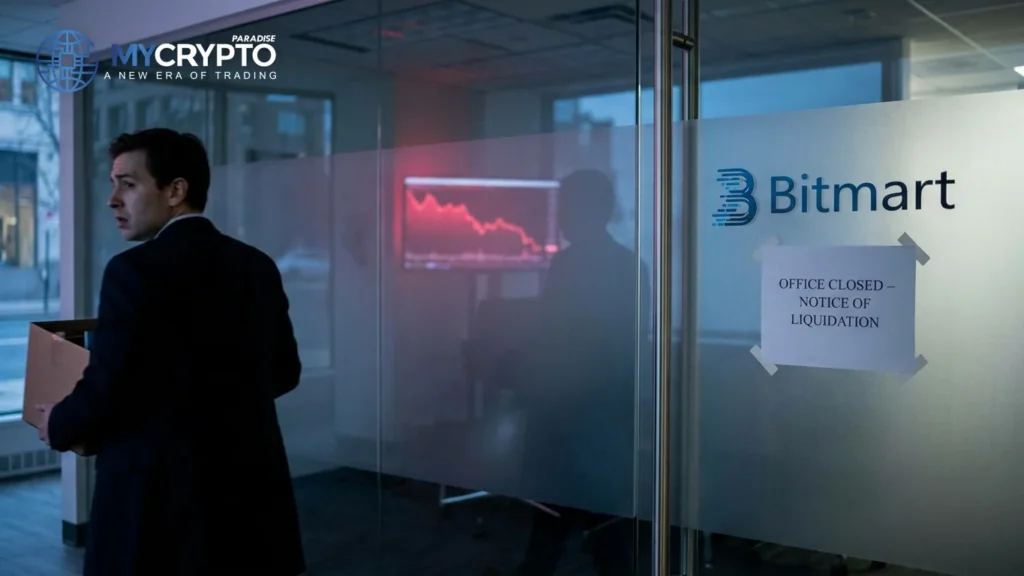
- Bitmart, a former top-10 exchange by 24-hour volume, has announced its closure, following BitMEX.
- Fenbushi and Hack VC backed Bitmart in 2021 at a $300 million valuation; that chapter is closing.
- BTC held near $64,415 and ETH near $1,878, so price shrugged while trust in centralized venues thinned again.
The Bitmart closure lands with barely a flinch in price, yet another top-10 exchange is gone. So why does a quiet exit still matter for your positioning?
Another centralized crypto exchange has switched off the lights. Bitmart has announced its closure, following BitMEX out the same door. Price did not care. BTC sat near $64,415 and ETH near $1,878 while the news made the rounds.
Rewind to 2021 and the picture was different. Bitmart pulled in retail investors chasing altcoins, and its 24-hour trading volume once cracked the top 10. Fenbushi and Hack VC put money behind it that year at a $300 million valuation. That was the era when almost every venue felt like a rocket, and few asked what happened when the fuel ran out.
Now the venue is winding down, and the $300 million story ends quietly rather than loudly. There is no drama in the tape, no cascade, no obvious victim beyond the users who now have to move their coins.
That is precisely why this is worth reading carefully. A closure that moves no price is not a closure without meaning. It is one more brick pulled from the wall of trust that retail once placed, without much thought, in centralized platforms. Each brick removed makes the next departure feel a little more normal, and normal is how confidence erodes.
Why a quiet exit still erodes trust
The macro effect here is not a shock. It is attrition. Bitmart leaving does not drain the market of liquidity in one hit. It chips at something slower and more important: the assumption that a centralized venue you deposited into last cycle will still be there next cycle.
That assumption is the plumbing of retail participation. When it weakens, behavior changes at the margin. Some users pull funds to self-custody. Some sit on the sidelines. Some simply trade less, because the venue they trusted is gone and the effort of trusting a new one is real.
This is where the transmission runs. Thinner trust means thinner retail flow into the riskiest corners of the market. And the riskiest corners are exactly where Bitmart made its name in 2021: altcoins, the long tail, the tokens that need constant new buyers to hold their bids.
So the second-order effect skips BTC almost entirely and lands hardest on the assets furthest out the risk curve. A closure like this does not sell BTC. It quietly raises the cost of confidence for everything below it.
The honest caveat: there is no single confirmed same-day catalyst driving price here. This is a reinforcing factor, not the cause of anything. We read it as one input into a broader mood, not a trigger you can time a chart against.
How the closure filters down to alts
Start with what did not happen. BTC did not move on this. Up 0.5 percent over 24 hours, flat over the last hour. ETH is calm too, up 0.8 percent near $1,878. If a former top-10 exchange closing cannot dent the majors, the majors are not where the fragility lives.
The fragility lives further down. When retail confidence in centralized venues thins, the first liquidity to evaporate is on the low-cap order books, not on BTC or ETH. Those markets survive on continuous fresh participation. Remove a slice of trusting retail and the bids get shallower, the spreads get wider, and the moves get sharper in both directions.
That is the real cascade from a story like this. Not a crash, a hollowing. BTC and ETH hold their structure while the long tail quietly loses depth.
For smart money, thin books are a feature, not a bug. Distress and departure create the conditions for patient accumulation at prices retail is too nervous to touch.
None of this shows up as a green or red candle today. It shows up over weeks, as the assets that most needed retail trust find that a little more of it has walked out the door with Bitmart.
Signals that turn attrition into capitulation
The first thing to watch is whether this stays isolated. One closure is attrition. A cluster of them, closures, halted withdrawals, or venues quietly restricting access, would turn a mood into a genuine confidence event. That is the line between background noise and a signal.
Watch stablecoin flows next. If balances start leaving centralized exchanges in size, that is retail voting with its feet, and it usually precedes lower liquidity rather than higher prices. A steady drift off exchanges tells you trust is being withdrawn in the most literal way.
On the majors, the confirmation is simpler. As long as BTC holds its current structure near $64,000, this story remains a footnote. A clean break lower, on rising volume, would mean the market has found a reason to sell that is bigger than one exchange.
Invalidation of the bearish-mood read is equally clean. If alts stabilize and exchange balances stop bleeding while BTC grinds higher, then the closure was fully absorbed and the FUD found no purchase.
The honest framing: we cannot point to a single catalyst forcing anyone's hand today. So we watch behavior, not headlines. Flows, depth, and whether the next bad-news day is met with fear or with a shrug will tell you more than any announcement.
What the Bitmart exit means for positioning
The ParadiseTeam reads this as confirmation, not catalyst. BTC was trading near $64,415 as this crossed, and it did not blink. That non-reaction is the signal worth keeping.
Our working map has BTC needing a deeper flush toward the $59,000 to $60,000 zone, and potentially the $44,000 region, before a durable reaccumulation base is built. A closure like Bitmart does not create that flush. It feeds the retail fear that eventually produces it.
So we treat this as one more log on the capitulation fire, not a reason to act today. At $64,000, BTC is mid-range for our read, not at a level where smart money is aggressively bidding. The interesting behavior sits lower.
Where it matters most is the alts. If retail keeps losing faith in centralized venues, the long tail gets its air let out first, and that is where reaccumulation opportunities tend to appear at the deepest discounts. Patience there is the edge.
What would change our stance: a break and hold under $59,000 that arrives with visible retail panic would flip our read toward accumulation, because that is the flush we are waiting for. A calm grind higher from here, with alts steadying, would tell us the fear never took hold. For now, we watch. Fear is a resource, and smart money prefers to buy it, not sell it.
Track it live: our Crypto Fear and Greed Index and the crypto liquidation heatmap both update in real time, so you can watch this shift for yourself.
Related coverage
For exact entries, targets, and stop losses with full risk management, that is what ParadiseFamilyVIP is for. New to reading these moves? Start with our crypto trading strategies guide.
ParadiseTeam is monitoring the market situation closely, and we are taking these developments into consideration while building our trading tactics inside ParadiseFamilyVIP.
Crypto trading involves substantial risk. Prices are volatile and you can lose money. This article is educational and is not financial advice. Past performance does not guarantee future results.
Does the Bitmart closure signal more CEX exits ahead, or a one-off?
How the Paradisers are calling it
The first call is still open
Free account, no password. Members just sign in.







Join the discussion
No comments yet. Members, share how you are reading this.