

In short
Realized price is the average price at which every bitcoin last moved on-chain: the whole market’s cost basis. On 31 October 2026 our MCP Insights cost-basis series reads spot at $77,569, some 44 percent above that realized price of $54,025. Comfortable, on the surface. Look one cohort down and it splits: short-term holders, the most recent buyers, sit at a seven-day spent output profit ratio (SOPR) of 0.9993, below one, meaning the median recent coin now moves at a small loss. We called this neutral, explicitly not a top call, because an aggregate cushion and a cohort in mild loss are not the same signal. Both readings carry a model-estimate flag, so we quote them as our recon reading, not as a calibrated frequency. This piece shows you how to read realized price and SOPR together yourself, and where each one breaks.
Key facts
- Bitcoin price at the reading
- $77,569
- Short-term holder cost basis
- $75,759
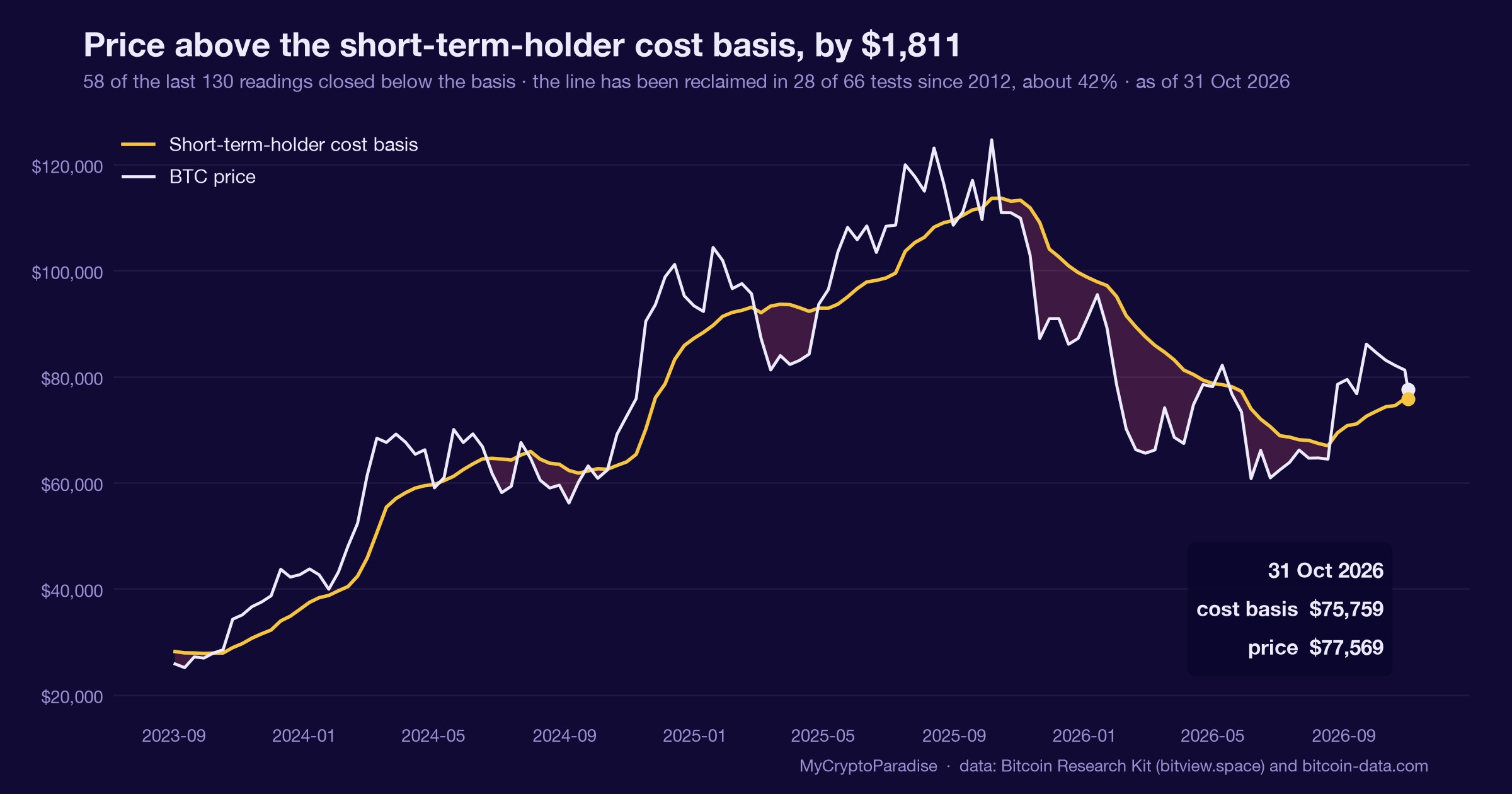
- Price against that cost basis
- $1,811 above
- Share of short-term holder supply underwater
- 60.1%
- State
- price above the short-term-holder cost basis
- What would prove this read wrong
- The cohort seven-day SOPR reclaiming one with the loss share falling week over week, which lifts recent buyers back to profit; or conversely a daily BTC close below the short-term-holder cost basis near $75,759, which deepens the stress rather than relieving it.
- Reading taken
- 31 October 2026
- Source
- Our MCP Insights tools, from Bitcoin Research Kit (bitview.space) and bitcoin-data.com. Upstream data published by the Bitcoin Research Kit
Realized price is the market’s cost basis
Every bitcoin carries a memory: the price at the last moment it moved on-chain. Average that across the entire supply and you get the realized price, the aggregate cost basis of the whole market. When spot trades above it, the median coin is in profit; when spot trades below, the average holder is underwater.
Spent output profit ratio, or SOPR, measures the same idea in motion. It takes the coins that actually moved on a given day and compares the price they sold at to the price they were last bought at. Above one, sellers are realizing gains; below one, they are realizing losses.
A cost basis tells you where conviction was priced. It does not promise that price respects it.
The aggregate is calm, the cohort is not
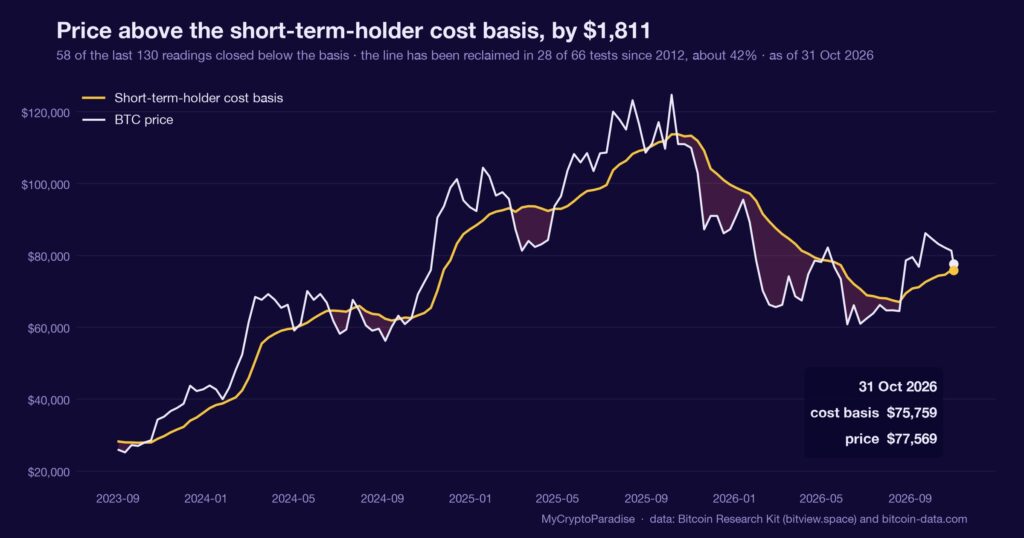
On 31 October 2026 our MCP Insights cost-basis series puts spot at $77,569 against a realized price of $54,025: a 44 percent premium, and 1.83 average true ranges above the short-term-holder cost basis of $75,759. By the aggregate measure, this is a comfortable mid-cycle reading.
Drop into the newest buyers and the picture inverts. Our series flags 2,247,936 of the 3,739,631 short-term-holder coins underwater, a 60.1 percent loss share, while the cohort’s seven-day SOPR reads 0.9993. The aggregate SOPR sits at 1.0019 and the long-term-holder SOPR at 1.1318: those cohorts are still banking gains.
The headline number and the cohort number describe the same market and disagree about it. That disagreement is the reading.
A 44 percent cushion is not a bottom
The obvious misread is to treat distance from realized price as safety. A 44 percent premium has coincided with mid-cycle grind and with cycle tops alike, so the number is a position, not a timer.
The more honest frame is cohort stress. When the most recent buyers move to a net loss while the aggregate stays green, it is the recent cohort that sets the near-term tape, because those are the coins with the thinnest conviction and the fastest trigger.
This is one input. It sits alongside funding, open interest and spot absorption, and today it is the cohort split, not the calm aggregate, that carries the weight.
An average that looks safe can hide a margin that is already bleeding. The cohort is where the risk lives.
What is different here
The ParadiseTeam does not read realized price as a single safety gauge. We split it by cohort and cross it against SOPR, so an aggregate cushion and a recent-buyer loss are two separate inputs, not one blended number that hides which holders are actually under pressure today.
Which cohort is paying to hold
Both readings are real and they are not symmetric. The long-term cohort, realizing roughly 13 percent above cost at a long-term SOPR of 1.1318, is under no pressure to sell. The recent cohort, 60.1 percent underwater and moving coins at a slight loss, is the one absorbing the pain.
That asymmetry is the whole of the claim: the sellers who are hurting are the newest ones, and their cost basis near $75,759 is the line the market keeps retesting. Our recon log holds five recent approaches to that cohort line, one defended and four rejected.
Five is a tally, not a base rate, and both series carry a model-estimate flag, so we quote them as our recon reading rather than a calibrated frequency.
The holder already in profit can wait. The holder underwater is the one the tape pressures first.
Reading realized price and SOPR yourself, step by step
- Pull the realized price and current spot, then express the gap as a percent, not as a dollar distance.
- Split the supply into long-term and short-term holders, because one cohort’s cost basis can sit far from the other’s.
- Check the short-term-holder SOPR against one: below one means recent buyers are moving coins at a net loss.
- Read the loss share: what percent of recent-buyer supply sits underwater, and whether that share is rising week over week.
- Mark the short-term-holder cost basis as your invalidation line, then watch daily closes against it rather than intraday wicks.
The step most skip is the loss share: a cohort can sit in aggregate profit while most of its recent coins are underwater, the stress that moves price first.
Every number above is checkable against the live data. Start with the MCP Insights hub, then cross-read the Crypto Fear and Greed Index and the live crypto funding rates.
Act and invalidate
| Scenario | What confirms it | What kills it |
|---|---|---|
| Cohort cost basis holds | Daily close back above $75,759 | A daily close below it |
| Recent-buyer flush | SOPR deepens below one | Loss share falls week over week |
| Aggregate rolls over | Long-term SOPR compresses toward one | Long-term holders keep banking gains |
Posture: Defensive while spot sits this close to the short-term-holder cost basis, with the newest cohort underwater. A daily close below $75,759 turns the lean bearish; a reclaim with SOPR back above one neutralizes it.
Frequently asked questions
What is bitcoin’s realized price right now?
On 31 October 2026 our MCP Insights series puts the realized price at $54,025, with spot at $77,569. That is a 44 percent premium, meaning the average coin last moved far below today’s market and sits in unrealized profit.
Why are recent buyers losing money if price is up?
Realized price averages the entire supply, including coins bought years ago near $1,000. Short-term holders bought recently, near $75,759, so a market at $77,569 leaves most of them barely above or below their cost while the aggregate stays comfortably green.
Does a SOPR below one mean a bottom?
Not on its own. A seven-day SOPR of 0.9993 says recent sellers are realizing small losses, which can mark exhaustion or the start of deeper capitulation. We treat it as one input and watch whether the loss deepens or the reading reclaims one.
What invalidates this cautious read?
The cohort SOPR reclaiming one and the loss share falling week over week would lift recent buyers back toward profit and remove the stress this cautious read rests on. A daily close below the short-term-holder cost basis near $75,759 does the opposite and deepens it.
How does this fit with other on-chain metrics?
It is one layer. Realized price and SOPR describe holder cost and realized behavior, and they sit alongside funding, open interest and spot absorption. Today the cohort split is the piece that disagrees with the calm aggregate, which is why it is worth a line of risk.
Crypto trading involves substantial risk and is not suitable for everyone. Nothing here is financial advice; it is education only. Never risk more than you can afford to lose.
The private Extras feed, where the realized price gap, the short-term-holder cost basis and the cohort SOPR update with their invalidation levels, is part of PRO Paradiser, the intelligence layer behind the ParadiseFamilyVIP strategies.












Join the discussion
No comments yet. Members, share how you are reading this.