

In short
A cycle panel scores Bitcoin against its own long history. It compares price to trailing averages, miner revenue to its own year, and aggregate cost basis to spot. Our MCP Insights cycle and valuation series on 18 November 2026 read cycle heat at 33 of 100 in an accumulation phase. Valuation sat at the 7th percentile of its range, with a market-value-to-realised-value (MVRV) ratio of 1.167 and spot near $62,478. We called this constructive on the cycle horizon, explicitly not a bottom and not a trade. The reading is a model estimate that has not cleared its calibration gate: the valuation grade eased from 30 to 25 while the top-risk grade firmed from 45 to 52. This piece shows you how to read a cycle panel yourself, treating it as one input among several.
A cycle panel is a ratio of now to history
A cycle panel does not forecast. It takes several measures that each compare Bitcoin’s present state to its own past, then stacks them so that no single ratio gets to speak alone. The point of the stack is disagreement: when the measures diverge, the panel shows you something a lone number would have smoothed over.
The Mayer Multiple sets price against its long moving average. The Puell Multiple sets miner revenue against its own trailing year, a read on how well mining pays relative to its own normal. Market-value-to-realised-value, or MVRV, sets spot against the aggregate price at which every coin last moved.
None of these is a timer. Each is a thermometer: it tells you how hot or cold the present is against the same metric’s history, and nothing about the hour the weather turns.
The 18 November panel reads cold, with one exception
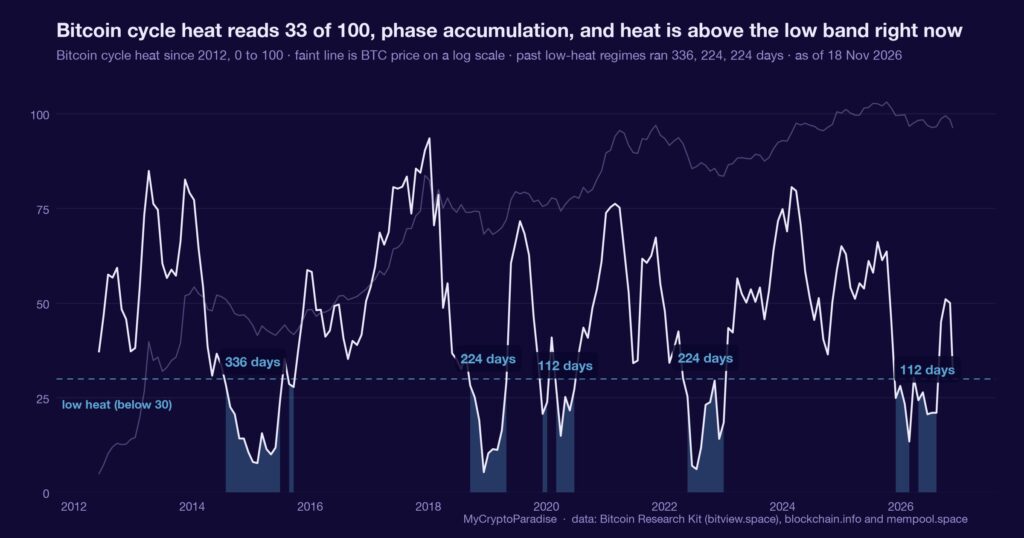
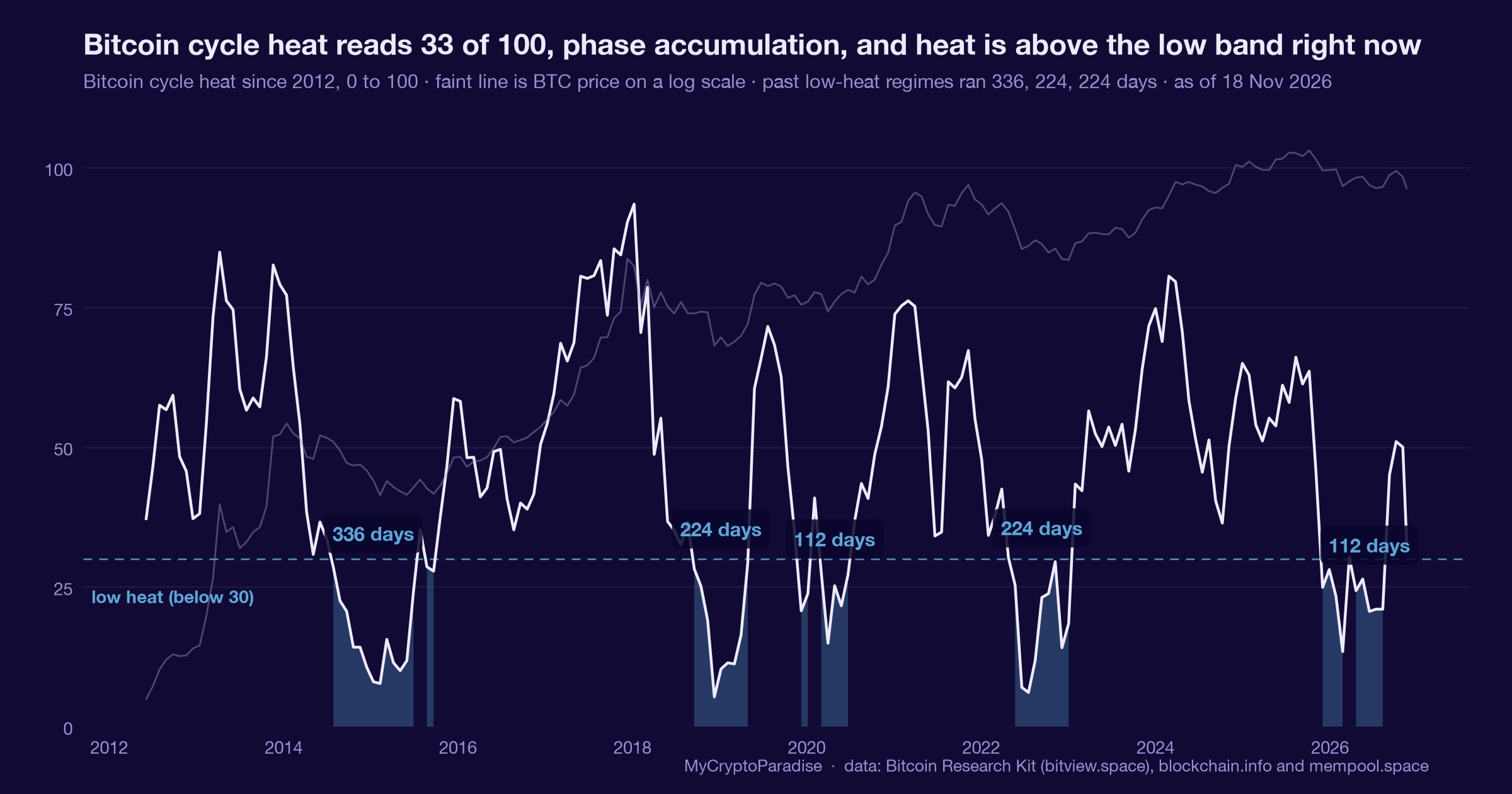
Our MCP Insights cycle series on 18 November 2026 put cycle heat at 33 of 100, with the regime in accumulation. Four of the five components sit in the lower half of their range.
The Mayer Multiple read 0.86 against a 2.4 top threshold, in the 16th percentile. The two-year moving-average multiplier read 0.70, the 9th percentile. Pi Cycle proximity sat at 0.51, the 32nd percentile.
The exception is miner economics. The Puell Multiple, miner revenue over its 365-day average, read 1.05, the 50th percentile: exactly ordinary. Hash Ribbons sat at 1.02, above the inversion line, so no miner capitulation showed.
Our valuation series put the same day at the 7th percentile, inside its value zone, with MVRV at 1.167 and net unrealised profit/loss (NUPL) at 0.143. Spot near $62,478 sat at roughly 0.74 of estimated production cost. All of this carries a model-estimate flag that has not cleared its gate.
A panel that reads cold on value and ordinary on miner pay is not a bottom call. It is a location, and location is not timing.
What is different here
The ParadiseTeam reads the panel as a location, never a trigger: we publish the estimate flag, grade our own cold call as it softens, and refuse the frequency the data has not earned. Most cycle commentary quotes the percentile and skips the part where miner revenue disagrees with it.
The value zone is a location, not a green light
The obvious misreading of a 7th-percentile value zone is to treat it as a bottom and size up. The percentile says where price sits against its own cost-basis history. It says nothing about when, and it never has.
Two readings on the same panel argue against the clean version. Miner revenue sits at its median, not its floor, and the top-risk grade firmed from 45 to 52 even as the valuation grade eased from 30 to 25. The cold print is real and it is softening at the edges at once.
This is one input. It sits alongside funding, open interest and spot absorption, and on the cycle horizon it is the slow one: a weight on a bias measured over months, not a catalyst for this week.
A gauge that places you in a range has done its whole job. Asking it for an entry is asking a map for a departure time.
Distance from any prior top is the real content
Measured against our own cycle peaks, today’s reading is nowhere near one. MVRV topped between 2.79 and 6.03 at the last five cycle highs; today it reads 1.167. NUPL topped between 0.64 and 0.83; today it reads 0.143.
That distance is the claim, and it is the honest half of a cold reading. It does not promise the gap closes, and it does not say when. A value-zone print has preceded both long bases and deeper lows.
The constructive lean is a statement about where the panel sits, not about next week’s candle. In accumulation, with top-risk estimated near the middle of its range and new-high risk graded at zero, the asymmetry over the cycle horizon favours patience over chasing.
The probability shifted; it did not resolve. Deep on value and dull on momentum is a lean, and a lean is worth exactly one line of risk.
Reading a cycle panel yourself, step by step
- Open the cycle valuation tool and read the percentile first: it places spot against Bitcoin’s entire cost-basis history in one number.
- Scan the five components for agreement, and flag any that disagrees, such as miner revenue sitting mid-range while price reads cold.
- Check the regime label and cycle heat together: accumulation with low heat is a location, not an entry or a forecast.
- Read the top-risk and new-high grades for the other direction, so a cold value print does not become a one-sided story.
- Note the estimate flag, and treat an ungated reading as a lean to size small, never as a calibrated probability.
The step people skip is the second one. A single cold percentile is easy to screenshot; the component that disagrees with it is what sizes the risk.
Every number above is checkable against the live data. Start with the MCP Insights hub, then cross-read the Crypto Fear and Greed Index and the live crypto funding rates.
Act and invalidate
| Scenario | What confirms it | What kills it |
|---|---|---|
| Value zone persists | Percentile holds under 25 | A climb past the 25th percentile |
| Cold base builds | Accumulation phase, heat under 40 | Mayer Multiple clearing 1.4 |
| Lean fails lower | Puell and top-risk roll over | Hash Ribbons invert below one |
Posture: Patient accumulation discipline on the cycle horizon, not an entry: the value-zone location rewards waiting over chasing. It turns cautious only if valuation climbs past the 25th percentile or Hash Ribbons invert.
Frequently asked questions
What does a cycle heat of 33 mean?
It places Bitcoin’s current state at 33 on a 0-to-100 composite, toward the cold end, with the regime labelled accumulation. It is a location against the metric’s own history, not a prediction, and on 18 November 2026 it carried a model-estimate flag.
Does the value zone mean price has bottomed?
No. The 7th-percentile value zone says spot sits low against Bitcoin’s own cost-basis history, which is a statement about location, not timing. Value-zone prints have preceded both long bases and deeper lows, so the reading sizes a lean rather than calling a turn.
Why does miner revenue disagree with valuation?
The Puell Multiple read 1.05, its 50th percentile, so miner revenue sits exactly at its yearly average even while price-based valuation reads cold. Different inputs measure different things: one tracks spot against cost basis, the other tracks mining pay against its own recent normal.
What would invalidate the constructive cycle lean?
Valuation climbing out of its value zone above the 25th percentile would do it, as would the Mayer Multiple clearing 1.4 or Hash Ribbons inverting below one. Any of those shifts the panel from a cold location toward the warmer middle of its range.
Why not quote a historical frequency here?
The cycle and valuation series both carry a model-estimate flag that has not cleared its calibration gate, and no base rate is wired for cycle-phase regimes. Quoting a frequency the sample has not earned would be decoration, so we publish the reading as an estimate instead.
Crypto trading involves substantial risk and is not suitable for everyone. Nothing here is financial advice; it is education only. Never risk more than you can afford to lose.
The private Extras feed, where the cycle panel, valuation percentile and miner-revenue read update with their estimate flags and invalidation levels attached, is part of PRO Paradiser, the intelligence layer behind the ParadiseFamilyVIP strategies.










Join the discussion
No comments yet. Members, share how you are reading this.