

In short
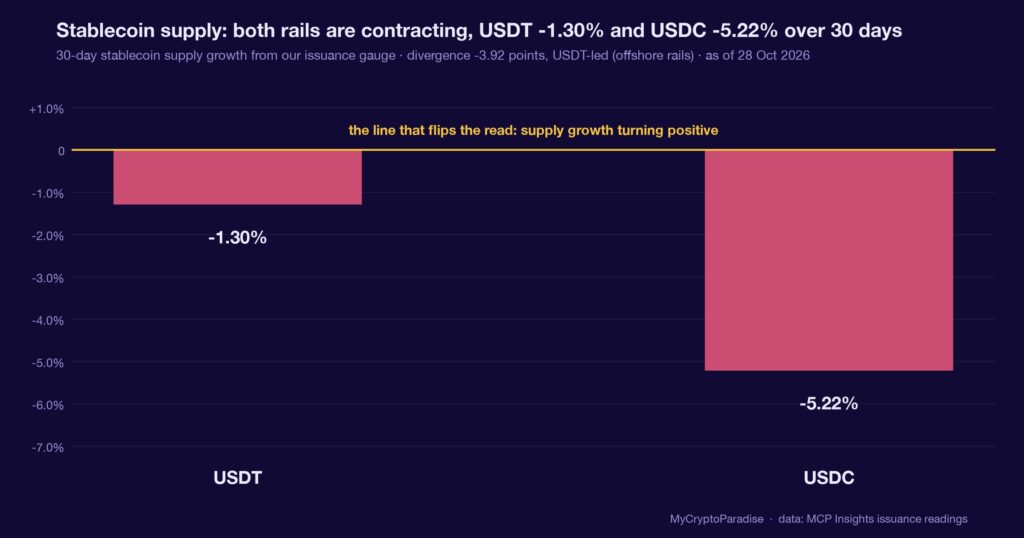
Stablecoin supply is the market’s dry powder: the dollar liquidity parked on crypto rails that can bid for coins. On 28 October 2026, our MCP Insights stablecoin issuance data shows that powder contracting, not growing: USDC thirty-day supply growth sits at minus 5.22 percent, USDT at minus 1.3 percent, a 3.92 percentage-point divergence led by offshore USDT rails. Bitcoin held near $81,200 through this, roughly the $80K the source feed flagged against a reported $2B of Binance stablecoin outflows. We lean cautious on the liquidity backdrop, and we explicitly do not call a top: a draining tank is a headwind, not a reversal. The reading carries a model-estimate flag, so we quote no historical frequency, only the contraction itself. This piece shows you how to read stablecoin supply yourself, and the level that would flip the lean.
Stablecoin supply is the bid before the bid
A stablecoin is a dollar that lives on a blockchain, and the total supply of them is the clearest proxy we have for dry powder: money already on the rails, waiting to buy. It is not a sentiment survey or a positioning gauge. It is an inventory count of the cash in the room.
When net issuance grows, dollars are entering the system and the marginal bid is getting deeper. When supply contracts, the opposite is happening: coins are being redeemed back to bank dollars, and the pool that can chase price is shrinking.
This matters most at the margin, and most quietly. A contracting float does not sell anything by itself. It removes the buyers who were not there yet, so the effect shows up as weaker follow-through on rallies rather than as a visible wave of selling.
Supply is not a timing tool. It is the size of the room before anyone walks in, and a smaller room is harder to fill.
The powder shrank while price sat still
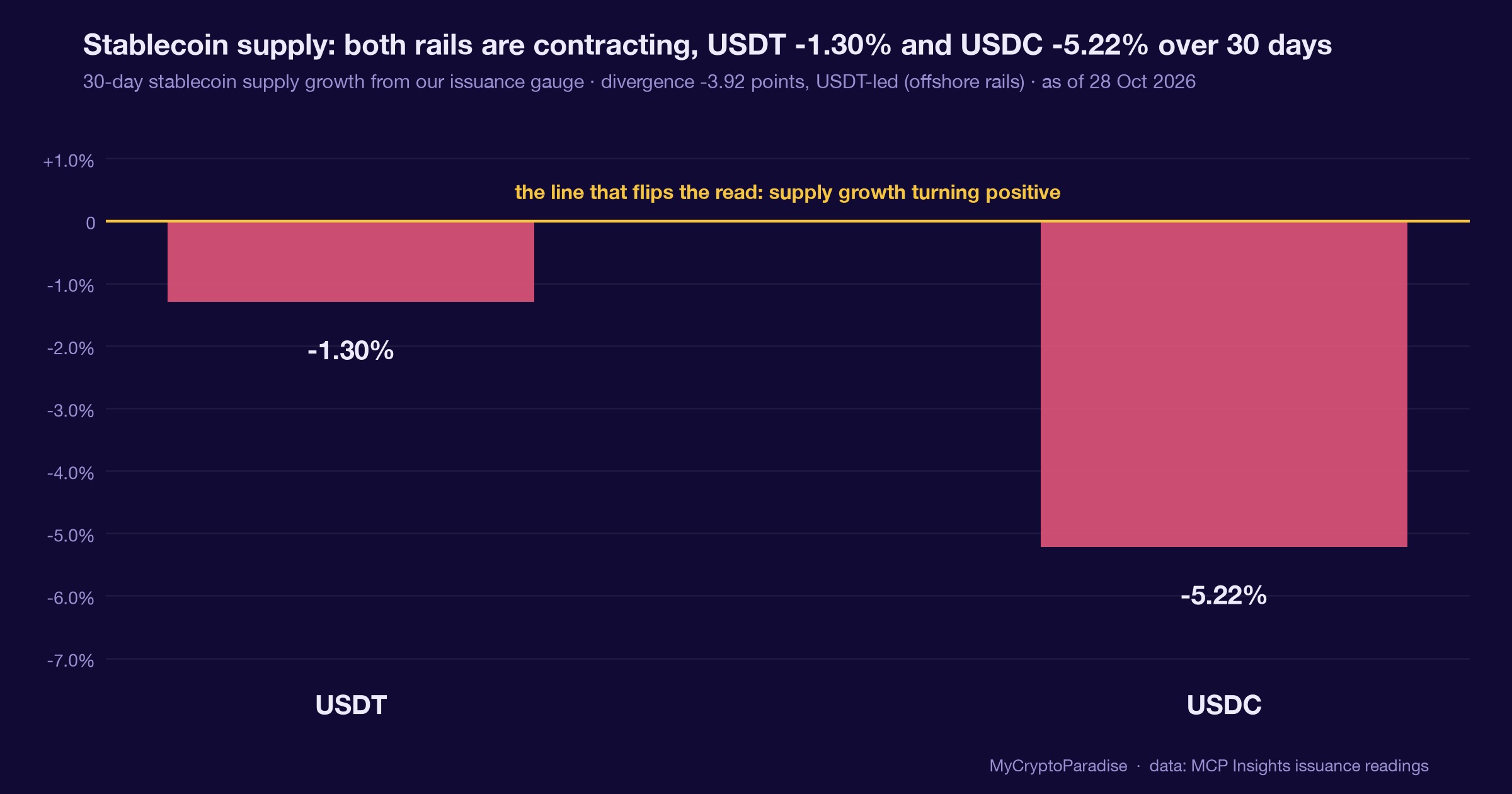
Here are the numbers for 28 October 2026. Our MCP Insights stablecoin issuance data shows USDC thirty-day supply growth at minus 5.22 percent and USDT at minus 1.3 percent: a 3.92 percentage-point divergence, with the contraction led by offshore USDT rails rather than the regulated USDC float.
Price barely noticed. Bitcoin traded around $81,192 on our Coinbase reference and $81,327 on Binance, holding the $80K the source feed flagged against its reported $2B of Binance stablecoin outflows.
The companion gauges are quiet. Our Coinbase premium reads minus 0.0264 percent, essentially flat, funding sits at 8.04 percent annualized with longs paying, and open interest is near $31.7 billion.
The one hot corner is Korea. Our recon puts the kimchi premium at plus 1.043 percent, the 73rd percentile of 150 days, with USDT into Korea at a 1.073 percent inflow premium.
A shrinking float under a flat tape is the signature of a market coasting on prior liquidity, not refuelling for the next leg.
What is different here
The ParadiseTeam does not treat a single venue’s outflow as automatic selling pressure. We separate a transfer between wallets from a genuine redemption by checking net stablecoin supply growth across issuers, then weigh that against funding and the premium, so one headline never becomes one conclusion.
The lazy read says $2B left, so sell
The obvious reading of the headline is simple: $2B of stablecoins leaving Binance is $2B of selling pressure. That is not what an exchange outflow is.
Stablecoins leaving one venue can move to another exchange, settle into cold storage, or be redeemed for bank dollars. Only the last of those shrinks the total float, and it is the net supply figure, not any single venue flow, that tells you which of the three actually happened.
The net figure here is the quieter and more honest story. Supply is contracting, but gently, at minus 5.22 percent on USDC over thirty days, and the lead is offshore USDT rather than a regulated-dollar exit. Gentle and offshore is a headwind, not an evacuation.
A single venue’s outflow is a transfer until the net supply confirms it is a withdrawal. The net is what sizes the risk; the headline just sets the mood.
One gauge, and the ones it sits beside
Stablecoin supply is one input, and today it sits alongside a flat Coinbase premium, funding at 8.04 percent with longs paying, and a cumulative volume delta (CVD) read our recon files as churn: between states, with no clear aggressor on either side.
On their own, each of those says little. Stacked, they describe a market with thinning fuel and no urgent flow in either direction, which is precisely the regime where a slow liquidity headwind matters more than any single price catalyst.
The honest caveat sits on the reading itself. This issuance figure carries a model-estimate flag and has not cleared its calibration gate, so we treat it as a recon reading, not a calibrated probability, and we quote no historical frequency behind it.
More layers of this read, and the funding and flow gauges beside it, sit inside PRO Paradiser. A single contracting float is a lean, never a conclusion.
Reading stablecoin supply yourself, step by step
- Start with aggregate stablecoin supply, not a single exchange’s inflow or outflow, because net float is the only number that shows real redemptions.
- Separate the issuers: compare USDC thirty-day growth against USDT, since a regulated-dollar exit reads very differently from offshore USDT rotation.
- Check whether the contraction is broad or led by one rail, because an offshore-led drain is often rotation rather than capital truly leaving crypto.
- Lay the supply read beside funding and the Coinbase premium, so you know whether thinning fuel meets crowded positioning or calm flow.
- Mark the invalidation now: the supply-growth flip or price level that would turn a draining tank back into a filling one.
The step people skip is the issuer split: a falling headline supply led entirely by offshore USDT is a very different risk from USDC redeeming to bank dollars.
Every number above is checkable against the live data. Start with the MCP Insights hub, then cross-read the Crypto Fear and Greed Index and the live crypto funding rates.
Act and invalidate
| Scenario | What confirms it | What kills it |
|---|---|---|
| Liquidity headwind holds | Net supply keeps contracting | USDC growth turns positive |
| Contraction is offshore rotation | USDT-led drain, USDC stable | Broad multi-issuer redemption |
| Fuel refills under price | Supply growth flips positive | Flat tape breaks down first |
Posture: Defensive on the liquidity backdrop while net stablecoin supply contracts and the tape stays flat; this is a headwind to size risk against, not a trade to enter. A return to positive supply growth, USDC first, retires the lean.
Frequently asked questions
What are stablecoin outflows from an exchange?
They are stablecoins leaving one venue’s wallets. Those dollars can move to another exchange, to cold storage, or be redeemed for bank money. Only redemption shrinks the total float, so an outflow alone does not tell you capital left crypto.
Does shrinking stablecoin supply mean Bitcoin falls?
No. A contracting float removes marginal buyers rather than forcing sellers, so it is a headwind, not a trigger. On 28 October 2026 Bitcoin held near $81,200 while supply contracted, which is exactly how a headwind looks before it matters.
Why compare USDC and USDT growth separately?
Because they sit on different rails. USDC is a regulated-dollar float; USDT dominates offshore venues. A drain led by USDT often reflects rotation between exchanges, while falling USDC is closer to real redemption back to bank dollars, a more meaningful exit.
What would flip this cautious read?
Net stablecoin supply growth turning positive, with USDC expanding first, would refill the tank and retire the liquidity headwind. A flat tape breaking lower before supply recovers would instead confirm it. Our recon tracks both against the invalidation level.
Is this reading a calibrated probability?
No. Our MCP Insights issuance figure carries a model-estimate flag and has not cleared its calibration gate, so we quote it as a recon reading, never a historical frequency. It describes a contraction we measured, not a forecast of the outcome.
Crypto trading involves substantial risk and is not suitable for everyone. Nothing here is financial advice; it is education only. Never risk more than you can afford to lose.
The private Extras feed, where the stablecoin supply read, Coinbase premium and funding gauge update intraday with their invalidation levels attached, is part of PRO Paradiser, the intelligence layer behind the ParadiseFamilyVIP strategies.












Join the discussion 45
Offshore lead" sounds a bit like hopium to me, honestly. We've seen how quickly that liquidity can dry up elsewhere. 🤔 Always got to check the other side of the coin with these things.
ricardo, i hear you. that "other side of the coin" is exactly what makes things interesting, no? offshore flows do need watching. 👀
i dont see it as hopium if its written into the protocol with clear entry and exit parameters
Written into the protocol doesn't mean it's immune to external pressures, Anna. Custodians can still freeze things, right? That's the part I'm always looking at. 🇵🇹
Ricardo, fair point on the hopium, but i'd check where the offshore money actually sits before calling it dry.. stablecoin supply on exchange wallets vs cold storage tells a different story ??
I just track the weekly closes myself to get a read on liquidity. All that four-hour noise is not a signal, honestly. 🙄
Fair point on the four-hour noise. Weekly closes also make it harder to fool yourself, since one bad candle can't flip the read. Would be curious whether you still wait for a retest of the close before you trust it.
Ingrid, the weekly close read is underrated, honestly. its the slower tape that tends to show you what the four-hour noise is hiding, and i'd be curious how your weekly view lined up with the october drain.
Ingrid, weekly closes are a patient way to read liquidity, and I respect that. I started on Japanese forums back when Mt. Gox was still the big story, and I still think the slow view is the honest one.
Ah, the offshore lead stuff is always a bit tricky 😬. I'm just not fully convinced the stablecoin contraction means as much as it used to, feels different now ya know? 🤔📉
offshore lead stuff... i usually watch these capital inflows from a P2P volume angle... its helped me to see early shifts... never offshore per se...
That's a smart way to track things, Derek. P2P volume makes sense… especially with the stablecoins…
Derek, I see the P2P angle differently. Volume on local rails can move for reasons unrelated to the offshore flow, like fees or a holiday. Before reading it as an early signal, I'd want to see whether it holds across a few cycles.
Sorry if this is obvious to everyone, but when the dry powder shrinks while BTC just sits at 80K, is that the part people mean by it being hard to read?! I keep rereading the bit about the level that flips the lean and I'm still not sure I follow it.
Ricardo's right to be wary of hopium, but I've been the guy who bought a story in 2017 and watched it bleed all of 2018, so I'd want to see the stablecoin supply number before anyone calls it a lead.
Bram, thank you for being so honest about 2017. Wanting to see the stablecoin supply number before calling it a lead feels like the gentlest kind of caution. 🐱
ok but how do u tell apart 👀 dry powder leaving from people just parking in stables to wait out a dip?? in 2021 i read every stablecoin drop as a rocket 🚀 lol my bad 😅
i always check the offshore stablecoin flows using the transaction volume on major DEXs. it's a good cross-reference for the dry powder contraction.
Yeah the dex volume cross-check is useful but its noisy when the big routers are doing mev-heavy flow, so id want to see it net of bots before trusting the contraction read. might be worth checking if the offshore lead holds on the same window
stablecoin supply drain is the one i actually keep an eye on, no need for the offshore angle for me. if it keeps shrinking while btc sits on 80k thats the bit i'd want to see in sats terms, not just a headline
Honestly this is the part that gets me, because my brother's transfers home would have looked so different if cheap stablecoin rails had existed back then 🥹 Reading the offshore lead through the corridor lens makes Ricardo's dry-up worry feel a lot more real 👀
honestly the part i keep coming back to is how quiet the drain was.... digital dollars were the only thing that moved money for my family in Beirut, so i notice when that pool shrinks before the price does
I hear you, Nadia, and I'd weigh the same signal differently. A shrinking stablecoin pool can mean less dry powder, but it can also mean holders moved into other rails or simply stopped parking cash, so I'd want to see whether the drop shows up in on-chain transfer volume before reading it as a drain.
Fair point on transfer volume, but I'd look at the reserve side first. The pool fell while on-chain transfers held steady, which is what a quiet exit looks like, not a rail switch. Last month's settlement reports showed the same pattern in two other venues.... I'd rather see the reserve line move than guess at the rails.
fair point that the reserve line is the cleaner test, and i take it seriously given what you saw in those settlement reports. i still want the transfer data to confirm it before i call it an exit, so we can leave that one open for now.
the quiet kind of drain is what gets me, nothing screams, the number just keeps sliding !! after two failed bank wires, stablecoins were the first thing that felt real to me, so watching that dry powder shrink feels oddly personal 🐱
i keep watching the stablecoin side too... like when the supply goes flat while btc sits at 80k i get nervous it's not the same thing as the offshore stuff tho.... anyone else tracking the level they mention? 🤔
Noah, fair point on the flat supply. In my terminal planning, a dead quay looks calm until a single barge shows up, so I'd want to know what level on the stablecoin side would make you call the drain over.
Not fully sold on the "dry powder" framing. Stablecoin supply can shrink on redemptions alone without anyone sitting on the sidelines, so I'd want to see net flows by wallet type before reading it as bearish. Could be the same drain at a different timeframe.
The stablecoin dynamic matters. I track net change over several periods to confirm a true retest of capital structure.
Lukas, the net change angle is solid, but the tricky part is that the stablecoin supply can look like it's draining while people are just parking it on exchanges between trades, so i'd want to see the wallet counts too!! 🤔📉
Lukas, the way you said that about tracking net change over several periods made me smile, that's exactly how I feel when I watch the stablecoin numbers too 😊 Your patience with the retest is inspiring, I'm still learning to wait for confirmation 📈
Hmm, I'd argue the opposite @ Lukas, stacking several periods of net change feels like too many dashboards on one screen!! Just watching whether that one level holds says more to me 🤔
the offshore stuff always messes me up man, feels like i'm playing with a hand tied behind my back. anyone else get chopped up worse on those moves? 😵💫 📉
Offshore is where the money goes... not where it gets tied up. It's just a different set of rules.
yeah the offshore stuff for sure, its hard to see past the big players when they move that money around
Before I accept an offshore lead as a reason to lean, what is the invalidation level, and what happens to the read if that level breaks first?
so if the stablecoin supply is draining but btc is still holding 80k, what would tell you the lean is actually flipping and not just the offshore money pausing for a bit? asking because the article doesnt say what i'd need to see
Priya, my ledger view is the flip shows up in the stablecoin inflows turning positive again, not in price holding. BTC staying at 80k only tells you the bid is still there. If the dry powder refills while price keeps stalling, that's the entry I'd want to see booked 📒
Back in 2021 I kept a tiny dollar stash on the side and told myself the lead was just noise. Watching stablecoin supply shrink while price just sits there still makes me nervous, so I'd want to see the liquidity actually come back before believing the lean..?
Fair point Elif, but I'm not sure the 2021 stash lesson fits here... the stablecoin supply shrinking is what I'd watch too, though I'd want to see if it recovers before calling it a drain 🤔
Reading this in spring 2013 on a train, that same stablecoin-style question about where the dry powder sits is what first pulled me in, so I'm inclined to watch that $80K level with you. Ricardo's point about the offshore lead drying up is the part I keep returning to.
Isabella, that 2013 train detail is lovely, and it's the same instinct that got me hooked: follow the money to where it actually moves. 🌍 Glad the $80K level caught your eye too 📈
Ah Isabella, the 2013 train story gets me every time 😄 Ricardo's dry-up point is worth keeping in mind though, because if the offshore lead goes quiet first, the $80K level might not hold the way we'd hope 👀
Isabella, reading about bitcoin on a train in 2013 sounds like a good place to start. i still think about those early forum days too, so i get why that stablecoin question stuck with you.