


Listen: the breakdown
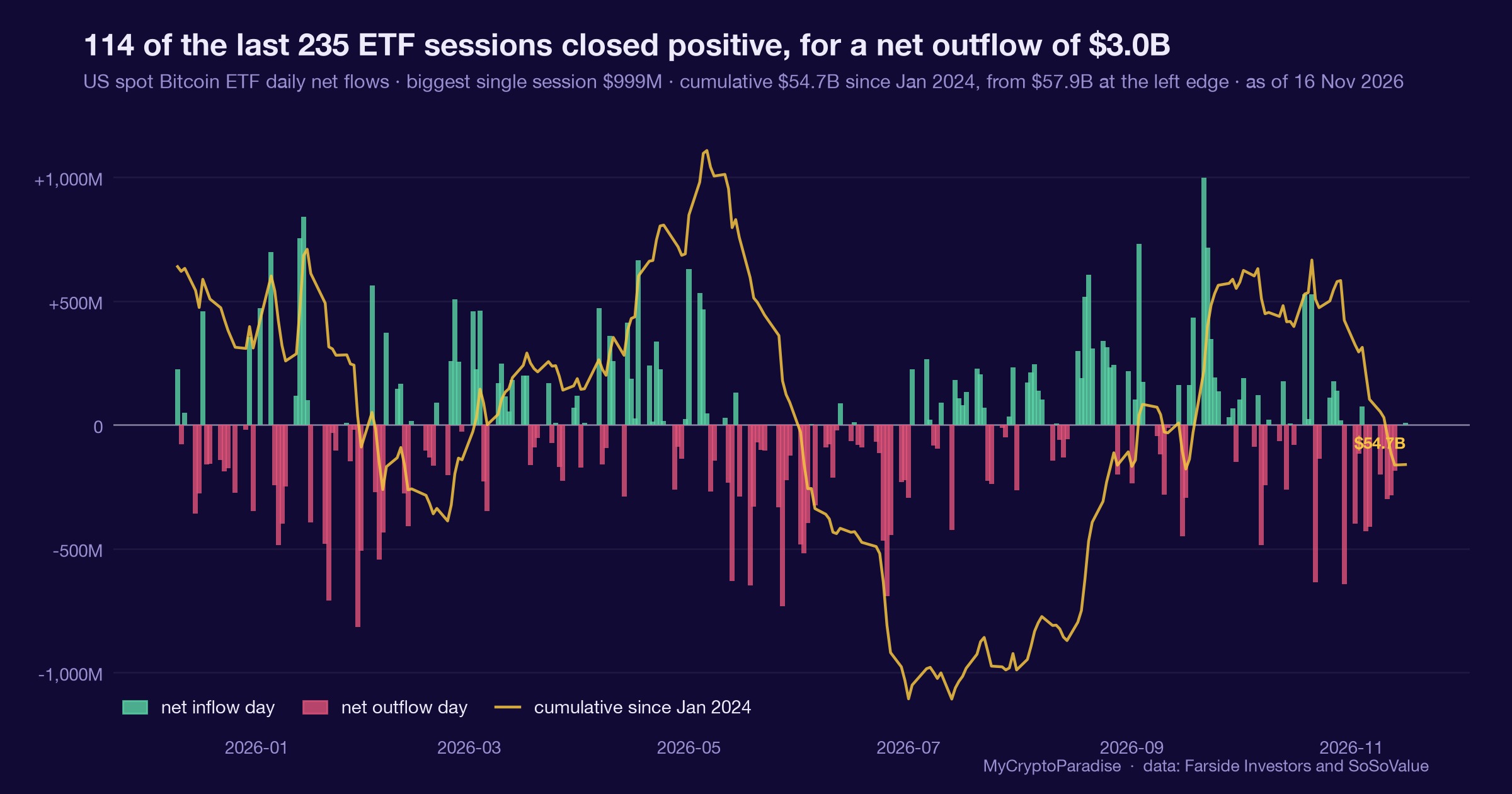
Market briefing: Spot Bitcoin ETFs gave up $240 million on November 17, led by IBIT, as on-chain data called a bearish phase. BTC held near $64,535, roughly flat, as the loud outflow met a quiet tape.
- Spot Bitcoin ETFs lost $240M on November 17, with IBIT alone shedding about $210M.
- Ethereum ETFs logged a third straight day of redemptions as a cumulative $1.91B exited the complex.
- On-chain data flagged a bearish phase and a realized-loss spike, with $62K to $65K floated as support.
Bitcoin ETFs just bled another $240 million and on-chain data called a bearish phase, yet BTC barely moved on the day. So is this the next leg down, or sellers running out of road?
Spot Bitcoin ETFs swung back to net outflows on November 17, giving up $240 million after a single day's pause. BlackRock's IBIT led the exit, with roughly $210 million leaving the fund. One day of calm, then straight back to selling.
The redemptions did not stop at Bitcoin. Ethereum ETFs logged a third straight day of money walking out the door. A session earlier, combined US spot Bitcoin and Ethereum products had already bled a joint $269 million.
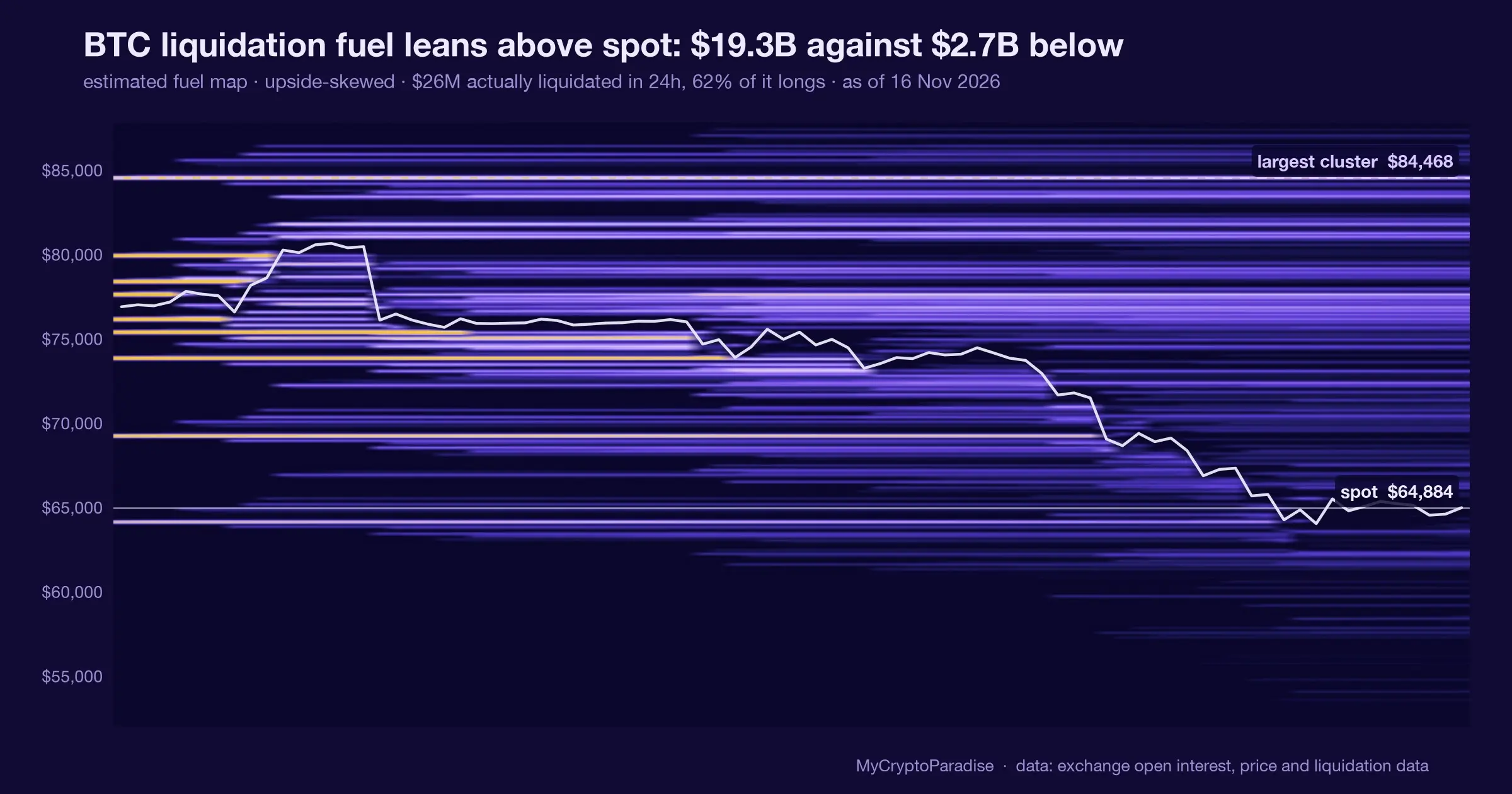
Alongside the flows, on-chain data flashed a warning: Bitcoin had returned to a bearish market phase. The same work flagged a sharp jump in realized losses, the signature of holders selling for less than they paid. A support band of $62,000 to $65,000 was floated as the line price now leans on.
Here is the part worth sitting with. Across this stretch, as Bitcoin slid toward $62,000, ETFs have shed a cumulative $1.91 billion, and price is down about 12% on the week. And yet, on the day itself, Bitcoin barely moved. It was trading near $64,535 as of this writing, roughly flat over 24 hours. A $240 million outflow headline, and the tape shrugged.
That gap between a loud number and a quiet chart is the whole story. The bearish-phase call confirms a mood the market already knew. It does not, on its own, light a new fire under sellers.
A weak-demand regime behind the redemptions
ETF flows are now the clearest read on institutional appetite, and right now that appetite is thin. When issuers register net redemptions, authorised participants sell the underlying Bitcoin to meet them. That selling lands directly on the spot market, not in some abstract sentiment gauge.
A $240 million outflow, led almost entirely by IBIT, means the largest single pipe into Bitcoin ran backwards for the day. The one-day inflow pause that preceded it looks less like a turn and more like a breath.
The realized-loss spike matters more than the headline number. When realized losses jump, it tells us holders are capitulating, locking in red rather than waiting. That is the behaviour of a weak-demand regime, not a healthy pullback.
Ethereum tells the same story in parallel. A third consecutive day of ETH ETF redemptions removes a second bid that usually cushions the broader market. Two of the largest institutional channels pulling back at once thins the whole book.
The macro frame is simple. Fresh money is not arriving fast enough to absorb the supply holders want to sell. Until several consecutive days of broad inflows show up, the path of least resistance stays heavy.
None of this guarantees a crash. It describes pressure, not a trigger. But pressure with no incoming bid is how slow bleeds begin, and the $1.91 billion already gone is the measure of how long this one has run.
Spot selling meets an already tired tape
Spot selling from redemptions hits Bitcoin first, and that is exactly where it landed. Yet BTC held near $64,535 rather than cracking, which tells us the outflow met a tape that had already done most of its selling. Exhausted supply, not fresh panic. This is the texture of distribution finding a shelf, not a breakdown. The $62,000 to $65,000 band is where price is resting, and so far it is holding the weight of a $240 million day without buckling.
Ethereum is the weaker link. Three straight days of ETH ETF redemptions mean its own bid is thinner than Bitcoin's. When the leader stalls and the second-largest asset bleeds, altcoins lose their two main sources of upside liquidity at once.
Alts always feel this last and worst. With both majors on the back foot, capital does not rotate down the risk curve; it leaves. Thin books get thinner, and spreads widen on the names retail loves most.
The honest read is that negative flows plus a flat price is not a bullish signal. It is a market absorbing selling without yet finding new buyers. Sellers are tiring, but tiring sellers do not mark a bottom on their own.
For now the cascade is orderly. The risk is that one more leg of outflows, into an already thin ETH and alt bid, turns an orderly shelf into a step down toward the lower edge of support.
Several green inflow days would change this
The single cleanest signal here is inflows, several days of them. On-chain work is explicit that only multiple consecutive sessions of broad-based ETF buying would mark a genuine reversal. One green day proves nothing, and the market just gave us proof of that.
Watch IBIT specifically. It led the outflow, so it will likely lead any turn. If the largest fund flips back to steady net creations and holds, the weak-demand read starts to weaken with it.
On price, the $62,000 to $65,000 support band is the referee. Holding it while flows stay negative would confirm the exhausted-seller thesis: supply drying up even as the mood stays sour. That is quietly constructive.
Losing it is the invalidation. A clean break below $62,000, especially on rising realized losses, would say the shelf gave way and the bearish phase has a second leg. At that point the next structural reference sits lower.
Ethereum is the early-warning light. If ETH ETF redemptions stretch to a fourth and fifth day, treat it as the broader risk bid still deteriorating, regardless of what Bitcoin does on the surface.
Realized losses are the tell underneath all of it. A cooling in that metric, holders no longer rushing to sell red, would matter more than any single flow print. Rising losses into a held level is a warning; falling losses into a held level is the first hint the selling is genuinely done.
What exhausted ETF selling means near $64K
The ParadiseTeam reads this outflow as lagging confirmation, not a fresh catalyst. Price slid before the bearish-phase call arrived, which means the data describes a move already made, not the one coming next. The headline is loud; the chart is calm.
Our standing weekly view stays cautious. We have treated $64,000, the 0.786 retracement where a bullish hammer formed, as the line that matters, and this $240 million day did not break it. That hammer is still the thing to protect.
Here is the mechanism we are watching. ETF sellers de-risked into weakness, and there is no sign of aggressive spot buyers stepping in against them. That is exhausted selling finding a shelf, not smart money decisively accumulating, and the distinction decides everything from here.
Retail is fearful and selling red into scary headlines, which historically hands cheap coins to patient capital. But we need real volume to confirm re-accumulation, not another retail-driven bounce. So far we do not have it.
Our base case still frames deeper risk toward the $58,000 prior low, and below that a $44,000 macro re-accumulation target, before any durable push higher. Reclaiming the $71,000 re-accumulation zone is the level that would start to repair this.
Probabilities, not promises. Flat price on negative flows buys time, nothing more. We respect the $62,000 to $65,000 band while it holds and stay patient for the inflow confirmation that is still missing.
The read behind this: we framed this story through our own market analysis, Why Did Bitcoin Crash After the Binance Hack?
Track it live: our Crypto Fear and Greed Index and the live crypto funding rates both update in real time, so you can watch this shift for yourself.
Related coverage
For exact entries, targets, and stop losses with full risk management, that is what ParadiseFamilyVIP is for. New to reading these moves? Start with our crypto trading strategies guide.
ParadiseTeam is monitoring the market situation closely, and we are taking these developments into consideration while building our trading tactics inside ParadiseFamilyVIP.
Crypto trading involves substantial risk. Prices are volatile and you can lose money. This article is educational and is not financial advice. Past performance does not guarantee future results.
Does the $62K to $65K support hold through this ETF outflow phase?
How 3 Paradisers are calling it
The first call is still open
Free account, no password. Members just sign in.
Follow this topic: Bitcoin ETF news












Join the discussion
No comments yet. Members, share how you are reading this.