


Listen: the breakdown
Market briefing: A crypto-stealing malware campaign rode compromised sites from Zoom to IKEA to reach wallets and iPhones. BTC shrugged it off, trading near $64,831 as the threat targets users, not the chart.
- Six major brand sites, including Zoom, HSBC and IKEA, were turned into malware delivery pipes
- The campaign steals cryptocurrency and infects iPhones through trusted web infrastructure
- BTC held near $64,831 and ETH stayed flat, treating the disclosure as a user-safety issue, not a price catalyst
A crypto-stealing malware campaign just turned the web's most trusted brands into weapons. If the threat to your bag isn't the chart but your browser, are you watching the right thing?
The warning landed on Monday, and it was not about a protocol or an exchange. A security researcher disclosed that multiple widely-visited websites had been quietly subverted to steal cryptocurrency and infect iPhones.
The list reads like a roll call of household names. Zoom, HSBC, Equifax, CNN, Salesforce and IKEA all appeared among the compromised sites. These are domains people type without a second thought, which is exactly the point.
The attackers did not break into your wallet directly. They poisoned the trusted plumbing that sits underneath big-brand pages: the scripts, ad tech and shared infrastructure a familiar site loads in the background. Visit a safe-looking page, and the malicious code runs anyway.
Two payloads matter here. One hunts for cryptocurrency to drain. The other targets iOS, the platform many holders assume is the safe one.
There is a grim comedy in watching a decade of crypto security advice, cold wallets, seed phrases, hardware keys, get routed around by a web page you already trusted. The front door was never the weak link. The hallway was.
Crucially, this is a cybersecurity disclosure, not a market event. No dollar losses, wallet addresses or exchange flows were reported. There is no macro channel, no policy shift, no liquidity shock attached to it.
So the chart barely blinked. BTC traded near $64,831 as the news broke, and ETH held flat. The market read it for what it is: a threat aimed at individual holders, not at the trend.
Why trusted infrastructure is the real weak link
This story matters because it attacks the one assumption most holders never question: that a familiar domain is a safe domain.
The mechanism is supply-chain, not macro. There is no rate decision, no fund flow, no regulatory trigger in the chain. A legitimate, high-traffic site loads third-party code, that code gets compromised, and the malicious payload reaches your device through a name you trust. The transmission runs through trust, not through liquidity.
That makes this a recurring vector rather than a one-off event. Crypto-stealing campaigns keep finding their way onto major brand sites through poisoned ad tech, scripts or shared delivery networks. They work regardless of where price sits.
The practical reach is personal. It touches the wallet on your phone, the approvals you signed months ago, the browser you leave logged in. It does not touch order books or whale balances.
For traders, the lesson is uncomfortable. You can run flawless risk management on every position and still lose the lot to a drained wallet. The malware does not care about your stop-loss. That is why we treat this as a wallet-hygiene story, not a directional one. The danger is lateral, moving across the infrastructure you use, not vertical, moving the market up or down.
The quiet truth is that the biggest risk to your capital this week may not appear on any chart. It may be sitting in a browser tab you opened without thinking.
Why the market shrugged off this disclosure
The clearest market signal here is the absence of one. BTC held near $64,831 as the disclosure circulated, up slightly on the day, with no visible flinch.
ETH did the same, flat to marginally green. Nothing in the price action suggests traders repriced anything. That silence is the data point.
It makes sense once you follow the chain. A malware campaign drains individual wallets. It does not force exchange outflows, it does not move funding, and it does not shift the supply sitting on order books. Without an exchange-level or flow channel, there is no cascade to transmit.
Contrast that with a real catalyst. An exchange insolvency or a large unlock pushes coins toward the market and pressures BTC first, then ETH, then the long tail of alts. This story has none of those pipes connected.
So the usual cascade simply never fires. BTC does not lead, ETH does not follow, and alts have nothing to react to. The liquidity map stays unchanged.
If anything, the muted response is mildly instructive. A market that was fragile and jumpy might overreact to a scary security headline. This one filed it under personal safety and moved on.
We would be cautious reading even that as strength, though. Flat price into a security scare tells you the news lacks a flow channel. It does not tell you the trend has turned. The chart is responding to liquidation dynamics, not to this disclosure.
Guarding your wallet while the chart stays quiet
What to watch here is mostly off-chart, because this threat lives on your devices, not on the order book.
Start with contract approvals. Old token approvals you granted and forgot are standing permissions a drainer can exploit. Reviewing and revoking stale ones removes a door the attacker may already be holding open.
Next, treat domain familiarity as worthless. The whole campaign depends on trusted sites carrying hostile code. A name you recognise is no longer evidence of safety, which means verifying transactions on-device matters more than ever.
iPhone holders deserve a specific note. The iOS targeting breaks the comfortable assumption that Apple's platform keeps you immune. Keeping software current and refusing surprise profile or configuration prompts is basic defence here.
On the market side, the confirmation question is simple: does any flow channel appear? Watch for reported dollar losses, named wallet drains or exchange-level outflows tied to this campaign. None have surfaced yet.
If such figures do emerge and they are large, the story could graduate from a user-safety issue into something with a flow footprint. That is the line between a warning and a catalyst.
Until then, the price read stays separate. BTC near $64,831 is being driven by positioning and liquidations, not by this disclosure. Treat the two as different conversations.
The honest framing is that your watchlist this week has two tracks. One is the chart. The other is your own wallet hygiene, and that one does not wait for a candle close.
Why this threat sits beside, not inside, the trend
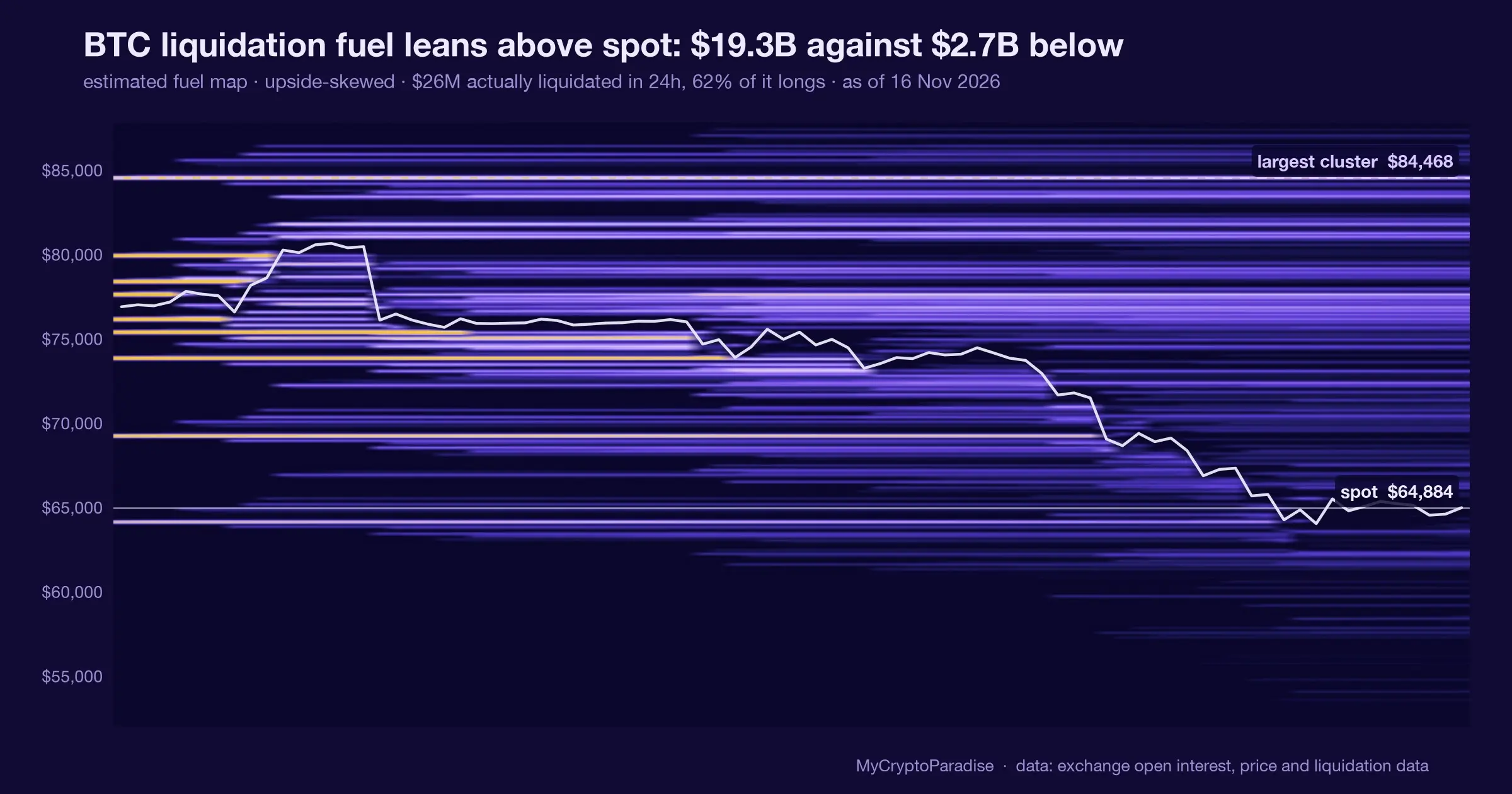
The ParadiseTeam reads this cleanly: it is a wallet-hygiene warning, not a positioning signal. There is nothing in the facts to read as whale accumulation or distribution, so it does not move our directional view. That said, it arrives into a market we still see as fragile. Our standing weekly bias remains bearish, with BTC near $64,831 sitting right at the $64,000 support we have been tracking as the 0.786 retracement.
The backdrop matters for how you size, even if this story does not change direction. Whales sold heavily for a week, then eased off near support over the past day, an early hint of slow re-accumulation rather than a confirmed bottom.
The current decline looks liquidation-driven, not fresh institutional selling. Crowded longs are getting flushed while funding stays stubbornly positive, which tells us retail is still catching the knife. So the caution is twofold. A security scare can rattle holders into panic selling at the worst spot, exactly when nervous hands are already thin.
Our bigger structural map is unchanged: the $55,000 to $44,000 exchange-of-hands zone remains the area we respect for a macro bottom, and we would want funding to reset toward zero or negative before trusting any bounce.
For this specific event, the takeaway is narrow. Protect your keys, revoke stale approvals, and do not let a browser-level threat push you into an emotional trade against a still-bearish weekly trend.
The read behind this: we framed this story through our own market analysis, Bitcoin Crash to $44K or Bounce First?
Track it live: our live crypto funding rates and the Crypto Fear and Greed Index both update in real time, so you can watch this shift for yourself.
Related coverage
For exact entries, targets, and stop losses with full risk management, that is what ParadiseFamilyVIP is for. New to reading these moves? Start with our crypto trading strategies guide.
ParadiseTeam is monitoring the market situation closely, and we are taking these developments into consideration while building our trading tactics inside ParadiseFamilyVIP.
Crypto trading involves substantial risk. Prices are volatile and you can lose money. This article is educational and is not financial advice. Past performance does not guarantee future results.
What is the bigger risk to your crypto this week?
How 1 Paradiser is calling it
The first call is still open
Free account, no password. Members just sign in.












Join the discussion
No comments yet. Members, share how you are reading this.